
2 Samuel 11:1-27 is about the tragic consequences of King David’s affair with Bathsheba, illustrating the destructive power of temptation, abuse of power, and the importance of taking responsibility for one’s actions.
1 In the spring of the year, the time when kings go out to battle, David sent Joab, and his servants with him, and all Israel. And they ravaged the Ammonites and besieged Rabbah. But David remained at Jerusalem.
2 It happened, late one afternoon, when David arose from his couch and was walking on the roof of the king’s house, that he saw from the roof a woman bathing; and the woman was very beautiful.
3 And David sent and inquired about the woman. And one said, “Is not this Bathsheba, the daughter of Eliam, the wife of Uriah the Hittite?”
4 So David sent messengers and took her, and she came to him, and he lay with her. (Now she had been purifying herself from her uncleanness.) Then she returned to her house.
5 And the woman conceived, and she sent and told David, “I am pregnant.”
6 So David sent word to Joab, “Send me Uriah the Hittite.” And Joab sent Uriah to David.
7 When Uriah came to him, David asked how Joab was doing and how the people were doing and how the war was going.
8 Then David said to Uriah, “Go down to your house and wash your feet.” And Uriah went out of the king’s house, and there followed him a present from the king.
9 But Uriah slept at the door of the king’s house with all the servants of his lord, and did not go down to his house.
10 When they told David, “Uriah did not go down to his house,” David said to Uriah, “Have you not come from a journey? Why did you not go down to your house?”
11 Uriah said to David, “The ark and Israel and Judah dwell in booths, and my lord Joab and the servants of my lord are camping in the open field. Shall I then go to my house, to eat and to drink and to lie with my wife? As you live, and as your soul lives, I will not do this thing.”
12 Then David said to Uriah, “Remain here today also, and tomorrow I will send you back.” So Uriah remained in Jerusalem that day and the next.
13 And David invited him, and he ate in his presence and drank, so that he made him drunk. And in the evening he went out to lie on his couch with the servants of his lord, but he did not go down to his house.
14 In the morning David wrote a letter to Joab and sent it by the hand of Uriah.
15 In the letter he wrote, “Set Uriah in the forefront of the hardest fighting, and then draw back from him, that he may be struck down, and die.”
16 And as Joab was besieging the city, he assigned Uriah to the place where he knew there were valiant men.
17 And the men of the city went out and fought with Joab, and some of the servants of David among the people fell. Uriah the Hittite also died.
18 Then Joab sent and told David all the news about the fighting.
19 and charged the messenger, “As soon as you see David, tell him, ‘All is well with me from the battle.’ Then, in the morning, send him away.”
20 and if the king’s anger rises and he says to you, ‘Why did you go so near the city to fight? Did you not know that they would shoot from the wall?
21 Who struck down Abimelech the son of Jerubbesheth? Did not a woman cast an upper millstone on him from the wall, so that he died at Thebez? Why did you go so near the wall?’ then you shall say, ‘Your servant Uriah the Hittite is dead also.’”
22 So the messenger went and came and told David all that Joab had sent him to tell.
23 The messenger said to David, “The men gained an advantage over us and came out against us in the field, but we drove them back to the entrance of the gate.
24 Then the archers shot at your servants from the wall. Some of the king’s servants are dead, and your servant Uriah the Hittite is dead also.”
25 Then David said to the messenger, “Thus shall you say to Joab, ‘Do not let this matter displease you, for the sword devours now one and now another. Strengthen your attack against the city and overthrow it.’ And encourage him.”
26 When the wife of Uriah heard that Uriah her husband was dead, she lamented over her husband.
27 And when the mourning was over, David sent and brought her to his house, and she became his wife and bore him a son. But the thing that David had done displeased the Lord.
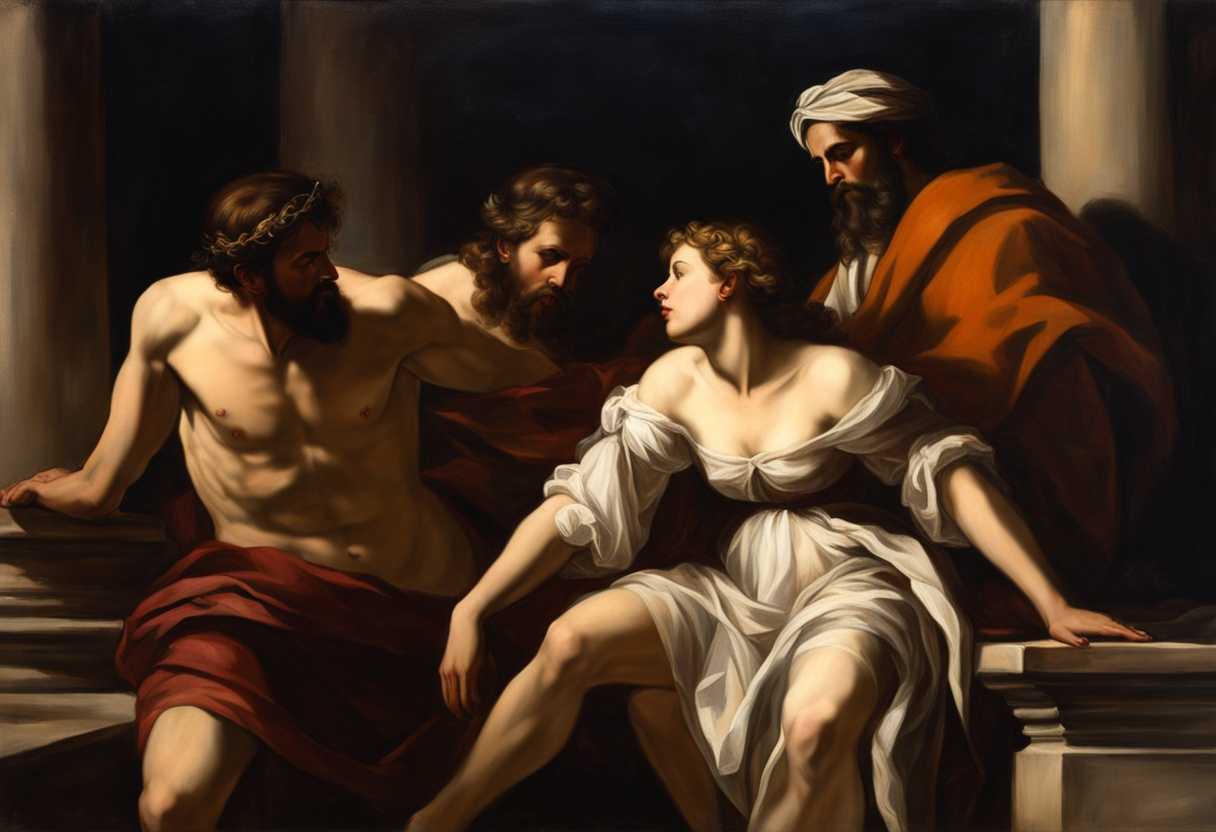
Setting the Scene for 2 Samuel 11:1-27
In 2 Samuel chapter 11, we find King David of Israel at the peak of his reign. It is a time of prosperity and peace for the nation. The scene opens with David walking on the roof of his palace in Jerusalem, enjoying the warm evening breeze. From this vantage point, he can see the city bustling below him, the sun setting in the distance, casting a golden hue over the landscape.
As David looks out over his kingdom, his eyes fall upon a beautiful woman bathing on a rooftop nearby. This woman is Bathsheba, the wife of Uriah the Hittite, one of David’s loyal soldiers. Bathsheba is unaware of the king’s gaze as she bathes, her silhouette illuminated by the fading light of the day. David is captivated by her beauty and desires her, setting in motion a tragic series of events that will forever change the course of his reign.
The stage is set for a tale of power, betrayal, and redemption as David’s actions lead to a chain of events that culminate in tragedy and loss. The consequences of his choices will reverberate throughout the kingdom, testing the very fabric of David’s leadership and character.
What is 2 Samuel 11:1-27 about?
David’s actions confront us with the grave consequences in this verse. David’s lust for Bathsheba led him to commit adultery with her and subsequently murder her husband, Uriah. This sequence of events offers a stark reminder of the destructive power of unchecked desires and deceitful actions. It serves as a cautionary tale, highlighting the importance of resisting temptations and being truthful in all aspects of our lives. We must ask ourselves: What are the implications of allowing our desires to control our actions as we reflect on this verse? How can deceit lead us down a path of destruction and harm to others? By examining David’s story, we can be reminded of the importance of self-control, integrity, and accountability in our relationships and decisions. Let this verse serve as a warning to us all to guard against the temptations of lust and deceit, and to strive for honesty and righteousness in all that we do.
Understanding what 2 Samuel 11:1-27 really means
In the passage of 2 Samuel 11:1-27, we delve into the intricate narrative of King David, Bathsheba, and Uriah, a tale woven with threads of temptation, sin, and the inevitable consequences that follow. This story is not merely a historical account but a profound reflection on the frailty of human nature, even within the most esteemed biblical figures, underscoring the critical themes of accountability and repentance that resonate through the ages.
“In the spring, at the time when kings go off to war,” sets the backdrop for David’s pivotal error of remaining in Jerusalem instead of leading his troops, paving the way for idleness and the allure of temptation. The moment David beheld Bathsheba bathing, his gaze transformed into lust, illustrating how a fleeting weakness can spiral into grievous sin. As David progressed from temptation to action by inquiring about Bathsheba, we witness the dangerous path that unfolds when one succumbs to desires, disregarding moral boundaries.
The revelation that Bathsheba was the wife of Uriah underscores David’s conscious choice to pursue his forbidden desires, disregarding the sanctity of marriage and the repercussions of his actions. David’s subsequent attempts to conceal his transgressions by summoning Uriah back from battle and orchestrating his demise reveal the escalating nature of sin, where one wrongdoing begets another, more heinous deed. This progression mirrors the cautionary words in James 1:14-15, elucidating how unchecked desires lead to sin and ultimately to destruction.
David’s story in Psalm 51 serves as a poignant reminder of the significance of acknowledging one’s sins and seeking repentance, showcasing the redemptive power of genuine contrition. Galatians 6:7 further emphasizes the immutable principle that our actions yield consequences, echoing the repercussions David faced due to his moral failings. Today, David’s narrative resonates as a timeless lesson on the perils of temptation, the weight of accountability, and the hope found in seeking forgiveness.
Consider a contemporary parallel where a successful individual succumbs to ethical lapses, initiating a chain of deceit and unethical conduct that culminates in profound personal and professional ramifications. This modern anecdote mirrors David’s narrative, underscoring the enduring relevance of integrity, the ripple effects of our choices, and the imperative of owning up to our missteps.
In conclusion, 2 Samuel 11:1-27 stands as a poignant testament to the universal struggles with sin, the imperative of resisting temptation, and the transformative power of genuine repentance. It beckons us to navigate our lives with integrity, embrace accountability for our actions, and humbly seek forgiveness when we stumble on our moral journey.
How does succumbing to temptation lead to destruction?
Succumbing to temptation leads to destruction by causing a person to stray from God’s will and plan for their life. When we give in to temptation, we often make choices that are contrary to God’s commands and principles, leading us down a path of sin and disobedience. This can result in a breakdown of our relationship with God and distance us from His protection and guidance.
Furthermore, giving in to temptation can have negative consequences on our relationships with others. David’s decision to give in to temptation with Bathsheba not only tarnished his relationship with God but also led to the destruction of his relationships with others, including Bathsheba’s husband Uriah. David’s actions resulted in brokenness, deception, and ultimately the loss of life. The ripple effect of succumbing to temptation can bring about devastation not only in our own lives but also in the lives of those around us.
Application
Life is busy, and just like balancing work and family, staying true to your values requires constant attention. We all face temptations that can lead us astray, but staying vigilant is key. Think of David’s story as a mirror, showing us the importance of making wise choices daily. Can you commit to living with integrity and honoring what truly matters?

Reverend Michael Johnson is an experienced Church Minister with a profound expertise in spirituality and guidance. With a serene presence and a compassionate heart, he has faithfully served his congregation for over 20 years, leading them on a spiritual journey towards inner peace and enlightenment. Reverend Johnson’s extensive knowledge of religious philosophies and profound understanding of human nature have made him a trusted confidant and mentor to many, as he seamlessly weaves his profound wisdom into life teachings. Reverend Johnson’s calming demeanor and empathetic nature continue to uplift and heal souls, nurturing a sense of unity and tranquility within his community.