
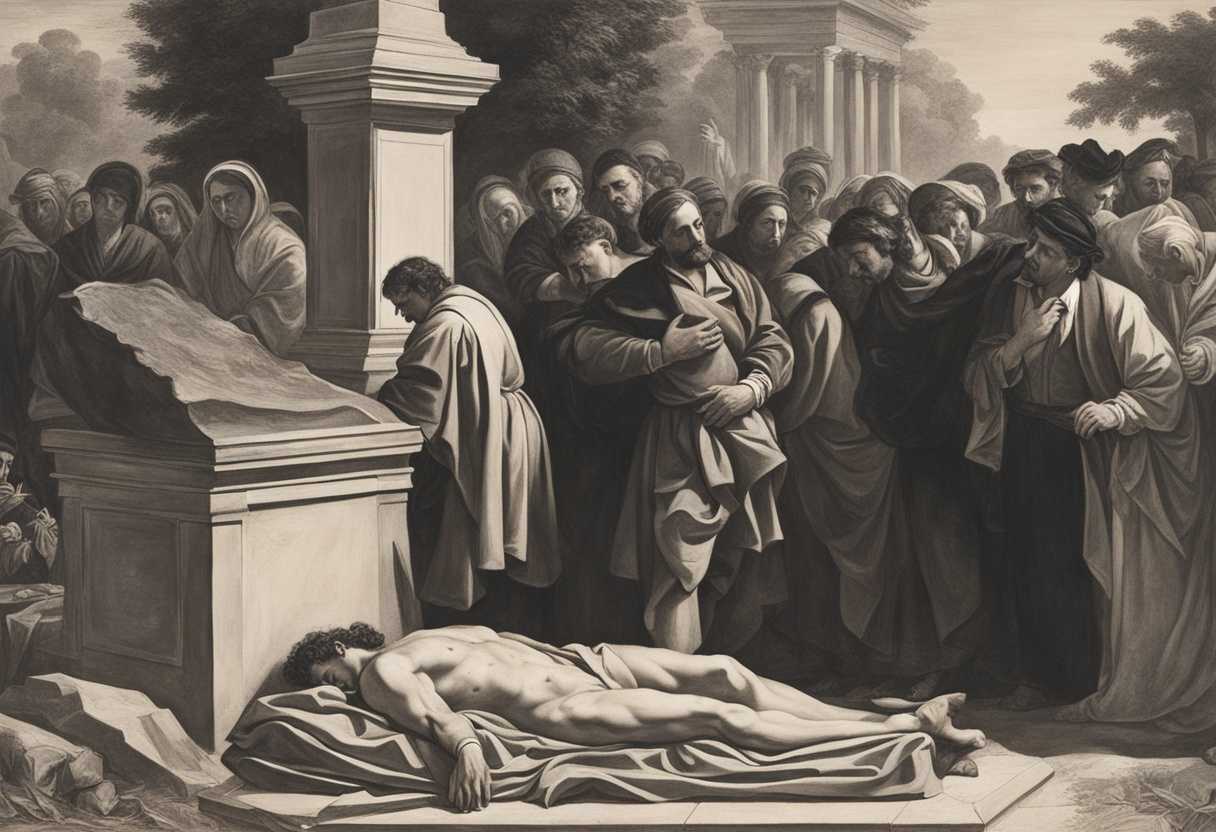
1 It was told Joab, “Behold, the king is weeping and mourning for Absalom.”
2 And the victory that day was turned into mourning for all the people, for the people heard that day, “The king is grieving for his son.”
3 The people stole into the city that day as people steal in who are ashamed when they flee in battle.
4 The king covered his face, and the king cried with a loud voice, “O my son Absalom, O Absalom, my son, my son!”
5 Then Joab came into the house to the king and said, “You have today covered with shame the faces of all your servants, who have this day saved your life and the lives of your sons and your daughters and the lives of your wives and your concubines,
6 You love those who hate you and hate those who love you. For you have made it clear today that commanders and servants are nothing to you, for today I know that if Absalom were alive and all of us were dead today, then you would be pleased.
7 Now therefore arise, go out and speak kindly to your servants, for I swear by the Lord, if you do not go, not a man will stay with you this night, and this will be worse for you than all the evil that has come upon you from your youth until now.”
8 Then the king arose and took his seat in the gate. And the people were all told, “Behold, the king is sitting in the gate.” So all the people came before the king.
9 And all the people were arguing throughout all the tribes of Israel, saying, “The king delivered us from the hand of our enemies and saved us from the hand of the Philistines, and now he has fled out of the land from Absalom.
10 But Absalom, whom we anointed over us, is dead in battle. Now therefore why do you say nothing about bringing the king back?
11 And King David sent this message to Zadok and Abiathar the priests: “Say to the elders of Judah, ‘Why should you be the last to bring the king back to his house, when the word of all Israel has come to the king?
12 And you are my brothers; you are my bone and my flesh. Why then should you be the last to bring back the king?
13 And say to Amasa, ‘Are you not my bone and my flesh? God do so to me and more also, if you are not commander of my army from now on in place of Joab.’”
14 And he swayed the heart of all the men of Judah as one man, so that they sent word to the king, “Return, both you and all your servants.”
15 And the king came back to the Jordan, and Judah came to Gilgal to meet the king and to bring the king over the Jordan.
16 And Shimei the son of Gera, the Benjaminite, from Bahurim, hurried to come down with the men of Judah to meet King David.
17 And with him were a thousand men from Benjamin. And Ziba the servant of the house of Saul, with his fifteen sons and his twenty servants, rushed down to the Jordan before the king,
18 And there went over a ferry boat to carry over the king’s household and to do his pleasure.
19 And said to him, “Let not my lord hold me guilty or remember how your servant did wrong on the day my lord the king left Jerusalem. Do not let the king take it to heart.
20 For your servant knows that I have sinned. Therefore, behold, I have come this day, the first of all the house of Joseph to come down to meet my lord the king.”
21 But Abishai the son of Zeruiah answered, “Shall not Shimei be put to death for this, because he cursed the Lord’s anointed?”
22 But David said, “What have I to do with you, you sons of Zeruiah, that you should this day be as an adversary to me? Shall anyone be put to death in Israel this day? For do I not know that I am this day king over Israel?”
23 And the king said to Shimei, “You shall not die.” And the king gave him his oath.
24 And Mephibosheth the son of Saul came down to meet the king. He had neither taken care of his feet nor trimmed his beard nor washed his clothes, from the day the king departed until the day he came back in safety.
25 And when he had turned his back to go from Samuel, God gave him another heart.
26 And he answered, “My lord, O king, my servant deceived me, for your servant said to him, ‘Saddle a donkey for me, that I may ride on it and go with the king.’ For your servant is lame.
27 And he has slandered your servant to my lord the king. But my lord the king is like the angel of God; do therefore what seems good to you.
28 For all my father’s house were but men doomed to death before my lord the king, but you set your servant among those who eat at your table. What further right have I, then, to cry to the king?”
29 And the king said to him, “Why speak any more of your affairs? I have decided: you and Ziba shall divide the land.”
30 And Mephibosheth said to the king, “Oh, let him take it all, since my lord the king has come safely home.”
31 Barzillai the Gileadite had come down from Rogelim, and he went on with the king to the Jordan, to escort him over the Jordan.
32 Now Barzillai was a very aged man, eighty years old. He had provided the king with food while he stayed at Mahanaim, for he was a very wealthy man.
33 And the king said to Barzillai, “Come over with me, and I will provide for you with me in Jerusalem.”
34 Barzillai said to the king, “How many years have I still to live, that I should go up with the king to Jerusalem?
35 I am this day eighty years old. Can I discern what is pleasant and what is not? Can your servant taste what he eats or what he drinks? Can I still listen to the voice of singing men and singing women? Why then should your servant be an added burden to my lord the king?
36 Your servant will go a little way over the Jordan with the king. Why should the king repay me with such a reward?
37 Please let your servant return, that I may die in my own city near the grave of my father and my mother. But here is your servant Chimham. Let him go over with my lord the king, and do for him whatever seems good to you.
38 And the king answered him, “Chimham shall go over with me, and I will do for him whatever seems good to you, and all that you desire of me I will do for you.”
39 All the people crossed the Jordan, and the king crossed too. And the king kissed Barzillai and blessed him, and he returned to his own home.
40 Then the king went on to Gilgal, and Chimham went on with him. All the people of Judah, and also half the people of Israel, brought the king on his way.
41 Then all the men of Israel came to the king and said to the king, “Why have our brothers the men of Judah stolen you away and brought the king and his household over the Jordan, and all David’s men with him?”
42 Then all the men of Judah answered the men of Israel, “Because the king is our close relative. Why then are you angry over this matter? Have we eaten at all at the king’s expense? Or has he given us any gift?”
43 And the men of Israel answered the men of Judah, “We have ten shares in the king, and in David also we have more than you. Why then did you despise us? Were we not the first to speak of bringing back our king?” But the words of the men of Judah were fiercer than the words of the men of Israel.
The True Meaning of 2 Samuel 19
The Book of 2 Samuel was written by the prophet Nathan, who was a close advisor to King David. This chapter recounts the aftermath of the rebellion led by David’s son Absalom, and the king’s return to Jerusalem. David grapples with the consequences of his family’s turmoil in this passage. The chapter opens with David mourning the death of Absalom, even as his kingdom is restored. We’ll witness David’s interactions with those who remained loyal to him, as well as those who betrayed him. This chapter ultimately highlights the complexities of forgiveness and the delicate balance of power in David’s reign.
The events described here echo themes found throughout the Scriptures, such as the importance of godly leadership, the dangers of pride and ambition, and the mercy of a loving God. Our choices can have a profound impact on ourselves and on those around us as we examine this passage.
2 Samuel 19:1-8
The aftermath of the civil war between King David’s forces and those of his son Absalom, who rebelled against him, is seen in 2 Samuel 19:1-8. The verse begins with Joab, David’s commander, being stern with the king. He questions David’s behavior, reminding him that his mourning over Absalom’s death is causing those who fought for him to feel unappreciated and demoralized. Joab essentially shakes David out of his grief, urging him to act like a king and show gratitude to his loyal followers who risked their lives for him.
This interaction between Joab and David highlights the importance of leadership and the need for a leader to put aside personal emotions for the greater good of the people they are responsible for. It speaks to the balance leaders must strike between showing human emotions and upholding their responsibilities. David’s excessive mourning for Absalom may have been perceived as a lack of appreciation for his loyal supporters, and Joab’s intervention serves as a reminder to David to consider the impact of his actions on others.
This passage also reflects the theme of forgiveness and reconciliation. Despite Absalom’s betrayal and rebellion, David still loved his son deeply, as evidenced by his mourning. The conflicting emotions David experiences demonstrate the complexities of relationships within families and the difficulties of reconciling love with betrayal. This theme of forgiveness and reconciliation is a recurring one in the Bible and serves as a model for believers to strive towards in their own relationships.
Furthermore, the return of David to Jerusalem after the conflict symbolizes restoration and renewal. David’s reinstatement as king marks a new beginning for the nation of Israel, a chance to rebuild and move forward from the divisions that threatened to tear them apart. This idea of restoration and renewal is a powerful message of hope and redemption that resonates throughout the Bible, emphasizing God’s ability to bring beauty from ashes and to turn even the darkest of situations into opportunities for growth and transformation. 2 Samuel 19:1-8 provides valuable insights into leadership, forgiveness, reconciliation, and restoration. It serves as a reminder of the complexities of human relationships and the importance of balancing personal emotions with responsibilities. Through the story of David, Joab, and Absalom, we are reminded of the timeless truths found in the Bible and the enduring relevance of its messages for our lives today.
2 Samuel 19:9-15
King David’s victory over his son Absalom’s rebellion is seen in the aftermath in 2 Samuel 19:9-15. The verse reads, “And all the people were at strife throughout all the tribes of Israel, saying, The king saved us out of the hand of our enemies, and he delivered us out of the hand of the Philistines; and now he is fled out of the land for Absalom. And Absalom, whom we anointed over us, is dead in battle. Now therefore why speak ye not a word of bringing the king back?” This passage reveals the internal conflict within the tribes of Israel regarding the return of King David to the throne.
The people are divided in their loyalty – some were grateful for David’s past victories and wanted him to return as their rightful king, while others were still mourning the death of Absalom, whom they had initially supported. This division highlights the fickle nature of human allegiance and how quickly public opinion can shift.
Furthermore, this situation reflects the consequences of rebellion and the importance of unity in a nation. When Absalom rebelled against his father David, it led to a civil war that tore the kingdom apart. Now that Absalom is dead, the people are left to reconcile their conflicting emotions and decide on the future leadership of Israel.
From a broader perspective, this passage also underscores the theme of forgiveness and redemption. Despite David’s own faults and the pain caused by Absalom’s rebellion, there is still a path to restoration and reconciliation. This theme of forgiveness and second chances is central to the biblical narrative as a whole, exemplified by the mercy and grace of God towards His people throughout history. We can draw parallels to the biblical theme of repentance and restoration in considering the return of King David. The people of Israel had to come to terms with their actions and decisions, just as David had to face the consequences of his sins. This process of repentance and reconciliation is a recurring motif in the Bible, emphasizing the importance of humility, forgiveness, and seeking God’s guidance in times of turmoil. This passage in 2 Samuel 19 ultimately serves as a reminder of the complexities of human nature and the need for divine wisdom and grace in times of division and strife. It shows how the decisions and actions of individuals can have far-reaching consequences on a national scale, and highlights the overarching message of hope and redemption found throughout the biblical narrative.
2 Samuel 19:16-23
King David has a conversation with a man named Barzillai the Gileadite in 2 Samuel 19:16-23. Barzillai had provided provisions for David and his men while they were fleeing from Absalom, King David’s rebellious son who had usurped the throne. Now that the rebellion had been quelled, David was returning to Jerusalem.
Barzillai is a significant figure in this passage as he exemplifies the virtue of loyalty and generosity. Despite his old age, he had shown great kindness and support to David during his time of need. When David offers to bring Barzillai with him to Jerusalem and provide for him there, Barzillai declines, citing his old age and impending death, as well as his desire to return home. This act of selflessness and humility is commendable and serves as a lesson in integrity and gratitude.
David’s interaction with Barzillai highlights the importance of recognizing and honoring those who have supported us in times of trouble. It demonstrates the value of loyalty and the mutual respect between David and his loyal supporters. This theme of loyalty is prevalent throughout the Bible, particularly in the relationships between God and His people. God recognizes and rewards the faithfulness of His followers just as David acknowledged Barzillai’s loyalty.
Furthermore, this passage emphasizes the transient nature of life and the passing of generations. Barzillai acknowledges his old age and impending death, showcasing a humble acceptance of mortality. This reminder of the brevity of life encourages reflection on the priorities and values we uphold during our time on earth. It prompts us to consider the legacy we leave behind and the impact of our actions on others, as we see through the legacy of loyalty that Barzillai leaves with David. David’s return to Jerusalem after the tumultuous events surrounding Absalom’s rebellion marks a pivotal moment in his reign in the broader context of 2 Samuel. It signifies a time of restoration and reconciliation for the nation of Israel under David’s leadership. The interactions between David and figures like Barzillai serve to humanize the king and showcase his relationships with his subjects, illustrating his qualities as a compassionate and grateful ruler. 2 Samuel 19:16-23 provides valuable insights into themes of loyalty, gratitude, humility, and the transient nature of life. It serves as a reminder to honor and appreciate those who support us, to be mindful of our mortality, and to strive for integrity and loyalty in our own relationships.
2 Samuel 19:24-30
King David and a man named Mephibosheth have a profound interaction in 2 Samuel 19:24-30. Mephibosheth was the son of Jonathan and the grandson of King Saul, whom David had made a covenant with to show kindness to his descendants. The specific event of Mephibosheth meeting David after his return from exile is significant because it reveals much about both David’s character and Mephibosheth’s situation.
Mephibosheth’s appearance before David is marked by humility and distress. Upon seeing David, Mephibosheth states, “My lord the king, take whatever you wish, for I am your servant.” This response is filled with humility and deference towards David, recognizing his authority as king. Mephibosheth had previously been shown favor by David, who had restored to him the land that belonged to his grandfather Saul and ensured that he would always eat at the king’s table as a member of the royal court.
David, in turn, responds to Mephibosheth with compassion and understanding. He reassures Mephibosheth that he will be treated with kindness and tells him that he and Ziba, a servant from Saul’s household, will divide the land between them. This act reflects David’s commitment to upholding the covenant he made with Jonathan and demonstrates his sense of justice and mercy, even in the midst of political turmoil and conflict.
This interaction between David and Mephibosheth serves as a powerful reminder of the importance of honoring promises and showing kindness to others, especially those who may be in need or marginalized. It also highlights the complexities of political power and the ways in which leaders can use their authority to either uplift or oppress those under their rule.
The story of Mephibosheth’s relationship with David is also deeply intertwined with themes of loyalty and betrayal. Mephibosheth’s grandfather, King Saul, had been an adversary of David, and yet David chose to show kindness and forgiveness to Saul’s descendants. This act of grace and mercy echoes the New Testament teachings of forgiveness and love towards enemies, as seen in verses like Matthew 5:44 – “But I tell you, love your enemies and pray for those who persecute you. The encounter between David and Mephibosheth in 2 Samuel 19:24-30 serves as a poignant example of redemption, forgiveness, and the enduring impact of loyalty and kindness in the face of adversity. It underscores the timeless message of extending grace to others, even in challenging circumstances, and the transformative power of acts of compassion and mercy.
2 Samuel 19:31-39
King David and a man named Barzillai the Gileadite have a poignant interaction in 2 Samuel 19:31-39. Barzillai had shown kindness and provided for King David and his men during their exile from Jerusalem due to the rebellion of David’s son, Absalom. When the king returns victorious after the defeat of Absalom’s forces, he wants to reward Barzillai for his loyalty and support.
Barzillai, though advanced in years, is offered by David to come and live in Jerusalem, to eat at the king’s table, and enjoy the comforts of the palace. However, Barzillai declines the king’s offer, explaining that he is too old to enjoy such luxuries and comforts, preferring to return to his own city and homeland to live out his remaining days.
This passage provides powerful insights into humility, loyalty, and the passage of time. Despite being offered the chance to live a life of ease in Jerusalem, Barzillai chooses to remain humble, preferring the simplicity of his own home. His loyalty to David was not based on seeking rewards or personal gain but on doing what was right and honorable. This speaks to a timeless message about the importance of integrity and selflessness in relationships, as Barzillai’s actions exemplify. Chimham accepts David’s offer and chooses to live in Jerusalem, highlighting the different motivations and character qualities present in individuals. While Chimham may seek to gain from his association with the king, Barzillai’s motivations are rooted in sincerity and faithfulness.
This passage also serves as a reflection of the transient nature of power and wealth. Despite David’s position as a powerful king, he acknowledges the wisdom and humility of Barzillai in choosing to return to his homeland. This humility and respect for one’s roots are echoed in other parts of the Bible, such as Proverbs 15:33, which states, “The fear of the Lord teaches wisdom, and humility comes before honor.” David’s respect for Barzillai’s decision demonstrates a recognition of the value of steadfastness and simplicity over material wealth and glory.
Through the story of Barzillai and his interactions with King David, readers are reminded of the importance of authenticity, loyalty, and humility in relationships, as well as the fleeting nature of worldly rewards compared to the eternal value of integrity and faithfulness.
2 Samuel 19:40-43
King David is returning to Jerusalem in 2 Samuel 19:40-43 after a tumultuous time where he had to flee due to the rebellion of his son Absalom. A delegation from the tribe of Judah, headed by a man named Shimei, along with a thousand Benjamites who had stayed loyal to Saul’s house, meet David as he approaches the Jordan River to cross back into Jerusalem. Shimei had previously cursed David and thrown stones at him during his exile, yet now he is seeking reconciliation with the king. Despite his past actions, Shimei falls on his knees before David and asks for forgiveness, acknowledging his wrongs and seeking mercy.
This passage showcases the theme of forgiveness and reconciliation which runs throughout the Bible. David, who had been through so much betrayal and suffering, has the opportunity to extend grace to someone who had wronged him. David demonstrates the power of mercy and the importance of reconciliation in relationships by choosing to forgive Shimei. It also emphasizes the concept of repentance and the idea that no one is beyond redemption if they humbly seek forgiveness.
The encounter between David and Shimei also echoes the teachings of Jesus in the New Testament about forgiveness. Jesus instructs his disciples in Matthew 18:21-22 to forgive not just seven times, but seventy-seven times, showing the limitless nature of forgiveness. David exemplifies this principle by choosing to forgive Shimei despite his previous actions. It is a reminder to us all that forgiveness is a key component of Christian living, and that extending mercy to others can lead to healing and restoration in relationships.
Furthermore, the presence of the Benjamites who had remained loyal to Saul’s house is significant. It highlights the lingering divisions and loyalties in Israel, even after Saul’s death. The fact that they are now coming to meet David as he returns to Jerusalem suggests a shifting of allegiances and a desire for unity under David’s rule. It signifies a new chapter in Israel’s history, where the nation can move past old rivalries and unite under David’s leadership. This passage serves as a poignant reminder of the power of forgiveness, the importance of repentance, and the possibility of reconciliation even in the midst of past hurts and conflicts. David’s choice to extend grace to Shimei and the Benjamites sets a powerful example for us all to follow in our own relationships, showing that reconciliation is possible through humility, forgiveness, and a willingness to move forward with grace and mercy.
After 2 Samuel 19
The chapter concluded with David’s triumphant return to Jerusalem. However, the road ahead was not without its challenges. The seeds of discord had been sown, and the unity of the kingdom hung in the balance. I, as the reverend, knew that the next chapter would test David’s leadership mettle, for a king’s true test lies not only in victories but in navigating treacherous waters of division and dissent. The future of the nation rested on David’s shoulders, and the congregation would need to pray for wisdom and discernment as the story unfolded.

Reverend Michael Johnson is an experienced Church Minister with a profound expertise in spirituality and guidance. With a serene presence and a compassionate heart, he has faithfully served his congregation for over 20 years, leading them on a spiritual journey towards inner peace and enlightenment. Reverend Johnson’s extensive knowledge of religious philosophies and profound understanding of human nature have made him a trusted confidant and mentor to many, as he seamlessly weaves his profound wisdom into life teachings. Reverend Johnson’s calming demeanor and empathetic nature continue to uplift and heal souls, nurturing a sense of unity and tranquility within his community.