
Acts 12:1-19 is about the miraculous deliverance of Peter from prison by an angel, showcasing the power of prayer and faith in the face of persecution.
1 About that time Herod the king laid violent hands on some who belonged to the church.
2 He killed James the brother of John with the sword.
3 And when he saw that it pleased the Jews, he proceeded to arrest Peter also. This was during the days of Unleavened Bread.
4 And when he had seized him, he put him in prison, delivering him over to four squads of soldiers to guard him, intending after the Passover to bring him out to the people.
5 So Peter was kept in prison, but earnest prayer for him was made to God by the church.
6 Now when Herod was about to bring him out, on that very night, Peter was sleeping between two soldiers, bound with two chains, and sentries before the door were guarding the prison.
7 And behold, an angel of the Lord stood next to him, and a light shone in the cell. He struck Peter on the side and woke him, saying, “Get up quickly.” And the chains fell off his hands.
8 And the angel said to him, “Dress yourself and put on your sandals.” And he did so. And he said to him, “Wrap your cloak around you and follow me.”
9 And he went out and followed him. He did not know that what was being done by the angel was real, but thought he was seeing a vision.
10 When they had passed the first and the second guard, they came to the iron gate leading into the city. It opened for them of its own accord, and they went out and went along one street, and immediately the angel left him.
11 When Peter came to himself, he said, “Now I am sure that the Lord has sent his angel and rescued me from the hand of Herod and from all that the Jewish people were expecting.”
12 When he realized this, he went to the house of Mary, the mother of John whose other name was Mark, where many were gathered together and were praying.
13 And when he knocked at the door of the gateway, a servant girl named Rhoda came to answer.
14 Recognizing Peter’s voice, in her joy she did not open the gate but ran in and reported that Peter was standing at the gate.
15 They said to her, “You are out of your mind.” But she kept insisting that it was so. They kept saying, “It is his angel!”
16 But Peter continued knocking, and when they opened, they saw him and were amazed.
17 But motioning to them with his hand to be silent, he described to them how the Lord had brought him out of the prison. And he said, “Tell these things to James and to the brothers.” Then he departed and went to another place.
18 Now when day came, there was no little disturbance among the soldiers over what had become of Peter.
19 And after Herod searched for him and did not find him, he examined the sentries and ordered that they should be put to death. Then he went down from Judea to Caesarea and spent time there.
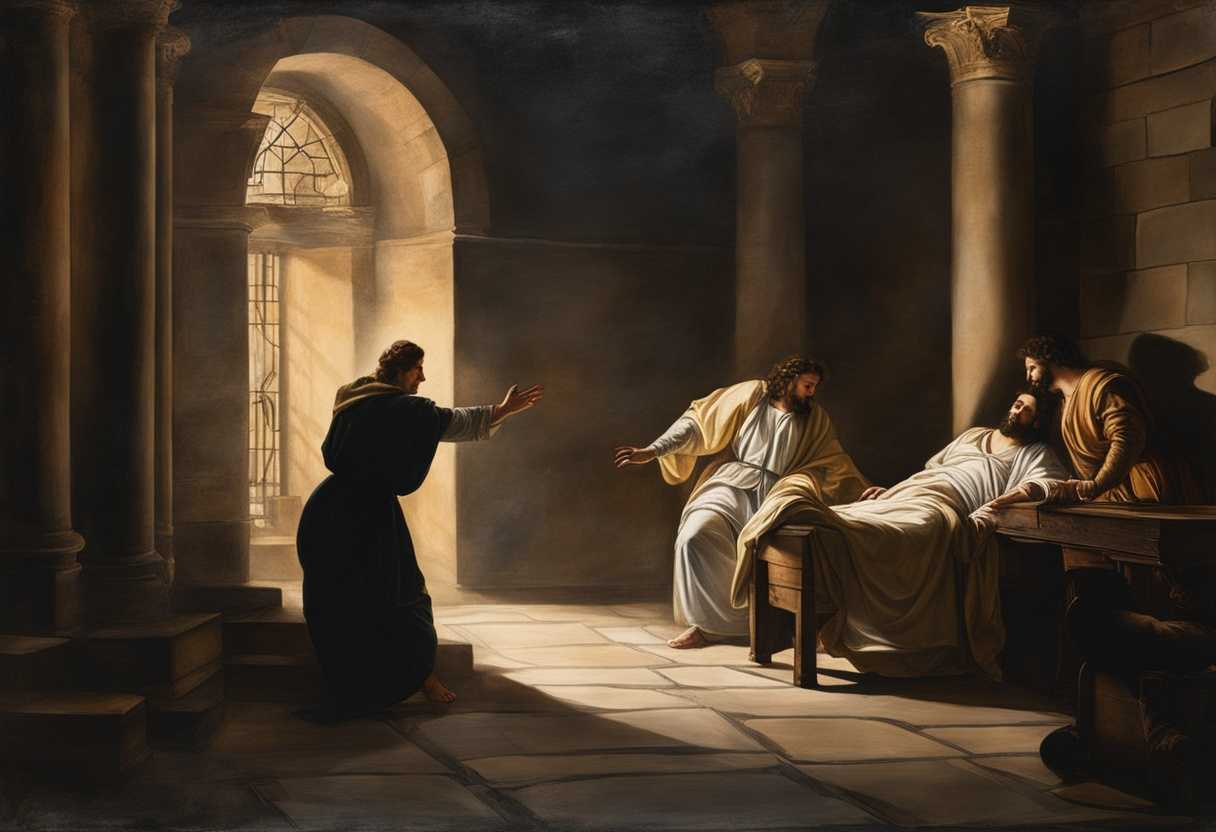
Setting the Scene for Acts 12:1-19
In Acts chapter 12, the scene opens in the city of Jerusalem during a time of great persecution against the early Christian church. King Herod Agrippa I, seeking to please the Jewish religious leaders, had James, the brother of John, put to death. This pleased the Jews, so Herod proceeded to arrest Peter with the intention of executing him as well.
Peter found himself imprisoned in a heavily guarded cell, bound with chains between two soldiers, while sentries stood watch at the entrance. The night before Peter was to be brought to trial, an angel of the Lord appeared in the cell, and miraculously freed Peter from his chains. The angel instructed Peter to get up quickly and follow him, leading him past the guards and out of the prison. Peter, initially thinking it was a vision, soon realized that the Lord had truly rescued him.
As Peter found himself standing outside the prison walls, free from his chains, he made his way to the house of Mary, the mother of John Mark, where many believers had gathered to pray for his release. The scene is one of disbelief and joy as Rhoda, a servant girl, recognizes Peter’s voice at the door but is so overjoyed that she forgets to open it for him. Inside, the believers are fervently praying for Peter’s safety and deliverance, not realizing that their prayers had been answered in such a miraculous way. Peter’s unexpected appearance among them serves as a powerful testament to the faithfulness and power of God in the face of persecution.
What is Acts 12:1-19 about?
Imagine the astonishment and wonder that Peter must have felt when he found himself freed from prison by an angel! This powerful moment showcases God’s ability to protect and deliver His servants in the face of seemingly impossible situations. The story of Peter’s miraculous escape is a testament to God’s sovereignty and his unwavering commitment to safeguarding those who serve Him faithfully.
Have you ever experienced a moment in your own life where you felt trapped or overwhelmed by circumstances beyond your control? This verse reminds us that God is always working behind the scenes, orchestrating events to bring about His perfect plan. We can take comfort in knowing that God has the power to intervene in our lives and provide a way out of even the most dire situations, just as Peter was miraculously freed from prison. Let this story serve as a reminder of God’s unfailing protection and encouragement that He is always present, ready to deliver us from any obstacle that stands in our way.
Understanding what Acts 12:1-19 really means
Structure for Commentary:
- Introduction and Context
- Verse Breakdown and Key Phrases
- Theological Insights
- Cross-References and Additional Biblical Support
- Relevance to Modern Life
- Anecdotal Illustration
- Conclusion and Reflection
Commentary on Acts 12:1-19
Introduction and Context
Acts 12:1-19 recounts a dramatic episode in the early church involving the apostle Peter’s miraculous escape from prison. Set during a time of severe persecution under King Herod, this passage highlights God’s intervention and the power of persistent prayer. Understanding the historical and cultural context of the early Christian church under Roman rule is vital for comprehending the profundity of this event.
Verse Breakdown and Key Phrases
Key phrases such as “earnest prayer for him was made to God by the church” and “an angel of the Lord stood next to him” stand out. The earnest prayer indicates the church’s intense and continuous intercession for Peter’s safety. The appearance of the angel signifies divine intervention and the miraculous nature of Peter’s escape. The chains fell off, and the iron gate opened by itself, emphasizing God’s power over human constraints.
Theological Insights
This passage underscores themes of divine providence, the power of prayer, and the reality of spiritual warfare. It illustrates that, despite human efforts to control or suppress, God’s plans prevail. It also shows the church’s role in intercession and collective faith, acting as a testament to the power of community prayer and reliance on God.
Cross-References and Additional Biblical Support
This narrative echoes similar miraculous deliverances in the Bible. Daniel in the lion’s den (Daniel 6) and Paul and Silas in prison (Acts 16:25-34) are notable examples. These stories collectively reinforce the belief in God’s ability to rescue His faithful servants from seemingly impossible situations. Additionally, the concept of “earnest prayer” can be compared to James 5:16, which states, “The prayer of a righteous person has great power as it is working.”
Relevance to Modern Life
Today, believers may not face the same physical persecutions as Peter did, but they encounter various trials and tribulations. This passage serves as a reminder that no situation is beyond God’s reach. It encourages believers to persist in prayer, trusting in God’s timing and methods. It also highlights the importance of community support in times of distress. A modern-day believer facing a severe health crisis can provide an anecdotal illustration. The church community gathers to pray earnestly for healing. Despite grim medical reports, the individual experiences a remarkable recovery, leaving doctors puzzled. This real-life scenario mirrors Peter’s miraculous release, showcasing the power of collective prayer and divine intervention.
Conclusion and Reflection
Reflecting on Acts 12:1-19, we are reminded of the sovereignty of God and the efficacy of prayer. Ask yourself: How can you incorporate persistent prayer into your daily life as you ponder this passage? How can my faith community better support each other through prayer? God is at work in our lives today, often in ways we cannot immediately see, just as He orchestrated Peter’s release. Let this passage inspire you to deepen your trust in God and commit to a life of earnest prayer.
How can we trust God’s plan in times of distress?
We can trust God’s plan in times of distress by remembering that He is always in control. Despite the challenges and difficulties we may face, we can find comfort in knowing that God’s plan is perfect and He works all things for our good. We can have faith that He will guide us through the storm by surrendering our worries and fears to Him.
Even when it may seem like everything is falling apart, we can hold on to the truth that God is with us every step of the way. We can find assurance that His plan for our lives will ultimately bring about blessings and fulfillment by leaning on His strength and seeking His wisdom through prayer and meditation on His Word. Trusting in God’s plan means believing that He has a purpose for our struggles and that He will lead us to a place of victory and peace.
Application
Think about how you tackle work deadlines or family issues—each moment of struggle is like a prison. In Acts 12:1-19, Peter was freed from actual chains through prayer. When you’re in a tight spot, prayer can be your key to freedom, too. Dive into your challenges with faith, like you would a project or a family crisis, and trust that God can deliver results. Will you turn to prayer as your first response to life’s obstacles?

Reverend Michael Johnson is an experienced Church Minister with a profound expertise in spirituality and guidance. With a serene presence and a compassionate heart, he has faithfully served his congregation for over 20 years, leading them on a spiritual journey towards inner peace and enlightenment. Reverend Johnson’s extensive knowledge of religious philosophies and profound understanding of human nature have made him a trusted confidant and mentor to many, as he seamlessly weaves his profound wisdom into life teachings. Reverend Johnson’s calming demeanor and empathetic nature continue to uplift and heal souls, nurturing a sense of unity and tranquility within his community.