
Acts 13:14-52 is about the apostle Paul and Barnabas preaching the Gospel to both Jews and Gentiles, highlighting the rejection of the message by some and the acceptance by others, showing how the message of salvation through Jesus Christ is meant for all people and the consequences of accepting or rejecting this message.
14 but they went on from Perga and came to Antioch in Pisidia. And on the Sabbath day they went into the synagogue and sat down.
15 And after the reading from the Law and the Prophets, the rulers of the synagogue sent a message to them, saying, “Brothers, if you have any word of encouragement for the people, say it.”
16 So Paul stood up, and motioning with his hand said: “Men of Israel and you who fear God, listen.
17 The God of this people Israel chose our fathers and made the people great during their stay in the land of Egypt, and with uplifted arm he led them out of it.
18 And for about forty years he put up with them in the wilderness.
19 And after destroying seven nations in the land of Canaan, he gave them their land as an inheritance.
20 All this took about 450 years. And after that he gave them judges until Samuel the prophet.
21 Then they asked for a king, and God gave them Saul the son of Kish, a man of the tribe of Benjamin, for forty years.
22 And when he had removed him, he raised up David to be their king, of whom he testified and said, ‘I have found in David the son of Jesse a man after my heart, who will do all my will.’
23 Of this man’s offspring God has brought to Israel a Savior, Jesus, as he promised.
24 Before his coming, John had proclaimed a baptism of repentance to all the people of Israel.
25 And as John was finishing his course, he said, ‘What do you suppose that I am? I am not he. No, but behold, after me one is coming, the sandals of whose feet I am not worthy to untie.’
26 “Brothers, sons of the family of Abraham, and those among you who fear God, to us has been sent the message of this salvation.”
27 For those who live in Jerusalem and their rulers, because they did not recognize him nor understand the utterances of the prophets, which are read every Sabbath, fulfilled them by condemning him.
28 And though they found in him no guilt worthy of death, they asked Pilate to have him executed.
29 And when they had carried out all that was written of him, they took him down from the tree and laid him in a tomb.
30 But God raised him from the dead,
31 and for many days he appeared to those who had come up with him from Galilee to Jerusalem, who are now his witnesses to the people.
32 And we bring you the good news that what God promised to the fathers,
33 this he has fulfilled to us their children by raising Jesus, as also it is written in the second Psalm, “‘You are my Son, today I have begotten you.’
34 And as for the fact that he raised him from the dead, no more to return to corruption, he has spoken in this way, “‘I will give you the holy and sure blessings of David.’
35 Therefore he says also in another psalm, “You will not let your Holy One see corruption.”
36 For David, after he had served the purpose of God in his own generation, fell asleep and was laid with his fathers and saw corruption,
37 but he whom God raised up did not see corruption.
38 Let it be known to you therefore, brothers, that through this man forgiveness of sins is proclaimed to you, and by him everyone who believes is freed from everything from which you could not be freed by the law of Moses.
39 and by him everyone who believes is freed from everything from which you could not be freed by the law of Moses.
40 Beware, therefore, lest what is said in the Prophets should come about:
41 “‘Look, you scoffers,
be astounded and perish;
for I am doing a work in your days,
a work that you will not believe, even if one tells it to you.’”
42 As they went out, the people begged that these things might be told them the next Sabbath.
43 And after the meeting of the synagogue broke up, many Jews and devout converts to Judaism followed Paul and Barnabas, who, as they spoke with them, urged them to continue in the grace of God.
44 The next Sabbath almost the whole city gathered to hear the word of the Lord.
45 But when the Jews saw the crowds, they were filled with jealousy and began to contradict what was spoken by Paul, reviling him.
46 And Paul and Barnabas spoke out boldly, saying, “It was necessary that the word of God be spoken first to you. Since you thrust it aside and judge yourselves unworthy of eternal life, behold, we are turning to the Gentiles.”
47 For so the Lord has commanded us, saying, “I have made you a light for the Gentiles, that you may bring salvation to the ends of the earth.”
48 And when the Gentiles heard this, they began rejoicing and glorifying the word of the Lord, and as many as were appointed to eternal life believed.
49 And the word of the Lord was spreading throughout the whole region.
But the Jews incited the devout women of high standing and the leading men of the city, stirred up persecution against Paul and Barnabas, and drove them out of their district.
13 And they shook off the dust from their feet against them and went to Iconium.
52 And the disciples were filled with joy and with the Holy Spirit.
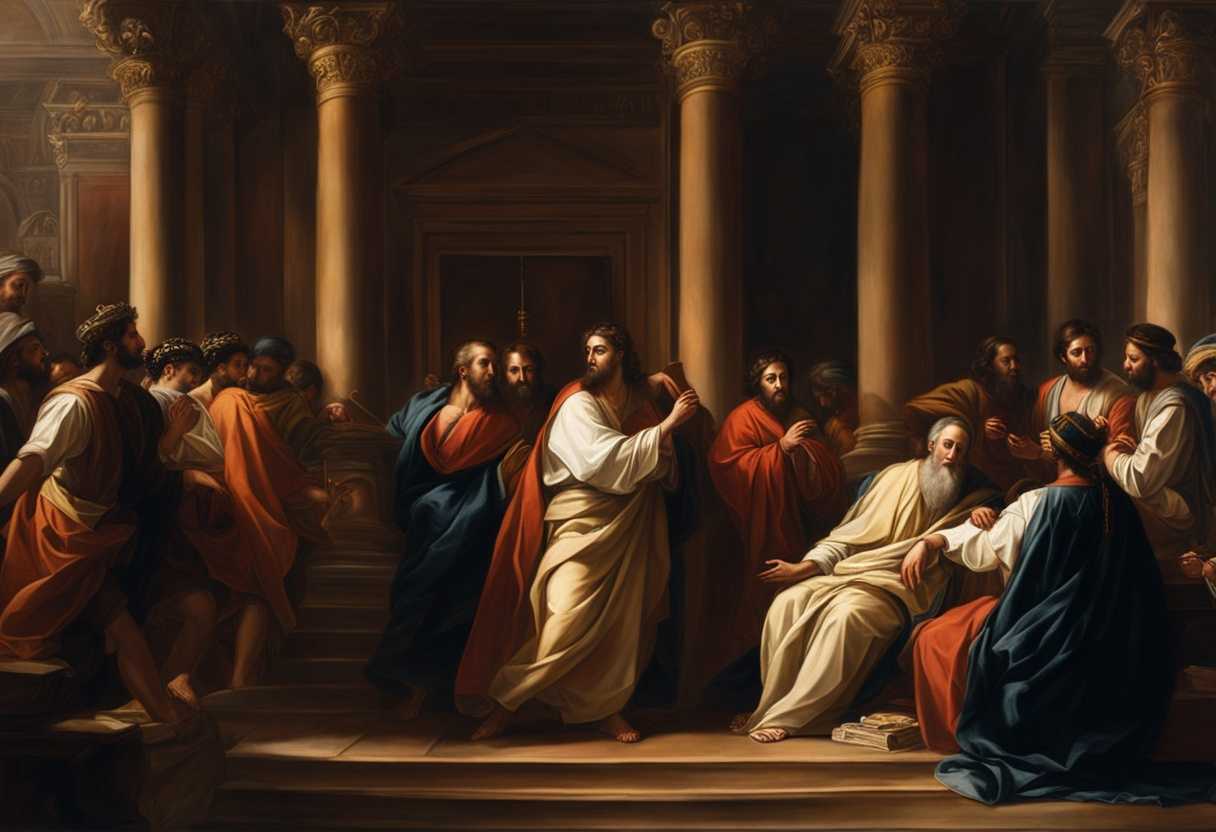
Setting the Scene for Acts 13:14-52
In Acts chapter 13, we find the apostle Paul and his companions arriving in Antioch of Pisidia. The scene is set in a synagogue on the Sabbath day. The synagogue is filled with Jews and God-fearing Gentiles who have gathered to worship and hear the Scriptures read. The room is adorned with intricate tapestries and ornate decorations, reflecting the reverence and importance of the place.
As the service begins, the synagogue leader invites Paul to share a word of exhortation with the congregation. Paul stands up, his presence commanding attention, and begins to recount the history of Israel, from their time in Egypt to the reign of King David. He then transitions to speak about Jesus, proclaiming Him as the long-awaited Messiah foretold by the prophets.
The audience listens intently, some nodding in agreement while others look puzzled or skeptical. As Paul continues to preach, his words stir up a mix of emotions among the crowd – some are filled with joy and belief, while others become envious and hostile. The scene is charged with tension as Paul boldly declares the message of salvation through Jesus Christ, sparking a lively debate and ultimately leading to a division among the listeners.
What is Acts 13:14-52 about?
This verse captures the essence of perseverance in spreading the message of the gospel, even in the face of adversity. Paul’s unwavering commitment to sharing the teachings of Jesus Christ in Antioch despite facing opposition underscores the importance of staying steadfast in our beliefs and mission, no matter the challenges we may encounter. We, as teachers and believers, can draw inspiration from Paul’s example to continue sharing the message of hope, love, and redemption with all people, regardless of their backgrounds or beliefs. The fact that Paul’s preaching reached both Jews and Gentiles highlights the universality of the gospel and the power it holds to unite diverse groups under a common faith.
Reflecting on this verse, we are encouraged to ask ourselves: How can we emulate Paul’s dedication and courage in sharing the good news with others? What obstacles might we face in our own efforts to spread the gospel, and how can we overcome them with faith and perseverance? Let Paul’s example in Antioch serve as a reminder to us that, despite challenges and opposition, the transformative power of the gospel can touch the lives of all who are open to receiving it.
Understanding what Acts 13:14-52 really means
In Acts 13:14-52, we witness a pivotal moment in Paul and Barnabas’ missionary journey as they arrive in Pisidian Antioch. Stepping into the synagogue on the Sabbath, Paul seizes the opportunity to address both Jews and God-fearing Gentiles, emphasizing the inclusive nature of the Gospel. His opening words, “Men of Israel and you who fear God, listen,” set the tone for a message that transcends cultural boundaries and welcomes all into the fold of God’s grace.
Central to Paul’s sermon is the proclamation of Jesus’ resurrection, a foundational belief that distinguishes Christianity from other faiths. By declaring, “God raised him from the dead,” Paul affirms Jesus as the promised Savior, whose victory over death paves the way for forgiveness of sins and reconciliation with God. This core message resonates through the ages, offering hope and assurance of eternal life to all who embrace it.
Quoting Isaiah 49:6, Paul underscores the universal scope of God’s redemptive plan, stating, “I have made you a light for the Gentiles.” This prophetic declaration reveals God’s heart for all nations, extending salvation not only to the Jewish people but to the ends of the earth. Such a message challenges us to break down barriers of exclusivity and share the Gospel boldly with those around us, embodying the light of Christ in a darkened world.
As we reflect on the relevance of Acts 13:14-52 for contemporary audiences, we are reminded of the enduring themes that permeate Paul’s sermon. The call to inclusivity echoes loudly in a society marked by division and prejudice, urging us to embrace all people with the love and grace of Christ. The resurrection of Jesus stands as a beacon of hope in a world plagued by despair, offering a firm foundation upon which to build our faith and find solace in troubled times.
Imagine a modern-day scenario where a diverse group gathers to hear a message of unity and redemption. Just as Paul’s words resonated with the crowds in Pisidian Antioch, so too can the Gospel transcend barriers and transform lives today. Through Acts 13:14-52, we are invited to participate in God’s redemptive work, becoming beacons of light in a world shrouded in darkness. May we heed Paul’s call to share the message of forgiveness and salvation with all, embodying the inclusive love of Christ in our words and actions.
Are we open to God’s message of salvation?
The passage from Acts 13:14-52 recounts Paul and Barnabas’ visit to the synagogue in Pisidian Antioch, where Paul delivers a sermon about Jesus as the promised Savior. Paul shares the good news of salvation through Jesus Christ in his message, emphasizing that through His death and resurrection, forgiveness of sins is offered to all who believe. Paul also warns against rejecting this message, citing Old Testament prophecies that point to Jesus as the Messiah.
The response to Paul’s message varied among the listeners in the synagogue. Some were open and eager to hear more about this message of salvation, while others rejected it and refused to believe. This passage illustrates the importance of being open and receptive to God’s message of salvation. We can receive the forgiveness and eternal life that Jesus offers to all who believe in Him by accepting Him as the Savior and believing in His sacrifice for our sins. We too have a choice to make, just as the people in the synagogue had a choice to either accept or reject the message of salvation. Are we open to God’s message of salvation through Jesus Christ? Will we believe in Him and receive the forgiveness and new life that He offers? Those who eagerly accepted the good news and responded in faith recognized the significance of Jesus as the promised Messiah and Savior.
Application
Are you ready to ignite the fire within you and share the message of hope with those around you? Just like a loving parent provides for their family, we are called to provide the gift of salvation to all. Let’s roll up our sleeves and work tirelessly, just like we do in our jobs, to spread the love of Christ. It’s time to take a stand, step out in faith, and make a difference in the lives of those who need it most. Will you rise to the occasion and be a beacon of light in a dark world?

Reverend Michael Johnson is an experienced Church Minister with a profound expertise in spirituality and guidance. With a serene presence and a compassionate heart, he has faithfully served his congregation for over 20 years, leading them on a spiritual journey towards inner peace and enlightenment. Reverend Johnson’s extensive knowledge of religious philosophies and profound understanding of human nature have made him a trusted confidant and mentor to many, as he seamlessly weaves his profound wisdom into life teachings. Reverend Johnson’s calming demeanor and empathetic nature continue to uplift and heal souls, nurturing a sense of unity and tranquility within his community.