
Acts 19:21-41 is about the uproar caused by Demetrius, a silversmith who incited a riot against Paul and his companions for preaching against the worship of idols, illustrating the powerful resistance faced by early Christians in spreading their faith and the clash between Christianity and the prevailing pagan beliefs of the time.
21 Now after these events Paul resolved in the Spirit to pass through Macedonia and Achaia and go to Jerusalem, saying, “After I have been there, I must also see Rome.”
22 And having sent into Macedonia two of his helpers, Timothy and Erastus, he himself stayed in Asia for a while.
23 About that time there arose no little disturbance concerning the Way.
24 For a man named Demetrius, a silversmith, who made silver shrines of Artemis, brought no little business to the craftsmen.
25 These he gathered together, with the workmen in similar trades, and said, “Men, you know that from this business we have our wealth.
26 And you see and hear that not only in Ephesus but in almost all of Asia this Paul has persuaded and turned away a great many people, saying that gods made with hands are not gods.
27 And there is danger not only that this trade of ours may come into disrepute but also that the temple of the great goddess Artemis may be counted as nothing, and that she may even be deposed from her magnificence, she whom all Asia and the world worship.”
28 When they heard this they were enraged and were crying out, “Great is Artemis of the Ephesians!”
And the city was filled with the confusion, and they rushed together into the theater, dragging with them Gaius and Aristarchus, Macedonians who were Paul’s companions in travel.
30 But when Paul wished to go in among the crowd, the disciples would not let him.
31 Now some cried out one thing, some another, for the assembly was in confusion, and most of them did not know why they had come together.
And when the town clerk had quieted the crowd, he said, “Men of Ephesus, who is there who does not know that the city of the Ephesians is temple keeper of the great Artemis, and of the sacred stone that fell from the sky?”
33 Some of the crowd prompted Alexander, whom the Jews had put forward. And Alexander, motioning with his hand, wanted to make a defense to the crowd.
34 But when they recognized that he was a Jew, for about two hours they all cried out with one voice, “Great is Artemis of the Ephesians!”
35 And when the town clerk had quieted the crowd, he said, “Men of Ephesus, who is there who does not know that the city of the Ephesians is temple keeper of the great Artemis, and of the sacred stone that fell from the sky?
36 So, since these things cannot be denied, you ought to be quiet and do nothing rash.
37 For you have brought these men here who are neither sacrilegious nor blasphemers of our goddess.
38 If therefore Demetrius and the craftsmen with him have a complaint against anyone, the courts are open, and there are proconsuls. Let them bring charges against one another.
39 But if you seek anything further, it shall be settled in the regular assembly.
40 For we really are in danger of being charged with rioting today, since there is no cause that we can give to justify this commotion.”
And when he had said these things, he dismissed the assembly.
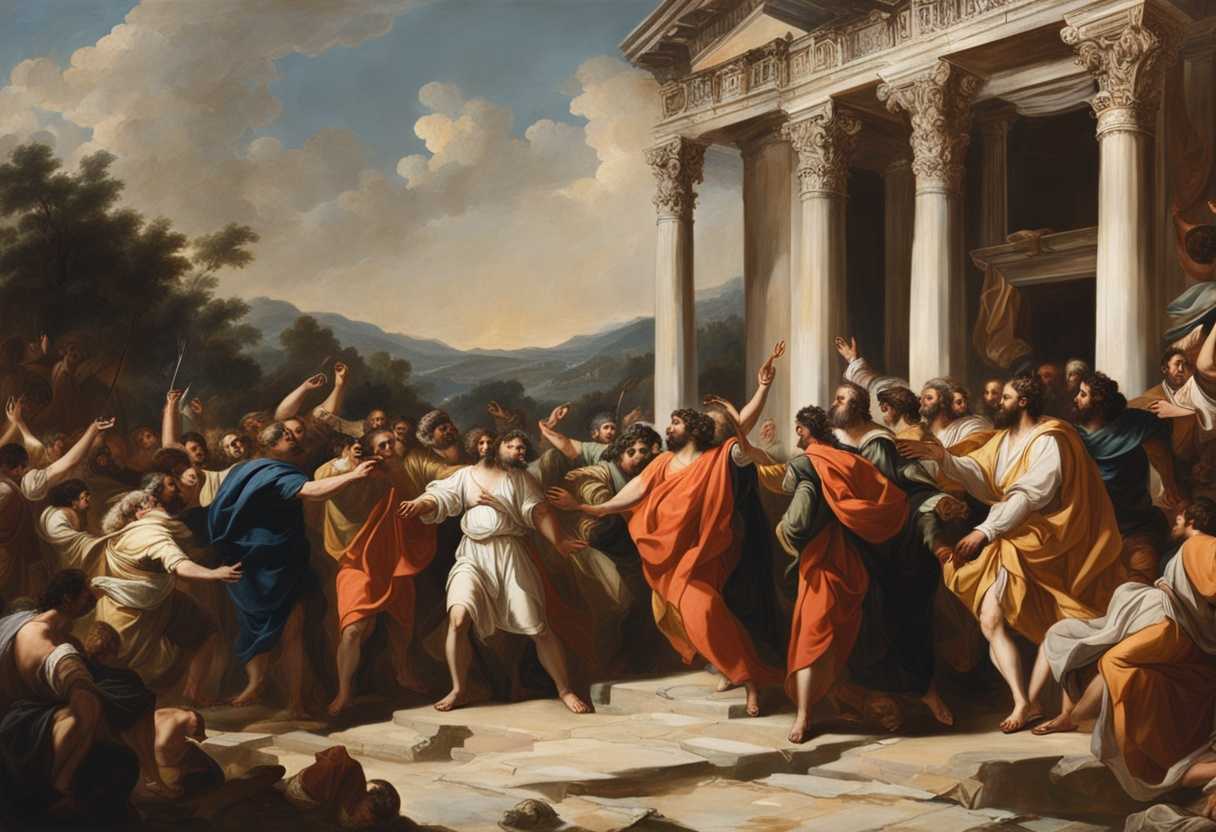
Setting the Scene for Acts 19:21-41
In Acts chapter 19, we find the apostle Paul in the city of Ephesus. The scene is set in the bustling marketplace of the city, where merchants from all over have gathered to sell their goods. Paul is accompanied by some of his disciples, including Timothy and Silas, as they navigate through the crowded streets.
The group had come to Ephesus to spread the teachings of Jesus Christ and to establish a church in the city. As they preached and performed miracles, many people began to believe in the message of the Gospel. This caused a stir among the silversmiths who made their living crafting idols of the goddess Artemis, as they saw their business threatened by the spread of Christianity.
As tensions rose, a riot broke out in the marketplace, with the angry mob seizing two of Paul’s companions and dragging them into the theater. The uproar continued as the crowd chanted praises to Artemis for hours on end, creating a chaotic and dangerous situation for Paul and his followers. This event serves as a powerful example of the opposition faced by early Christians as they sought to share the message of salvation with the world.
What is Acts 19:21-41 about?
Oh, the power of words! Paul’s preaching in Ephesus had a significant impact in this verse. His message was so powerful that it threatened the livelihood of the idol makers in the city. Imagine the strength of Paul’s words that it led to such a significant uproar among the people. His teachings challenged the beliefs and practices that were deeply ingrained in the community.
This verse shows us the transformative power of preaching and the resistance it can face when it goes against the status quo. It makes us reflect on the profound influence that our words and beliefs can have on others, even if it means disrupting the norm. It also prompts us to consider the courage and conviction that Paul must have had to continue spreading his message despite the backlash he faced. We should ponder on the impact of our own words and beliefs, and summon the courage to stand up for what we believe in, even in the face of opposition.
Understanding what Acts 19:21-41 really means
In Acts 19:21-41, we witness a pivotal moment in Paul’s ministry as he plans to journey to Jerusalem and Rome, guided by the Spirit despite the looming challenges. The narrative unfolds in Ephesus, where a disturbance erupts due to Paul’s preaching, particularly impacting the trade of a silversmith named Demetrius. Demetrius, fearing the loss of business and the diminishing reverence for Artemis, incites a riot against Paul and his companions, revealing the clash between the Gospel message and entrenched idol worship.
The phrase “Paul resolved in the Spirit to pass through Macedonia and Achaia and go to Jerusalem” encapsulates Paul’s unwavering determination and divine guidance amidst adversity, showcasing the reliance on spiritual discernment in navigating his mission. Demetrius’ outcry about the potential discredit to their trade and the temple of Artemis underscores the intertwined economic and religious implications of Paul’s teachings, emphasizing the profound impact of the Gospel on societal structures and beliefs.
As the crowd chants “Great is Artemis of the Ephesians!”, we glimpse the deep-rooted idolatry in Ephesus and the resistance to change, reflecting how entrenched practices can fiercely resist the transformative message of Christ. This resistance echoes themes found in related passages like Acts 17:16-34, where Paul confronts idol worship in Athens, and 1 Corinthians 8:4-6, where he addresses the theological implications of idolatry, grounding the events in Ephesus in a broader biblical context.
The relevance of this passage extends to contemporary society, where idolatry may manifest in subtler forms such as materialism or misplaced priorities, diverting attention from God. Moreover, the economic and social repercussions of genuine faith, as seen in the conflict with the silversmiths, highlight how faith can challenge societal norms and structures, necessitating courage and conviction in the face of opposition.
Consider a modern parallel where advocating for ethical practices in a morally questionable industry leads to backlash and economic consequences. This scenario mirrors Paul’s stand in Ephesus, illustrating the tension between upholding faith-driven values and confronting societal resistance, urging believers to emulate Paul’s steadfastness in pursuing a higher moral and spiritual calling.
Acts 19:21-41 serves as a poignant reminder of the transformative power of the Gospel, the courage required to challenge entrenched practices, and the resilience needed when faith clashes with societal norms. It prompts introspection on modern forms of idolatry and encourages believers to stand firm in their convictions, trusting in the guidance of the Holy Spirit amidst opposition, much like Paul did in the face of adversity.
How can we align our actions with genuine faith?
To align our actions with genuine faith, we must be mindful of our intentions and ensure they are rooted in sincerity and love for God. Our faith should guide us in all that we do, motivating us to act in ways that reflect our belief in Him. We should strive to cultivate a deep sense of trust and reliance on God, seeking His guidance and will in all aspects of our lives.
Furthermore, aligning our actions with genuine faith involves living according to the principles and values taught in the Scriptures. We should exhibit traits such as compassion, forgiveness, humility, and honesty in our interactions with others. Our faith should translate into tangible deeds that positively impact those around us and bring glory to God. Through our actions, we should strive to be a light in the world, reflecting the love and grace of Jesus Christ to all we encounter.
Application
In the realm of our modern lives, we are constantly navigating through challenges, just as Paul did in Ephesus. Let’s hold fast to our beliefs in times of opposition, for our faith can spark change in the world just as it did then. Are you ready to step up and share the message of hope fearlessly, despite the obstacles that may come our way? Let our actions speak louder than words as we pave the way for a brighter tomorrow.

Reverend Michael Johnson is an experienced Church Minister with a profound expertise in spirituality and guidance. With a serene presence and a compassionate heart, he has faithfully served his congregation for over 20 years, leading them on a spiritual journey towards inner peace and enlightenment. Reverend Johnson’s extensive knowledge of religious philosophies and profound understanding of human nature have made him a trusted confidant and mentor to many, as he seamlessly weaves his profound wisdom into life teachings. Reverend Johnson’s calming demeanor and empathetic nature continue to uplift and heal souls, nurturing a sense of unity and tranquility within his community.