
Acts 1:1-26 is about the preparation and appointment of a replacement disciple for Judas Iscariot, highlighting the necessity of maintaining faith, prayer, and unity in the early Christian community.
1 In the first book, O Theophilus, I have dealt with all that Jesus began to do and teach,
2 until the day when he was taken up, after he had given commands through the Holy Spirit to the apostles whom he had chosen.
3 He presented himself alive to them after his suffering by many proofs, appearing to them during forty days and speaking about the kingdom of God.
4 And while staying with them he ordered them not to depart from Jerusalem, but to wait for the promise of the Father, which, he said, “you heard from me;
5 for John baptized with water, but you will be baptized with the Holy Spirit not many days from now.
6 So when they had come together, they asked him, “Lord, will you at this time restore the kingdom to Israel?”
7 He said to them, “It is not for you to know times or seasons that the Father has fixed by his own authority.
8 But you will receive power when the Holy Spirit has come upon you, and you will be my witnesses in Jerusalem and in all Judea and Samaria, and to the end of the earth.”
9 And when he had said these things, as they were looking on, he was lifted up, and a cloud took him out of their sight.
10 And while they were gazing into heaven as he went, behold, two men stood by them in white robes,
11 and said, “Men of Galilee, why do you stand looking into heaven? This Jesus, who was taken up from you into heaven, will come in the same way as you saw him go into heaven.”
12 Then they returned to Jerusalem from the mount called Olivet, which is near Jerusalem, a Sabbath day’s journey away.
13 And when they had entered, they went up to the upper room, where they were staying, Peter and John and James and Andrew, Philip and Thomas, Bartholomew and Matthew, James the son of Alphaeus and Simon the Zealot and Judas the son of James.
14 All these with one accord were devoting themselves to prayer, together with the women and Mary the mother of Jesus, and his brothers.
15 In those days Peter stood up among the brothers (the company of persons was in all about 120) and said,
16 “Brothers, the Scripture had to be fulfilled, which the Holy Spirit spoke beforehand by the mouth of David concerning Judas, who became a guide to those who arrested Jesus.
17 For he was numbered among us and was allotted his share in this ministry.
18 (Now this man acquired a field with the reward of his wickedness, and falling headlong he burst open in the middle and all his bowels gushed out.
19 And it became known to all the inhabitants of Jerusalem, so that the field was called in their own language Akeldama, that is, Field of Blood.
20 “For it is written in the Book of Psalms, ‘May his camp become desolate, and let there be no one to dwell in it’; and ‘Let another take his office.’”
21 So one of the men who have accompanied us during all the time that the Lord Jesus went in and out among us,
22 beginning from the baptism of John until the day when he was taken up from us—one of these men must become with us a witness to his resurrection.”
23 And they put forward two, Joseph called Barsabbas, who was also called Justus, and Matthias.
24 And they prayed and said, “You, Lord, who know the hearts of all, show which one of these two you have chosen.
26 And they cast lots for them, and the lot fell on Matthias, and he was numbered with the eleven apostles.
26 And they cast lots for them, and the lot fell on Matthias, and he was numbered with the eleven apostles.
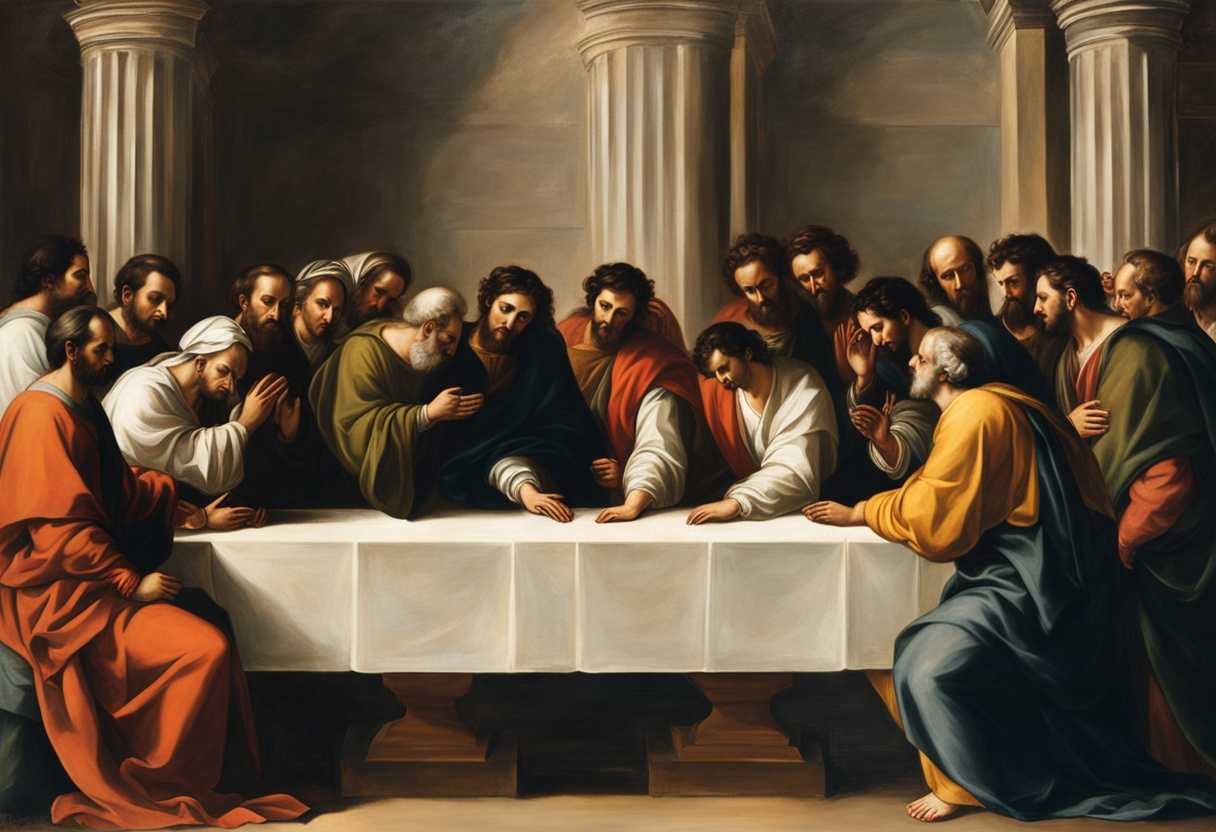
Setting the Scene for Acts 1:1-26
The scene in Acts chapter 1 opens with the disciples gathered in Jerusalem, just days after the resurrection of Jesus. The group consists of the eleven remaining apostles, including Peter, John, James, and the others, who had been following Jesus throughout his ministry. They are joined by other believers, totaling about 120 people in all. The disciples are still processing the recent events of Jesus’ crucifixion, resurrection, and subsequent appearances to them.
The setting is likely a room in Jerusalem where they have been staying, possibly the same upper room where they had the Last Supper with Jesus. The atmosphere is filled with a mix of emotions – awe, confusion, anticipation, and perhaps a bit of fear as they grapple with the implications of Jesus’ resurrection and what it means for their future. The disciples are in prayer and discussion, seeking guidance and direction as they wait for the promised Holy Spirit to come upon them. This period of waiting and preparation sets the stage for the momentous events that will unfold in the following chapters of Acts.
What is Acts 1:1-26 about?
We witness the powerful moment of Jesus ascending to heaven in this verse, marking the end of his earthly ministry. The ascension demonstrates Jesus’ departure to return to the Father, signaling the completion of his mission on Earth. This event symbolizes Jesus’ victory over death and sin, as well as his exaltation to the right hand of God. It also serves as a source of hope and encouragement for believers, as it signifies Jesus’ continued presence and authority even after his physical departure. Matthias’s selection as an apostle in this verse highlights the importance of leadership and succession within the early Christian community. The selection of Matthias shows the significance of having a complete and unified group of apostles to continue spreading the message of Jesus by filling the vacancy left by Judas Iscariot. This act also reinforces the idea of divine guidance and intervention in the selection process, affirming the belief that God is actively involved in shaping and building his church. The profound impact of Jesus’ ascension and the deliberate choices made within the early church remind us as we reflect on this verse. We are called to consider the significance of leadership, continuity, and divine purpose in our own lives and communities. We too are invited to discern our unique callings and responsibilities in furthering the work of God in the world, just as Matthias was chosen to fulfill a specific role in the early church. May we draw inspiration from this verse and strive to embody the faith, obedience, and boldness exemplified by Jesus and his apostles.
Understanding what Acts 1:1-26 really means
Acts 1:1-26 sets the stage for the Acts of the Apostles, penned by Luke, chronicling pivotal events like Jesus’ ascension, the promise of the Holy Spirit, and the selection of Matthias to fill Judas Iscariot’s place. The opening phrase, “In my former book, Theophilus, I wrote about all that Jesus began to do and to teach,” links Luke’s Gospel to Acts, emphasizing the continuation of Jesus’ ministry. This connection underscores the seamless transition from Christ’s earthly ministry to the work of the apostles empowered by the Holy Spirit.
The assurance, “You will receive power when the Holy Spirit comes on you; and you will be my witnesses,” highlights the transformative role of the Holy Spirit in empowering believers to spread the Gospel. This promise of divine enablement resonates with the Great Commission in Matthew 28:19-20, where Jesus commissions His followers to make disciples of all nations. The concept of believers being witnesses not only in word but also in deed underscores the holistic nature of Christian witness, embodying Christ’s teachings through actions and words.
The emphasis on communal prayer in Acts 1:1-26, where believers “joined together constantly in prayer,” underscores the significance of unity and fellowship in the early church. This unity in prayer mirrors the unity of purpose and spirit that characterized the early Christians, serving as a model for contemporary Christian communities. The selection of Matthias through prayer and discernment exemplifies the importance of seeking God’s guidance and will in decision-making processes, highlighting the reliance on God’s direction in crucial matters.
The relevance of Acts 1:1-26 extends to modern believers, reminding them of the promise of the Holy Spirit’s empowerment, the importance of unity in prayer, and the significance of seeking God’s will in decision-making. By reflecting on these themes and phrases, individuals can draw inspiration for their spiritual journeys, recognizing that the same Spirit that emboldened the early church is available to empower and guide them today. Just as the early Christians found strength and direction through prayer and unity, contemporary believers can tap into the same wellspring of divine empowerment and guidance for their lives and ministries.
How can we ensure our decisions align with God’s will?
We can align our decisions with God’s will by seeking guidance through prayer. Communing with God through prayer opens us to His wisdom and direction. Prayer allows us to align our thoughts and desires with His divine plan, helping us make decisions that are in line with His will.
Additionally, studying and meditating on God’s word can provide us with valuable insight and guidance. The Bible is a source of wisdom and truth that can help us discern God’s will in different situations. We can gain a better understanding of God’s character and desires by immersing ourselves in the teachings of Scripture, which can in turn inform our decision-making process.
Finally, seeking counsel from fellow believers can also help us navigate decisions in accordance with God’s will. Spiritually mature individuals who are grounded in God’s word can provide us with perspective and advice that can help us make choices that honor God. Community and accountability within the body of Christ can provide valuable support and guidance as we seek to align our decisions with God’s will.
Application
Imagine you’ve just been promoted at work, a pivotal role where your actions shape the future. Acts 1:1-26 is your manual for this moment. Jesus’ ascension and Matthias replacing Judas show the power of stepping into your divine assignment. Like the early disciples, let this inspire you to share your faith boldly and seek God’s wisdom in every decision. How will you respond to the call to transform lives and live out your faith in concrete ways today?

Reverend Michael Johnson is an experienced Church Minister with a profound expertise in spirituality and guidance. With a serene presence and a compassionate heart, he has faithfully served his congregation for over 20 years, leading them on a spiritual journey towards inner peace and enlightenment. Reverend Johnson’s extensive knowledge of religious philosophies and profound understanding of human nature have made him a trusted confidant and mentor to many, as he seamlessly weaves his profound wisdom into life teachings. Reverend Johnson’s calming demeanor and empathetic nature continue to uplift and heal souls, nurturing a sense of unity and tranquility within his community.