
Acts 27-28 is about the trials and triumphs of the Apostle Paul’s journey to Rome, highlighting themes of faith, perseverance through adversity, and the fulfillment of God’s promises amidst danger, as Paul faces a shipwreck and then continues to proclaim the Gospel in Rome despite his imprisonment.
1 And when it was decided that we should sail for Italy, they delivered Paul and some other prisoners to a centurion of the Augustan Cohort named Julius.
2 And embarking in a ship of Adramyttium, which was about to sail to the ports along the coast of Asia, we put to sea, accompanied by Aristarchus, a Macedonian from Thessalonica.
3 The next day we put in at Sidon. And Julius treated Paul kindly and gave him leave to go to his friends and be cared for.
4 And putting out to sea from there we sailed under the lee of Cyprus, because the winds were against us.
5 When we had sailed across the open sea along the coast of Cilicia and Pamphylia, we came to Myra in Lycia.
6 And there the centurion found a ship from Alexandria sailing for Italy and put us on board.
7 When we had sailed slowly for a good many days, and arrived with difficulty off Cnidus, the wind not allowing us to go farther, we sailed under the lee of Crete off Salmone.
8 Since much time had passed, and the voyage was now dangerous because even the Fast was already over, Paul advised them,
9 Since much time had passed, and the voyage was now dangerous because even the Fast was already over, Paul advised them,
10 “saying, ‘Sirs, I perceive that the voyage will be with injury and much loss, not only of the cargo and the ship, but also of our lives.’”
11 But the centurion paid more attention to the pilot and to the owner of the ship than to what Paul said.
12 And because the harbor was not suitable to spend the winter in, the majority decided to put out to sea from there, on the chance that somehow they could reach Phoenix, a harbor of Crete, facing both southwest and northwest, and spend the winter there.
13 Now when the south wind blew gently, supposing that they had obtained their purpose, they weighed anchor and sailed along Crete, close to the shore.
14 But soon a tempestuous wind, called the northeaster, struck down from the land.
15 And setting sail from there, we sailed under the lee of Cyprus because the winds were against us.
16 Running under the lee of a small island called Cauda, we managed with difficulty to secure the ship’s boat.
17 After hoisting it up, they used supports to undergird the ship. Then, fearing that they would run aground on the Syrtis, they lowered the gear, and thus they were driven along.
18 Since we were violently storm-tossed, they began the next day to jettison the cargo.
19 On the third day they threw the ship’s tackle overboard with their own hands.
20 When neither sun nor stars appeared for many days, and no small tempest lay on us, all hope of our being saved was at last abandoned.
21 Since they had been without food for a long time, Paul stood up among them and said, “Men, you should have listened to me and not have set sail from Crete and incurred this injury and loss.
22 Yet now I urge you to take heart, for there will be no loss of life among you, but only of the ship.
23 For this very night there stood before me an angel of the God to whom I belong and whom I worship,
24 and said, ‘Do not be afraid, Paul; you must stand before Caesar. And behold, God has granted you all those who sail with you.’
25 So take heart, men, for I have faith in God that it will be exactly as I have been told.
26 But we must run aground on some island.”
27 When the fourteenth night had come, as we were being driven across the Adriatic Sea, about midnight the sailors suspected that they were nearing land.
28 So they took a sounding and found twenty fathoms. A little farther on they took a sounding again and found fifteen fathoms.
29 Fearing that we might run aground on the rocks, they let down four anchors from the stern and prayed for day to come.
30 Then the sailors were seeking to escape from the ship, and had lowered the ship’s boat into the sea under pretense of laying out anchors from the bow,
31 Paul said to the centurion and the soldiers, “Unless these men stay in the ship, you cannot be saved.”
32 Then the soldiers cut away the ropes of the ship’s boat and let it go.
33 As day was about to dawn, Paul urged them all to take some food, saying, “Today is the fourteenth day that you have continued in suspense and without food, having taken nothing.
34 Therefore I urge you to take some food. For it will give you strength, for not a hair is to perish from the head of any of you.”
35 And when he had said these things, he took bread, and giving thanks to God in the presence of all he broke it and began to eat.
36 Then they were all encouraged and ate some food themselves.
37 All together there were 276 of us on board.
38 And when they had eaten enough, they lightened the ship, throwing out the wheat into the sea.
39 Now when it was day, they did not recognize the land, but they noticed a bay with a beach, on which they planned if possible to run the ship ashore.
40 So they cast off the anchors and left them in the sea, at the same time loosening the ropes that tied the rudders. Then hoisting the foresail to the wind they made for the beach.
41 But striking a reef, they ran the vessel aground. The bow stuck and remained immovable, and the stern was being broken up by the surf.
42 The soldiers’ plan was to kill the prisoners, lest any should swim away and escape.
43 But the centurion, wishing to save Paul, kept them from carrying out their plan. He ordered those who could swim to jump overboard first and make for the land,
44 and the rest on planks or on pieces of the ship. And so it was that all were brought safely to land.
1 After we were brought safely through, we then learned that the island was called Malta.
2 The native people showed us unusual kindness, for they kindled a fire and welcomed us all, because it had begun to rain and was cold.
3 When Paul had gathered a bundle of sticks and put them on the fire, a viper came out because of the heat and fastened on his hand.
4 When the native people saw the creature hanging from his hand, they said to one another, “No doubt this man is a murderer. Though he has escaped from the sea, Justice has not allowed him to live.”
5 He, however, shook off the creature into the fire and suffered no harm.
6 They were waiting for him to swell up or suddenly fall down dead. But when they had waited a long time and saw no misfortune come to him, they changed their minds and said that he was a god.
7 Now in the neighborhood of that place were lands belonging to the chief man of the island, named Publius, who received us and entertained us hospitably for three days.
8 It happened that the father of Publius lay sick with fever and dysentery. And Paul visited him and prayed, and putting his hands on him, healed him.
9 And when this had taken place, the rest of the people on the island who had diseases also came and were cured.
10 They also honored us greatly, and when we were about to sail, they put on board whatever we needed.
11 After three months we set sail in a ship that had wintered in the island, a ship of Alexandria, with the twin gods as a figurehead.
12 And putting in at Syracuse, we stayed there for three days.
13 And from there we made a circuit and arrived at Rhegium. And after one day a south wind sprang up, and on the second day we came to Puteoli.
14 There we found brothers and were invited to stay with them for seven days. And so we came to Rome.
15 And the brothers there, when they heard about us, came as far as the Forum of Appius and Three Taverns to meet us. On seeing them, Paul thanked God and took courage.
16 And when we came into Rome, Paul was allowed to stay by himself, with the soldier who guarded him.
17 After three days he called together the local leaders of the Jews, and when they had gathered, he said to them, “Brothers, though I had done nothing against our people or the customs of our fathers, yet I was delivered as a prisoner from Jerusalem into the hands of the Romans.”
18 They came to him; for they had heard that he had done a notable sign.
19 But because the Jews objected, I was compelled to appeal to Caesar—though I had no charge to bring against my nation.
20 For this reason, therefore, I have asked to see you and speak with you, since it is because of the hope of Israel that I am wearing this chain.”
21 They said to him, “We have received no letters from Judea about you, and none of the brothers coming here has reported or spoken any evil about you.
28 But we desire to hear from you what your views are, for with regard to this sect we know that everywhere it is spoken against.”
23 When they had appointed a day for him, they came to him at his lodging in greater numbers. From morning till evening he expounded to them, testifying to the kingdom of God and trying to convince them about Jesus both from the Law of Moses and from the Prophets.
24 And some were convinced by what he said, but others disbelieved.
25 And disagreeing among themselves, they departed after Paul had made one statement: “The Holy Spirit was right in saying to your fathers through Isaiah the prophet:
26 “‘Go to this people, and say,
“You will indeed hear but never understand,
and you will indeed see but never perceive.”
27 For this people’s heart has grown dull, and with their ears they can barely hear, and their eyes they have closed; lest they should see with their eyes and hear with their ears and understand with their heart and turn, and I would heal them.’
28 Therefore let it be known to you that this salvation of God has been sent to the Gentiles; they will listen.”
And when he had said these words, the Jews departed, having much dispute among themselves.
30 He lived there two whole years at his own expense, and welcomed all who came to him,
31 proclaiming the kingdom of God and teaching about the Lord Jesus Christ with all boldness and without hindrance.
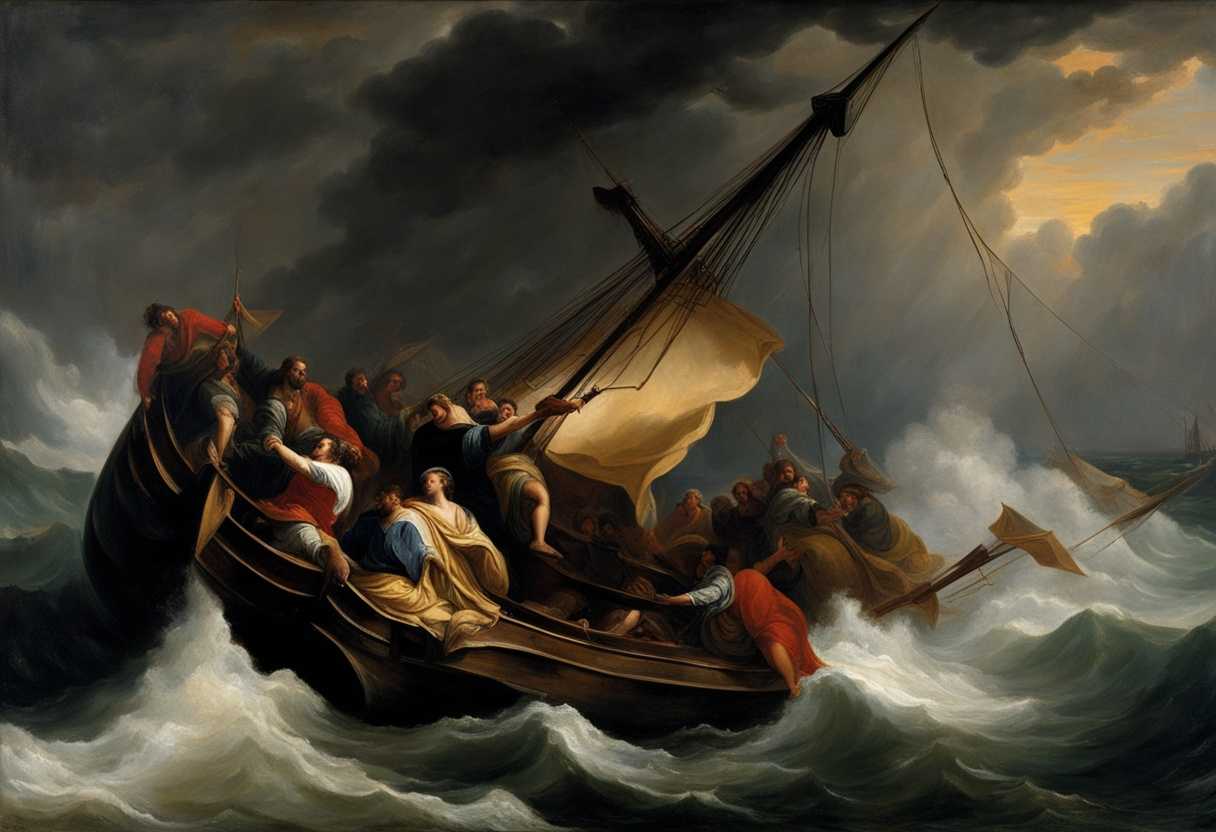
Setting the Scene for Acts 27-28
The scene unfolds on the turbulent waters of the Mediterranean Sea, where a ship is caught in a fierce storm. The Apostle Paul, a prisoner bound for Rome, stands at the helm, his face weathered yet resolute. He is accompanied by a diverse group of individuals, including Julius, a centurion of the Augustan cohort, who is tasked with ensuring Paul’s safe passage. The ship is filled with sailors, prisoners, and other passengers, all of whom are gripped by fear as the winds howl and the waves crash against the vessel. The atmosphere is thick with tension, as the crew struggles to maintain control, throwing cargo overboard in a desperate attempt to lighten the load and keep the ship afloat.
As the storm rages on, Paul, filled with a sense of divine assurance, gathers the frightened crew and passengers. He speaks with a calm authority, sharing a message of hope that he received from an angel of God. He reassures them that despite the chaos surrounding them, not a single life will be lost, though the ship itself will be wrecked. The scene is one of stark contrast: the raging storm outside and the calm, steadfast faith of Paul within. The ship, battered and worn, is a microcosm of the trials faced by those who follow a path of faith amidst adversity. The crew, initially skeptical, begins to find solace in Paul’s words, recognizing the strength of his conviction.
As the storm finally begins to subside, the ship approaches the shores of Malta, where the passengers will find refuge. The island is lush and inviting, a stark contrast to the tumultuous sea they have just navigated. The sun breaks through the clouds, casting a warm glow on the sandy beaches and rocky cliffs. The inhabitants of Malta, curious and welcoming, gather to assist the weary travelers. Paul, despite his status as a prisoner, emerges as a leader among them, demonstrating kindness and resilience. This moment marks a significant turning point in Paul’s journey, as he continues to fulfill his mission of spreading the Gospel, even in the face of adversity. The scene encapsulates the themes of faith, perseverance, and divine providence that resonate throughout the narrative of Acts.
What is Acts 27-28 about?
We witness the incredible account of Paul’s journey to Rome in Acts 27-28, which is marked by adversity and divine intervention. Have you ever thought about how the significant challenges we face in our lives shape our destiny as we explore this narrative together? Paul’s journey was fraught with danger—from treacherous seas to a shipwreck—yet throughout it all, we see a profound illustration of God’s protection and overarching purpose for our lives. This raises an important question: how often do we recognize the hand of God guiding us through our own trials?
The shipwreck, which might seem like a disastrous setback, becomes a pivotal moment where God’s plan unfolds. When Paul finds himself on the island of Malta, he not only survives but also begins to minister to the people there, highlighting that even amid chaos, there often exists an opportunity for growth and outreach. Isn’t it inspiring to think that our difficulties can lead us to unexpected places where we can make a positive impact? Paul’s unwavering faith during these trying times emphasizes a vital lesson: that God’s purposes often transcend our immediate circumstances. Do we trust that there is a greater plan for us, even when we find ourselves in tumultuous situations?
Furthermore, Paul’s interactions with the Maltese people exemplify the transformative power of grace and hope in the face of struggles. When we read about his healing of the sick and the way he was received on the island, we can reflect on our own lives and consider how we, too, can be vessels of hope to others during trying times. How can we slow down in our fast-paced world to recognize these divine moments where we can offer help or comfort amidst distractions? Acts 27-28 reminds us that while our journeys may have unforeseen twists and turns, they can lead us to fulfill our purpose and serve others—if only we remain open to God’s guidance along the way.
Understanding what Acts 27-28 really means
Acts 27-28 recounts the remarkable journey of the Apostle Paul as he is transported to Rome for trial. This narrative is rich with themes of faith, perseverance, and divine providence amidst adversity. It invites us to reflect on how we respond to life’s storms and the assurance that God is with us through every trial.
Paul, a prisoner, finds himself on a ship filled with other prisoners and soldiers. The journey is fraught with danger, culminating in a violent storm that threatens their very lives. This context serves as a poignant reminder of the trials faced by believers. How often do we find ourselves in situations that feel overwhelming? Paul’s experience encourages us to lean into our faith during such times, reminding us that we are not alone in our struggles.
One of the key themes in this passage is faith in adversity. Paul’s unwavering trust in God during the storm is a powerful testament to the strength of belief when circumstances seem dire. His calm assurance amidst chaos challenges us to consider our own responses to life’s challenges. Do we trust God when the winds of life howl around us? Additionally, the theme of divine providence shines through as God orchestrates events for Paul’s protection and eventual arrival in Rome. This illustrates His sovereignty and care for His people, reminding us that even when we cannot see the way forward, God is at work behind the scenes.
The interactions among the crew, soldiers, and prisoners also highlight the importance of community and support. In times of crisis, we often rely on those around us for strength and encouragement. Paul’s leadership and the way he rallies those on the ship serve as a reminder that our faith can have a ripple effect, impacting others positively. How can we be a source of support for those navigating their own storms?
In today’s world, filled with uncertainty and personal storms—be it health crises, financial struggles, or societal issues—this passage resonates deeply. Just as Paul faced a literal storm, many of us encounter metaphorical storms in our lives. The words of Psalm 107:29, “He stilled the storm to a whisper,” remind us of God’s power over nature and our circumstances. Romans 8:28 reassures us that God can bring good out of our trials, while Philippians 4:6-7 encourages us to find peace in God amidst chaos.
Consider the story of a friend who faced a significant health challenge. Despite a grim prognosis, they held onto their faith, finding strength in prayer and community support. Much like Paul, they navigated their storm with hope, ultimately experiencing healing and a renewed sense of purpose. This illustrates how faith can anchor us during turbulent times, providing a foundation upon which we can stand firm.
The phrases “Do not be afraid,” “You will stand trial before Caesar,” and “Everyone will be safe” carry profound meaning. They signify courage, purpose, and the ripple effect of faith. Paul’s declaration reassures us that our lives have direction, even when we cannot see the path ahead. As we reflect on these phrases, we are reminded that God’s presence is a source of comfort and strength.
In conclusion, Acts 27-28 serves as a powerful testament to the strength of faith in adversity. It encourages us to trust in God’s providence, to support one another in our journeys, and to remember that even in the storms of life, we are not alone. As we navigate our own challenges, may we hold fast to the hope and assurance found in God’s Word, knowing that He is with us every step of the way.
How do we maintain faith during turbulent times?
Maintaining faith is essential to navigate the challenges we face in times of turmoil. One way to fortify our belief is by embracing the understanding that difficult situations often serve a greater purpose. Remembering that adversity can lead to personal growth and deeper understanding of our beliefs helps reinforce our faith. Look for the lessons embedded within our trials in these moments and trust that there is a larger plan at work.
Additionally, community support plays a crucial role in sustaining faith during turbulent times. Engaging with others who share similar beliefs can provide encouragement and remind us that we are not alone in our struggles. We can bolster our spirit and maintain hope by sharing experiences and drawing strength from one another. Collective faith can be empowering, reminding us that we have a support system that can guide us through hardship and uncertainties.
Lastly, cultivating a posture of prayer and reflection can significantly help in maintaining faith. Individuals can find solace and peace amidst chaos by dedicating time to connect with their spirituality. This practice allows us to voice our fears, seek guidance, and find comfort in the idea that we are not in control of all circumstances. Setting aside regular time for introspection can ground us in our values and beliefs, reinforcing our faith as we navigate the stormy waters of life.
Application
Imagine navigating the rough waters of life, like a ship battling fierce storms. Just as Paul showed incredible strength and faith during his trials, you can harness that same spirit in your own journey. When work feels overwhelming or family challenges arise, remember that resilience can keep you afloat. Commit to being a source of hope and encouragement for those around you; lend a hand, share a kind word. Are you ready to steer your ship with unwavering trust and uplift others amidst their storms?

Reverend Michael Johnson is an experienced Church Minister with a profound expertise in spirituality and guidance. With a serene presence and a compassionate heart, he has faithfully served his congregation for over 20 years, leading them on a spiritual journey towards inner peace and enlightenment. Reverend Johnson’s extensive knowledge of religious philosophies and profound understanding of human nature have made him a trusted confidant and mentor to many, as he seamlessly weaves his profound wisdom into life teachings. Reverend Johnson’s calming demeanor and empathetic nature continue to uplift and heal souls, nurturing a sense of unity and tranquility within his community.