
Acts 7:18-19 is about the oppressive rise of a new king over Egypt who exploited the Israelites, reflecting themes of persecution and the moral decay of leadership that lead to suffering among God’s people.
18 until there arose over Egypt another king who did not know Joseph.
19 He dealt shrewdly with our race and forced our fathers to expose their infants, so that they would not be kept alive.
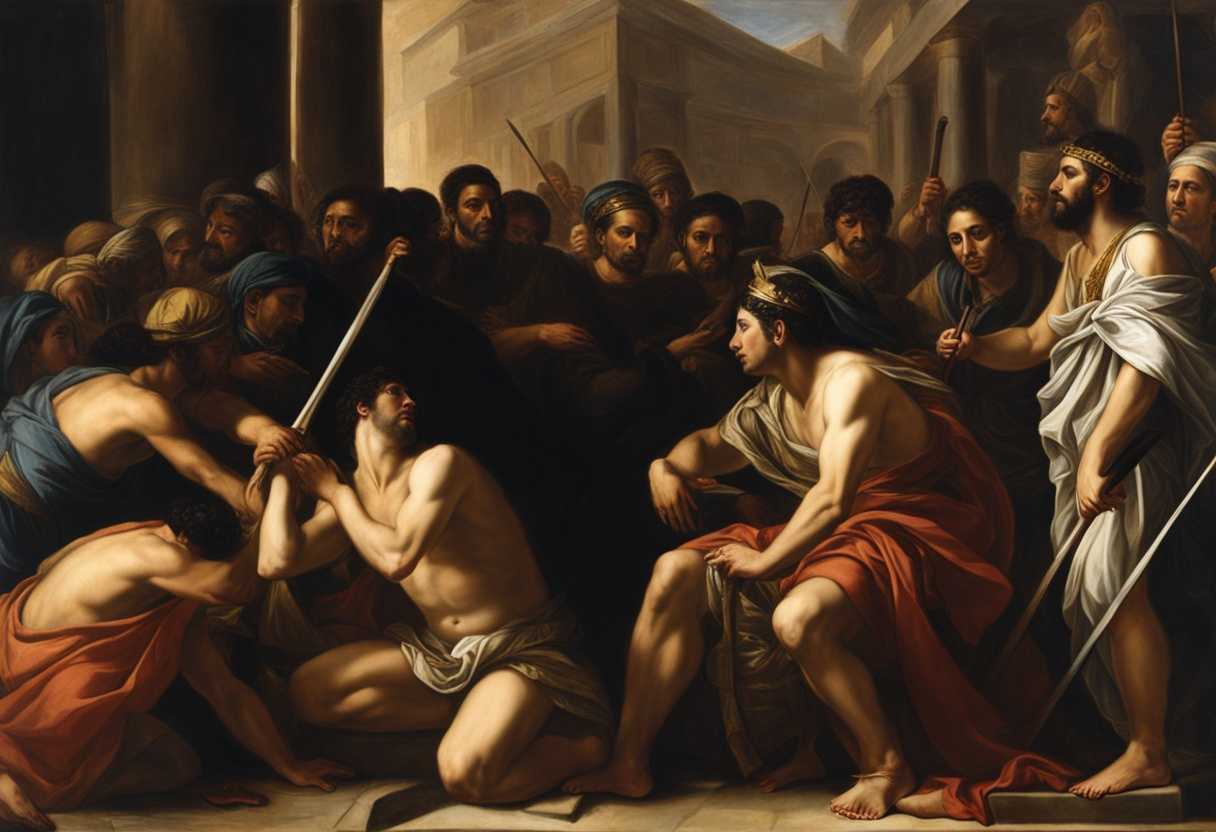
Setting the Scene for Acts 7:18-19
In the heart of ancient Egypt, a time of great turmoil and oppression loomed over the Israelites. The sun hung high in the sky, casting a harsh light over the bustling city of Memphis, where the grand structures of the Pharaohs towered above the common folk. The air was thick with the sounds of laborers, the clanging of tools, and the cries of children playing in the dusty streets. Among the throngs of people, a sense of unease permeated the atmosphere, as the Israelites found themselves increasingly marginalized under the rule of a new Pharaoh who did not remember Joseph and his contributions to Egypt. This Pharaoh, driven by fear of the growing Israelite population, devised a plan to subjugate them, leading to a dark chapter in their history.
In this oppressive environment, a man named Moses emerged, born into a Hebrew family but raised in the opulence of the royal court. His mother, Jochebed, had hidden him for three months to protect him from the Pharaoh’s decree to kill all newborn Hebrew boys. Eventually, she placed him in a basket and set him afloat on the Nile, where he was discovered by the Pharaoh’s daughter. This act of desperation and faith would set the stage for Moses’ destiny. As he grew, he became acutely aware of the suffering of his people, witnessing the harsh treatment they endured at the hands of the Egyptians. The tension between his dual identity as an Egyptian prince and a Hebrew became a source of inner conflict, leading him to seek justice for his oppressed kin.
One fateful day, as Moses ventured out to observe the labor of his fellow Israelites, he witnessed an Egyptian taskmaster brutally beating a Hebrew slave. Anger surged within him, and in a moment of impulsive rage, he intervened, killing the Egyptian and burying his body in the sand. This act of defiance, however, did not go unnoticed. The next day, when he attempted to mediate a quarrel between two Hebrews, he was met with hostility and fear, as they questioned his authority and reminded him of his crime. Realizing that his actions had not only endangered himself but also his people, Moses fled into the wilderness, leaving behind the life of privilege he had known. This pivotal moment marked the beginning of his journey toward becoming the leader who would ultimately deliver the Israelites from bondage, setting the stage for the unfolding of God’s plan for His chosen people.
What is Acts 7:18-19 about?
In this passage, a new Pharaoh emerges in Egypt, one who does not remember Joseph and the way his leadership positively impacted the nation. This sets the stage for an act of cruelty that goes beyond simple governance; it illustrates a profound shift in the societal fabric where oppression replaces understanding and empathy. The Israelites, who were once welcomed guests in this land, are now seen as a threat. This transition compels us to ask: how easily can fear lead to systemic oppression? What does it say about our humanity when vulnerability is exploited rather than protected? We must consider the implications of this power dynamic as we delve deeper into the narrative. The Pharaoh’s actions highlight a fundamental bias against the marginalized, suggesting that the more dominant group may choose to overlook empathy in times of perceived threat. This prompts us to reflect on our own lives: Are we ever in a position where we ignore the struggles of others because we feel secure in our circumstances? Could we, like the Pharaoh, allow fear to cloud our judgment and impact our treatment of vulnerable groups? This text invites us to engage in introspection on how we handle differences and the responsibilities we hold toward our fellow beings, especially those who may be at our mercy.
Understanding what Acts 7:18-19 really means
In Acts 7:18-19, we encounter a pivotal moment in the narrative of Israel’s history, as Stephen recounts the rise of a new king in Egypt who did not know Joseph. This transition marks a significant shift in the treatment of the Israelites, illustrating how quickly circumstances can change. The phrase “a new king arose” signifies not just a change in leadership, but a departure from the previous favor shown towards Joseph and his family. It serves as a stark reminder of the fragility of goodwill and the ease with which it can be forgotten.
The phrase “who did not know Joseph” carries profound implications. It highlights the importance of memory and recognition in shaping our identities and relationships. The new king’s ignorance of Joseph’s contributions to Egypt reflects a broader theme of forgetting one’s history. This amnesia can lead to dire consequences, as it did for the Israelites, who found themselves oppressed by a ruler who failed to acknowledge their past significance. How often do we overlook the contributions of those who came before us? This question invites us to reflect on our own lives and communities.
Related passages, such as Exodus 1:8-10, further elaborate on the new king’s fear of the growing Israelite population, which ultimately leads to their oppression. This fear, rooted in misunderstanding, serves as a cautionary tale about the dangers of allowing ignorance to dictate policy and treatment of marginalized groups. Similarly, Psalm 105:23-25 recounts how God’s people felt unwelcome in a land where they had once been favored, reinforcing the idea that changing fortunes can lead to injustice. These connections remind us that the themes of fear and misunderstanding are not confined to ancient texts; they resonate deeply in our contemporary society.
Today, we witness similar shifts in leadership and policy that can marginalize certain groups. The story of the new king serves as a cautionary tale about the dangers of forgetting history and the contributions of those who have shaped our communities. It challenges us to remain vigilant and aware of the narratives that influence our society. Are we honoring the legacies of those who have paved the way for us, or are we allowing ignorance to dictate our actions?
Consider a community that once thrived on the contributions of immigrants, who brought diverse skills and cultures. Over time, a new generation of leaders may arise who forget the foundational role these immigrants played. This can lead to policies that marginalize these groups, echoing the sentiments of the new king in Egypt. Such scenarios remind us of the importance of honoring our history and recognizing the contributions of all individuals in our society.
In conclusion, Acts 7:18-19 serves as a powerful reminder of the importance of memory, recognition, and the potential for change in leadership to impact the lives of many. As we reflect on these themes, we are called to be advocates for justice and remembrance. Let us ensure that we do not repeat the mistakes of the past, but instead strive to create a society that honors its history and values the contributions of all its members. How can we actively engage in this process of remembrance and recognition in our own lives?
How can we recognize oppression in our lives?
To recognize oppression in our lives, we must be attentive to the subtle and overt ways in which power dynamics play out in our daily experiences. Oppression often manifests in systemic inequalities where certain groups are marginalized or dehumanized, whether through discriminatory practices, economic disadvantages, or social exclusion. Awareness of these injustices can begin with reflecting on our interactions and the structures around us—identifying who has power and who lacks it, as well as understanding the historical context that shapes these relationships.
It is also crucial to consider how oppression affects our sense of identity and community. Those who are oppressed may experience feelings of isolation, fear, and resentment, stemming from a lack of agency and the constant pressures of conforming to a dominant narrative. Recognizing this can help individuals and communities become more empathetic and supportive, fostering solidarity against oppressive systems. We can better understand the realities faced by others and ourselves by looking out for signs of dehumanization or exploitation in our environments.
Finally, awareness of oppression involves a willingness to confront uncomfortable truths and engage in difficult conversations. This requires critical self-reflection and a commitment to equity, acknowledging that personal comfort may sometimes come at the expense of others’ rights and dignity. We challenge prejudices and advocate for justice, identifying oppression and becoming part of a collective movement toward empowerment and liberation for all.
Application
Imagine your workplace where unfairness stirs like a storm, and your family feels the weight of injustice like a heavy cloud overhead. As followers of Christ, we’re called to be the sunlight breaking through that cloud—shining love and truth into dark places. Are you ready to step up and be the voice for those who are unheard? It’s time to take action, to stand alongside those who suffer, and to be that beacon of light even when the world feels heavy and indifferent. What will you do when the winds of injustice blow through your life?

Reverend Michael Johnson is an experienced Church Minister with a profound expertise in spirituality and guidance. With a serene presence and a compassionate heart, he has faithfully served his congregation for over 20 years, leading them on a spiritual journey towards inner peace and enlightenment. Reverend Johnson’s extensive knowledge of religious philosophies and profound understanding of human nature have made him a trusted confidant and mentor to many, as he seamlessly weaves his profound wisdom into life teachings. Reverend Johnson’s calming demeanor and empathetic nature continue to uplift and heal souls, nurturing a sense of unity and tranquility within his community.