
Acts 7:44-60 is about the martyrdom of Stephen, who boldly proclaimed the truth of Jesus Christ despite facing severe persecution and ultimately being stoned to death, mirroring the martyrdom of Jesus himself and exemplifying unwavering faith and commitment to the gospel.
44 “Our fathers had the tent of witness in the wilderness, just as he who spoke to Moses directed him to make it, according to the pattern that he had seen.”
45 Our fathers in turn brought it in with Joshua when they dispossessed the nations that God drove out before our fathers. So it was until the days of David,
46 who found favor in the sight of God and asked to find a dwelling place for the God of Jacob.
47 But it was Solomon who built a house for him.
48 Yet the Most High does not dwell in houses made by hands, as the prophet says,
49 “‘Heaven is my throne,
and the earth is my footstool.
What kind of house will you build for me, says the Lord,
or what is the place of my rest?
51 “You stiff-necked people, uncircumcised in heart and ears, you always resist the Holy Spirit. As your fathers did, so do you.”
51 “You stiff-necked people, uncircumcised in heart and ears, you always resist the Holy Spirit. As your fathers did, so do you.”
Which of the prophets did your fathers not persecute? And they killed those who announced beforehand the coming of the Righteous One, whom you have now betrayed and murdered,
You who received the law as delivered by angels and did not keep it.
54 Now when they heard these things they were enraged, and they ground their teeth at him.
55 But he, full of the Holy Spirit, gazed into heaven and saw the glory of God, and Jesus standing at the right hand of God.
56 And he said, “Behold, I see the heavens opened, and the Son of Man standing at the right hand of God.”
57 But they cried out with a loud voice and stopped their ears and rushed together at him.
58 Then they cast him out of the city and stoned him. And the witnesses laid down their garments at the feet of a young man named Saul.
59 And as they were stoning Stephen, he called out, “Lord Jesus, receive my spirit.”
60 Then falling to his knees he cried out with a loud voice, “Lord, do not hold this sin against them.” And when he had said this, he fell asleep.
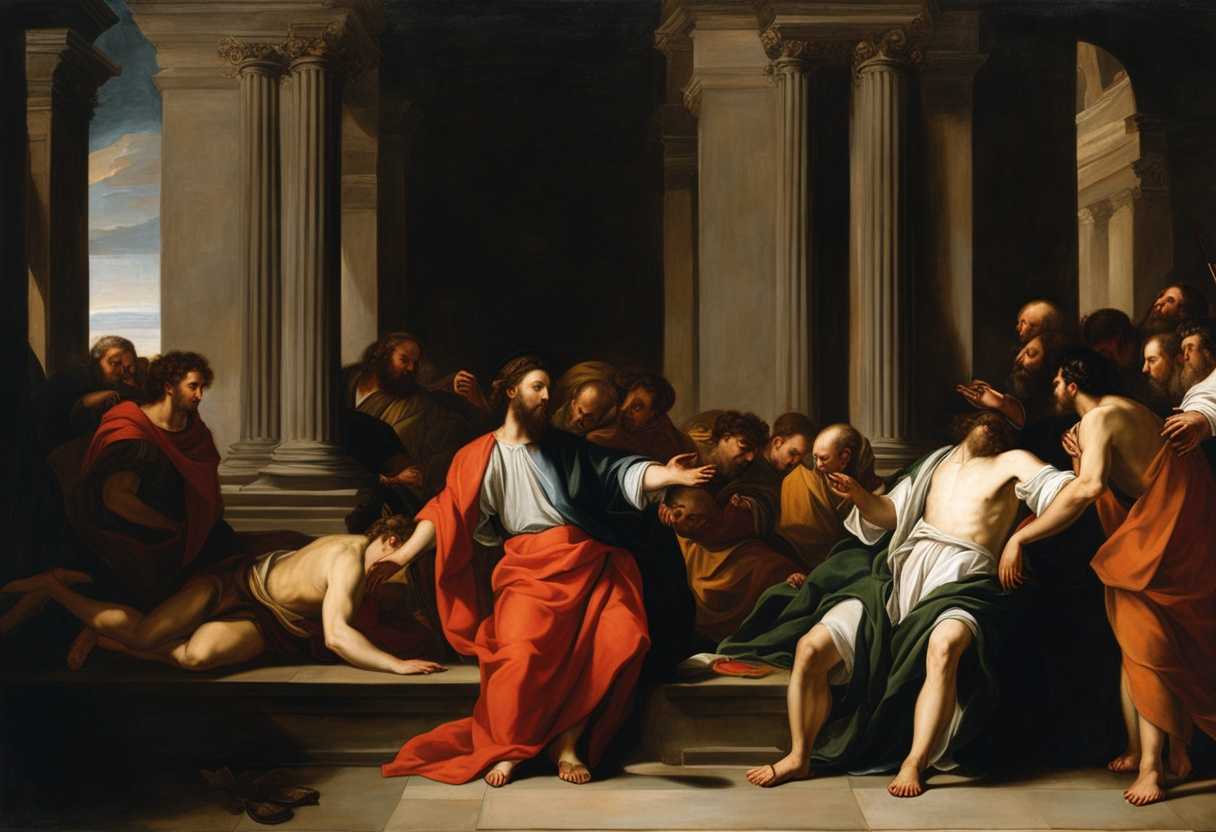
Setting the Scene for Acts 7:44-60
In Acts chapter 7, we find Stephen, a man full of faith and the Holy Spirit, standing before the Sanhedrin, the Jewish high court in Jerusalem. The scene is tense as Stephen is being accused of blasphemy against Moses, God, and the temple. The high priest questions Stephen, and he responds with a powerful speech recounting the history of the Israelites and their repeated rejection of God’s chosen leaders.
Surrounded by the religious leaders and a crowd of onlookers, Stephen fearlessly proclaims the truth, pointing out their ancestors’ resistance to God’s messengers and their role in the betrayal and murder of the Righteous One, Jesus Christ. The atmosphere is charged with emotion as Stephen confronts the religious authorities with their guilt and calls them to repentance.
As Stephen’s speech reaches its climax, the crowd becomes enraged, and they drag him outside the city to be stoned to death. Despite the danger and hostility surrounding him, Stephen remains steadfast in his faith, even praying for his persecutors as he is martyred for his beliefs. The scene is a powerful reminder of the cost of standing up for the truth and the ultimate victory of faith over persecution.
What is Acts 7:44-60 about?
Stephen, a follower of Christ who faced persecution, displayed the ultimate act of forgiveness and love in this powerful verse. Despite being unjustly accused and facing death, Stephen chose to emulate Jesus’s teachings by forgiving his persecutors. His actions not only demonstrate the depth of his faith and commitment to Christ, but also serve as a profound example for us all to follow. We are challenged to consider the implications of forgiveness in our own lives as we reflect on Stephen’s martyrdom. Can we find the strength and grace to forgive those who have wronged us, even in the face of great adversity? Are we able to embody Christ’s love and extend forgiveness to others, regardless of the circumstances? Stephen’s example calls us to dig deep into our faith and truly live out the teachings of Jesus in our daily lives, even when it is difficult or uncomfortable. Let Stephen’s bravery and unwavering faith inspire us as we seek to cultivate a spirit of forgiveness and love in our own hearts. May his story serve as a reminder of the transformative power of forgiveness and the radical love that Jesus calls us to embody. Let us strive to follow in Stephen’s footsteps by choosing forgiveness over bitterness, love over hate, and grace over judgment.
Understanding what Acts 7:44-60 really means
In Acts 7:44-60, we witness a pivotal moment in the early Christian church as Stephen, a devoted follower of Christ, boldly stands before the Sanhedrin to defend his faith. As he recounts the history of Israel and accuses the Jewish leaders of resisting the Holy Spirit, Stephen’s words carry weight and conviction. His speech culminates in a powerful vision of Jesus standing at the right hand of God, a testament to his unwavering faith even in the face of persecution.
Stephen’s reference to “the tabernacle of the covenant law” in the wilderness serves as a reminder of God’s presence among His people throughout their journey. This portable sanctuary symbolized the closeness of God to His chosen ones, a theme that resonates throughout the Bible. Stephen’s accusation of the Jewish leaders as “stiff-necked people” with “uncircumcised hearts and ears” highlights their stubbornness and resistance to God’s message, drawing parallels to their ancestors’ behavior.
The vision Stephen shares of seeing “heaven open and the Son of Man standing at the right hand of God” is a profound moment that underscores Jesus’ divine authority and role as humanity’s intercessor. His final words, echoing Jesus’ plea for forgiveness on the cross, demonstrate a remarkable display of grace and love even in the midst of persecution. This act of forgiveness challenges us to reflect on our own capacity to extend grace to those who wrong us.
The relevance of Stephen’s story extends to believers today in various ways. His faithfulness in adversity serves as a model for standing firm in the face of trials, inspiring us to remain steadfast in our beliefs even when confronted with opposition. Stephen’s act of forgiveness towards his persecutors underscores the transformative power of forgiveness in personal relationships and community life, urging us to emulate Christ’s example of grace and mercy.
Stephen’s bold proclamation of his vision also prompts believers to consider their role in witnessing for Christ. Just as Stephen fearlessly shared his faith despite the consequences, we are called to testify to the truth of the Gospel in our daily lives, regardless of the challenges we may encounter. His story challenges us to examine our own commitment to faith, forgiveness, and evangelism, encouraging us to live out these principles authentically in our interactions and struggles.
In a modern context, Stephen’s example can be likened to a scenario where someone unjustly faces repercussions at work but chooses to respond with forgiveness and integrity. This act not only brings peace to their own heart but also serves as a powerful testimony to those around them, illustrating the transformative impact of faith in action. Stephen’s speech and martyrdom ultimately remind us of the enduring lessons of faith, forgiveness, and bold witness for Christ, inviting us to reflect on how we can embody these principles in our own lives.
Do we forgive those who hurt us?
The verse encourages us to forgive those who may have hurt us, just as Stephen forgave those who stoned him. Stephen remained steadfast in his faith and forgave his persecutors, showing a great example of forgiveness even in the face of extreme pain and injustice.
It teaches us that forgiveness is a powerful act of love and grace that can bring freedom and peace to our hearts. Choosing forgiveness releases us from the weight of anger and resentment, allowing us to move forward in our lives with a spirit of reconciliation and healing. Forgiveness is not easy, especially in situations where we have been deeply hurt. It requires a conscious decision to let go of the desire for revenge and to extend grace and mercy to the ones who have wronged us. However, through forgiveness, we can experience true freedom and allow God’s love and grace to work in our lives and in the lives of those who have hurt us.
Application
Let Stephen’s courage inspire us to stand firm in our beliefs. We must not shy away from declaring our faith, even amidst challenges and adversity. Just as Stephen stood tall in the face of persecution, let us be unwavering in our dedication to following Jesus. Let his story serve as a beacon of strength in our own spiritual journey. Are we ready to boldly proclaim our faith with the same determination as Stephen did?

Reverend Michael Johnson is an experienced Church Minister with a profound expertise in spirituality and guidance. With a serene presence and a compassionate heart, he has faithfully served his congregation for over 20 years, leading them on a spiritual journey towards inner peace and enlightenment. Reverend Johnson’s extensive knowledge of religious philosophies and profound understanding of human nature have made him a trusted confidant and mentor to many, as he seamlessly weaves his profound wisdom into life teachings. Reverend Johnson’s calming demeanor and empathetic nature continue to uplift and heal souls, nurturing a sense of unity and tranquility within his community.