
Acts 7:54-8:3 is about Stephen’s unwavering faith and courageous martyrdom in the face of persecution, demonstrating the power of forgiveness and spreading the message of Christ even in the midst of intense opposition and violence.
54 Now when they heard these things they were enraged, and they ground their teeth at him.
55 But he, full of the Holy Spirit, gazed into heaven and saw the glory of God, and Jesus standing at the right hand of God.
56 And he said, “Behold, I see the heavens opened, and the Son of Man standing at the right hand of God.”
57 But they cried out with a loud voice and stopped their ears and rushed together at him.
58 Then they cast him out of the city and stoned him. And the witnesses laid down their garments at the feet of a young man named Saul.
59 And as they were stoning Stephen, he called out, “Lord Jesus, receive my spirit.”
60 Then falling to his knees he cried out with a loud voice, “Lord, do not hold this sin against them.” And when he had said this, he fell asleep.
1 And Saul approved of his execution. And there arose on that day a great persecution against the church in Jerusalem, and they were all scattered throughout the regions of Judea and Samaria, except the apostles.
2 Devout men buried Stephen and made great lamentation over him.
3 But Saul was ravaging the church, and entering house after house, he dragged off men and women and committed them to prison.
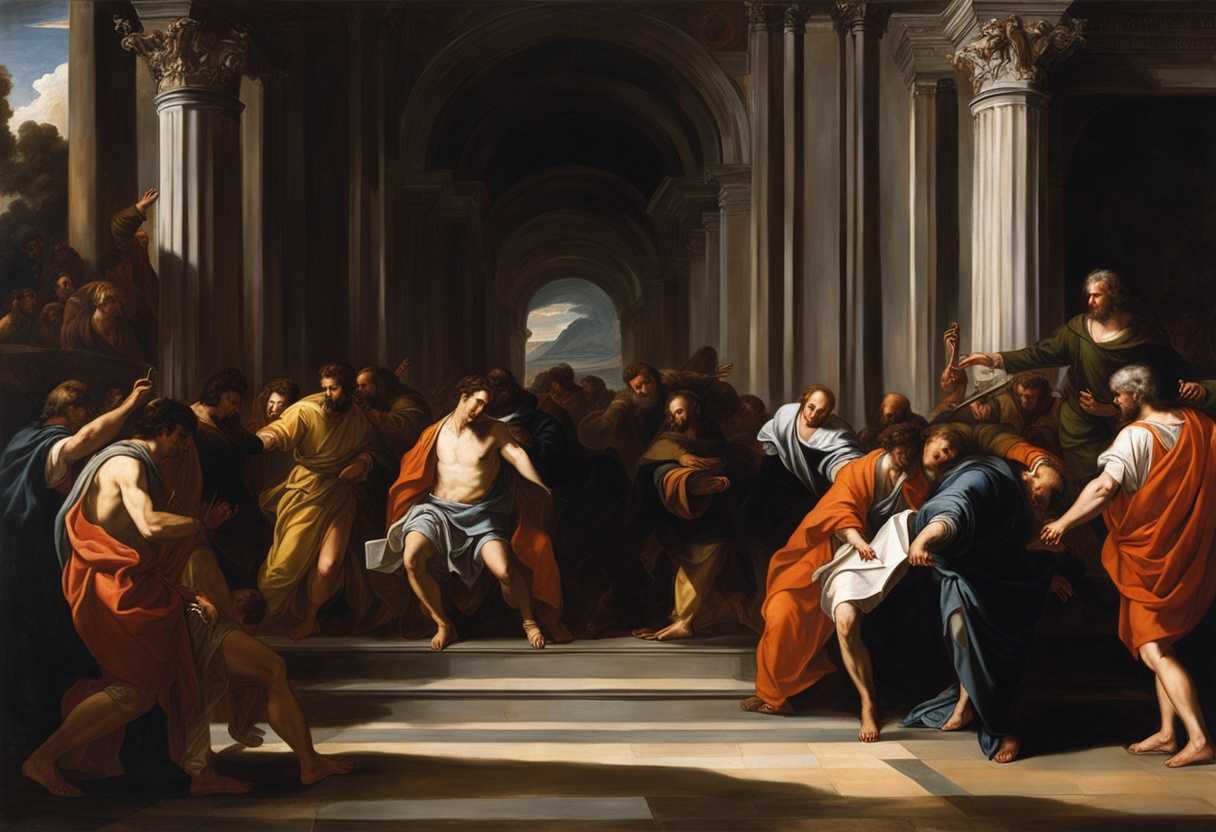
Setting the Scene for Acts 7:54-8:3
The scene in Acts 7:54-8:3 takes place in Jerusalem, following the powerful speech of Stephen before the Sanhedrin. Stephen, a devout follower of Jesus, had been brought before the council on charges of blasphemy. In his defense, he delivered a passionate recounting of the history of Israel, highlighting their rejection of God’s prophets throughout the ages. This angered the religious leaders, and they responded by gnashing their teeth at him.
Among those present in this intense moment were the members of the Sanhedrin, including high priest Caiaphas and other religious authorities. The atmosphere was charged with tension and hostility as Stephen fearlessly confronted the council with the truth of their rebellion against God. As the situation escalated, Stephen looked up and saw a vision of heaven, proclaiming that he saw the Son of Man standing at the right hand of God. This declaration further incensed the leaders, leading them to drag Stephen out of the city to be stoned to death. Among those who watched over the cloaks of the executioners was a young man named Saul, who would later become the apostle Paul, a key figure in the spread of Christianity. This event marked the beginning of a great persecution against the early church in Jerusalem, with Saul playing a prominent role in hunting down and imprisoning believers.
What is Acts 7:54-8:3 about?
This verse from the Bible highlights a pivotal moment in the early Christian church’s history. The martyrdom of Stephen, one of the first deacons chosen to serve the early church, shows the profound faith and commitment to Christ that believers had, even in the face of violent persecution. Stephen’s stoning symbolizes the challenges and dangers that early Christians faced for their beliefs. It also showcases how Stephen’s response to his killers, asking for forgiveness for them, mirrored Jesus’ own forgiveness on the cross, illustrating the power of love and grace in the face of hatred and violence.
Saul’s approval of Stephen’s death is a significant moment as well, foreshadowing his conversion to Christianity and transformation into the apostle Paul. The scattering of believers due to persecution reveals the challenges and hardships that the early Christians faced as they spread the message of the Gospel. This verse serves as a reminder of the sacrifices and obstacles that early believers endured to advance the Kingdom of God, challenging us to reflect on our own faith and commitment in the face of adversity. What lessons can we draw from Stephen’s courage and forgiveness in the midst of persecution? How does Saul’s involvement in Stephen’s death show the transformative power of God’s grace? And how can we apply the perseverance and dedication of the early believers to our own lives as modern-day Christians?
Understanding what Acts 7:54-8:3 really means
The passage in Acts 7:54-8:3 unveils a poignant narrative following Stephen’s bold proclamation of Jesus Christ to the Sanhedrin. Filled with the Holy Spirit, Stephen beholds a vision of Jesus at the right hand of God, provoking the crowd to a furious frenzy that culminates in his martyrdom through stoning. This pivotal moment not only marks Stephen as the first Christian martyr but also introduces Saul, later known as Paul, who consents to Stephen’s death and initiates a severe persecution against the early church.
In the midst of the chaos, key phrases like “They were furious and gnashed their teeth at him” vividly portray the intense hostility towards Stephen’s message. Stephen’s vision of Jesus standing at the right hand of God symbolizes divine approval and provides him with solace in his final moments. His prayer for forgiveness for his persecutors echoes Jesus’ own words on the cross, showcasing profound forgiveness and love even in the face of death. The introduction of Saul’s persecution of the church marks the beginning of his transformative journey from a persecutor to a pivotal figure in spreading the Gospel.
Drawing parallels with other biblical passages, such as Luke 23:34 where Jesus forgives his executioners and Matthew 5:44 where Jesus teaches to love and pray for enemies, underscores the theme of forgiveness and love exemplified by Stephen. Acts 9:1-19 further illustrates God’s transformative power through Saul’s conversion, emphasizing that no one is beyond redemption and that God can use even the most unlikely individuals for His divine purposes.
The relevance of this passage resonates strongly in contemporary times, urging Christians to embody principles of forgiveness, grace, courage, and faith. Stephen’s remarkable ability to forgive his persecutors amidst extreme adversity serves as a compelling example of extending grace and forgiveness, even in the face of grave injustice. His unwavering faith and vision of Jesus inspire courage and steadfastness in navigating trials and persecution. Saul’s transformation into Paul serves as a poignant reminder that God’s grace can reach anyone, transforming them into powerful instruments for His work.
To illustrate the enduring impact of forgiveness and transformation, envision a modern-day scenario where someone unjustly faces severe consequences but chooses to forgive and pray for their accusers. This act of forgiveness not only brings peace to the individual but also holds the potential to transform the hearts of those who wronged them, mirroring Stephen’s prayer and Saul’s eventual conversion. In conclusion, Acts 7:54-8:3 stands as a profound testament to the transformative power of faith, forgiveness, and God’s redemptive work, challenging believers to embody these principles in their lives with unwavering trust in God’s sovereign plan.
How can we show forgiveness to our enemies?
One way we can show forgiveness to our enemies is by following the example of Jesus Christ, who forgave those who hurt Him, even as he was being crucified. We demonstrate love and compassion by choosing to forgive our enemies and show that we are willing to let go of resentment and anger. Forgiveness is a powerful act that can bring about healing and reconciliation, not only in our own hearts but also in the relationships with our enemies.
When we forgive our enemies, we are choosing to release them from the debt they owe us, just as God has forgiven us for our own sins. It is an act of grace that can break the cycle of hatred and violence. We show that we are willing to let go of the desire for revenge and instead seek to build bridges and foster peace by extending forgiveness to our enemies.
Forgiveness is not always easy, especially when we have been wronged or hurt deeply by someone. But by choosing to forgive, we free ourselves from the burden of carrying anger and bitterness in our hearts. We can pray for our enemies, ask God to help us forgive them, and trust that He will give us the strength and grace to show mercy and love to those who have wronged us.
Application
Reflect on Acts 7:54-8:3. Are you ready to stand tall in your beliefs like Stephen did? Don’t just read the Word; live it boldly. Will you answer the call to spread the Good News in a world that needs the light of Christ?

Reverend Michael Johnson is an experienced Church Minister with a profound expertise in spirituality and guidance. With a serene presence and a compassionate heart, he has faithfully served his congregation for over 20 years, leading them on a spiritual journey towards inner peace and enlightenment. Reverend Johnson’s extensive knowledge of religious philosophies and profound understanding of human nature have made him a trusted confidant and mentor to many, as he seamlessly weaves his profound wisdom into life teachings. Reverend Johnson’s calming demeanor and empathetic nature continue to uplift and heal souls, nurturing a sense of unity and tranquility within his community.