
Acts 9:1-31 is about the transformative power of God’s grace and the conversion of Saul, demonstrating that no one is beyond redemption and that God can change even the staunchest opponent into a fervent advocate for His kingdom.
1 But Saul, still breathing threats and murder against the disciples of the Lord, went to the high priest
2 and asked him for letters to the synagogues at Damascus, so that if he found any belonging to the Way, men or women, he might bring them bound to Jerusalem.
3 Now as he went on his way, he approached Damascus, and suddenly a light from heaven shone around him.
4 And falling to the ground, he heard a voice saying to him, “Saul, Saul, why are you persecuting me?”
5 And he said, “Who are you, Lord?” And he said, “I am Jesus, whom you are persecuting.
6 But rise and enter the city, and you will be told what you are to do.”
7 The men who were traveling with him stood speechless, hearing the voice but seeing no one.
8 Saul rose from the ground, and although his eyes were opened, he saw nothing. So they led him by the hand and brought him into Damascus.
9 And for three days he was without sight, and neither ate nor drank.
10 Now there was a disciple at Damascus named Ananias. The Lord said to him in a vision, “Ananias.” And he said, “Here I am, Lord.”
11 And the Lord said to him, “Rise and go to the street called Straight, and at the house of Judas look for a man of Tarsus named Saul, for behold, he is praying,
12 and he has seen in a vision a man named Ananias come in and lay his hands on him so that he might regain his sight.”
13 But Ananias answered, “Lord, I have heard from many about this man, how much evil he has done to your saints in Jerusalem.
14 And here he has authority from the chief priests to bind all who call on your name.”
15 But the Lord said to him, “Go, for he is a chosen instrument of mine to carry my name before the Gentiles and kings and the children of Israel.
16 For I will show him how much he must suffer for the sake of my name.
17 So Ananias departed and entered the house. And laying his hands on him he said, “Brother Saul, the Lord Jesus who appeared to you on the road by which you came has sent me so that you may regain your sight and be filled with the Holy Spirit.”
18 And immediately something like scales fell from his eyes, and he regained his sight. Then he rose and was baptized.
19 and taking food, he was strengthened.
20 And immediately he proclaimed Jesus in the synagogues, saying, “He is the Son of God.”
21 And all who heard him were amazed and said, “Is not this the man who made havoc in Jerusalem of those who called upon this name? And has he not come here for this purpose, to bring them bound before the chief priests?”
22 But Saul increased all the more in strength, and confounded the Jews who lived in Damascus by proving that Jesus was the Christ.
23 When many days had passed, the Jews plotted to kill him,
24 but their plot became known to Saul. They were watching the gates day and night in order to kill him,
25 but his disciples took him by night and let him down through an opening in the wall, lowering him in a basket.
26 And when he had come to Jerusalem, he attempted to join the disciples. And they were all afraid of him, for they did not believe that he was a disciple.
27 But Barnabas took him and brought him to the apostles and declared to them how on the road he had seen the Lord, who spoke to him, and how at Damascus he had preached boldly in the name of Jesus.
28 So he went in and out among them at Jerusalem, preaching boldly in the name of the Lord.
29 And he spoke and disputed against the Hellenists. But they were seeking to kill him.
30 And when the brothers learned this, they brought him down to Caesarea and sent him off to Tarsus.
31 So the church throughout all Judea and Galilee and Samaria had peace and was being built up. And walking in the fear of the Lord and in the comfort of the Holy Spirit, it multiplied.
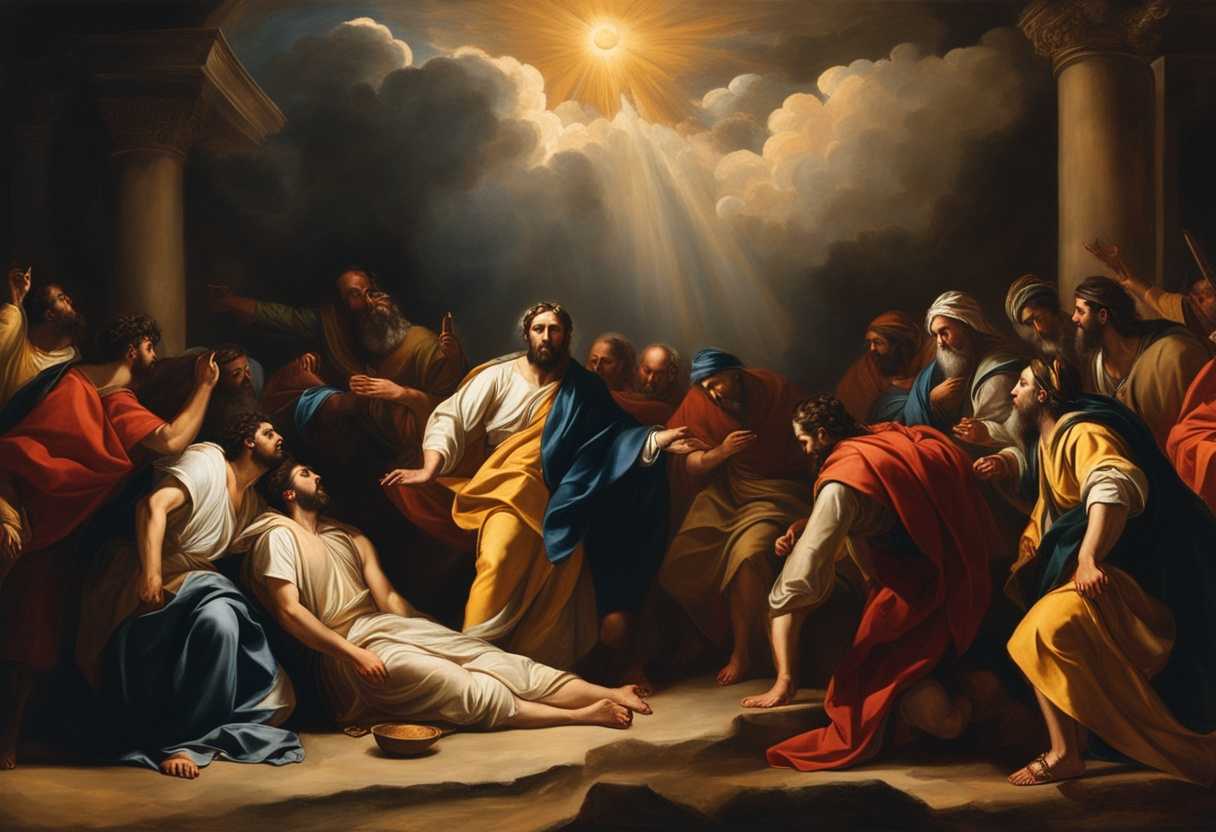
Setting the Scene for Acts 9:1-31
In Acts chapter 9, we find Saul of Tarsus, a zealous Pharisee who was known for persecuting Christians. As he was on his way to Damascus to arrest followers of Jesus, a bright light from heaven suddenly flashed around him, and he fell to the ground. He heard a voice saying, “Saul, Saul, why are you persecuting me?” Saul, trembling and astonished, asked, “Who are you, Lord?” The voice replied, “I am Jesus, whom you are persecuting.”
Saul was blinded by the encounter and was led into Damascus by his companions. Meanwhile, a disciple named Ananias received a vision from the Lord instructing him to go to Saul and restore his sight. Ananias was hesitant at first because of Saul’s reputation, but he obeyed and went to him. As Ananias laid his hands on Saul, something like scales fell from his eyes, and he regained his sight. Saul was baptized and immediately began preaching about Jesus in the synagogues, causing amazement among the people who knew him as a persecutor of Christians.
The scene in Acts 9 is a powerful display of God’s transformative power and grace. It shows how Saul, later known as the apostle Paul, went from being a fierce opponent of Christianity to becoming one of its most influential advocates. The encounter on the road to Damascus not only changed Saul’s life but also had a profound impact on the early Christian community, demonstrating that no one is beyond the reach of God’s love and redemption.
What is Acts 9:1-31 about?
The verse about Saul’s conversion on the road to Damascus, where he becomes Paul, is a powerful reminder of the transformative power of faith. Before this moment, Saul was known for persecuting early Christians, but encountering Jesus on the road changed his life forever. This experience not only marked a significant turning point in Saul’s personal journey but also in the spread of Christianity. It shows that no one is beyond redemption and that even those who oppose the faith can become its most fervent advocates.
Reflecting on this verse, we are prompted to consider the unexpected ways in which faith can enter our lives and turn them upside down. We are reminded that our lives can be completely transformed when we open ourselves to the possibility of divine intervention, just as Saul’s encounter with Jesus led to his profound conversion and subsequent missionary work. It challenges us to examine our own beliefs and preconceptions, and to remain open to the possibility of experiencing a radical shift in perspective. Have you ever experienced a moment that completely changed your outlook on life? Can you imagine the impact of encountering something so profound that it alters the course of your entire existence? Let Saul’s conversion serve as a beacon of hope and inspiration, showing us that no one is ever too far gone to receive the grace of transformation.
Understanding what Acts 9:1-31 really means
Acts 9:1-31 unveils a remarkable narrative of Saul’s conversion to Paul, a pivotal moment in the New Testament that showcases the transformative power of God’s grace. Saul, initially a vehement persecutor of Christians, undergoes a radical change, becoming one of the most influential apostles of Jesus Christ. The passage not only highlights Saul’s personal transformation but also signifies the beginning of his impactful ministry, shaping the early Christian community.
One of the key themes in this passage is Saul’s intense hostility towards Christians, vividly depicted as “breathing out murderous threats against the Lord’s disciples.” This phrase underscores the severity of Saul’s opposition and sets the stage for the divine intervention that follows. As Saul is struck by a “light from heaven,” symbolizing God’s presence and intervention, the narrative emphasizes the profound nature of his encounter with Jesus, leading to his conversion.
Jesus’ direct question to Saul, “Why do you persecute me?” serves as a poignant reminder of the intimate connection between Christ and His followers. This personal address highlights the unity and solidarity within the body of believers, emphasizing that persecution against Christians is akin to persecuting Jesus Himself. Furthermore, the declaration that Saul is God’s “chosen instrument” reveals God’s sovereign choice and purpose, showcasing His ability to transform even the most unlikely individuals for His divine plan.
The relevance of this passage extends to contemporary audiences, offering a message of hope and redemption. Saul’s transformation serves as a powerful testimony to the possibility of change through God’s grace, inspiring individuals to believe in the transformative power of faith. Moreover, the narrative underscores God’s sovereignty and purpose in the lives of believers, reassuring them that no one is beyond the reach of His redemptive love.
Drawing parallels to other biblical passages such as Galatians 1:13-16 and 1 Timothy 1:12-16 further illuminates the themes of grace, mercy, and transformation present in Saul’s conversion. Additionally, the anecdote of John Newton, a former slave trader turned advocate for abolition and author of “Amazing Grace,” mirrors Saul’s journey, emphasizing the profound impact of encountering God’s grace and experiencing a life-changing transformation.
By reflecting on the themes and phrases within Acts 9:1-31, readers are invited to contemplate the transformative power of God’s grace, the significance of personal encounters with Christ, and the assurance of God’s purpose in every life. Just as Saul’s conversion exemplifies a radical shift from persecution to proclamation, it serves as a timeless reminder of God’s ability to bring about profound change in the lives of individuals who are willing to surrender to His transformative love.
How can I show love and forgiveness like Jesus?
To show love and forgiveness like Jesus, one can emulate His example of compassion and mercy towards others, despite their past actions or beliefs. We can extend forgiveness to those who may have wronged us, offering them a chance for redemption and reconciliation, just as Jesus showed forgiveness to even those who persecuted Him. This act of forgiveness reflects the unconditional love that Jesus demonstrated throughout His ministry, showing that love transcends any offense or wrongdoing.
Additionally, following Jesus’ example involves actively seeking out opportunities to show kindness and grace to others, regardless of their circumstances. This may entail reaching out to those who are in need, offering a helping hand, or simply listening with empathy and understanding. We can reflect the transformative power of Jesus’ message and the profound impact it can have on relationships and communities by demonstrating a spirit of love and forgiveness in our interactions with others. Embodying a spirit of humility and selflessness in all our interactions ultimately means showing love and forgiveness like Jesus, prioritizing empathy and understanding over judgment and condemnation. We can cultivate a heart of love and forgiveness that reflects His divine grace and mercy towards all by following the teachings of Jesus and striving to emulate His example in our daily lives.
Application
Embrace the divine message in Acts 9:1-31, a call to embrace change and strive for transformation. Allow God’s power to ignite a shift within you and those you hold dear, just as Saul became Paul. Will you respond with humility and resolve, becoming instruments of love and grace in our modern world, ready to make a difference?

Reverend Michael Johnson is an experienced Church Minister with a profound expertise in spirituality and guidance. With a serene presence and a compassionate heart, he has faithfully served his congregation for over 20 years, leading them on a spiritual journey towards inner peace and enlightenment. Reverend Johnson’s extensive knowledge of religious philosophies and profound understanding of human nature have made him a trusted confidant and mentor to many, as he seamlessly weaves his profound wisdom into life teachings. Reverend Johnson’s calming demeanor and empathetic nature continue to uplift and heal souls, nurturing a sense of unity and tranquility within his community.