
Daniel 7:1-28 is about the visions and prophecies revealed to Daniel, showcasing the rise and fall of kingdoms and the eventual establishment of God’s eternal kingdom.
1 In the first year of Belshazzar king of Babylon, Daniel saw a dream and visions of his head as he lay in his bed. Then he wrote down the dream and told the sum of the matter.
2 Daniel declared, “I saw in my vision by night, and behold, the four winds of heaven were stirring up the great sea.
3 And four great beasts came up out of the sea, different from one another.
4 The first was like a lion and had eagles’ wings. Then as I looked its wings were plucked off, and it was lifted up from the ground and made to stand on two feet like a man, and the mind of a man was given to it.
5 And behold, another beast, a second one, like a bear. It was raised up on one side. It had three ribs in its mouth between its teeth; and it was told, ‘Arise, devour much flesh.’
6 After this I looked, and behold, another, like a leopard, with four wings of a bird on its back. And the beast had four heads, and dominion was given to it.
7 After this I saw in the night visions, and behold, a fourth beast, terrifying and dreadful and exceedingly strong. It had great iron teeth; it devoured and broke in pieces and stamped what was left with its feet. It was different from all the beasts that were before it, and it had ten horns.
8 I considered the horns, and behold, there came up among them another horn, a little one, before which three of the first horns were plucked up by the roots. And behold, in this horn were eyes like the eyes of a man, and a mouth speaking great things.
9 “As I looked, thrones were placed, and the Ancient of Days took his seat; his clothing was white as snow, and the hair of his head like pure wool; his throne was fiery flames; its wheels were burning fire.
10 A stream of fire issued and came out from before him; a thousand thousands served him, and ten thousand times ten thousand stood before him; the court sat in judgment, and the books were opened.
11 “I looked then because of the sound of the great words that the horn was speaking. And as I looked, the beast was killed, and its body destroyed and given over to be burned with fire.”
12 As for the rest of the beasts, their dominion was taken away, but their lives were prolonged for a season and a time.
13 I saw in the night visions, and behold, with the clouds of heaven there came one like a son of man, and he came to the Ancient of Days and was presented before him.
14 And to him was given dominion and glory and a kingdom, that all peoples, nations, and languages should serve him; his dominion is an everlasting dominion, which shall not pass away, and his kingdom one that shall not be destroyed.
15 “As for me, Daniel, my spirit within me was anxious, and the visions of my head alarmed me.
16 I approached one of those who stood there and asked him the truth concerning all this. So he told me and made known to me the interpretation of the things.
17 These four great beasts are four kings who shall arise out of the earth.
18 But the saints of the Most High shall receive the kingdom and possess the kingdom forever, forever and ever.
19 “Then I desired to know the truth about the fourth beast, which was different from all the rest, exceedingly terrifying, with its teeth of iron and claws of bronze, and which devoured and broke in pieces and stamped what was left with its feet,
20 and about the ten horns that were on its head, and the other horn that came up and before which three of them fell, the horn that had eyes and a mouth that spoke great things, and that seemed greater than its companions.
21 As I looked, this horn made war with the saints and prevailed over them,
22 until the Ancient of Days came, and judgment was given for the saints of the Most High, and the time came when the saints possessed the kingdom.
23 “Thus he said: ‘As for the fourth beast,
there shall be a fourth kingdom on earth,
which shall be different from all the kingdoms,
and it shall devour the whole earth,
and trample it down, and break it to pieces.
24 As for the ten horns, out of this kingdom ten kings shall arise, and another shall arise after them; he shall be different from the former ones, and shall put down three kings.
25 He shall speak words against the Most High, and shall wear out the saints of the Most High, and shall think to change the times and the law; and they shall be given into his hand for a time, times, and half a time.
26 But the court shall sit in judgment, and his dominion shall be taken away, to be consumed and destroyed to the end.
27 And the kingdom and the dominion and the greatness of the kingdoms under the whole heaven shall be given to the people of the saints of the Most High; their kingdom shall be an everlasting kingdom, and all dominions shall serve and obey them.’
28 “Here is the end of the matter. As for me, Daniel, my thoughts greatly alarmed me, and my color changed, but I kept the matter in my heart.”
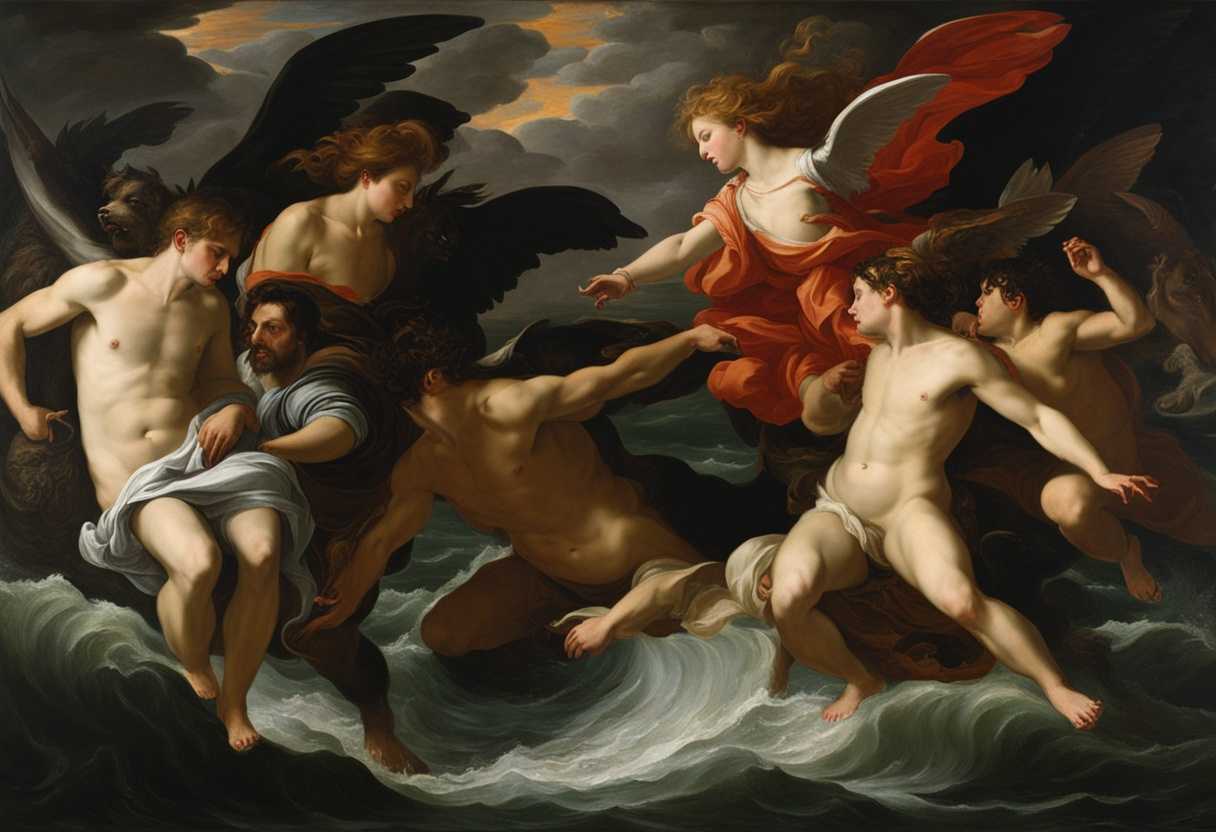
Setting the Scene for Daniel 7:1-28
In Daniel chapter 7, the scene is set in the Babylonian Empire during the reign of King Belshazzar. The prophet Daniel, a captive from Judah, is the central figure in this scene. He is known for his wisdom and ability to interpret dreams and visions. As the story unfolds, Daniel finds himself in a vivid dream where he sees four great beasts rising out of the sea, each representing a powerful kingdom that will rule over the earth.
Surrounded by his fellow exiles, Shadrach, Meshach, and Abednego, Daniel is troubled by the vision and seeks understanding from God. The setting is a humble dwelling where the exiles have gathered for prayer and reflection. The room is dimly lit by oil lamps, casting flickering shadows on the walls as Daniel recounts his dream to his companions. The atmosphere is tense yet filled with a sense of awe and reverence as they ponder the significance of the prophetic vision and its implications for the future.
As Daniel describes the beasts and the divine judgment that will come upon them, his friends listen intently, their faces reflecting a mixture of fear and faith. The room is filled with the sound of Daniel’s voice, resonating with authority and conviction as he speaks of the ultimate triumph of God’s kingdom over all earthly powers. In this moment, the exiles are reminded of their unwavering trust in the Almighty, who holds the future in His hands and will ultimately bring justice and redemption to His people.
What is Daniel 7:1-28 about?
The prophet Daniel sees a vision of four terrifying beasts rising out of the sea, each representing a powerful earthly kingdom in this verse. These beasts symbolize oppressive and ruthless governments that exercise control over the world. Despite their might and authority, they are ultimately subdued by the power of God, who establishes His eternal kingdom that will reign forever. This vision serves as a reminder of the transient nature of human kingdoms and the ultimate sovereignty of God over all.
When reflecting on this verse, consider the imagery and symbolism used by Daniel to convey his message. What do the ferocious beasts represent? What is the significance of God’s eternal kingdom triumphing over these earthly powers? How does this vision inspire hope and trust in God’s ultimate plan for the world and His people? We can find comfort in the assurance that God’s kingdom is everlasting and unshakable, transcending all earthly kingdoms that may rise and fall as we navigate through the complexities and uncertainties of life.
Understanding what Daniel 7:1-28 really means
The Book of Daniel, nestled in the Old Testament, offers a glimpse into the life of the prophet Daniel during the Babylonian exile. Chapter 7 stands out as a pivotal moment, where Daniel receives a vision of four beasts, each symbolizing different kingdoms and culminating in the eternal reign of God. In verses 1-3, we witness the commencement of this vision in the first year of Belshazzar’s reign, with the imagery of the four winds stirring the great sea, representing the tumultuous nature of nations. The emergence of the four distinct beasts signifies the rise and fall of powerful kingdoms throughout history.
Moving on to verses 4-8, a detailed description of the beasts unfolds, starting with a lion with eagle’s wings symbolizing Babylon, followed by a bear representing Medo-Persia, a leopard embodying Greece, and a terrifying fourth beast symbolizing Rome. Within this vision, a little horn emerges, boasting eyes and a mouth speaking arrogantly, foreshadowing a future oppressive ruler. As we delve into verses 9-10, the focus shifts to the majestic vision of the Ancient of Days, portraying God’s eternal sovereignty and the divine court’s judgment, underscoring His authority and justice.
The narrative progresses in verses 11-12, depicting the fate of the beasts, with the fourth beast’s destruction and the temporary reprieve of the others, hinting at a transitional period. Verses 13-14 introduce the Son of Man, a figure resembling Christ, who receives dominion and an everlasting kingdom, symbolizing the eternal reign of the Messiah. Daniel’s distress and subsequent request for understanding in verses 15-18 lead to the interpretation that while earthly kingdoms will pass, the saints of the Most High will inherit the eternal kingdom.
Further inquiry into the fourth beast and the little horn in verses 19-22 reveals the persecution faced by the saints until the intervention of the Ancient of Days. Verses 23-27 provide a detailed interpretation, highlighting the fourth beast’s global dominance, the ten kings, and the oppressive actions of the little horn. Despite the persecution, the saints are assured of ultimate judgment and the everlasting kingdom. The chapter concludes in verse 28 with Daniel’s profound reaction to the vision, showcasing the impact of divine revelations on the human spirit.
In today’s context, the message of Daniel 7 resonates with believers, offering hope amidst trials and persecution. Just as the saints in Daniel’s vision faced adversity with the promise of God’s eternal kingdom, modern-day believers can find solace in the assurance of God’s ultimate justice and sovereignty. By reflecting on the themes of divine sovereignty, the transient nature of earthly powers, and the eternal reign of God’s kingdom, readers are encouraged to anchor their faith in the unshakable truth of God’s victory and justice.
What can we learn from Daniel’s prophetic visions?
From Daniel’s visions in chapter 7, we can learn about the rise and fall of powerful kingdoms throughout history. The vision of the four beasts represents different kingdoms that will come and go, with specific characteristics and behaviors that mirror actual historical empires. We can see the overarching theme of God’s sovereignty over all earthly kingdoms and his ultimate victory in establishing his eternal kingdom by understanding these visions.
Another important lesson we can draw from Daniel’s prophetic visions is the reassurance of God’s faithfulness and protection for his people. Despite the turmoil and persecution faced by the saints at the hands of earthly powers, the vision also speaks of the coming of the “Ancient of Days” who will set up a kingdom that will never be destroyed. This provides comfort to believers that no matter what trials they face in the world, God’s kingdom will ultimately prevail and they will share in its eternal glory.
Daniel’s visions remind us of the importance of staying faithful to God even in the midst of trials and tribulations. The future may hold challenges and uncertainties, but through Daniel’s example, we see the importance of remaining steadfast in our faith and trust in God’s sovereign plan. We are encouraged to persevere in our beliefs, knowing that ultimately God’s kingdom will reign supreme and all earthly powers will be brought to an end.
Application
Step into the realm of God’s authority, where His power reigns over all like a CEO leading a company. Reflect on the strength and control He holds, like the head of a household guiding their family. Let this passage be a gentle nudge to realign your path with His divine plan, just as a team follows the vision of their leader at work. Are you prepared to surrender to the ultimate ruler and find true purpose in His guidance?

Reverend Michael Johnson is an experienced Church Minister with a profound expertise in spirituality and guidance. With a serene presence and a compassionate heart, he has faithfully served his congregation for over 20 years, leading them on a spiritual journey towards inner peace and enlightenment. Reverend Johnson’s extensive knowledge of religious philosophies and profound understanding of human nature have made him a trusted confidant and mentor to many, as he seamlessly weaves his profound wisdom into life teachings. Reverend Johnson’s calming demeanor and empathetic nature continue to uplift and heal souls, nurturing a sense of unity and tranquility within his community.