
Deuteronomy 27-28 is about the proclamation of blessings for obedience and curses for disobedience to God’s commandments, emphasizing the covenant relationship between God and Israel and the consequences of their choices.
1 Now Moses and the elders of Israel commanded the people, saying, “Keep the whole commandment that I command you today.
2 And on the day you cross over the Jordan to the land that the Lord your God is giving you, you shall set up large stones and plaster them with plaster.
3 And you shall write on them all the words of this law, when you cross over to enter the land that the Lord your God is giving you, a land flowing with milk and honey, as the Lord, the God of your fathers, has promised you.
4 So when you have crossed over the Jordan, you shall set up these stones, concerning which I command you today, on Mount Ebal, and you shall plaster them with plaster.
5 And there you shall build an altar to the Lord your God, an altar of stones. You shall wield no iron tool on them;
6 You shall build the altar of the Lord your God of uncut stones, and you shall offer burnt offerings on it to the Lord your God.
7 And you shall sacrifice peace offerings and shall eat there, and you shall rejoice before the Lord your God.
8 And you shall write on the stones all the words of this law very plainly.”
9 Then Moses and the Levitical priests said to all Israel, “Keep silence and hear, O Israel: this day you have become the people of the Lord your God.
10 “You shall therefore obey the voice of the Lord your God, keeping his commandments and his statutes, which I command you today.”
11 That day Moses charged the people, saying,
12 “When you have crossed over the Jordan, these shall stand on Mount Gerizim to bless the people: Simeon, Levi, Judah, Issachar, Joseph, and Benjamin.
13 And these shall stand on Mount Ebal for the curse: Reuben, Gad, Asher, Zebulun, Dan, and Naphtali.
14 And the Levites shall declare to all the men of Israel in a loud voice:
15 “‘Cursed be the man who makes a carved or cast metal image, an abomination to the Lord, a thing made by the hands of a craftsman, and sets it up in secret.’ And all the people shall answer and say, ‘Amen.’
16 “‘Cursed be anyone who dishonors his father or his mother.’ And all the people shall say, ‘Amen.’
17 “‘Cursed be anyone who moves his neighbor’s landmark.’ And all the people shall say, ‘Amen.’
18 “‘Cursed be anyone who misleads a blind man on the road.’ And all the people shall say, ‘Amen.’
19 “‘Cursed be anyone who perverts the justice due to the sojourner, the fatherless, and the widow.’ And all the people shall say, ‘Amen.’
20 “‘Cursed be anyone who lies with his father’s wife, because he has uncovered his father’s nakedness.’ And all the people shall say, ‘Amen.’
21 “‘Cursed be anyone who lies with any kind of animal.’ And all the people shall say, ‘Amen.’
22 “‘Cursed be anyone who lies with his sister, whether the daughter of his father or the daughter of his mother.’ And all the people shall say, ‘Amen.’
23 “‘Cursed be anyone who lies with his mother-in-law.’ And all the people shall say, ‘Amen.’
24 “‘Cursed be anyone who strikes down his neighbor in secret.’ And all the people shall say, ‘Amen.’
25 “‘Cursed be anyone who takes a bribe to shed innocent blood.’ And all the people shall say, ‘Amen.’
26 “‘Cursed be anyone who does not confirm the words of this law by doing them.’ And all the people shall say, ‘Amen.’
1 “And if you faithfully obey the voice of the Lord your God, being careful to do all his commandments that I command you today, the Lord your God will set you high above all the nations of the earth.”
2 And all these blessings shall come upon you and overtake you, if you obey the voice of the Lord your God.
3 Blessed shall you be in the city, and blessed shall you be in the field.
4 Blessed shall be the fruit of your womb and the fruit of your ground and the fruit of your cattle, the increase of your herds and the young of your flock.
5 Blessed shall be your basket and your kneading bowl.
6 Blessed shall you be when you come in, and blessed shall you be when you go out.
7 “The Lord will cause your enemies who rise against you to be defeated before you. They shall come out against you one way and flee before you seven ways.”
8 The Lord will command the blessing on you in your barns and in all that you undertake.
9 The Lord will establish you as a people holy to himself, as he has sworn to you, if you keep the commandments of the Lord your God and walk in his ways.
10 And all the peoples of the earth shall see that you are called by the name of the Lord, and they shall be afraid of you.
11 And the Lord will make you abound in prosperity, in the fruit of your womb and in the fruit of your livestock and in the fruit of your ground, within the land that the Lord swore to your fathers to give you.
12 The Lord will open to you his good treasury, the heavens, to give the rain to your land in its season and to bless all the work of your hands. And you shall lend to many nations, but you shall not borrow.
13 And the Lord will make you the head and not the tail, and you shall only go up and not down, if you obey the commandments of the Lord your God, which I command you today, being careful to do them,
14 and if you do not turn aside from any of the words that I command you today, to the right hand or to the left, to go after other gods to serve them.
15 “But if you will not obey the voice of the Lord your God or be careful to do all his commandments and his statutes that I command you today, then all these curses shall come upon you and overtake you.”
16 Cursed shall you be in the city, and cursed shall you be in the field.
17 Cursed shall be your basket and your kneading bowl.
18 Cursed shall be the fruit of your womb and the fruit of your ground, the increase of your herds and the young of your flock.
19 Cursed shall you be when you come in, and cursed shall you be when you go out.
20 “The Lord will send on you curses, confusion, and frustration in all that you undertake to do, until you are destroyed and perish quickly on account of the evil of your deeds, because you have forsaken me.
21 The Lord will make the pestilence stick to you until he has consumed you off the land that you are entering to take possession of it.
22 The Lord will strike you with wasting disease and with fever, inflammation and fiery heat, and with drought and with blight and with mildew. They shall pursue you until you perish.
23 And the heavens over your head shall be bronze, and the earth under you shall be iron.
24 The Lord will make the rain of your land powder. From heaven dust shall come down on you until you are destroyed.
25 “The Lord will cause you to be defeated before your enemies. You shall go out one way against them and flee seven ways before them. And you shall be a horror to all the kingdoms of the earth.”
26 Your dead body shall be food for all birds of the air and for the beasts of the earth, and there shall be no one to frighten them away.
27 The Lord will strike you with the boils of Egypt, and with tumors and scabs and itch, of which you cannot be healed.
28 The Lord will strike you with madness and blindness and confusion of mind,
29 and you shall grope at noonday, as the blind grope in darkness, and you shall not prosper in your ways. And you shall be only oppressed and robbed continually, and there shall be no one to help you.
30 You shall betroth a wife, but another man shall ravish her.
31 Your ox shall be slaughtered before your eyes, but you shall not eat any of it. Your donkey shall be seized before your face, but shall not be restored to you. Your sheep shall be given to your enemies, but there shall be no one to help you.
32 Your sons and your daughters shall be given to another people, while your eyes look on and fail with longing for them all day long, but you shall be helpless.
33 A nation that you have not known shall eat up the fruit of your ground and of all your labors, and you shall be only oppressed and crushed continually,
34 So you shall be driven mad by the sights that your eyes see.
35 The Lord will strike you on the knees and on the legs with grievous boils of which you cannot be healed, from the sole of your foot to the crown of your head.
36 “The Lord will bring you and your king whom you set over you to a nation that neither you nor your fathers have known. And there you shall serve other gods of wood and stone.”
37 And you shall become a horror, a proverb, and a byword among all the peoples where the Lord will lead you away.
38 “You shall carry much seed into the field and shall gather in little, for the locust shall consume it.”
39 You shall plant vineyards and dress them, but you shall neither drink of the wine nor gather the grapes, for the worm shall eat them.
40 You shall have olive trees throughout all your territory, but you shall not anoint yourself with the oil, for your olives shall drop off.
41 You shall father sons and daughters, but they shall not be yours, for they shall go into captivity.
42 The cricket shall possess all your trees and the fruit of your ground.
43 The sojourner who is among you shall rise higher and higher above you, and you shall come down lower and lower.
44 “He shall lend to you, and you shall not lend to him. He shall be the head, and you shall be the tail.”
45 “All these curses shall come upon you and pursue you and overtake you till you are destroyed, because you did not obey the voice of the Lord your God, to keep his commandments and his statutes that he commanded you.”
46 They shall be a sign and a wonder against you and your offspring forever.
47 Because you did not serve the Lord your God with joyfulness and gladness of heart, because of the abundance of all things,
48 therefore you shall serve your enemies whom the Lord will send against you, in hunger and thirst, in nakedness, and lacking everything. And he will put a yoke of iron on your neck until he has destroyed you.
49 The Lord will bring a nation against you from far away, from the end of the earth, swooping down like the eagle, a nation whose language you do not understand,
50 a hard-faced nation who shall not respect the old or show mercy to the young.
51 It shall eat the offspring of your cattle and the fruit of your ground, until you are destroyed; it also shall not leave you grain, wine, or oil, the increase of your herds or the young of your flock, until they have caused you to perish.
52 “They shall besiege you in all your towns, until your high and fortified walls, in which you trusted, come down throughout all your land. And they shall besiege you in all your towns throughout all your land, which the Lord your God has given you.”
53 And you shall eat the fruit of your womb, the flesh of your sons and daughters, whom the Lord your God has given you, in the siege and in the distress with which your enemies shall distress you.
54 The man who is the most tender and refined among you will begrudge food to his brother, to the wife he embraces, and to the last of the children whom he has left,
55 so that he will not give to any of them any of the flesh of his children whom he is eating, because he has nothing else left, in the siege and in the distress with which your enemy shall distress you in all your towns.
56 The most tender and refined woman among you, who would not venture to set the sole of her foot on the ground because she is so delicate and tender, will begrudge the husband she embraces, her son and her daughter,
57 her afterbirth that comes out from between her feet and her children whom she bears, because lacking everything she will eat them secretly, in the siege and in the distress with which your enemy shall distress you in your towns.
58 “If you are not careful to do all the words of this law that are written in this book, that you may fear this glorious and awesome name, the Lord your God,”
59 then the Lord will bring on you and your offspring extraordinary afflictions, afflictions severe and lasting, and sicknesses grievous and lasting.
60 He will bring upon you again all the diseases of Egypt, of which you were afraid, and they shall cling to you.
61 Also every sickness and every affliction that is not recorded in the book of this law, the Lord will bring upon you, until you are destroyed.
62 Whereas you were as numerous as the stars of heaven, you shall be left few in number, because you did not obey the voice of the Lord your God.
63 And as the Lord took delight in doing you good and multiplying you, so the Lord will take delight in bringing ruin upon you and destroying you.
64 “And the Lord will scatter you among all peoples, from one end of the earth to the other, and there you shall serve other gods of wood and stone, which neither you nor your fathers have known.”
65 And among these nations you shall find no respite, and there shall be no resting place for the sole of your foot, but the Lord will give you there a trembling heart and failing eyes and a languishing soul.
66 Your life shall hang in doubt before you. Night and day you shall be in dread and have no assurance of your life.
67 In the morning you shall say, ‘If only it were evening!’ and at evening you shall say, ‘If only it were morning!’ because of the dread that your heart shall feel, and the sights that your eyes shall see.
68 And the Lord will bring you back in ships to Egypt, a journey that I promised that you should never make again; and there you shall offer yourselves for sale to your enemies as male and female slaves, but there will be no buyer.”
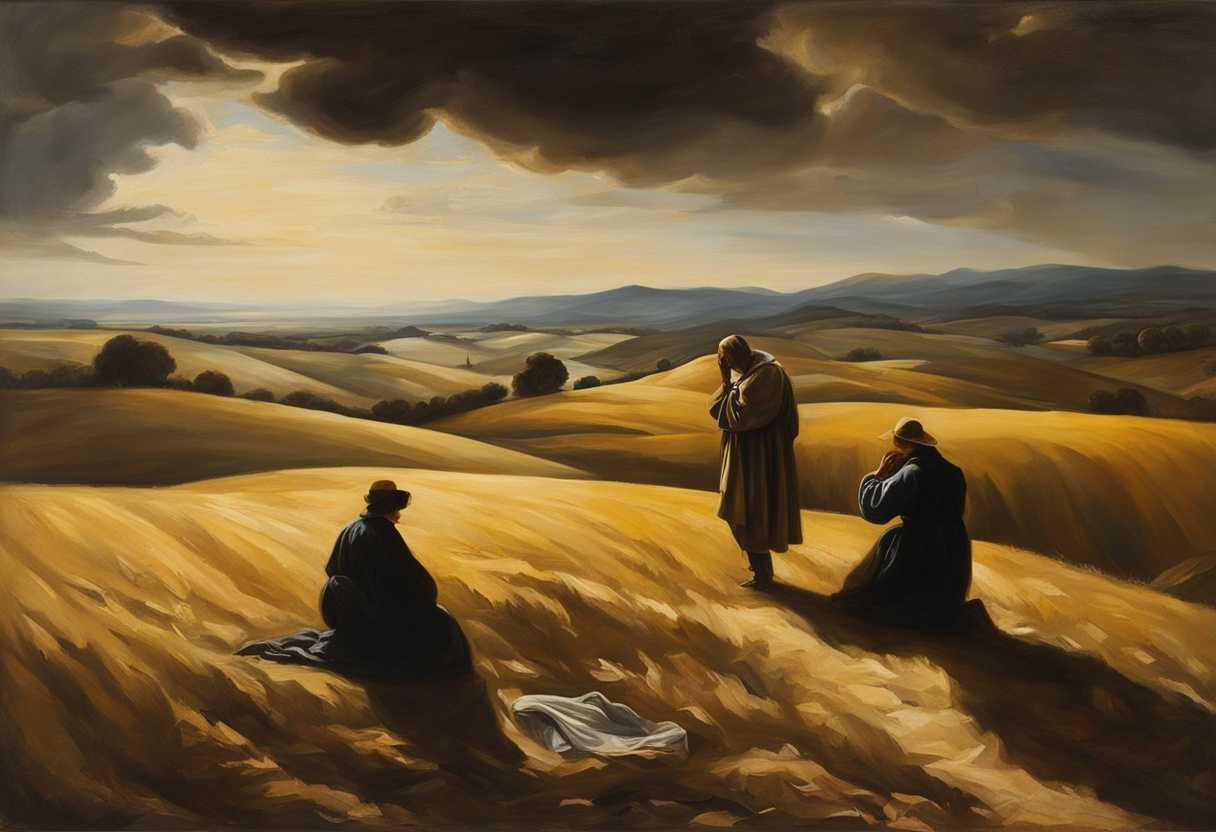
Setting the Scene for Deuteronomy 27-28
The scene unfolds on the plains of Moab, where the Israelites stand poised on the brink of entering the Promised Land. The air is thick with anticipation and a sense of solemnity as Moses, their revered leader, prepares to deliver a pivotal message from God. The sun hangs high in the sky, casting a warm glow over the gathered multitude, which includes men, women, and children, all eager to hear the words that will guide their future. The landscape is rugged yet beautiful, with the distant hills of Canaan visible on the horizon, a land flowing with milk and honey that has been promised to them. The sound of rustling robes and murmurs of excitement fills the air as the people gather around Moses, their hearts filled with hope and trepidation.
Moses stands before the assembly, flanked by the Levites, who are tasked with the sacred duty of proclaiming the blessings and curses that will define the covenant between God and His people. The Levites, dressed in their priestly garments, are ready to echo Moses’ words, ensuring that every Israelite hears the gravity of the commitments they are about to undertake. As Moses recalls the laws given to them, he emphasizes the importance of obedience to God’s commandments, as outlined in the chapters of Deuteronomy 27-28. He speaks of the blessings that will flow from faithfulness—prosperity, health, and protection—as well as the dire consequences of disobedience, which include curses that will lead to ruin and exile. The people listen intently, their faces reflecting a mix of determination and fear, understanding that their choices will shape not only their lives but the legacy of their descendants.
The setting is both majestic and humbling, with the vast expanse of the wilderness surrounding them, a reminder of their long journey from slavery in Egypt to this moment of potential. The rocky terrain beneath their feet symbolizes the trials they have endured, while the promise of Canaan looms ahead, a beacon of hope. As Moses speaks, the wind carries his voice, and the Israelites feel the weight of their history and the responsibility of their future. They are not just a wandering tribe; they are a nation on the cusp of destiny, called to be a light to the nations. The scene is charged with emotion, as the people grapple with the significance of their covenant with God, knowing that their choices will echo through generations to come.
What is Deuteronomy 27-28 about?
The verses in Deuteronomy 27-28 present a profound dichotomy between blessings and curses, serving as a critical reminder of the principles of cause and effect in our lives. The Holy Scriptures often emphasize the relationship between our actions and their consequences as we delve into these passages. The blessings described for those who adhere to God’s commandments highlight not only material and social prosperity but also an inner sense of peace and fulfillment. They reflect a life aligned with divine principles, suggesting that obedience to these commandments leads to a harmonious existence with God, oneself, and the surrounding community. How might one apply this model of obedience in their daily decision-making process?
Conversely, the curses associated with disobedience serve as a stark warning about the repercussions of turning away from God’s will. Would you agree that understanding the potential negative outcomes of our actions can often serve as a deterrent against poor choices? These verses illustrate a more profound spiritual truth: that straying from a righteous path does not merely result in immediate hardships but can also create lasting disconnect with the divine. The consequences of disobedience are not just punitive in this way; they are inherently educational, designed to guide us back to a path of righteousness. Could we consider how our choices reflect our commitment to these commandments as we reflect on our own lives? These powerful teachings ultimately urge us to be mindful of our behavior and its alignment with greater spiritual principles, inviting us to cultivate a life filled with blessings through our obedience.
Understanding what Deuteronomy 27-28 really means
Deuteronomy 27-28 presents a profound exploration of the blessings and curses tied to the Israelites’ obedience and disobedience to God’s commandments. These chapters mark a critical juncture in the journey of the Israelites as they stand on the threshold of the Promised Land. Moses, their leader, is not merely delivering laws; he is emphasizing the covenant relationship between God and His people. This moment is about choices and their consequences, a theme that resonates deeply throughout the biblical narrative.
Historically, the Israelites are poised to enter a new chapter in their existence. The significance of Mount Gerizim and Mount Ebal cannot be overstated. These mountains serve as physical representations of the choices before them: one leading to blessings for obedience and the other to curses for disobedience. This geographical symbolism reinforces the idea that their relationship with God is not abstract; it is tangible and requires active participation.
A key theme in these chapters is the conditional nature of the covenant. The blessings promised for obedience are abundant, while the curses for disobedience are severe. This duality highlights the accountability that comes with being part of God’s chosen people. The public declaration of these blessings and curses serves as a communal reminder that the Israelites are collectively responsible for upholding God’s standards. How often do we consider the impact of our actions on our community? This passage challenges us to reflect on our role within the larger body of believers.
The principles found in Deuteronomy echo throughout the New Testament. For instance, Galatians 6:7 reminds us that “a man reaps what he sows.” This reinforces the idea that our actions have consequences, a truth that transcends time and culture. Similarly, James 1:22 urges us to not merely listen to God’s word but to act upon it. This call to action is vital; it emphasizes that understanding God’s commands is not enough—we must live them out.
In today’s world, the relevance of these principles is undeniable. We are constantly faced with choices that can lead to blessings or consequences. Consider the example of a young professional who opts to cut corners for immediate success. Initially, this may seem advantageous, but the long-term effects—loss of trust and integrity—illustrate the reality of disobedience to ethical standards. How do our daily choices reflect our commitment to God’s commands?
The phrases within these chapters carry significant weight. “Blessed shall you be in the city, and blessed shall you be in the field” signifies that God’s blessings are comprehensive, touching every aspect of life. Conversely, “Cursed shall you be in the city, and cursed shall you be in the field” serves as a stark reminder of the far-reaching consequences of disobedience. Our choices do not exist in isolation; they affect not only ourselves but also those around us. How can we be more mindful of the impact our decisions have on our community?
In conclusion, the messages in Deuteronomy 27-28 are timeless and call us to reflect on our choices and their consequences. As we navigate our lives, let us strive to align our actions with God’s commands, seeking His blessings while avoiding the pitfalls of disobedience. The covenant relationship we have with God invites us to live in a way that honors Him, leading to a life filled with His blessings. How will you respond to the call of obedience in your own life?
How do my choices impact my spiritual life?
Your choices play a critical role in shaping your spiritual life as they directly influence the relationship you have with a higher power and the fulfillment of your spiritual journey. Engaging in positive actions and adhering to moral and ethical principles can lead to blessings, fostering a deeper connection and sense of purpose. Conversely, actions that stray from these principles can result in challenges and a sense of disconnection. This highlights the concept of accountability in spiritual growth, emphasizing that the path you choose directly affects your overall well-being and spiritual fulfillment. Your values and beliefs are reflected in each decision you make, impacting not only your own life but also the lives of those around you. Choices grounded in compassion, integrity, and respect can create a ripple effect, encouraging a supportive community that uplifts everyone involved. This interconnectedness points to the importance of mindful decision-making, urging you to consider how your actions align with your spiritual aspirations and the greater good. Every choice in this sense offers an opportunity for growth and alignment with your spiritual objectives.
Finally, your choices can lead to a deeper understanding of the consequences of actions—both positive and negative. You gain insights that can guide future choices and enhance your spiritual awareness by experiencing the outcomes of your decisions. This cycle of choice and consequence fosters resilience and wisdom, inviting you to engage more profoundly with your beliefs and values. Reflecting on how each choice contributes to your overall growth and connection to the divine is essential as you navigate your spiritual journey.
Application
Life is like a road with many signs—every choice you make is like a turn that leads you toward blessings or challenges. Think of your actions like building a foundation for your family and your work; strong choices create stability and growth. Today, take a moment to commit to what truly matters—align your actions with what you believe is right. Each step forward can draw you closer to the abundance you’re seeking. Are you ready to take charge of your journey and choose the path that leads to a richer life?

Reverend Michael Johnson is an experienced Church Minister with a profound expertise in spirituality and guidance. With a serene presence and a compassionate heart, he has faithfully served his congregation for over 20 years, leading them on a spiritual journey towards inner peace and enlightenment. Reverend Johnson’s extensive knowledge of religious philosophies and profound understanding of human nature have made him a trusted confidant and mentor to many, as he seamlessly weaves his profound wisdom into life teachings. Reverend Johnson’s calming demeanor and empathetic nature continue to uplift and heal souls, nurturing a sense of unity and tranquility within his community.