
Esther 6:1-14 is about divine intervention and timing, showing how God orchestrates events to bring about justice and deliverance for His people.
1 On that night the king could not sleep. And he gave orders to bring the book of memorable deeds, the chronicles, and they were read before the king.
2 And it was found written how Mordecai had told about Bigthana and Teresh, two of the king’s eunuchs, who guarded the threshold, and who had sought to lay hands on King Ahasuerus.
3 And the king said, “What honor or distinction has been bestowed on Mordecai for this?” The king’s young men who attended him said, “Nothing has been done for him.”
4 And the king said, “Who is in the court?” Now Haman had just entered the outer court of the king’s palace to speak to the king about having Mordecai hanged on the gallows that he had prepared for him.
5 And the king’s young men told him, “Haman is there, standing in the court.” And the king said, “Let him come in.”
6 So Haman came in, and the king said to him, “What should be done to the man whom the king delights to honor?” And Haman said to himself, “Whom would the king delight to honor more than me?”
7 And Haman said to the king, “For the man whom the king delights to honor,
8 let royal robes be brought, which the king has worn, and the horse that the king has ridden, and on whose head a royal crown is set.
9 And let the robes and the horse be handed over to one of the king’s most noble officials. And let them dress the man whom the king delights to honor, and lead him on the horse through the square of the city, proclaiming before him: ‘Thus shall it be done to the man whom the king delights to honor.’”
10 Then the king said to Haman, “Hurry; take the robes and the horse, as you have said, and do so to Mordecai the Jew, who sits at the king’s gate. Leave out nothing that you have mentioned.”
11 Then Haman took the robes and the horse, and he dressed Mordecai and led him through the square of the city, proclaiming before him, “Thus shall it be done to the man whom the king delights to honor.”
12 Then Mordecai returned to the king’s gate. But Haman hurried to his house, mourning and with his head covered.
13 And Haman told his wife Zeresh and all his friends everything that had happened to him. Then his wise men and his wife Zeresh said to him, “If Mordecai, before whom you have begun to fall, is of the Jewish people, you will not overcome him but will surely fall before him.”
14 While they were yet talking with him, the king’s eunuchs arrived and hurried to bring Haman to the feast that Esther had prepared.
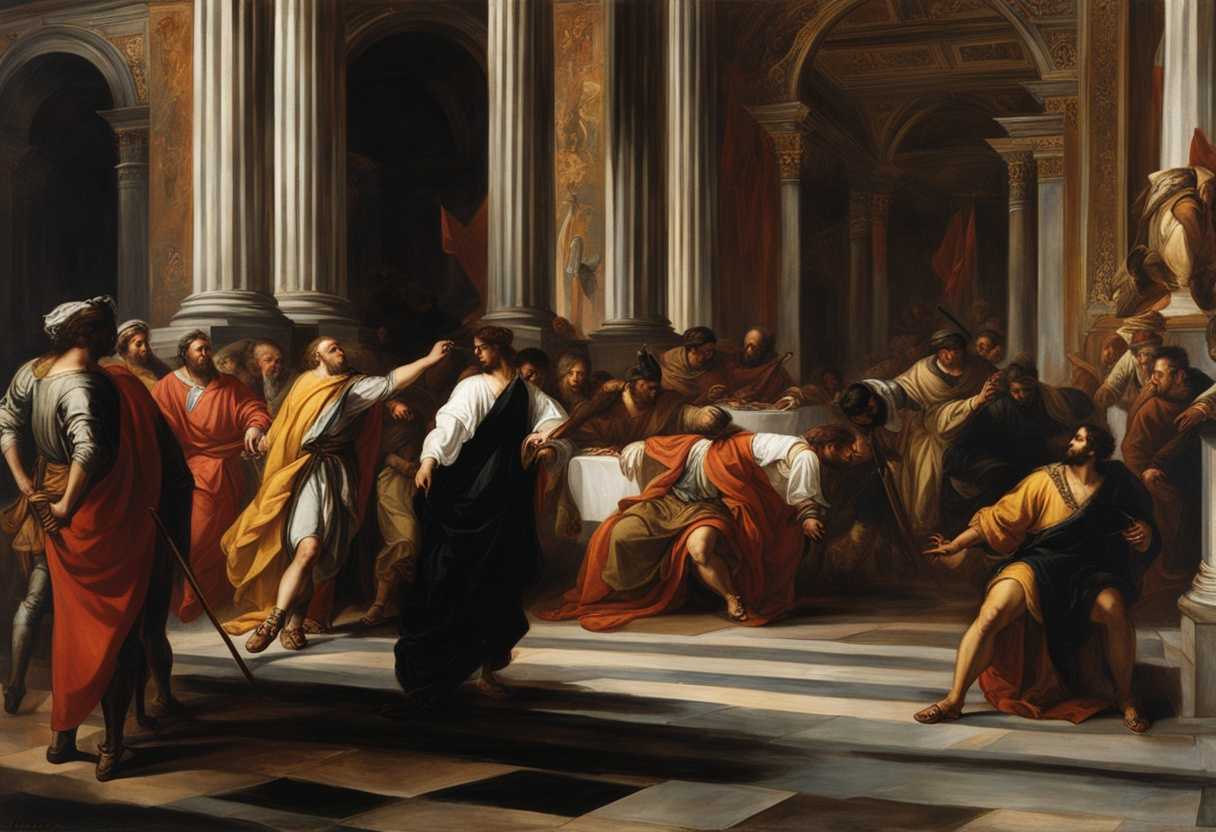
Setting the Scene for Esther 6:1-14
The scene in Esther chapter 6 takes place in the royal palace of King Xerxes in the ancient city of Susa. The king is unable to sleep one night and orders for the chronicles of his reign to be read to him. As the scribes read, they come across the account of Mordecai, a Jewish man who had uncovered a plot to assassinate the king.
In the scene, we see King Xerxes pondering over how to honor Mordecai for his loyalty and service to the kingdom. Just at that moment, Haman, the king’s chief advisor who harbors a deep hatred for Mordecai, enters the palace to request permission to have Mordecai hanged on the gallows he had prepared. Unaware of the king’s intention to honor Mordecai, Haman is instructed by the king to honor Mordecai instead, leading to a turn of events that ultimately saves the Jewish people from destruction.
The tension in the room is palpable as King Xerxes and Haman navigate the delicate situation, with the fate of Mordecai and the Jewish people hanging in the balance. The opulence of the royal palace contrasts with the moral dilemma faced by the characters, creating a dramatic backdrop for the unfolding events that will shape the course of history for the Jewish people.
What is Esther 6:1-14 about?
This verse reflects the belief in divine justice and intervention. It suggests that God plays an active role in the world, ensuring that the actions of individuals are not without consequences. For those who strive to lead righteous lives, there is the promise of recognition and reward from a higher power. On the other hand, those who choose to act wickedly will face repercussions for their behavior.
Have you ever wondered if there is a greater force at play in the events of our lives? This verse reminds us that even when things seem out of our control, there may be a larger plan unfolding. It encourages us to maintain faith and integrity in our actions, knowing that there is a divine measure of justice that will ultimately prevail. God offers a sense of order and balance in a sometimes chaotic world by honoring the righteous and punishing the wicked.
Understanding what Esther 6:1-14 really means
In Esther 6:1-14, we witness a remarkable turn of events orchestrated by divine intervention. The passage opens with King Ahasuerus, unable to sleep, a seemingly mundane occurrence that sets the stage for a chain of events that will alter the course of history. This simple detail reminds us that God works in mysterious ways, even in the seemingly ordinary aspects of our lives, to fulfill His greater purposes.
As the chronicles are read before the king, the pivotal moment arrives when Mordecai’s past act of loyalty and bravery is brought to light. The question posed by the king about honoring Mordecai underscores the theme of justice and the importance of acknowledging and rewarding righteousness. This moment serves as a powerful reminder that no good deed goes unnoticed by God, and He is the ultimate arbiter of justice.
The passage resonates with timeless truths found in other biblical passages. Proverbs 21:1 emphasizes God’s sovereignty over rulers, highlighting His ability to influence their decisions for His purposes. Romans 8:28 reassures us that God works all things for the good of those who love Him, showcasing His providential care even in the midst of challenging circumstances. Psalm 121:4 reinforces the idea that God is ever-watchful and actively involved in the lives of His people, never slumbering or sleeping.
In a world where recognition and justice can often feel delayed or overlooked, the story of Mordecai and King Ahasuerus offers hope and encouragement. It reminds us that God sees and remembers every act of righteousness, urging us to continue doing good even when it seems unnoticed. This narrative prompts us to trust in God’s timing, knowing that He will ultimately bring about justice and reward in His perfect way.
Consider a modern-day parallel to this biblical account: a diligent employee whose hard work goes unrecognized for years. When the CEO, unable to sleep one night, reviews the employee’s contributions, a long-overdue promotion and raise follow. This anecdote mirrors Mordecai’s story, illustrating that diligence and righteousness will eventually be acknowledged and rewarded, often in unexpected and timely ways.
In conclusion, Esther 6:1-14 teaches us profound lessons about divine providence, the significance of honoring good deeds, and the assurance that God is actively working behind the scenes in our lives. It encourages us to trust in God’s timing, to persist in righteousness, and to have faith that He will bring about justice and reward at the appointed time.
What is the role of divine timing in life?
Divine timing plays a crucial role in the events that unfold in our lives. This can be seen in the story of Esther, where the perfect timing of events orchestrated by God led to the saving of the Jewish people. The timing of Xerxes unable to sleep, the reading of the chronicles, and Haman’s arrival at the king’s court all coincided to set the stage for Esther’s pivotal moment. We may not always see divine timing in the moment in our own lives, but looking back, we can often see how things fell into place at just the right time. Trusting in the timing of higher powers can provide us with comfort and reassurance, knowing that everything is unfolding as it should be. It reminds us to have faith and patience as we navigate through life’s uncertainties, knowing that there is a greater plan at work beyond our understanding. Divine timing ultimately reminds us that there is a purpose and a plan for each of us, and things will happen when they are meant to happen. Just like Esther’s story, where everything aligned at the perfect moment, we too can trust that the events in our lives are unfolding according to a greater design, and have faith that everything will fall into place at the right time.
Application
Embrace the divine orchestration of your life like a master composer crafting a symphony. Trust in the perfect timing, just like a well-oiled machine running smoothly. Will you stay faithful and resilient even in times of uncertainty, aware that every piece is falling into place?

Reverend Michael Johnson is an experienced Church Minister with a profound expertise in spirituality and guidance. With a serene presence and a compassionate heart, he has faithfully served his congregation for over 20 years, leading them on a spiritual journey towards inner peace and enlightenment. Reverend Johnson’s extensive knowledge of religious philosophies and profound understanding of human nature have made him a trusted confidant and mentor to many, as he seamlessly weaves his profound wisdom into life teachings. Reverend Johnson’s calming demeanor and empathetic nature continue to uplift and heal souls, nurturing a sense of unity and tranquility within his community.