
Esther 8:7-8 is about the reversal of a decree that threatened the Jewish people with destruction, showcasing how God’s providence can bring about redemption and salvation in times of peril.
7 Then King Ahasuerus said to Queen Esther and to Mordecai the Jew, “Behold, I have given Esther the house of Haman, and they have hanged him on the gallows, because he intended to lay hands on the Jews.
8 But you may write as you please with regard to the Jews, in the name of the king, and seal it with the king’s ring, for an edict written in the name of the king and sealed with the king’s ring cannot be revoked.”
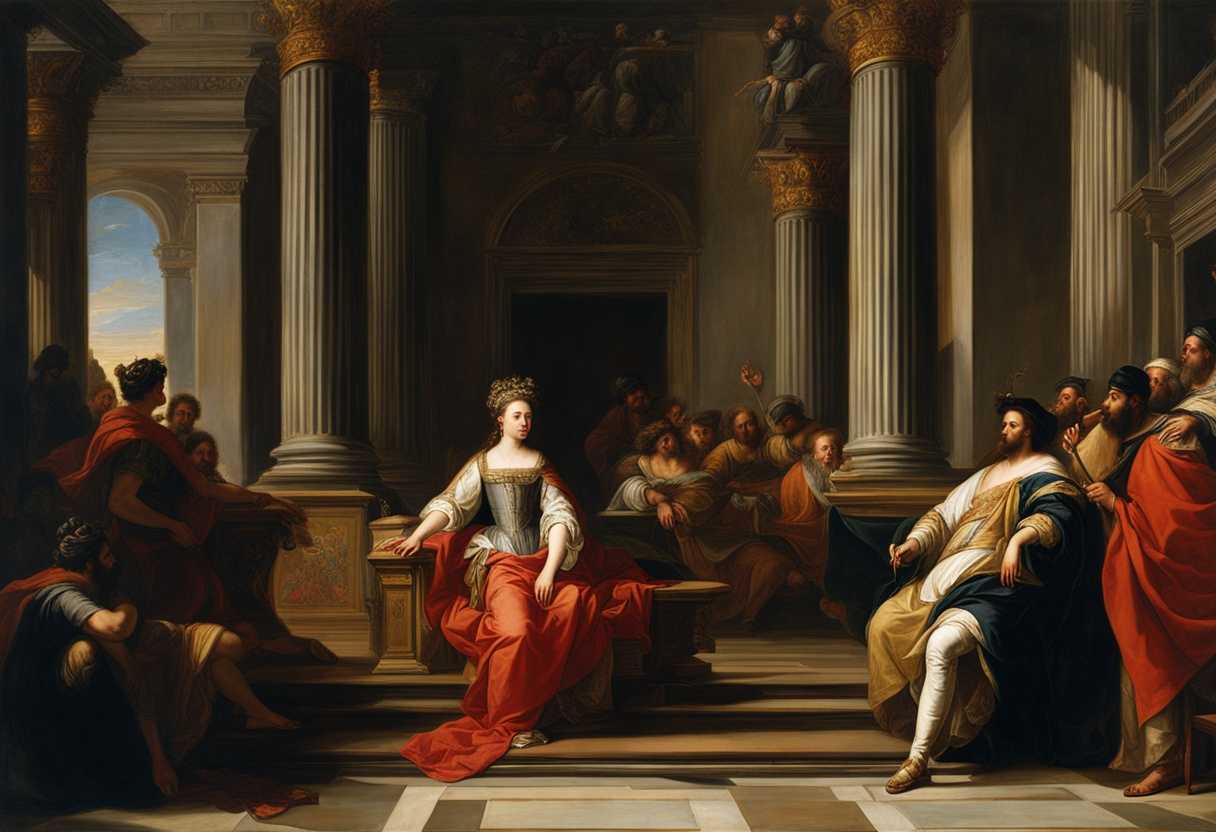
Setting the Scene for Esther 8:7-8
The scene in Esther chapter 8 unfolds in the royal palace of Susa, the capital of the Persian Empire. Esther, the Jewish queen, stands before King Xerxes, also known as King Ahasuerus, along with her cousin Mordecai. The atmosphere is tense yet hopeful as Esther pleads with the king to revoke the decree issued by Haman, the villain who sought to annihilate the Jewish people.
Esther’s heart is heavy with the weight of her people’s impending doom, and she knows that she must use her position of influence to intercede on their behalf. Mordecai, who raised Esther as his own daughter, stands by her side, offering support and wisdom. The room is adorned with opulent decorations, reflecting the grandeur of the Persian court, but Esther’s focus is solely on the king and the fate of her people.
As Esther presents her petition to the king, her courage and faith shine through, and King Xerxes listens intently to her words. The fate of the Jewish people hangs in the balance, and Esther’s plea for mercy and justice reverberates throughout the palace, setting the stage for a dramatic turn of events that will ultimately lead to the salvation of her people.
What is Esther 8:7-8 about?
King Ahasuerus grants the Jews the right to defend themselves against their enemies in this verse. This act is particularly significant because it reverses a previous decree that authorized the annihilation of the Jewish people. King Ahasuerus shows compassion and acknowledges the Jews’ right to self-preservation and protection by allowing them to defend themselves. This decision empowers the Jews to stand up against injustice and persecution, demonstrating the importance of standing firm in the face of adversity.
Can you imagine the relief and gratitude the Jewish people must have felt upon hearing this news? This verse highlights the power of empathy and justice in reversing unjust decrees and promoting equality and human rights. It serves as a reminder that even in the darkest times, there is always hope for redemption and justice. King Ahasuerus’ decision to allow the Jews to defend themselves ultimately serves as a powerful example of how leadership and empathy can lead to positive change and the protection of marginalized communities.
Understanding what Esther 8:7-8 really means
The Book of Esther unfolds in the intriguing backdrop of King Xerxes’ reign in Persia, where Esther, a Jewish woman, rises to become queen and faces the daunting task of saving her people from annihilation. In the verses at hand, we witness King Xerxes’ response to Esther and Mordecai following the exposure of Haman’s sinister plot. Despite Haman’s demise, the decree threatening the Jewish community still looms ominously.
“I have given Esther the house of Haman,” a pivotal phrase symbolizing the transfer of wealth from the wicked to the righteous, marking a profound shift in fortunes and the ultimate triumph of good over evil. The king’s decree empowers Esther and Mordecai to draft a new edict, granting them the authority to act decisively in defense of their people. When the king’s ring seals the decree, its irrevocable nature underscores the gravity of their actions and the weight of their responsibility.
Drawing parallels from other biblical passages, such as Genesis 50:20 and Romans 8:28, we see a recurring theme of God’s ability to turn malevolent intentions into avenues for salvation and to work all things for the good of those who trust in Him. This narrative resonates with contemporary audiences, reminding us of the empowerment and responsibility that come with positions of influence, urging us to wield our power judiciously for the betterment of others.
Consider a modern-day scenario where a community leader uncovers a harmful policy affecting their neighborhood. Initially overwhelmed, akin to Esther and Mordecai, they embark on a journey of advocacy and action, leveraging their influence to reverse the detrimental effects and catalyze positive change. This narrative mirrors the transformative potential inherent in individuals who choose to confront injustice and champion righteousness.
In conclusion, reflect on the spheres of influence in your own life. How can you, like Esther and Mordecai, utilize your authority for the betterment of those around you? Trust in the belief that you are part of a larger narrative, where your actions, no matter how small, can contribute to a greater good. Embrace the call to action, knowing that even in the face of adversity, your choices can shape a brighter tomorrow.
How can we use our position to help others?
We can use our position and influence to stand up for those who are marginalized or oppressed, in light of the message conveyed in Esther 8:7-8. We too can leverage our resources, opportunities, and connections to advocate for justice and assist those in need, just as Esther used her position as queen to save her people from destruction. We can make a positive impact in the world by being aware of the power we hold and using it to help others.
Additionally, we can use our position to speak out against injustice and promote equality. Whether it’s through raising awareness, supporting causes that uplift marginalized communities, or using our voices to address systemic issues, we have the ability to make a difference in the lives of others. Through our actions and advocacy, we can strive to create a more just and compassionate society where everyone is treated with dignity and respect. We can fulfill the call to serve others and make a meaningful difference in the world by recognizing the responsibility that comes with our position and actively working to empower and support those in need. Our actions have the potential to bring about positive change and contribute to a more equitable and inclusive society, just as Esther’s bravery and intervention had a profound impact on her people.
Application
Be inspired by Esther’s courage to speak up for justice in difficult times. Your voice can make a difference in creating a fairer world. Are you up for the challenge of being a beacon of hope for those in need?

Reverend Michael Johnson is an experienced Church Minister with a profound expertise in spirituality and guidance. With a serene presence and a compassionate heart, he has faithfully served his congregation for over 20 years, leading them on a spiritual journey towards inner peace and enlightenment. Reverend Johnson’s extensive knowledge of religious philosophies and profound understanding of human nature have made him a trusted confidant and mentor to many, as he seamlessly weaves his profound wisdom into life teachings. Reverend Johnson’s calming demeanor and empathetic nature continue to uplift and heal souls, nurturing a sense of unity and tranquility within his community.