
Exodus 16-17 is about God’s provision and faithfulness to the Israelites in the wilderness, highlighting the importance of trusting in God’s guidance and provision even in times of difficulty.
1 They set out from Elim, and all the congregation of the people of Israel came to the wilderness of Sin, which is between Elim and Sinai, on the fifteenth day of the second month after they had departed from the land of Egypt.
2 And the whole congregation of the people of Israel grumbled against Moses and Aaron in the wilderness,
3 and the people of Israel said to them, “Would that we had died by the hand of the Lord in the land of Egypt, when we sat by the meat pots and ate bread to the full, for you have brought us out into this wilderness to kill this whole assembly with hunger.”
4 Then the Lord said to Moses, “Behold, I am about to rain bread from heaven for you, and the people shall go out and gather a day’s portion every day, that I may test them, whether they will walk in my law or not.
5 On the sixth day they shall prepare what they bring in, and it will be twice as much as they gather daily.”
6 So Moses and Aaron said to all the people of Israel, “At evening you shall know that it was the Lord who brought you out of the land of Egypt,
7 and in the morning you shall see the glory of the Lord, because he has heard your grumbling against the Lord. For what are we, that you grumble against us?”
8 And Moses said, “When the Lord gives you in the evening meat to eat and in the morning bread to the full, because the Lord has heard your grumbling that you grumble against him—what are we? Your grumbling is not against us but against the Lord.”
9 Then Moses said to Aaron, “Say to the whole congregation of the people of Israel, ‘Come near before the Lord, for he has heard your grumbling.’”
10 And as soon as Aaron spoke to the whole congregation of the people of Israel, they looked toward the wilderness, and behold, the glory of the Lord appeared in the cloud.
11 The Lord spoke to Moses, saying,
12 “I have heard the grumbling of the people of Israel. Say to them, ‘At twilight you shall eat meat, and in the morning you shall be filled with bread. Then you shall know that I am the Lord your God.’”
13 In the evening quail came up and covered the camp, and in the morning dew lay around the camp.
14 And when the dew had gone up, there was on the face of the wilderness a fine, flake-like thing, fine as frost on the ground.
15 When the people of Israel saw it, they said to one another, “What is it?” for they did not know what it was. And Moses said to them, “It is the bread that the Lord has given you to eat.
16 This is what the Lord has commanded: ‘Gather of it, each one of you, as much as he can eat. You shall each take an omer, according to the number of the persons that each of you has in his tent.’”
17 The people of Israel did so. They gathered, some more, some less.
18 But when they measured it with an omer, whoever gathered much had nothing left over, and whoever gathered little had no lack. Each of them gathered as much as he could eat.
19 And Moses said to them, “Let no one leave any of it over till the morning.”
20 But they did not listen to Moses. Some left part of it till the morning, and it bred worms and stank. And Moses was angry with them.
21 Morning by morning they gathered it, each as much as he could eat; but when the sun grew hot, it melted.
22 On the sixth day they gathered twice as much bread, two omers each. And when all the leaders of the congregation came and told Moses.
23 he said to them, “This is what the Lord has commanded: ‘Tomorrow is a day of solemn rest, a holy Sabbath to the Lord; bake what you will bake and boil what you will boil, and all that is left over lay aside to be kept till the morning.’”
24 So they laid it aside till the morning, as Moses commanded them, and it did not stink, and there were no worms in it.
25 And Moses said, “Eat it today, for today is a Sabbath to the Lord; today you will not find it in the field.
26 Six days you shall gather it, but on the seventh day, which is a Sabbath, there will be none.
27 On the seventh day some of the people went out to gather, but they found none.
28 And the Lord said to Moses, “How long will you refuse to keep my commandments and my laws?
29 See! The Lord has given you the Sabbath; therefore on the sixth day he gives you bread for two days. Remain each of you in his place; let no one go out of his place on the seventh day.”
30 So the people rested on the seventh day.
31 Now the house of Israel called its name manna. It was like coriander seed, white, and the taste of it was like wafers made with honey.
32 Moses said, “This is what the Lord has commanded: ‘Let an omer of it be kept throughout your generations, so that they may see the bread with which I fed you in the wilderness, when I brought you out of the land of Egypt.’”
33 And Moses said to Aaron, “Take a jar, and put an omer of manna in it, and place it before the Lord to be kept throughout your generations.”
34 As the Lord commanded Moses, so Aaron placed it before the testimony to be kept.
35 The people of Israel ate the manna forty years, till they came to a habitable land. They ate the manna till they came to the border of the land of Canaan.
36 (Now an omer is the tenth part of an ephah.)
1 All the congregation of the people of Israel moved on from the wilderness of Sin by stages, according to the commandment of the Lord, and camped at Rephidim, but there was no water for the people to drink.
2 Therefore the people quarreled with Moses and said, “Give us water to drink.” And Moses said to them, “Why do you quarrel with me? Why do you test the Lord?”
3 But the people thirsted there for water, and the people grumbled against Moses and said, “Why did you bring us up out of Egypt, to kill us and our children and our livestock with thirst?”
4 So Moses cried to the Lord, “What shall I do with this people? They are almost ready to stone me.”
5 And the Lord said to Moses, “Pass on before the people, taking with you some of the elders of Israel, and take in your hand the staff with which you struck the Nile, and go.
6 Behold, I will stand before you there on the rock at Horeb, and you shall strike the rock, and water shall come out of it, and the people will drink.” And Moses did so, in the sight of the elders of Israel.
7 And he called the name of the place Massah and Meribah, because of the quarreling of the people of Israel, and because they tested the Lord by saying, “Is the Lord among us or not?”
8 Then Amalek came and fought with Israel at Rephidim.
9 So Moses said to Joshua, “Choose for us men, and go out and fight with Amalek. Tomorrow I will stand on the top of the hill with the staff of God in my hand.”
10 So Joshua did as Moses told him, and fought with Amalek, while Moses, Aaron, and Hur went up to the top of the hill.
11 Whenever Moses held up his hand, Israel prevailed, and whenever he lowered his hand, Amalek prevailed.
12 But Moses’ hands grew weary, so they took a stone and put it under him, and he sat on it, while Aaron and Hur held up his hands, one on one side, and the other on the other side. So his hands were steady until the going down of the sun.
13 And Joshua overwhelmed Amalek and his people with the sword.
14 Then the Lord said to Moses, “Write this as a memorial in a book and recite it in the ears of Joshua, that I will utterly blot out the memory of Amalek from under heaven.”
15 And Moses built an altar and called the name of it, The Lord Is My Banner,
16 saying, “A hand upon the throne of the Lord! The Lord will have war with Amalek from generation to generation.”
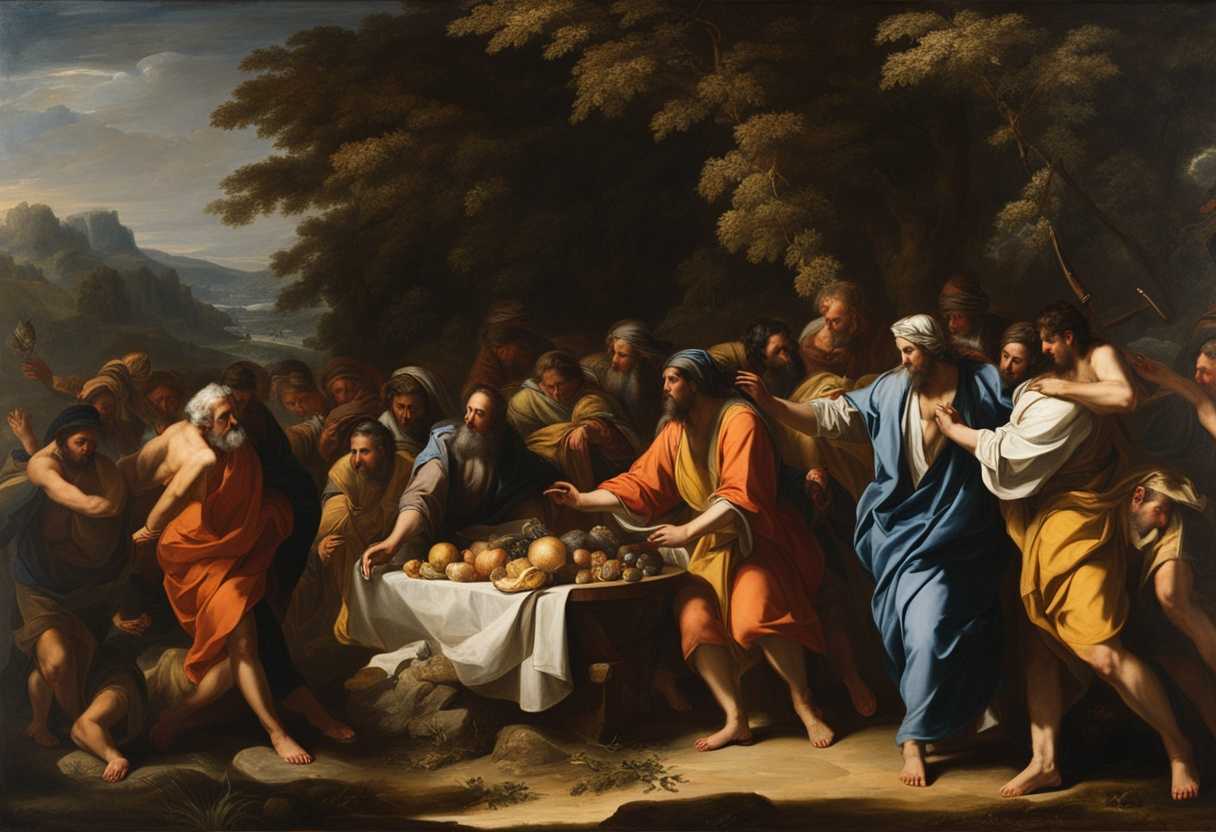
Setting the Scene for Exodus 16-17
The scene in Exodus 16-17 takes place in the wilderness after the Israelites have been freed from slavery in Egypt. The Israelites, led by Moses and Aaron, have been traveling through the desert for some time now, and they are beginning to face challenges such as hunger and thirst. As they journey through the barren landscape, the people start to grumble and complain to Moses about their lack of food and water.
Moses, in turn, prays to God for help, and in response, God provides manna from heaven for the Israelites to eat. The manna appears as a dew-like substance on the ground each morning, providing sustenance for the people. Despite this miraculous provision, the Israelites continue to grumble and doubt God’s care for them.
In Exodus 17, the Israelites face another challenge when they run out of water. Once again, they complain to Moses, who strikes a rock with his staff, and water miraculously gushes forth for the people to drink. These scenes in Exodus 16-17 highlight the Israelites’ journey of faith and dependence on God’s provision as they navigate the challenges of the wilderness.
What is Exodus 16-17 about?
This verse showcases a powerful example of God’s provision and faithfulness towards His people. God ensures the Israelites in the wilderness have food to eat by providing manna and quail. This act of divine provision demonstrates God’s care and concern for His people even in the most desperate of circumstances. It reinforces the idea that God is a provider who meets our needs, often in unexpected ways.
Reflecting on this verse, consider the message it conveys about trust and reliance on God. How often do we doubt God’s ability to provide for us in our own metaphorical “wilderness”? Do we truly believe that God is able to sustain us and meet our needs, just like He did for the Israelites with manna and quail? This verse challenges us to trust in God’s provision and have faith that He will take care of us, no matter how impossible our situation may seem. Let’s hold onto the reassurance that just as God provided for the Israelites in the wilderness, He will also provide for us in our times of need.
Understanding what Exodus 16-17 really means
The narrative in Exodus 16-17 unfolds as the Israelites traverse the wilderness post their deliverance from Egypt. Amidst their journey, they encounter both physical and spiritual trials, grappling with hunger and thirst. However, in these moments of desperation, God manifests His divine care by providing for their sustenance through extraordinary means, such as the bestowal of manna from heaven and water gushing forth from a rock.
The phrase “manna from heaven” encapsulates the essence of God’s unwavering provision and concern for His people. It serves as a poignant lesson on the importance of relying on God for our daily sustenance, highlighting the necessity of acknowledging our dependence on Him for all our needs. Similarly, the imagery of “water from the rock” symbolizes God’s capacity to furnish life-sustaining resources even in the most improbable circumstances, foreshadowing Christ as the ultimate source of living water, as referenced in John 4:14.
Drawing parallels to other biblical passages enriches our understanding of the significance of these events. In John 6:31-35, Jesus identifies Himself as the “bread of life,” mirroring the provision of manna in the wilderness. Paul, in 1 Corinthians 10:3-4, equates the spiritual nourishment bestowed upon the Israelites to Christ, represented by the rock from which water flowed. Philippians 4:19 further reinforces the theme of divine provision, assuring believers that God will meet all their needs through the abundance of His glory in Christ Jesus.
The timeless relevance of this narrative resonates with contemporary audiences on various levels. It underscores the importance of cultivating a deep-seated reliance on God, akin to the Israelites’ dependence on Him for sustenance. Moreover, the wilderness experience serves as a poignant reminder to maintain faith and trust in God, even amidst the most challenging circumstances. Additionally, the communal aspect of gathering manna emphasizes the significance of unity and sharing resources within a community, fostering a spirit of generosity and mutual support.
Consider a modern-day scenario where a family grapples with financial hardships, unsure of how they will meet their basic needs. Through the unexpected blessings and support from their church community, they witness their needs being met, akin to experiencing contemporary “manna.” This anecdote serves as a tangible illustration of God’s provision through diverse channels, encouraging individuals to place their trust in His unwavering care and sustenance.
In conclusion, the narrative of manna and water in Exodus 16-17 serves as a poignant testament to God’s faithfulness and provision throughout history. It beckons us to place our trust in Him, particularly during times of need, and to acknowledge His continuous sustenance in our daily lives.
How can we trust God to provide for us?
God provides for the Israelites in Exodus 16-17 by giving them manna to eat and water from a rock. This shows us that God is aware of our needs and has the power to provide for us. The Israelites had to trust in God’s provision daily, as they were only given enough manna for each day. This teaches us the importance of relying on God for our daily needs and trusting that He will provide for us.
Seeing how God provided for the Israelites in the wilderness can reassure us that God will also provide for us in our own lives. We too can trust that God will take care of our needs, just as the Israelites had to trust God for their food and water. We can have faith that God, who is the same yesterday, today, and forever, will not abandon us and will meet us in our times of need. This passage reminds us that we can trust in God’s faithfulness and provision for us.
Application
Believer, in our modern desert of uncertainty and challenges, just like how God sustained His people in ancient times, He is willing and able to provide for us too. His abundant blessings will overflow in every aspect of our lives, just as a reliable coworker always has our back in times of need. Let us have faith and trust in His unwavering care, just as we trust a beloved family member. Will we take the leap of faith and rely on His never-ending grace and provision today?

Reverend Michael Johnson is an experienced Church Minister with a profound expertise in spirituality and guidance. With a serene presence and a compassionate heart, he has faithfully served his congregation for over 20 years, leading them on a spiritual journey towards inner peace and enlightenment. Reverend Johnson’s extensive knowledge of religious philosophies and profound understanding of human nature have made him a trusted confidant and mentor to many, as he seamlessly weaves his profound wisdom into life teachings. Reverend Johnson’s calming demeanor and empathetic nature continue to uplift and heal souls, nurturing a sense of unity and tranquility within his community.