
Exodus 17:8-15 is about the faithfulness and power of God in providing for His people’s needs, as symbolized by the water flowing from the rock when Moses struck it in response to the people’s thirst and the importance of remembering and acknowledging God’s provision for us in times of trial and difficulty.
8 Then Amalek came and fought with Israel at Rephidim.
9 So Moses said to Joshua, “Choose for us men, and go out and fight with Amalek. Tomorrow I will stand on the top of the hill with the staff of God in my hand.”
10 So Joshua did as Moses told him, and fought with Amalek, while Moses, Aaron, and Hur went up to the top of the hill.
11 Whenever Moses held up his hand, Israel prevailed, and whenever he lowered his hand, Amalek prevailed.
12 But Moses’ hands grew weary, so they took a stone and put it under him, and he sat on it, while Aaron and Hur held up his hands, one on one side, and the other on the other side. So his hands were steady until the going down of the sun.
13 And Joshua overwhelmed Amalek and his people with the sword.
14 Then the Lord said to Moses, “Write this as a memorial in a book and recite it in the ears of Joshua, that I will utterly blot out the memory of Amalek from under heaven.”
15 And Moses built an altar and called the name of it, The Lord Is My Banner,
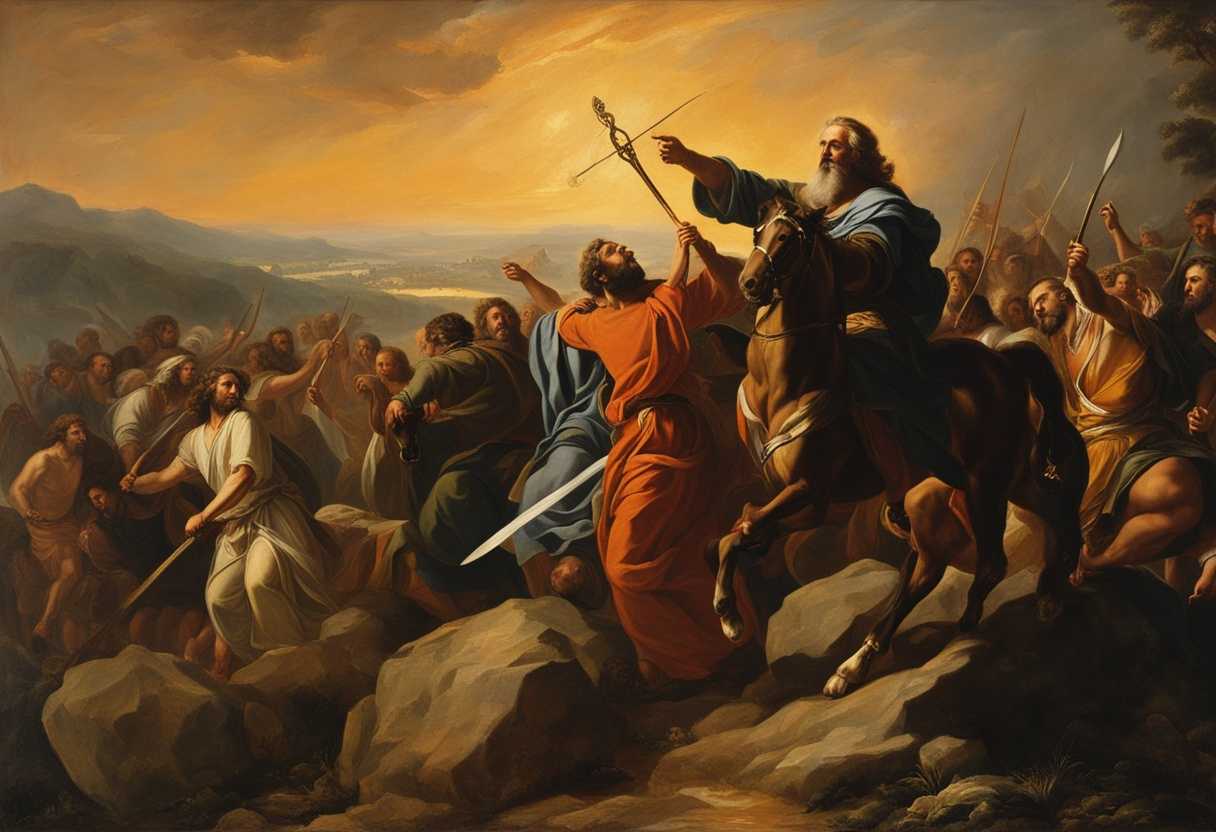
Setting the Scene for Exodus 17:8-15
The scene in Exodus 17:8-15 takes place in the wilderness as the Israelites journey from Egypt to the Promised Land. Moses, the leader chosen by God, is at the forefront, with his brother Aaron and a trusted companion named Hur by his side. The Israelites, weary from their travels, are gathered around, their tents pitched in the vast desert expanse. The scorching sun beats down on the sandy terrain, creating a harsh and unforgiving environment.
As the Israelites continue their journey, they are suddenly attacked by the Amalekites, a fierce and warlike tribe. In response, Moses instructs Joshua, a young warrior and his trusted aide, to choose men to go out and fight against the Amalekites. As the battle rages on, Moses, Aaron, and Hur climb to the top of a nearby hill. Moses raises his staff, a symbol of God’s power and authority, towards the heavens, invoking divine intervention in the conflict below.
As long as Moses holds up his hands, the Israelites prevail in battle. However, as fatigue sets in, his arms grow heavy and begin to lower. Sensing the importance of this moment, Aaron and Hur come to his aid, supporting his arms until the sun sets and the Israelites secure victory over their enemies. This pivotal scene showcases the power of unity, faith, and divine intervention in the face of adversity.
What is Exodus 17:8-15 about?
The image of Moses raising his arms during a battle carries a profound spiritual meaning in this verse. Arms lifted high, Moses demonstrates his trust in God as the source of strength and victory. It symbolizes a recognition of one’s own limitations and the need to rely on a higher power for guidance and support. Just like Moses, our battles may seem overwhelming, but when we surrender our struggles to a divine force, we acknowledge that success is not solely dependent on our own efforts, but on the grace of God.
Have you ever felt overwhelmed by the challenges in your life, unsure of how to navigate the obstacles before you? The image of Moses raising his arms serves as a powerful reminder that in times of difficulty, we can find reassurance in turning to our faith for strength and guidance. It invites us to reflect on our own dependence on God, to lift our arms metaphorically in surrender, and to trust that with faith, even the fiercest battles can be won. We can emulate Moses’ unwavering faith and find solace in the knowledge that with God by our side, we can overcome any obstacle that stands in our way.
Understanding what Exodus 17:8-15 really means
The Israelites, on their journey through the wilderness post-exodus from Egypt, encounter a new challenge as the Amalekites come to fight them at Rephidim. In this pivotal moment, Moses demonstrates his leadership by instructing Joshua to select men for battle, showcasing the significance of delegation and teamwork in facing adversities. As the conflict unfolds, a profound lesson emerges as long as Moses raises his hands, the Israelites prevail; when his hands lower, the Amalekites gain the upper hand. This dynamic illustrates the power of intercession and the necessity of unwavering faith and perseverance in prayer.
Moreover, the narrative takes a poignant turn as Aaron and Hur come alongside Moses, supporting his hands—one on each side—until sunset. This act underscores the vital role of community support and the strength derived from unity in overcoming challenges. The declaration by Moses, “The Lord is my Banner,” following their victory, serves as a poignant reminder that ultimate strength and triumph stem from God alone. This proclamation encapsulates the essence of relying on the divine source for victory in the face of adversity.
Drawing parallels from related biblical passages, such as 1 Timothy 2:8, Psalm 121:1-2, and Galatians 6:2, the themes of prayer, dependence on God, and communal support resonate across different contexts. These verses echo the importance of surrendering to God in prayer, acknowledging Him as the ultimate source of help, and fulfilling the duty of supporting one another in times of need. The timeless wisdom encapsulated in Exodus 17:8-15 transcends its historical context, offering profound insights that remain relevant and applicable to contemporary life.
In today’s world, the narrative of Moses, Joshua, Aaron, and Hur serves as a poignant reminder of the enduring principles of perseverance in prayer, the necessity of community support, and the paramount importance of relying on God for victory. Just as Moses needed his hands upheld and his community by his side, we too require unwavering faith, supportive relationships, and a reliance on God to navigate life’s challenges. The story prompts reflection on the significance of standing together in unity, lifting each other up in times of struggle, and recognizing that our ultimate triumphs are rooted in God’s grace and providence.
To illustrate the enduring relevance of this narrative, envision a contemporary scenario where a community faces a crisis, akin to the Israelites’ battle with the Amalekites. In this modern-day setting, a leader emerges to guide efforts, akin to Moses, but soon finds themselves weary and in need of support. Mirroring Aaron and Hur’s actions, others step in to provide assistance, encouragement, and practical help, ultimately leading the community to overcome the crisis through collective effort and reliance on God. This anecdote underscores the timeless lessons of Exodus 17:8-15, emphasizing the transformative power of leadership, community, perseverance, and faith in navigating life’s trials and triumphs.
In conclusion, the narrative of Moses, Joshua, Aaron, and Hur in Exodus 17:8-15 encapsulates profound truths about leadership, community, faith, and victory. It serves as a timeless reminder that, in the face of challenges, we are not alone. Through unwavering faith, communal support, and reliance on God, we can overcome obstacles and emerge victorious, echoing the enduring message of hope and resilience found in this ancient biblical account.
How can we trust in God’s victory?
We can trust in God’s victory by remembering that He is our ultimate source of strength and protection. The Israelites were able to prevail against their enemies, the Amalekites, through God’s intervention and support in the verse you mentioned. This serves as a powerful reminder that when we face challenges or battles in our own lives, we can rely on God to fight on our behalf and secure the victory for us.
Additionally, this passage teaches us the importance of obedience and faith in God’s commands. The Israelites were successful in battle when Moses kept his hands raised in prayer, symbolizing their reliance on God, and when Joshua led the troops into battle as God instructed. We can have confidence in God’s victory over any obstacles or enemies that stand in our way by aligning ourselves with His will and following His guidance.
Lastly, we can trust in God’s victory by looking to the bigger picture of His ultimate triumph over evil and injustice. We can have faith that God’s ultimate victory will bring about justice, peace, and righteousness in the world, just as the Israelites experienced a specific victory in battle. We can find assurance in the certainty of His victory by keeping our eyes fixed on the eternal perspective and trusting in God’s plan.
Application
In the battlefield of life, just as Moses raised his hands to support the Israelites, our prayers can uplift those fighting their battles. Let’s become prayer warriors, standing strong for our loved ones in their time of need. Our intercessions can spark divine intervention and bring triumph. Will you step up and join me in praying for spiritual victories today?

Reverend Michael Johnson is an experienced Church Minister with a profound expertise in spirituality and guidance. With a serene presence and a compassionate heart, he has faithfully served his congregation for over 20 years, leading them on a spiritual journey towards inner peace and enlightenment. Reverend Johnson’s extensive knowledge of religious philosophies and profound understanding of human nature have made him a trusted confidant and mentor to many, as he seamlessly weaves his profound wisdom into life teachings. Reverend Johnson’s calming demeanor and empathetic nature continue to uplift and heal souls, nurturing a sense of unity and tranquility within his community.