
Exodus 1:8-2:10 is about the oppression and salvation of the Israelites, showcasing the faithfulness of God in protecting and raising up a deliverer, Moses, to rescue His chosen people from slavery and fulfill His promises.
8 Now there arose a new king over Egypt, who did not know Joseph.
9 And he said to his people, “Behold, the people of Israel are too many and too mighty for us.
10 Come, let us deal shrewdly with them, lest they multiply, and, if war breaks out, they join our enemies and fight against us and escape from the land.”
11 Therefore they set taskmasters over them to afflict them with heavy burdens.
12 But the more they were oppressed, the more they multiplied and the more they spread abroad. And the Egyptians were in dread of the people of Israel.
13 So they ruthlessly made the people of Israel work as slaves.
14 and made their lives bitter with hard service, in mortar and brick, and in all kinds of work in the field. In all their work they ruthlessly made them work as slaves.
15 Then the king of Egypt said to the Hebrew midwives, one of whom was named Shiphrah and the other Puah,
16 “When you serve as midwife to the Hebrew women and see them on the birthstool, if it is a son, you shall kill him, but if it is a daughter, she shall live.”
17 But the midwives feared God and did not do as the king of Egypt commanded them, but let the male children live.
18 But the king of Egypt called the midwives and said to them, “Why have you done this, and let the male children live?”
19 Then the midwives said to Pharaoh, “Because the Hebrew women are not like the Egyptian women, for they are vigorous and give birth before the midwife comes to them.”
20 So God dealt well with the midwives. And the people multiplied and grew very strong.
21 And because the midwives feared God, he gave them families.
22 Then Pharaoh commanded all his people, “Every son that is born to the Hebrews you shall cast into the Nile, but you shall let every daughter live.”
1 Now a man from the house of Levi went and took as his wife a Levite woman.
2 The woman conceived and bore a son, and when she saw that he was a fine child, she hid him three months.
3 When she could hide him no longer, she took for him a basket made of bulrushes and daubed it with bitumen and pitch. She put the child in it and placed it among the reeds by the river bank.
4 And his sister stood at a distance to know what would be done to him.
5 Now the daughter of Pharaoh came down to bathe at the river, while her young women walked beside the river. She saw the basket among the reeds and sent her servant woman, and she took it.
6 When she opened it, she saw the child, and behold, the baby was crying. She took pity on him and said, “This is one of the Hebrews’ children.”
7 Then his sister said to Pharaoh’s daughter, “Shall I go and call you a nurse from the Hebrew women to nurse the child for you?”
8 Then Pharaoh’s daughter said to her, “Take this child away and nurse him for me, and I will give you your wages.” So the woman took the child and nursed him.
9 She said to Pharaoh’s daughter, “Shall I go and call you a nurse from the Hebrew women to nurse the child for you?”
10 When the child grew older, she brought him to Pharaoh’s daughter, and he became her son. She named him Moses, “Because,” she said, “I drew him out of the water.”
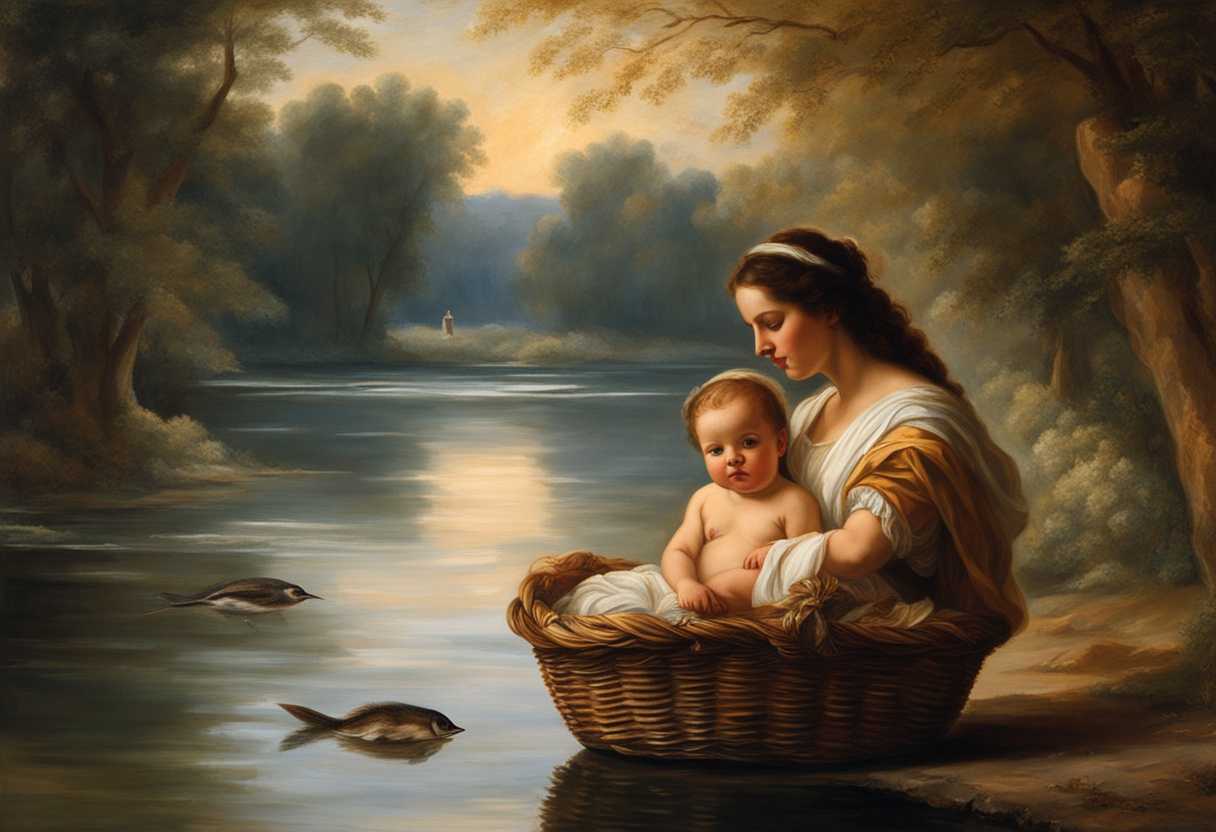
Setting the Scene for Exodus 1:8-2:10
The scene in Exodus 1:8-2:10 takes place in the land of Egypt during a time when the Israelites had multiplied greatly and were becoming a threat to the Egyptians. Pharaoh, the ruler of Egypt, became concerned about the Israelites’ population growth and issued a decree to oppress them, forcing them into hard labor and harsh conditions. Amidst this backdrop of oppression, a Hebrew woman named Jochebed gave birth to a baby boy and, in an act of desperation to save his life, she placed him in a basket and set him afloat on the Nile River.
As the story unfolds, Pharaoh’s daughter, accompanied by her attendants, goes down to the river to bathe. It is here that she discovers the baby in the basket among the reeds. Moved with compassion, she decides to adopt the child as her own, unknowingly saving him from the fate of many other Hebrew baby boys who were being killed. The baby, named Moses, grows up in the palace of Pharaoh, raised as an Egyptian prince while still retaining his Hebrew identity.
The scene is set against the backdrop of the majestic Nile River, with lush greenery and reeds lining its banks. The tension between the Israelites and the Egyptians is palpable, as the Israelites face increasing oppression and hardship. In the midst of this turmoil, the miraculous preservation of Moses’ life and his eventual adoption by Pharaoh’s daughter serve as a testament to God’s providence and his plan to deliver his people from bondage.
What is Exodus 1:8-2:10 about?
This verse captures the incredible faithfulness and intervention of God in protecting Moses, a chosen vessel for God’s divine plan. It highlights how even in the face of extreme adversity, such as Pharaoh’s decree to kill all Hebrew baby boys, God’s power and sovereignty prevail. Through this act of divine protection, we see that God’s plans cannot be thwarted by human efforts or schemes. The verse serves as a powerful reminder of God’s care and provision for His people, even in the midst of seemingly insurmountable challenges.
Reflecting on this verse, we can ask ourselves, “How does this demonstration of God’s faithfulness and protection speak to my own life and circumstances?” It prompts us to consider how God’s faithfulness is not bound by earthly limitations or obstacles, but transcends them with unwavering power and grace. This verse can serve as a source of strength and encouragement for us to trust in God’s unfailing protection and provision, even when faced with daunting circumstances. It underscores the importance of trusting in God’s sovereign plan and relying on His faithfulness, knowing that He is always working for our good, just as He did for Moses in this passage.
Understanding what Exodus 1:8-2:10 really means
The passage from Exodus 1:8-2:10 delves into a pivotal moment in the history of the Israelites, marking the rise of a new Pharaoh in Egypt who brings about oppression and suffering for God’s chosen people. This narrative serves as a precursor to the grander story of the Exodus, where God’s deliverance and faithfulness shine through. The introduction of a Pharaoh who did not know Joseph signifies a break from the past and the beginning of a dark period for the Israelites, highlighting the transient nature of human power and the enduring nature of God’s promises.
The key themes and phrases in this passage resonate with timeless truths and lessons. The harsh labor imposed on the Israelites paints a vivid picture of their suffering, while the courage of the midwives in defying Pharaoh’s orders showcases the importance of prioritizing obedience to God above earthly authority. The act of Moses’ mother in placing him in a basket coated with tar and pitch symbolizes a mother’s love and faith in God’s protection, foreshadowing the remarkable journey ahead for her son.
Related biblical passages such as Genesis 50:24-25, Hebrews 11:23, and Acts 7:17-22 provide additional context and insights into the significance of Moses’ early life and the faith exhibited by those around him. These connections bridge the Old and New Testaments, offering a comprehensive view of God’s redemptive plan throughout history. The relevance of this narrative to contemporary readers lies in its ability to inspire trust in God’s providence, offer hope in times of adversity, and encourage standing firm in faith even in the face of injustice.
Drawing parallels between the moral dilemmas faced by individuals today and the courageous actions of the midwives can prompt introspection and reflection on the importance of upholding one’s beliefs and values, even when confronted with challenges. Just as the midwives’ faithfulness led to unexpected blessings, modern-day acts of integrity and courage can pave the way for positive outcomes and demonstrate God’s faithfulness in the midst of trials. The detailed explanation of key phrases in the passage sheds light on the deeper meanings behind seemingly simple actions, emphasizing the profound impact of faith, obedience, and divine protection in shaping the course of events.
By immersing ourselves in the themes and phrases of Exodus 1:8-2:10, we uncover a rich tapestry of faith, courage, and divine intervention that transcends time and speaks to the core of our humanity. Through the lens of this ancient narrative, we are reminded of the enduring power of God’s promises, the transformative nature of obedience rooted in reverence for Him, and the assurance that even in the darkest moments, His light of deliverance and hope shines brightly for all who trust in Him.
What role do we play in fulfilling God’s plan?
Our role in fulfilling God’s plan involves being instruments through which His will is carried out. Individuals such as the Hebrew midwives and Moses’ mother, Jochebed, played crucial roles in preserving the Israelites, who were part of God’s chosen people, in this passage from Exodus. Despite the oppression and challenges they faced, these individuals showed courage, faith, and obedience to God’s plan by taking action to protect and care for the vulnerable. We can become vessels through which His purposes are achieved by aligning our actions with God’s will and trusting in His plan. We are called to be bold in following God’s guidance and standing up for what is right, just as the midwives and Jochebed defied Pharaoh’s orders and risked their own safety for the sake of God’s people. Through our obedience and faithfulness, we can participate in the unfolding of God’s plan for His people and the world. We ultimately fulfill God’s plan through obedience, trust, and active participation in His work. We can contribute to the realization of His purposes on earth by being attentive to God’s leading, stepping out in faith, and displaying courage in the face of challenges. Seemingly small acts of obedience and bravery can have far-reaching effects in advancing God’s plan and bringing about His justice and redemption, as we see in this passage from Exodus.
Application
Reflect on the bravery of Jochebed and see yourself as courageous in your own challenges. Take a bold step forward in the face of adversity, knowing that you are guided and protected. Will you choose to trust in your inner strength and the support of something greater, and face your challenges head-on with faith and courage?

Reverend Michael Johnson is an experienced Church Minister with a profound expertise in spirituality and guidance. With a serene presence and a compassionate heart, he has faithfully served his congregation for over 20 years, leading them on a spiritual journey towards inner peace and enlightenment. Reverend Johnson’s extensive knowledge of religious philosophies and profound understanding of human nature have made him a trusted confidant and mentor to many, as he seamlessly weaves his profound wisdom into life teachings. Reverend Johnson’s calming demeanor and empathetic nature continue to uplift and heal souls, nurturing a sense of unity and tranquility within his community.