
Exodus 28-29 is about God providing detailed instructions to Moses for the garments of the priests and the consecration of Aaron and his sons, symbolizing the importance of holiness, separation, and dedication in serving God.
1 “Then bring near to you Aaron your brother, and his sons with him, from among the people of Israel, to serve me as priests—Aaron and Aaron’s sons, Nadab and Abihu, Eleazar and Ithamar.”
2 And you shall make holy garments for Aaron your brother, for glory and for beauty.
3 You shall speak to all the skillful, whom I have filled with a spirit of skill, that they make Aaron’s garments to consecrate him for my priesthood.
4 These are the garments that they shall make: a breastpiece, an ephod, a robe, a coat of checker work, a turban, and a sash. They shall make holy garments for Aaron your brother and his sons to serve me as priests.
5 They shall take the gold, blue and purple and scarlet yarns, and fine twined linen.
6 “And they shall make the ephod of gold, of blue and purple and scarlet yarns, and of fine twined linen, skillfully worked.
7 It shall have two shoulder pieces attached to its two edges, so that it may be joined together.
8 And the skillfully woven band on it shall be made like it and be of one piece with it, of gold, blue and purple and scarlet yarns, and fine twined linen.
9 You shall take two onyx stones, and engrave on them the names of the sons of Israel,
10 six of their names on the one stone, and the remaining six on the other stone, in the order of their birth.
11 With the work of an engraver in stone, like the engravings of a signet, you shall engrave the two stones with the names of the sons of Israel. You shall enclose them in settings of gold filigree.
12 And you shall set the two stones on the shoulder pieces of the ephod, as stones of remembrance for the sons of Israel. And Aaron shall bear their names before the Lord on his two shoulders for remembrance.
13 You shall make settings of gold filigree,
14 two chains of pure gold, twisted like cords; and you shall attach the corded chains to the settings.
15 “You shall make a breastpiece of judgment, in skilled work. In the style of the ephod you shall make it—of gold, blue and purple and scarlet yarns, and fine twined linen shall you make it.
16 It shall be square and doubled, a span its length and a span its breadth.
17 You shall set in it four rows of stones. A row of sardius, topaz, and carbuncle shall be the first row;
18 and the second row a turquoise, a sapphire, and an emerald;
19 and the third row a jacinth, an agate, and an amethyst;
20 and the fourth row a beryl, an onyx, and a jasper. They shall be set in gold filigree.
21 There shall be twelve stones with their names according to the names of the sons of Israel. They shall be like signets, each engraved with its name, for the twelve tribes.
22 You shall make on the breastpiece twisted chains like cords, of pure gold.
23 You shall make on the breastpiece two rings of gold, and shall put the two rings on the two edges of the breastpiece.
24 and you shall put the two cords of gold in the two rings at the edges of the breastpiece.
25 And the other two ends of the two cords you shall attach to the two settings of filigree, and so attach it in front to the shoulder pieces of the ephod.
26 And you shall make two rings of gold, and attach them to the two shoulder pieces of the ephod, at its front, above the skillfully woven band of the ephod.
27 And you shall make two rings of gold, and attach them in front to the lower part of the two shoulder pieces of the ephod, at its seam above the skillfully woven band of the ephod.
28 And they shall bind the breastpiece by its rings to the rings of the ephod with a lace of blue, so that it may lie on the skillfully woven band of the ephod, so that the breastpiece shall not come loose from the ephod.
29 So Aaron shall bear the names of the sons of Israel in the breastpiece of judgment on his heart, when he goes into the Holy Place, to bring them to regular remembrance before the Lord.
30 And in the breastpiece of judgment you shall put the Urim and the Thummim, and they shall be on Aaron’s heart, when he goes in before the Lord. Thus Aaron shall bear the judgment of the people of Israel on his heart before the Lord regularly.
31 “You shall make the robe of the ephod all of blue.”
32 It shall have an opening for the head in the middle of it, with a woven binding around the opening, like the opening in a garment, so that it may not tear.
33 On its hem you shall make pomegranates of blue and purple and scarlet yarns, around its hem, with bells of gold between them,
34 A golden bell and a pomegranate, a golden bell and a pomegranate, around the hem of the robe.
35 It shall be on Aaron when he ministers, and its sound shall be heard when he goes into the Holy Place before the Lord, and when he comes out, so that he does not die.
36 “You shall make a plate of pure gold and engrave on it, like the engraving of a signet, ‘Holy to the Lord.’
37 You shall fasten it on a cord of blue and it shall be on the turban; it shall be at the front of the turban.
38 It shall be on Aaron’s forehead, and Aaron shall bear any guilt from the holy things that the people of Israel consecrate as their holy gifts. It shall regularly be on his forehead, that they may be accepted before the Lord.
39 “You shall weave the coat in checker work of fine linen, and you shall make a turban of fine linen, and you shall make a sash embroidered with needlework.
40 “For Aaron’s sons you shall make coats and sashes and caps. You shall make them for glory and beauty.
41 And you shall put them on Aaron your brother, and on his sons with him, and shall anoint them and ordain them and consecrate them, that they may serve me as priests.
42 You shall make for them linen undergarments to cover their naked flesh. They shall reach from the hips to the thighs;
43 They shall be on Aaron and on his sons when they go into the tent of meeting or when they come near the altar to minister in the Holy Place, lest they bear guilt and die. This shall be a statute forever for him and for his offspring after him.
29 “Now this is what you shall do to them to consecrate them, that they may serve me as priests. Take one bull of the herd and two rams without blemish,
2 And unleavened bread, unleavened cakes mixed with oil, and unleavened wafers smeared with oil. You shall make them of fine wheat flour.
3 You shall put them all in one basket and bring them in the basket and bring the bull and the two rams.
4 You shall bring Aaron and his sons to the entrance of the tent of meeting and wash them with water.
5 Then you shall take the garments, and put on Aaron the coat and the robe of the ephod, and the ephod, and the breastpiece, and gird him with the skillfully woven band of the ephod.
6 and you shall put the turban on his head and put the holy crown on the turban.
7 Then you shall take the anointing oil and pour it on his head and anoint him.
8 Then you shall bring his sons and put coats on them,
9 And you shall gird Aaron and his sons with sashes and bind caps on them. And the priesthood shall be theirs by a statute forever. Thus you shall ordain Aaron and his sons.
10 Then you shall bring the bull before the tent of meeting. Aaron and his sons shall lay their hands on the head of the bull.
11 Then you shall kill the bull before the Lord at the entrance of the tent of meeting,
12 And you shall take part of the blood of the bull and put it on the horns of the altar with your finger, and the rest of the blood you shall pour out at the base of the altar.
13 And you shall take all the fat that covers the entrails, and the long lobe of the liver, and the two kidneys with the fat that is on them, and burn them on the altar.
14 But the flesh of the bull and its skin and its dung you shall burn with fire outside the camp; it is a sin offering.
15 Then you shall take one of the rams, and Aaron and his sons shall lay their hands on the head of the ram,
16 and you shall burn the whole ram on the altar. It is a burnt offering to the LORD. It is a pleasing aroma, a food offering to the LORD.
17 Then you shall cut the ram into pieces, and wash its entrails and its legs, and put them with its pieces and its head,
18 And burn the whole ram on the altar. It is a burnt offering to the Lord. It is a pleasing aroma, a food offering to the Lord.
19 And you shall take the other ram, and Aaron and his sons shall lay their hands on the head of the ram,
20 Then you shall kill the ram and take part of its blood and put it on the tip of the right ear of Aaron and on the tips of the right ears of his sons, and on the thumbs of their right hands and on the great toes of their right feet, and throw the rest of the blood against the sides of the altar.
21 Then you shall take part of the blood that is on the altar, and of the anointing oil, and sprinkle it on Aaron and his garments, and on his sons and his sons’ garments with him. He and his garments shall be holy, and his sons and his sons’ garments with him.
22 “You shall also take the fat from the ram and the fat tail, and the fat that covers the entrails, and the long lobe of the liver and the two kidneys with the fat that is on them, and the right thigh (for it is a ram of ordination),”
23 And one loaf of bread and one cake of bread made with oil, and one wafer out of the basket of unleavened bread that is before the Lord.
24 and put all these in the hands of Aaron and in the hands of his sons and wave them as a wave offering before the Lord.
25 And you shall receive them from their hands and burn them on the altar as a burnt offering, a pleasing aroma before the Lord. It is a food offering to the Lord.
26 “You shall take the breast of the ram of Aaron’s ordination and wave it for a wave offering before the Lord, and it shall be your portion.
27 And you shall consecrate the breast of the wave offering that is waved and the thigh of the priests’ portion that is contributed from the ram of ordination, from what was Aaron’s and his sons’.
28 It shall be for Aaron and his sons as a perpetual due from the people of Israel, for it is a contribution. It shall be a contribution from the people of Israel from their peace offerings, their contribution to the Lord.
29 “The holy garments of Aaron shall be for his sons after him; they shall be anointed in them and ordained in them.
30 They shall eat those things with which atonement was made at their ordination and consecration, but an outsider shall not eat of them, because they are holy.
31 And you shall take the ram of ordination, and boil its flesh in a holy place.
32 And Aaron and his sons shall eat the flesh of the ram and the bread that is in the basket in the entrance of the tent of meeting.
33 They shall eat those things with which atonement was made at their ordination and consecration, but an outsider shall not eat of them, because they are holy.
34 If any of the flesh of the ordination offering or of the bread remains until the morning, then you shall burn the remainder with fire. It shall not be eaten, because it is holy.
35 “Thus you shall do to Aaron and to his sons, according to all that I have commanded you. Through seven days shall you ordain them,”
36 and every day you shall offer a bull as a sin offering for atonement. Also you shall purify the altar, when you make atonement for it, and shall anoint it to consecrate it.
37 Seven days you shall make atonement for the altar and consecrate it, and the altar shall be most holy. Whatever touches the altar shall become holy.
38 “Now this is what you shall offer on the altar: two lambs a year old day by day regularly.”
39 The one lamb you shall offer in the morning, and the other lamb you shall offer at twilight;
40 And with the first lamb a tenth measure of fine flour mingled with a fourth of a hin of beaten oil, and a fourth of a hin of wine for a drink offering.
41 The other lamb you shall offer at twilight, and shall offer with it a grain offering and its drink offering, as in the morning, for a pleasing aroma, a food offering to the Lord.
42 It shall be a regular burnt offering throughout your generations at the entrance of the tent of meeting before the Lord, where I will meet with you, to speak to you there.
43 There I will meet with the people of Israel, and it shall be sanctified by my glory.
44 I will consecrate the tent of meeting and the altar. Aaron also and his sons I will consecrate to serve me as priests.
45 I will dwell among the people of Israel and will be their God.
46 They shall know that I am the Lord their God, who brought them out of the land of Egypt that I might dwell among them. I am the Lord their God.
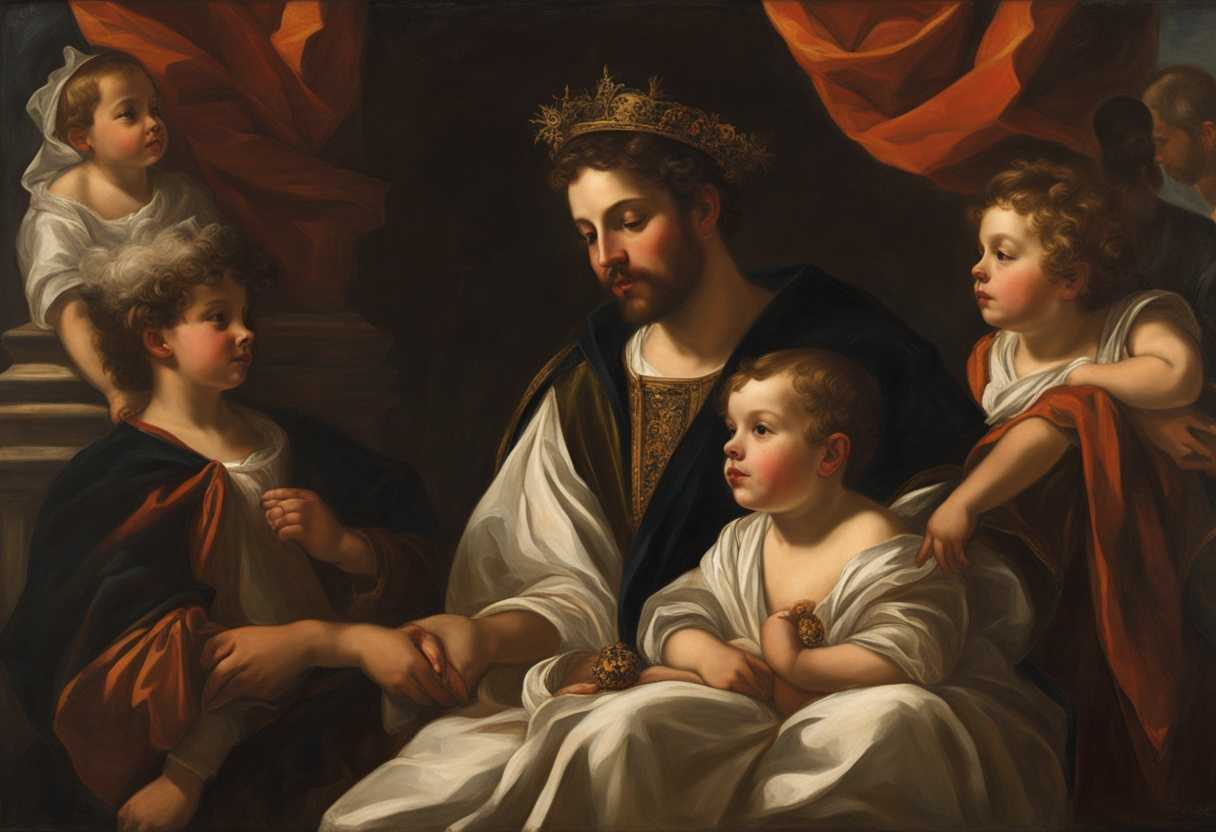
Setting the Scene for Exodus 28-29
In Exodus 28-29, the scene is set in the wilderness at the foot of Mount Sinai. The Israelites have been freed from slavery in Egypt and are now camped around the base of the mountain. Moses has ascended the mountain to receive instructions from God on behalf of the people. As he is receiving the laws and regulations for the Israelites, God also gives him detailed instructions for the consecration of Aaron and his sons as priests.
Moses gathers Aaron and his sons, along with the elders of Israel, at the entrance of the tent of meeting. The surroundings are stark and awe-inspiring, with the majestic Mount Sinai towering above them and the desert stretching out in all directions. The people are filled with anticipation and reverence as they witness the consecration ceremony unfold before them.
Aaron and his sons are dressed in the elaborate priestly garments that have been specially designed according to God’s instructions. Moses anoints them with oil and consecrates them for their sacred duties as priests. The scene is filled with solemnity and significance as the Israelites witness the establishment of the priesthood, a crucial element in their worship and relationship with God.
What is Exodus 28-29 about?
God gives detailed instructions to Moses in this verse regarding the garments that the priests were to wear and the consecration ceremony for Aaron and his sons to serve as priests. The elaborate attire of the priests symbolized their authority, holiness, and separation for their sacred duties. Each piece of clothing was carefully designed and held specific significance, representing different aspects of their role as mediators between God and the people.
The consecration ceremony was a solemn event where Aaron and his sons were set apart and sanctified for their service in the tabernacle. Through this ceremony, they were spiritually cleansed and dedicated to their sacred duties. This process of consecration served to signify the importance of their role and the need for their lives to be set apart for God’s service. It was a public declaration of their commitment to serving God and His people. We reflect on these instructions for priestly garments and consecration, reminding us of the significance of our own dedication to serving God. We too are called to live lives of holiness and commitment to God’s purposes, just as the priests were called to be set apart for their ministry. These instructions serve as a reminder of the importance of our own consecration to God, both in our actions and in the way we present ourselves before Him and others. How can we apply the principles of dedication and consecration seen in this verse to our own lives and service to God today?
Understanding what Exodus 28-29 really means
Exodus 28-29 provides a detailed account of God’s instructions to Moses regarding the consecration of Aaron and his sons as priests, highlighting the significance of holiness, preparation, and the role of the priesthood in mediating between God and the people. The passage emphasizes the importance of the priesthood being set apart for sacred duties, symbolized by the “holy garments” worn by the priests. These garments are not merely clothing but carry spiritual significance, underscoring the sanctity of the priesthood and the need for those who serve God to be spiritually pure and dedicated.
The phrase “Consecrate them” in Exodus 29:9 signifies the act of setting apart Aaron and his sons for a sacred purpose through rituals and sacrifices that symbolize purification and dedication. This process of consecration highlights the importance of dedication and purity in serving God, emphasizing the need for those in ministry to be morally upright and spiritually prepared for their roles. The enduring nature of these instructions is emphasized by the phrase “A perpetual statute” in Exodus 28:43, indicating that the principles of holiness and dedication outlined in these chapters are timeless and applicable to all generations.
The related biblical passages, such as Leviticus 8-9 and Hebrews 7:26-28, further illuminate the significance of the priesthood and the concept of consecration. Leviticus provides a detailed account of the consecration ceremony of Aaron and his sons, reinforcing the instructions given in Exodus, while Hebrews presents Jesus as the ultimate high priest who fulfills the priestly role in a perfect and eternal way. These passages highlight the importance of holiness, dedication, and the role of the priesthood in mediating between God and humanity.
The relevance of these themes to people today is evident in the call for believers to live lives that reflect dedication to God and to approach their service with preparation and intentionality. The concept of holiness and being set apart for God’s purposes remains relevant in contemporary times, reminding us of the importance of spiritual purity and dedication in our service to God. Just as a craftsman meticulously prepares his tools and workspace before beginning a significant project, the detailed instructions for the priestly garments and consecration in Exodus 28-29 serve as a reminder of the importance of preparing ourselves spiritually and morally for the tasks God has set before us.
In understanding the significance of the phrases “holy garments,” “Consecrate them,” and “A perpetual statute,” we gain insight into the depth of God’s instructions and their enduring relevance to our lives today. These principles of holiness, preparation, and dedication are not confined to ancient rituals but serve as timeless reminders of the spiritual purity and commitment required of those who serve God, encouraging us to approach our service with reverence and integrity.
How can we maintain a pure heart for God?
To maintain a pure heart for God, we must strive to live a life that is consistent with His will and commandments. This involves seeking to follow His teachings and walking in righteousness. We can keep our hearts pure before Him by obeying His word and allowing it to guide our thoughts, words, and actions.
It is also important to cultivate a spirit of humility and sincerity in our relationship with God. Acknowledging our dependence on Him and recognizing His sovereignty helps to keep our hearts focused on Him. Approaching Him with a reverent and sincere heart helps us maintain a pure and genuine connection with God.
Additionally, regularly examining our hearts and seeking His forgiveness when we fall short can help us to stay pure in His sight. Confessing our sins, repenting, and renewing our commitment to follow Him can help us to keep our hearts clean and open to His presence and guidance.
Application
Let’s take a moment to reflect on the teachings of Exodus 28-29, where we learn about honoring God and dedicating ourselves to His service. Let these words ignite a fire within us to strengthen our faith and serve with unwavering dedication. Imagine our lives as a masterpiece of devotion, each action a brushstroke creating a beautiful tapestry of service to the Almighty. Will you join me in answering the call to wholeheartedly dedicate ourselves to honoring and serving the Lord in everything we do?

Reverend Michael Johnson is an experienced Church Minister with a profound expertise in spirituality and guidance. With a serene presence and a compassionate heart, he has faithfully served his congregation for over 20 years, leading them on a spiritual journey towards inner peace and enlightenment. Reverend Johnson’s extensive knowledge of religious philosophies and profound understanding of human nature have made him a trusted confidant and mentor to many, as he seamlessly weaves his profound wisdom into life teachings. Reverend Johnson’s calming demeanor and empathetic nature continue to uplift and heal souls, nurturing a sense of unity and tranquility within his community.