
19 They said, “An Egyptian delivered us out of the hand of the shepherds and even drew water for us and watered the flock.”
Setting the Scene for Exodus 2:19
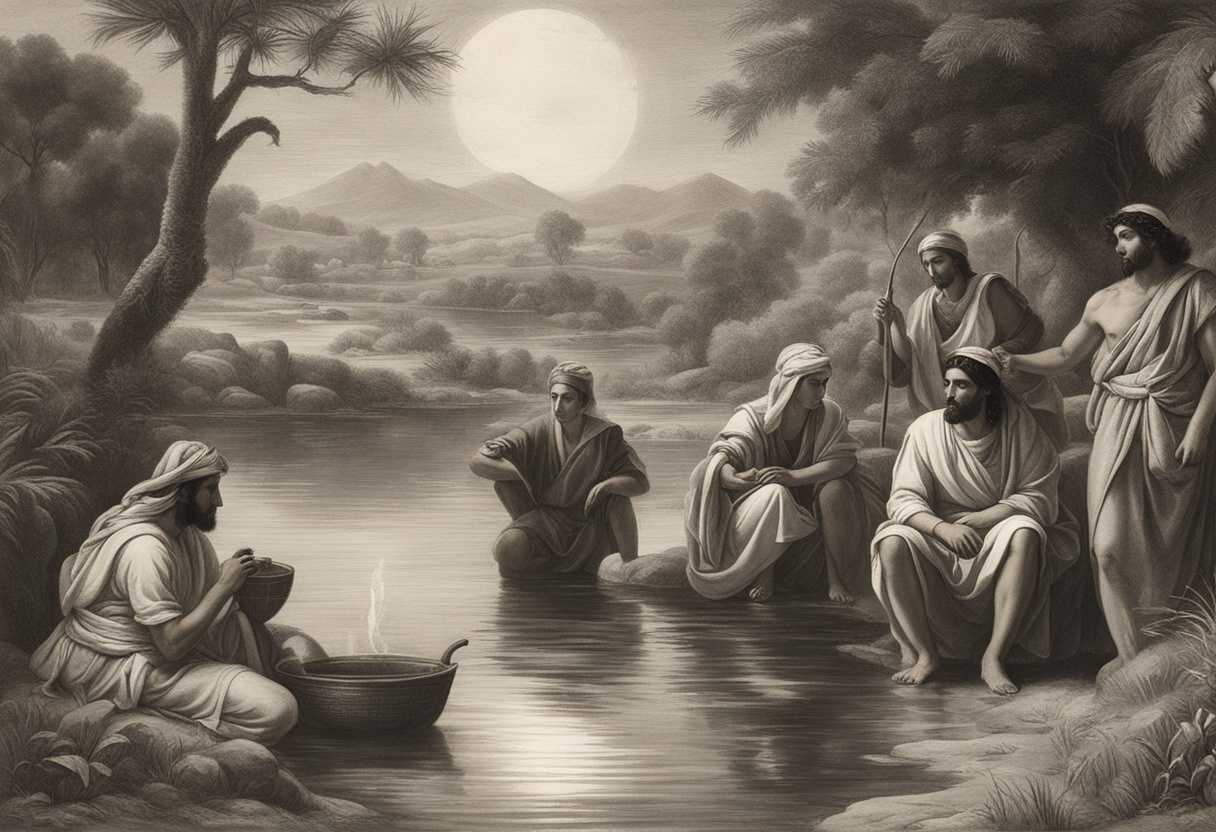
In Exodus chapter 2, we find the story of Moses fleeing Egypt after killing an Egyptian who was mistreating a Hebrew slave. As Moses arrived in the land of Midian, he came across a well where seven daughters of the priest of Midian had gathered to water their father’s flock. The scene is set in the vast desert, with the scorching sun beating down on the sandy landscape. The well is a precious source of water in this arid region, surrounded by a few sparse palm trees offering minimal shade.
The seven daughters, named in the Bible as Zipporah, Tirzah, Hoglah, Milcah, Noah, and Mahlah, are struggling to water their father’s flock as a group of shepherds come to drive them away. Moses, who had been resting by the well, intervenes and helps the women water their flock, standing up against the shepherds. The daughters return home earlier than usual, and when they tell their father Reuel (also known as Jethro) about the stranger who helped them, he invites Moses to their home. This encounter at the well marks the beginning of Moses’ time in Midian, where he finds refuge and a new purpose in life.
What is Exodus 2:19 about?
A powerful display of justice and protection is seen in this verse. Moses, known for his leadership and courage, steps in to defend the daughters of Jethro when they are being mistreated at the well. This act shows his compassion and sense of fairness. It highlights the importance of standing up for those who are marginalized or oppressed, even in seemingly small or everyday situations.
Imagine the scene at the well – the daughters of Jethro, vulnerable and facing mistreatment, and Moses, a figure of strength and righteousness, coming to their rescue. This moment teaches us the importance of using our own power and influence to support and advocate for others, especially those who may not have a voice or agency. It also reflects the idea of kindness and empathy towards others, regardless of their background or circumstances. Let us consider how we can embody the same sense of justice and compassion in our own lives as we reflect on this verse. How can we use our own agency and privilege to defend and uplift those around us who may be facing injustice or oppression? How can we follow Moses’ example and stand up for what is right, even in the face of adversity? Let this verse inspire us to be courageous advocates for equality and fairness in our communities.
Understanding what Exodus 2:19 really means
Structure for Commentary:
- Introduction and context
- Examination of key phrases
- Connections to other biblical passages
- Relevance to contemporary life
- Anecdote for relatability
- Conclusion and reflective questions
Commentary:
Introduction and Context
The verse in question narrates a scene where Moses, having fled from Egypt, encounters Zipporah and her sisters at a well in Midian. The sisters describe him as an “Egyptian” who helped them and watered their flock. This moment marks a significant turning point in Moses’s life, as he transitions from his Egyptian identity towards his destined role as the deliverer of Israel.
Examination of Key Phrases
The phrase “an Egyptian delivered us” is particularly striking. Here, Moses is perceived not by his Hebrew heritage but by his outward appearance as an Egyptian. This raises questions about identity and perception. Are we defined by our outward appearances or by our inner convictions and purpose? The actions of Moses, despite his Egyptian attire, align him with a divine purpose that transcends national or ethnic boundaries.
Connections to Other Biblical Passages
This scenario echoes Genesis 24 where Rebekah meets Abraham’s servant at a well, an event that leads to her becoming Isaac’s wife. The Bible often uses wells as significant sites for divine encounters and transitions by paralleling these events. Further, in the New Testament, Jesus meets the Samaritan woman at a well (John 4), revealing deep spiritual truths. These connections highlight wells as places where God facilitates life-changing encounters. The interaction between Moses and Zipporah in our modern context points to the importance of recognizing the divine workings in everyday acts of kindness and hospitality. How often do we judge others by their appearance or background, neglecting the potential God-given purpose they carry? This verse challenges us to look beyond outward identities and see the inherent worth and potential in everyone we encounter.
Anecdote for Relatability
I recall a story of a young woman named Sarah who worked in a corporate office but felt out of place because of her rural background and modest dressing. One day, she helped a colleague with a work crisis, and though initially underestimated, her actions spoke volumes about her character and capability. Similarly, Moses’s actions at the well overshadow his Egyptian appearance, proving that our deeds often announce our true identity more than our outward looks. Exodus 2:19 invites us to reflect on identity, perception, and divine purpose. It reminds us that God often operates through ordinary circumstances and appearances can be deceiving. How do you perceive others around you? Are there ways you can look deeper to understand their God-given purpose? Can you identify a moment in your life where God used an ordinary situation to reveal something extraordinary? Reflect on these questions and consider how this ancient text speaks to your modern life.
How can we show kindness to strangers in need?
Showing kindness to strangers in need can be demonstrated in various ways. One way is by being compassionate and empathetic towards their situation. This could involve listening to their needs, offering help or resources if possible, and showing genuine care and concern for their well-being. We can help alleviate their burden and provide comfort in times of need by acknowledging their struggles and showing understanding.
Another way to show kindness to strangers in need is by extending a helping hand or offering assistance without expecting anything in return. This selfless act of generosity can make a significant impact on someone’s life and demonstrate the value of compassion and empathy towards others. Whether it involves offering food, shelter, clothing, or simply a listening ear, these small acts of kindness can go a long way in showing compassion towards those who are in need of support.
Furthermore, showing kindness to strangers in need can also involve advocating for their rights and speaking up against injustices they may face. We can contribute to creating a more inclusive and compassionate society where everyone is treated with dignity and respect by standing up for those who are vulnerable and marginalized. We can create a more compassionate and supportive community where everyone feels valued and cared for by showing kindness and empathy towards strangers in need.
Application
Think about your daily grind—your job, your family—how often do you see others struggling? Like those shepherd girls who helped Moses, you have the power to make a real difference. Step up, be that person who notices and acts. Your compassion can transform someone’s day, or even their life. How will you take action and lend your hand today?

Reverend Michael Johnson is an experienced Church Minister with a profound expertise in spirituality and guidance. With a serene presence and a compassionate heart, he has faithfully served his congregation for over 20 years, leading them on a spiritual journey towards inner peace and enlightenment. Reverend Johnson’s extensive knowledge of religious philosophies and profound understanding of human nature have made him a trusted confidant and mentor to many, as he seamlessly weaves his profound wisdom into life teachings. Reverend Johnson’s calming demeanor and empathetic nature continue to uplift and heal souls, nurturing a sense of unity and tranquility within his community.