
is about God displaying His power and asserting His authority over the gods of Egypt through a series of miraculous plagues, ultimately leading to the liberation of the Israelites from slavery.
1 And the Lord said to Moses, “See, I have made you like God to Pharaoh, and your brother Aaron shall be your prophet.
2 You shall speak all that I command you, and your brother Aaron shall tell Pharaoh to let the people of Israel go out of his land.
3 But I will harden Pharaoh’s heart, and though I multiply my signs and wonders in the land of Egypt,
4 Pharaoh will not listen to you. Then I will lay my hand on Egypt and bring my hosts, my people the children of Israel, out of the land of Egypt by great acts of judgment.
5 The Egyptians shall know that I am the Lord, when I stretch out my hand against Egypt and bring out the people of Israel from among them.
6 Moses and Aaron did so; they did just as the Lord commanded them.
7 Now Moses was eighty years old, and Aaron eighty-three years old, when they spoke to Pharaoh.
8 Then the Lord said to Moses and Aaron, “When Pharaoh says to you, ‘Prove yourselves by working a miracle,’ then you shall say to Aaron, ‘Take your staff and cast it down before Pharaoh, that it may become a serpent.’”
9 “When Pharaoh says to you, ‘Prove yourselves by working a miracle,’ then you shall say to Aaron, ‘Take your staff and cast it down before Pharaoh, that it may become a serpent.’”
10 So Moses and Aaron went to Pharaoh and did just as the Lord commanded. Aaron cast down his staff before Pharaoh and his servants, and it became a serpent.
11 Then Pharaoh summoned the wise men and the sorcerers, and they, the magicians of Egypt, also did the same by their secret arts.
12 For each man cast down his staff, and they became serpents. But Aaron’s staff swallowed up their staffs.
13 Still Pharaoh’s heart was hardened, and he would not listen to them, as the Lord had said.
14 Then the Lord said to Moses, “Pharaoh’s heart is hardened; he refuses to let the people go.
15 Go to Pharaoh in the morning, as he is going out to the water. Stand on the bank of the Nile to meet him, and take in your hand the staff that turned into a serpent.
16 And you shall say to him, ‘The Lord, the God of the Hebrews, sent me to you, saying, “Let my people go, that they may serve me in the wilderness.” But so far, you have not obeyed.
17 Thus says the Lord, “By this you shall know that I am the Lord: behold, with the staff that is in my hand I will strike the water that is in the Nile, and it shall turn into blood.
18 The fish in the Nile shall die, and the Nile will stink, and the Egyptians will grow weary of drinking water from the Nile.”
19 And the Lord said to Moses, “Say to Aaron, ‘Take your staff and stretch out your hand over the waters of Egypt, over their rivers, their canals, and their ponds, and all their pools of water, so that they may become blood, and there shall be blood throughout all the land of Egypt, even in vessels of wood and in vessels of stone.’”
20 Moses and Aaron did as the Lord commanded. In the sight of Pharaoh and in the sight of his servants, he lifted up the staff and struck the water in the Nile, and all the water in the Nile turned into blood.
21 And the fish in the Nile died, and the Nile stank, so that the Egyptians could not drink water from the Nile. There was blood throughout all the land of Egypt.
22 But the magicians of Egypt did the same by their secret arts. So Pharaoh’s heart remained hardened, and he would not listen to them, as the Lord had said.
23 But Pharaoh turned and went into his house, and he did not take even this to heart.
24 And all the Egyptians dug along the Nile for water to drink, for they could not drink the water of the Nile.
25 Seven full days passed after the Lord had struck the Nile.
1 Then the Lord said to Moses, “Go in to Pharaoh and say to him, ‘Thus says the Lord, “Let my people go, that they may serve me.
2 But if you refuse to let them go, behold, I will plague all your country with frogs.
3 The Nile shall swarm with frogs that shall come up into your house and into your bedroom and on your bed and into the houses of your servants and your people, and into your ovens and your kneading bowls.
4 And the frogs shall go away from you and your houses and your servants and your people. They shall be left only in the Nile.”
5 And the Lord said to Moses, “Say to Aaron, ‘Stretch out your hand with your staff over the rivers, over the canals and over the pools, and make frogs come up on the land of Egypt!’”
6 So Aaron stretched out his hand over the waters of Egypt, and the frogs came up and covered the land of Egypt.
7 But the magicians did the same by their secret arts and made frogs come up on the land of Egypt.
8 Then Pharaoh called Moses and Aaron and said, “Plead with the Lord to take away the frogs from me and from my people, and I will let the people go to sacrifice to the Lord.”
9 Then Moses said to Pharaoh, “Be pleased to command me when I am to plead for you and for your servants and for your people, that the frogs be cut off from you and your houses and be left only in the Nile.”
10 Then he said, “Tomorrow.” So he said, “Be it according to your word, so that you may know that there is no one like the Lord our God.
11 Then Pharaoh summoned Moses and Aaron and said, “Plead with the Lord to take away the frogs from me and from my people, and I will let the people go to sacrifice to the Lord.”
12 Then Moses and Aaron went out from Pharaoh, and Moses cried to the Lord about the frogs, as he had agreed with Pharaoh.
13 And the Lord did according to the word of Moses. The frogs died out in the houses, the courtyards, and the fields.
14 And they gathered them together in heaps, and the land stank.
15 But when Pharaoh saw that there was a respite, he hardened his heart and would not listen to them, as the Lord had said.
16 Then the Lord said to Moses, “Say to Aaron, ‘Stretch out your staff and strike the dust of the earth, so that it may become gnats in all the land of Egypt.’”
17 They did so. Aaron stretched out his hand with his staff and struck the dust of the earth, and there were gnats on man and beast. All the dust of the earth became gnats in all the land of Egypt.
18 The magicians tried by their secret arts to produce gnats, but they could not. So there were gnats on man and beast.
19 Then the magicians said to Pharaoh, “This is the finger of God.” But Pharaoh’s heart was hardened, and he would not listen to them, as the Lord had said.
20 Then the Lord said to Moses, “Rise up early in the morning and present yourself to Pharaoh, as he goes out to the water, and say to him, ‘Thus says the Lord, “Let my people go, that they may serve me.
21 Or else, if you will not let my people go, behold, I will send swarms of flies on you and your servants and your people, and into your houses. And the houses of the Egyptians shall be filled with swarms of flies, and also the ground on which they stand.
22 But on that day I will set apart the land of Goshen, where my people dwell, so that no swarms of flies shall be there, that you may know that I am the Lord in the midst of the earth.
23 But I will put a division between my people and your people. Tomorrow this sign shall happen.”
24 And the Lord did so. There came great swarms of flies into the house of Pharaoh and into his servants’ houses. Throughout all the land of Egypt the land was ruined by the swarms of flies.
25 Then Pharaoh called Moses and Aaron and said, “Go, sacrifice to your God within the land.”
26 But Moses said, “It would not be right to do so, for the offerings we shall sacrifice to the Lord our God are an abomination to the Egyptians. If we sacrifice offerings abominable to the Egyptians before their eyes, will they not stone us?
27 We must go three days’ journey into the wilderness and sacrifice to the Lord our God as he tells us.”
28 So Pharaoh said, “I will let you go to sacrifice to the Lord your God in the wilderness; only you must not go very far away. Plead for me.”
29 Then Moses said, “Behold, I am going out from you and I will plead with the Lord that the swarms of flies may depart from Pharaoh, from his servants, and from his people, tomorrow. Only let not Pharaoh cheat again by not letting the people go to sacrifice to the Lord.”
30 So Moses went out from Pharaoh and prayed to the Lord.
31 And the Lord did as Moses asked, and removed the swarms of flies from Pharaoh, from his servants, and from his people; not one remained.
32 But Pharaoh hardened his heart this time also, and did not let the people go.
1 Then the Lord said to Moses, “Go in to Pharaoh and say to him, ‘Thus says the Lord, the God of the Hebrews, “Let my people go, that they may serve me.
2 For if you refuse to let them go and still hold them,
3 behold, the hand of the Lord will fall with a very severe plague upon your livestock that are in the field, the horses, the donkeys, the camels, the herds, and the flocks.
4 But the Lord will make a distinction between the livestock of Israel and the livestock of Egypt, so that nothing of all that belongs to the people of Israel shall die.”
5 And the Lord set a time, saying, “Tomorrow the Lord will do this thing in the land.”
6 And the next day the Lord did this thing. All the livestock of the Egyptians died, but not one of the livestock of the people of Israel died.
7 And Pharaoh sent, and behold, not one of the livestock of Israel was dead. But the heart of Pharaoh was hardened, and he did not let the people go.
8 Then the Lord said to Moses and Aaron, “Take handfuls of soot from the kiln, and let Moses throw them in the air in the sight of Pharaoh.
9 It shall become fine dust over all the land of Egypt, and become boils breaking out in sores on man and beast throughout all the land of Egypt.”
10 So they took soot from the kiln and stood before Pharaoh. And Moses threw it in the air, and it became boils breaking out in sores on man and beast.
11 And the magicians could not stand before Moses because of the boils, for the boils came upon the magicians and upon all the Egyptians.
12 But the Lord hardened the heart of Pharaoh, and he did not listen to them, as the Lord had spoken to Moses.
13 Then the Lord said to Moses, “Rise up early in the morning and present yourself before Pharaoh and say to him, ‘Thus says the Lord, the God of the Hebrews, “Let my people go, that they may serve me.”
14 For this time I will send all my plagues on you yourself, and on your servants and your people, so that you may know that there is none like me in all the earth.
15 For by now I could have put out my hand and struck you and your people with pestilence, and you would have been cut off from the earth.
16 But for this purpose I have raised you up, to show you my power, so that my name may be proclaimed in all the earth.
17 Still you exalt yourself against my people by not letting them go.
18 Behold, about this time tomorrow I will cause very heavy hail to fall, such as never has been in Egypt from the day it was founded until now.
19 Now therefore send, get your livestock and all that you have in the field into safe shelter, for every man and beast that is in the field and is not brought home will die when the hail falls on them.”
20 Whoever feared the word of the Lord among the servants of Pharaoh hurried his slaves and his livestock into the houses,
21 Then the Lord said to Moses, “Stretch out your hand toward heaven, so that there may be hail in all the land of Egypt, on man and beast and every plant of the field, in the land of Egypt.”
22 Then the Lord said to Moses, “Stretch out your hand toward heaven, so that there may be hail in all the land of Egypt, on man and beast and every plant of the field, in the land of Egypt.”
23 Then Moses stretched out his staff toward heaven, and the Lord sent thunder and hail, and fire ran down to the earth. And the Lord rained hail upon the land of Egypt.
24 So there was hail, and fire flashing continually in the midst of the hail, very heavy hail, such as had never been in all the land of Egypt since it became a nation.
25 And the hail struck down everything that was in the field in all the land of Egypt, both man and beast. And the hail struck down every plant of the field and broke every tree of the field.
26 Only in the land of Goshen, where the people of Israel were, was there no hail.
27 Then Pharaoh sent and called Moses and Aaron and said to them, “This time I have sinned; the Lord is in the right, and I and my people are in the wrong.
28 Plead with the Lord, for there has been enough of God’s thunder and hail. I will let you go, and you shall stay no longer.”
29 Moses said to him, “As soon as I have gone out of the city, I will stretch out my hands to the Lord. The thunder will cease, and there will be no more hail, so that you may know that the earth is the Lord’s.
30 But as for you and your servants, I know that you do not yet fear the Lord God.”
31 Now the flax and the barley were struck down, for the barley was in the ear and the flax was in bud.
32 The wheat and the emmer were not struck down, for they are late in coming up.
33 So Moses went out of the city from Pharaoh and stretched out his hands to the Lord, and the thunder and the hail ceased, and the rain no longer poured upon the earth.
34 But when Pharaoh saw that the rain and the hail and the thunder had ceased, he sinned yet again and hardened his heart, he and his servants.
35 So the heart of Pharaoh was hardened, and he did not let the people of Israel go, just as the Lord had spoken through Moses.
1 Then the Lord said to Moses, “Go in to Pharaoh, for I have hardened his heart and the heart of his servants, that I may show these signs of mine among them,
2 and that you may tell in the hearing of your son and of your grandson how I have dealt harshly with the Egyptians and what signs I have done among them, that you may know that I am the Lord.”
3 So Moses and Aaron went in to Pharaoh and said to him, “Thus says the Lord, the God of the Hebrews, ‘How long will you refuse to humble yourself before me? Let my people go, that they may serve me.
4 But if you refuse to let my people go, behold, tomorrow I will bring locusts into your country,
5 They shall cover the face of the land, so that no one can see the land. And they shall eat what is left to you after the hail, and they shall eat every tree of yours that grows in the field,
6 And they shall fill your houses and the houses of all your servants and of all the Egyptians, as neither your fathers nor your grandfathers have seen, from the day they came on earth to this day.’” Then he turned and went out from Pharaoh.
7 Then Pharaoh’s servants said to him, “How long shall this man be a snare to us? Let the men go, that they may serve the Lord their God. Do you not yet understand that Egypt is ruined?”
8 So Moses and Aaron were brought back to Pharaoh. And he said to them, “Go, serve the Lord your God. But which ones are to go?”
9 Moses said, “We will go with our young and our old. We will go with our sons and daughters and with our flocks and herds, for we must hold a feast to the Lord.”
10 Then he said to them, “The Lord be with you, if ever I let you and your little ones go! Look, you have some evil purpose in mind.
11 Not so! Go now, the men among you, and serve the Lord, for that is what you are asking.” And they were driven out from Pharaoh’s presence.
12 Then the Lord said to Moses, “Stretch out your hand over the land of Egypt for the locusts, so that they may come upon the land of Egypt and eat every plant in the land, all that the hail has left.”
13 So Moses stretched out his staff over the land of Egypt, and the Lord brought an east wind upon the land all that day and all that night. When it was morning, the east wind had brought the locusts.
14 The locusts came up over all the land of Egypt and settled on the whole country of Egypt, such a dense swarm of locusts as had never been before, nor ever will be again.
15 They covered the face of the whole land, so that the land was darkened, and they ate all the plants in the land and all the fruit of the trees that the hail had left. Not a green thing remained, neither tree nor plant of the field, through all the land of Egypt.
16 Then Pharaoh hastily called Moses and Aaron and said, “I have sinned against the Lord your God, and against you.
17 Now therefore, forgive my sin, please, only this once, and plead with the Lord your God only to remove this death from me.”
18 So he went out from Pharaoh and pleaded with the Lord.
19 And the Lord turned a very strong west wind, which lifted the locusts and drove them into the Red Sea. Not a single locust was left in all the country of Egypt.
20 But the Lord hardened Pharaoh’s heart, and he did not let the people of Israel go.
21 Then the Lord said to Moses, “Stretch out your hand toward heaven, that there may be darkness over the land of Egypt, a darkness to be felt.”
22 So Moses stretched out his hand toward heaven, and there was pitch darkness in all the land of Egypt three days.
23 They did not see one another, nor did anyone rise from his place for three days, but all the people of Israel had light where they lived.
24 Then Pharaoh called Moses and said, “Go, serve the Lord; your little ones also may go with you; only let your flocks and your herds remain behind.”
25 But Moses said, “You must also let us have sacrifices and burnt offerings, that we may sacrifice to the Lord our God.
26 Our livestock also must go with us; not a hoof shall be left behind, for we must take of them to serve the Lord our God, and we do not know with what we must serve the Lord until we arrive there.”
27 But the Lord hardened Pharaoh’s heart, and he would not let them go.
28 Then Pharaoh said to him, “Get away from me; take care never to see my face again, for on the day you see my face you shall die.”
29 But Moses said, “You must let us also have sacrifices and burnt offerings, that we may sacrifice to the Lord our God.
1 The Lord said to Moses, “Yet one plague more I will bring upon Pharaoh and upon Egypt. Afterward he will let you go from here. When he lets you go, he will drive you away completely.
2 Speak now in the hearing of the people, that they ask, every man of his neighbor and every woman of her neighbor, for silver and gold jewelry.”
3 And the Lord gave the people favor in the sight of the Egyptians.
4 So Moses said, “Thus says the Lord: About midnight I will go out in the midst of Egypt,
5 And every firstborn in the land of Egypt shall die, from the firstborn of Pharaoh who sits on his throne, even to the firstborn of the slave girl who is behind the handmill, and all the firstborn of the cattle.
6 There shall be a great cry throughout all the land of Egypt, such as there has never been, nor ever will be again.
7 But not a dog shall growl against any of the people of Israel, either man or beast, that you may know that the Lord makes a distinction between Egypt and Israel.
8 And all these your servants shall come down to me and bow down to me, saying, ‘Get out, you and all the people who follow you.’ And after that I will go out.” And he went out from Pharaoh in hot anger.
9 Then the Lord said to Moses, “Pharaoh will not listen to you, that my wonders may be multiplied in the land of Egypt.”
10 Moses and Aaron did all these wonders before Pharaoh, and the Lord hardened Pharaoh’s heart, and he did not let the people of Israel go out of his land.
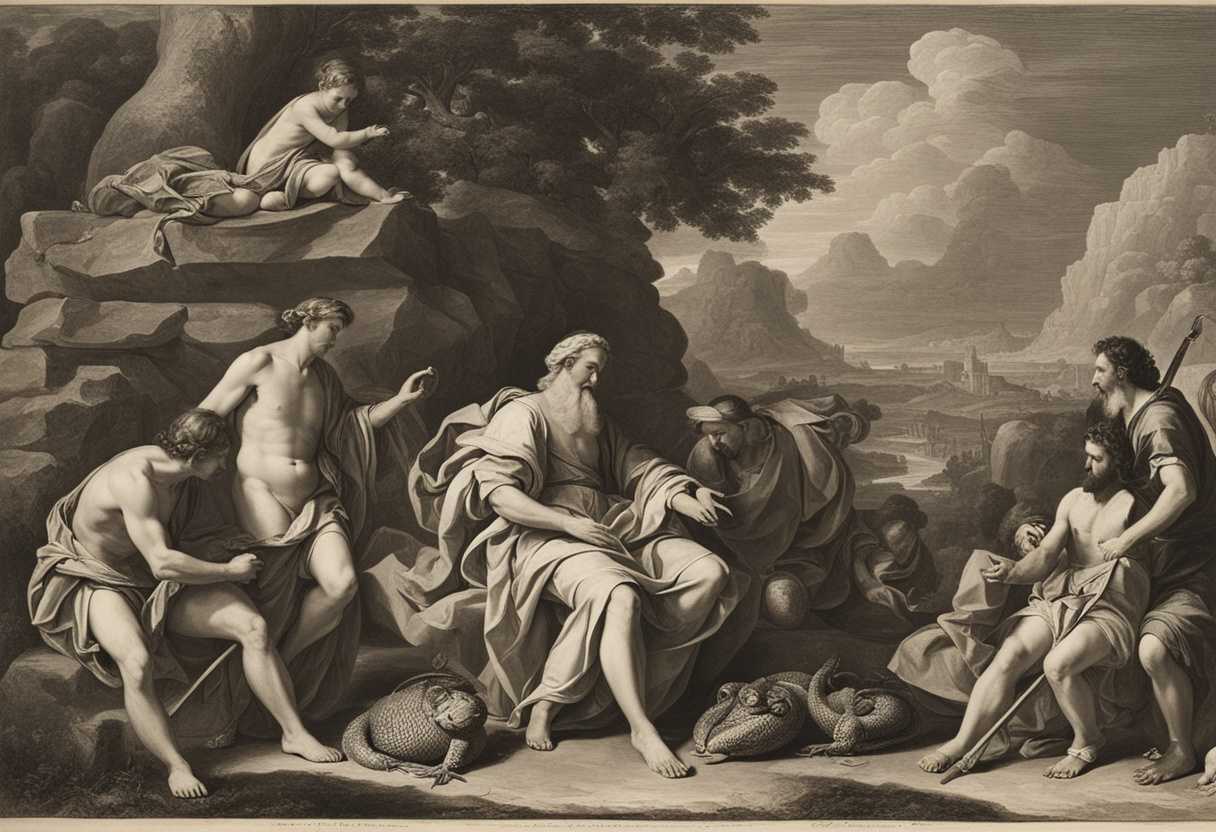
Setting the Scene for Exodus 7-11
The scene in Exodus 7-11 takes place in the land of Egypt during the time when Moses and his brother Aaron were sent by God to confront Pharaoh and demand the release of the Israelites from slavery. The setting is the grand palace of Pharaoh, a place of opulence and power, adorned with intricate hieroglyphics and towering columns. Pharaoh, the proud ruler of Egypt, sits on his throne, surrounded by his advisors and courtiers, exuding an air of authority and arrogance.
Moses and Aaron stand before Pharaoh, their faces determined and their hearts filled with the power of God. The tension in the room is palpable as Moses calls upon the name of the Lord, demanding that Pharaoh let the Israelites go. The air is thick with anticipation as Pharaoh, stubborn and defiant, refuses to heed their words, his heart hardened against the will of God.
As the scene unfolds, the power of God is displayed through a series of miraculous signs and plagues that descend upon Egypt, each one more awe-inspiring than the last. The room is filled with chaos and fear as the waters turn to blood, frogs overrun the land, and darkness shrouds the kingdom. Through it all, Moses and Aaron stand firm in their faith, unwavering in their mission to lead the Israelites to freedom.
What is Exodus 7-11 about?
When we reflect on the ten plagues of Egypt, we witness a powerful demonstration of God’s authority and sovereignty over all creation. Through this series of plagues, God showed His mighty power to the Egyptians and the Israelites alike, proving that He is in control of the natural world and all its elements. Each plague was strategically designed to challenge the false gods of Egypt, showcasing God’s superiority and the futility of worshipping anything other than Him. As we delve deeper into their meaning, we come to understand that the ten plagues were deliberate acts of judgment against Pharaoh and the Egyptians for their oppression of the Israelites, not just random acts of destruction. Each plague served as a warning for Pharaoh to release the Israelites from slavery, yet he hardened his heart time and time again, refusing to acknowledge God’s power and authority. Through these plagues, we learn about the consequences of defying God and the importance of heeding His warnings and commands. God’s faithfulness to His people and His willingness to intervene on their behalf are reminded to us as we contemplate the significance of the ten plagues of Egypt. We see that God is just and righteous in His judgments, holding both individuals and nations accountable for their actions. As we study these plagues, let us reflect on the power and majesty of God and consider aligning our lives with His will, avoiding the consequences of disobedience and instead embracing His grace and mercy.
Understanding what Exodus 7-11 really means
In Exodus 7-11, we delve into the narrative of the plagues that God inflicts upon Egypt to secure the release of the Israelites from slavery. This account is not merely a series of calamities but a profound demonstration of God’s sovereignty, the hardening of Pharaoh’s heart, the significance of faith, and the ultimate deliverance of God’s people.
Throughout these chapters, the recurring command from God through Moses to Pharaoh, “Let my people go,” resonates as a powerful symbol of God’s demand for freedom and justice. Pharaoh’s hardened heart, a phrase reiterated multiple times, serves as a stark reminder of human stubbornness and resistance to God’s will. The signs and wonders manifested in the form of miraculous plagues underscore God’s unmatched power and authority.
Drawing connections to other biblical passages enriches our understanding of Exodus 7-11. In Romans 9:17-18, Paul references Pharaoh’s hardened heart to illuminate God’s sovereignty and divine purpose. Psalm 105:26-36 poetically recounts the plagues, emphasizing God’s unwavering faithfulness to His covenant. Revelation 16:1-21 echoes the plagues in Exodus, symbolizing God’s judgment and the eventual deliverance of His people.
The relevance of these chapters extends to contemporary life. Just as Moses and Aaron exemplified faith and obedience in the face of adversity, we are called to trust and follow God’s guidance amidst challenges. The Exodus narrative serves as a poignant reminder of God’s commitment to justice and liberation for the oppressed, inspiring us to advocate for righteousness in our communities.
Consider a modern-day scenario where a community fights for social justice, mirroring the perseverance of Moses and the Israelites. Despite obstacles, their unwavering faith fuels their pursuit of justice, akin to the trust in God’s promise of deliverance exhibited in Exodus. The command “Let my people go” transcends physical liberation, embodying a call for spiritual freedom and the unrestricted worship of God.
The phrase “hardened his heart” cautions against pride and obstinacy, urging us to remain open to God’s will. The signs and wonders in the plagues serve as tangible manifestations of God’s power, reinforcing the notion that He can intervene in extraordinary ways to fulfill His divine purposes. Reflecting on these chapters unveils profound insights into God’s character, His redemptive plans for humanity, and the enduring lessons of faith, obedience, and justice embedded in the Exodus narrative.
What is the significance of God’s warning signs?
The warning signs sent by God throughout Exodus are significant as they serve as a demonstration of God’s power and the consequences of disobedience. These signs not only served as a means for God to display His authority and might but also to warn the Pharaoh and the people of Egypt of the impending judgment if they refused to heed God’s command. They were a clear indication that God was at work and that His will would be done, regardless of human resistance.
Furthermore, the warning signs also served as a means of separating the Israelites from the Egyptians, highlighting God’s protection and provision for His chosen people. While the Egyptians faced the full force of God’s judgment through the plagues, the Israelites were kept safe from harm, demonstrating God’s faithfulness to His promises and the covenant He made with His people. These signs not only showcased God’s power but also His mercy and protection over those who remained faithful to Him. The warning signs in Exodus served as a powerful reminder of the consequences of disobedience and the importance of heeding God’s commands. They demonstrated God’s sovereignty, faithfulness, and mercy, while also setting the stage for the eventual liberation of the Israelites from captivity. The signs were a testament to God’s desire for His people to trust in Him completely and follow His guidance, knowing that His plans would ultimately prevail.
Application
Embrace the power of God’s unwavering faithfulness and sovereignty. Actively live out your faith by obeying His word, serving others selflessly, and spreading love in your community. Make a commitment to surrender to His will and let His love guide your every action. Are you prepared to let your faith shine bright in a world that needs it now more than ever?

Reverend Michael Johnson is an experienced Church Minister with a profound expertise in spirituality and guidance. With a serene presence and a compassionate heart, he has faithfully served his congregation for over 20 years, leading them on a spiritual journey towards inner peace and enlightenment. Reverend Johnson’s extensive knowledge of religious philosophies and profound understanding of human nature have made him a trusted confidant and mentor to many, as he seamlessly weaves his profound wisdom into life teachings. Reverend Johnson’s calming demeanor and empathetic nature continue to uplift and heal souls, nurturing a sense of unity and tranquility within his community.