
Ezekiel 16:1-63 is about God’s love and faithfulness towards Israel as His chosen people, despite their unfaithfulness and idolatry, using the metaphor of a wayward woman redeemed and restored by her faithful husband.
1 Again the word of the Lord came to me:
2 “Son of man, make known to Jerusalem her abominations,”
3 and say, Thus says the Lord God to Jerusalem: Your origin and your birth are of the land of the Canaanites; your father was an Amorite and your mother a Hittite.
4 And as for your birth, on the day you were born your cord was not cut, nor were you washed with water to cleanse you, nor rubbed with salt, nor wrapped in swaddling cloths.
5 No eye pitied you, to do any of these things to you out of compassion for you, but you were cast out on the open field, for you were abhorred, on the day that you were born.
6 “And when I passed by you and saw you wallowing in your blood, I said to you in your blood, ‘Live!’ Yes, I said to you in your blood, ‘Live!’”
7 I made you flourish like a plant of the field.
8 “When I passed by you again and saw you, behold, you were at the age for love, and I spread the corner of my garment over you and covered your nakedness; I made my vow to you and entered into a covenant with you, declares the Lord God, and you became mine.”
9 Then I bathed you with water and washed off your blood from you and anointed you with oil.
10 I clothed you also with embroidered cloth and shod you with fine leather. I wrapped you in fine linen and covered you with silk.
11 And I adorned you with ornaments and put bracelets on your wrists and a chain on your neck.
12 And I put a ring on your nose and earrings in your ears and a beautiful crown on your head.
13 Thus you were adorned with gold and silver, and your clothing was of fine linen and silk and embroidered cloth. You ate fine flour and honey and oil. You grew exceedingly beautiful and advanced to royalty.
14 And your renown went forth among the nations because of your beauty, for it was perfect through the splendor that I had bestowed on you, declares the Lord God.
15 “But you trusted in your beauty and played the whore because of your renown and lavished your whorings on any passerby; your beauty became his.”
16 You took some of your garments and made for yourself colorful shrines, and on them played the whore.
17 You also took your beautiful jewels of my gold and of my silver, which I had given you, and made for yourself images of men, and with them played the whore.
18 And you took your embroidered garments to cover them, and set my oil and my incense before them.
19 Also my bread that I gave you—I fed you with fine flour and oil and honey—you set before them for a pleasing aroma; and so it was, declares the Lord God.
20 And you took your sons and your daughters, whom you had borne to me, and these you sacrificed to them to be devoured. Were your whorings so small a matter,
21 Thus you longed for the lewdness of your youth, when the Egyptians handled your bosom and pressed your young breasts.”
22 And in all your abominations and your whorings you did not remember the days of your youth when you were naked and bare, wallowing in your blood.
23 “And after all your wickedness (woe, woe to you! declares the Lord God),
24 you built yourself a vaulted chamber and made yourself a lofty place in every square.
25 At the head of every street you built your lofty place and made your beauty an abomination, offering yourself to any passerby and multiplying your whoring.
26 You also played the whore with the Egyptians, your lustful neighbors, multiplying your whoring, to provoke me to anger.
27 Behold, therefore, I stretched out my hand against you and diminished your allotted portion and delivered you to the greed of your enemies, the daughters of the Philistines, who were ashamed of your lewd behavior.
28 You played the whore also with the Assyrians, because you were not satisfied; yes, you played the whore with them, and still you were not satisfied.
29 You multiplied your whoring also with the trading land of Chaldea, and even with this you were not satisfied.
30 “How sick is your heart, declares the Lord God, because you did all these things, the deeds of a brazen prostitute,
31 And you built your vaulted chamber at the head of every street, and made your lofty place in every square. But you were not like a prostitute, because you scorned payment.
32 Adulterous wife, who receives strangers instead of her husband!
33 Men give gifts to all prostitutes, but you gave your gifts to all your lovers, bribing them to come to you from every side with your whorings.
34 And the contrary is in you from other women in your whoredoms, whereas none follows you to play the whore. And in that you give a reward, and no reward is given to you, therefore you are the contrary.
35 Therefore, O prostitute, hear the word of the Lord:
36 Thus says the Lord God, Because your lust was poured out and your nakedness uncovered in your whorings with your lovers, and with all your abominable idols, and because of the blood of your children that you gave to them,
37 therefore, behold, I will gather all your lovers with whom you took pleasure, all those you loved and all those you hated. I will gather them against you from every side and will uncover your nakedness to them, that they may see all your nakedness.
38 And I will judge you as women who commit adultery and shed blood are judged, and bring upon you the blood of wrath and jealousy.
39 And I will give you into their hands, and they shall throw down your vaulted chamber and break down your lofty places. They shall strip you of your clothes and take your beautiful jewels and leave you naked and bare.
40 They shall bring up a crowd against you, and they shall stone you and cut you to pieces with their swords.
41 And they shall burn your houses and execute judgments upon you in the sight of many women. Then I will make you stop playing the whore, and you shall also give payment no more.
42 So will I satisfy my wrath on you, and my jealousy shall depart from you. I will be calm and will no more be angry.
43 Because you have not remembered the days of your youth, but have enraged me with all these things, therefore, behold, I have returned your deeds upon your head, declares the Lord God. Behold, I have not committed this abomination that you have committed.
44 “Behold, everyone who uses proverbs will use this proverb about you: ‘Like mother, like daughter.’
45 You are the daughter of your mother, who loathed her husband and her children; and you are the sister of your sisters, who loathed their husbands and their children. Your mother was a Hittite and your father an Amorite.
46 And your elder sister is Samaria, who lived with her daughters to the north of you; and your younger sister, who lived to the south of you, is Sodom with her daughters.
47 Not only did you walk in their ways and do according to their abominations; within a very little time you were more corrupt than they in all your ways.
48 As I live, declares the Lord God, your sister Sodom and her daughters have not done as you and your daughters have done.
49 Behold, this was the guilt of your sister Sodom: she and her daughters had pride, excess of food, and prosperous ease, but did not aid the poor and needy.
50 They were haughty and did an abomination before me. So I removed them, when I saw it.
51 Samaria has not committed half your sins. You have committed more abominations than they, and have made your sisters appear righteous by all the abominations that you have committed.
52 Bear your disgrace, you also, for you have intervened on behalf of your sisters. Because of your sins in which you acted more abominably than they, they are more in the right than you. So be ashamed, you also, and bear your disgrace, for you have made your sisters appear righteous.
53 “And I will restore their fortunes, both the fortunes of Sodom and her daughters, and the fortunes of Samaria and her daughters, and I will restore your own fortunes in their midst,”
54 that you may bear your disgrace and be ashamed of all that you have done, becoming a consolation to them.
55 As for your sisters, Sodom and her daughters shall return to their former state, and Samaria and her daughters shall return to their former state, and you and your daughters shall return to your former state.
56 Behold, I will deal with you as you have done, you who have despised the oath in breaking the covenant,
57 before your wickedness was uncovered. Now you have become an object of reproach for the daughters of Edom and all her neighbors, and for the daughters of the Philistines, those all around who despise you.
58 You bear the penalty of your lewdness and your abominations, declares the Lord.
59 For thus says the Lord God: I will deal with you as you have done, you who have despised the oath in breaking the covenant,
60 yet I will remember my covenant with you in the days of your youth, and I will establish for you an everlasting covenant.
61 Then you will remember your ways and be ashamed when you take your sisters, both your elder and your younger, and I give them to you as daughters, but not on account of the covenant with you.
62 I will establish my covenant with you, and you shall know that I am the Lord,
63 that you may remember and be confounded, and never open your mouth again because of your shame, when I atone for you for all that you have done, declares the Lord God.”
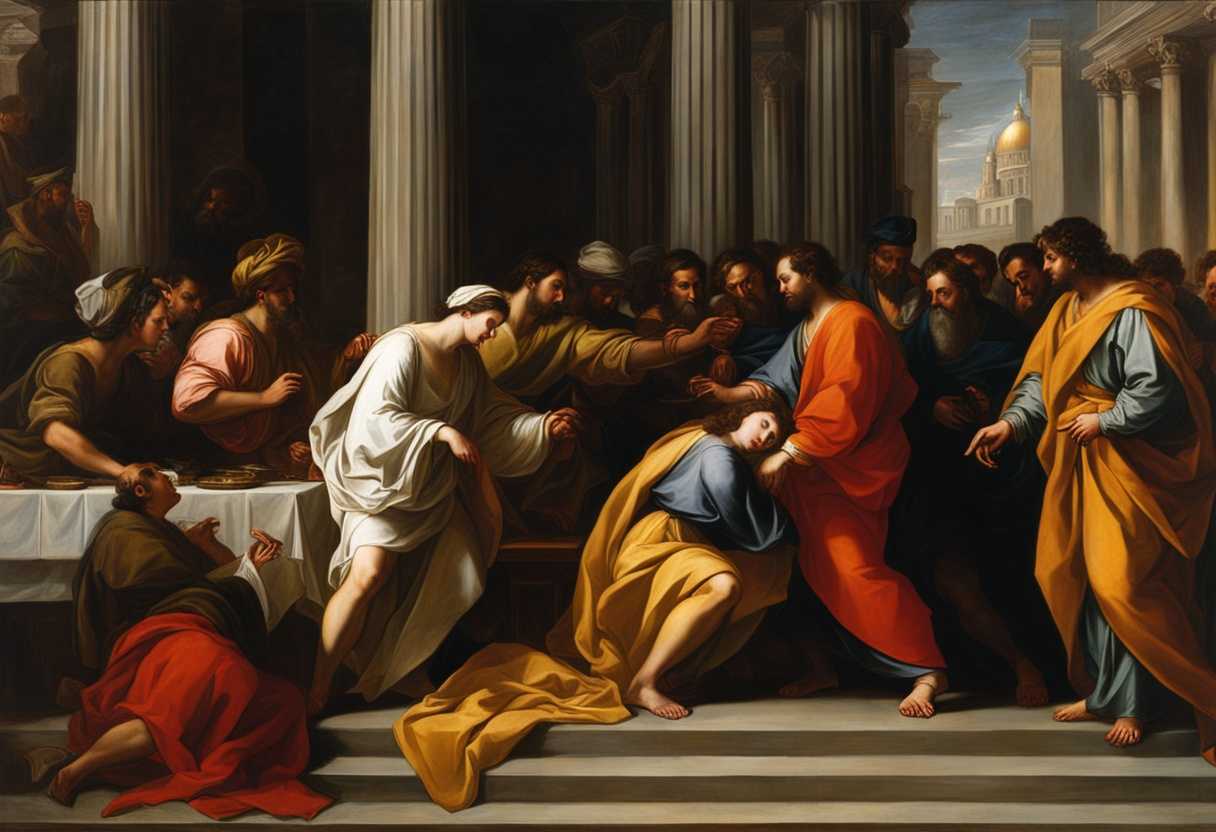
Setting the Scene for Ezekiel 16:1-63
In Ezekiel chapter 16, the prophet Ezekiel is called upon by God to deliver a powerful message to the people of Jerusalem. The scene is set in a vision where Ezekiel is taken by the Spirit of the Lord to a desolate place representing the sinful state of the city. As Ezekiel looks upon the ruins, he begins to recount the history of Jerusalem, likening it to a newborn baby abandoned in a field, covered in blood and left to die.
As Ezekiel continues his narrative, he describes how God, in His mercy, passed by and saw the baby squirming in its blood, and out of His great love, He took the child in, cleaned and clothed her, and made her His own. This allegory symbolizes God’s covenant relationship with the people of Jerusalem, how He chose them and blessed them abundantly, yet they turned away from Him and prostituted themselves with other nations and idols.
The scene is filled with imagery of betrayal, redemption, and restoration as Ezekiel vividly portrays the unfaithfulness of Jerusalem and God’s unwavering love and desire to bring them back into a right relationship with Him. The surroundings are bleak and desolate, mirroring the spiritual condition of the people, but through Ezekiel’s words, there is a glimmer of hope for reconciliation and renewal if they would only turn back to their faithful God.
What is Ezekiel 16:1-63 about?
God in this verse is comparing His relationship with the people of Israel to that of a faithful husband and a wayward wife. God is expressing His pain and heartache over Israel’s unfaithfulness, just as a husband would be hurt and disappointed if his wife were unfaithful. Despite Israel straying from Him and turning to other gods, God still remains faithful to them. This verse showcases God’s unconditional love and commitment to His people, even when they do not reciprocate that love.
This metaphor highlights the complexities of human relationships and the enduring nature of God’s love. Through this comparison, the verse conveys a deep sense of loyalty and forgiveness on God’s part, despite His people’s shortcomings. It prompts us to reflect on our own relationships and consider the ways in which we can emulate God’s unwavering faithfulness in our interactions with others. How does this metaphor of a wayward wife challenge us to examine our own faithfulness in our relationships, both with others and with God? How can we strive to embody God’s steadfast love and forgiveness in our own lives? Let this verse serve as a powerful reminder of the power of love and the importance of remaining faithful, even in times of adversity.
Understanding what Ezekiel 16:1-63 really means
In Ezekiel 16:1-63, we delve into a prophetic allegory where God uses the metaphor of an unfaithful wife to describe His relationship with Jerusalem. This passage serves as a poignant depiction of God’s grace, mercy, and the consequences of unfaithfulness. As we explore this chapter, we are transported to a time when Ezekiel, a prophet during the Babylonian exile, delivered messages addressing Israel’s sins and the promise of restoration. Through vivid imagery, the depth of Israel’s unfaithfulness and God’s unwavering commitment are vividly portrayed.
One key phrase, “Your birth and your nativity are from the land of Canaan,” underscores Israel’s humble and pagan origins, emphasizing that their identity and worth stem from God, not their beginnings. The imagery of God spreading His wing over Israel and covering their nakedness symbolizes His protective covenant, akin to a marriage vow. “You became Mine” signifies the intimate and exclusive relationship God desired with Israel, contrasting with their prideful turn to idolatry and infidelity. Despite Israel’s transgressions, God promises to establish a renewed covenant, showcasing His enduring mercy and faithfulness.
Drawing parallels with other biblical passages such as Hosea 2:19-20, Jeremiah 3:14, and Isaiah 54:5-8, we see consistent themes of God’s covenant love, forgiveness, and restoration despite Israel’s unfaithfulness. These verses echo the call for repentance and the assurance of God’s unwavering love, resonating with the message of Ezekiel 16:1-63. Today, this passage serves as a poignant reminder of God’s grace and mercy, urging us to reflect on our faithfulness in our relationship with Him and the consequences of spiritual infidelity.
Consider a story of someone who strayed from their faith, perhaps entangled in materialism or distractions, but found their way back to God. Just like Israel in the passage, they experienced God’s grace and restoration. For instance, a man deeply involved in his church who became consumed by his career, neglecting his spiritual life. Through personal and professional challenges, he rediscovered his need for God, returning to his faith with a renewed sense of purpose and peace. This anecdote mirrors the themes of Ezekiel 16:1-63, illustrating God’s enduring love and the hope of restoration.
In conclusion, Ezekiel 16:1-63 encapsulates profound lessons on God’s unwavering love, the significance of faithfulness, and the promise of restoration. Let us reflect on our own relationship with God, seeking His grace and mercy in our lives. Just as Israel was called to return to God despite their unfaithfulness, may we too turn back to Him, embracing His forgiveness and experiencing the fullness of His love.
How have I responded to God’s faithfulness and grace?
I have responded to God’s faithfulness and grace by recognizing my own unworthiness and the depth of His love for me. I see how He has been faithful to me even in the midst of my past failures and sins. Instead of turning away from me in disgust, He has shown me unconditional love and forgiveness, drawing me back to himself with open arms. The message of Ezekiel 16 reminds me of the need to respond to God’s faithfulness with humility and gratitude as I reflect on it. I acknowledge my own shortcomings and the ways I have strayed from God, but I am overwhelmed by His mercy and compassion towards me. This understanding leads me to repentance and a desire to live a life that reflects His love and faithfulness.
Through the example of God’s faithfulness in Ezekiel 16, I am inspired to remain steadfast in my faith and trust in Him. I am encouraged to seek repentance and renewal, knowing that God’s grace is always available to me. I am motivated to live a life that honors and glorifies Him, grateful for the unending love and faithfulness He continues to show me.
Application
Dear Reader, the words of Ezekiel 16 beckon us to look deep within our souls and reassess our connection with the divine. Just as a gardener tends to their garden with care, let us nurture our spiritual life with devotion and sincerity. The vivid pictures painted in these verses serve as a mirror, reflecting our own faith journey. It is time to heed the call, to embrace the light that guides us through life’s twists and turns. Will you take this chance to strengthen your bond with the divine and flourish in His grace?

Reverend Michael Johnson is an experienced Church Minister with a profound expertise in spirituality and guidance. With a serene presence and a compassionate heart, he has faithfully served his congregation for over 20 years, leading them on a spiritual journey towards inner peace and enlightenment. Reverend Johnson’s extensive knowledge of religious philosophies and profound understanding of human nature have made him a trusted confidant and mentor to many, as he seamlessly weaves his profound wisdom into life teachings. Reverend Johnson’s calming demeanor and empathetic nature continue to uplift and heal souls, nurturing a sense of unity and tranquility within his community.