
Ezekiel 29:1-6 is about Egypt’s pride and arrogance leading to judgment by God for claiming to have created the Nile River and failing to acknowledge God as the true creator and sovereign over all land and water.
1 In the tenth year, in the tenth month, on the twelfth day of the month, the word of the Lord came to me:
2 “Son of man, set your face against Pharaoh king of Egypt, and prophesy against him and against all Egypt;”
3 Speak, and say, Thus says the Lord God: “Behold, I am against you, Pharaoh king of Egypt, the great monster that lies in the midst of his streams, that says, ‘My Nile is my own; I made it for myself.’
4 But I will put hooks in your jaws, and make the fish of your streams stick to your scales. And I will draw you up out of the midst of your streams, with all the fish of your streams that stick to your scales.
5 And I will cast you out into the wilderness, you and all the fish of your streams; you shall fall on the open field, and not be brought together or gathered. To the beasts of the earth and to the birds of the heavens I give you as food.
6 Then all the inhabitants of Egypt shall know that I am the Lord. Because they have been a staff of reed to the house of Israel,
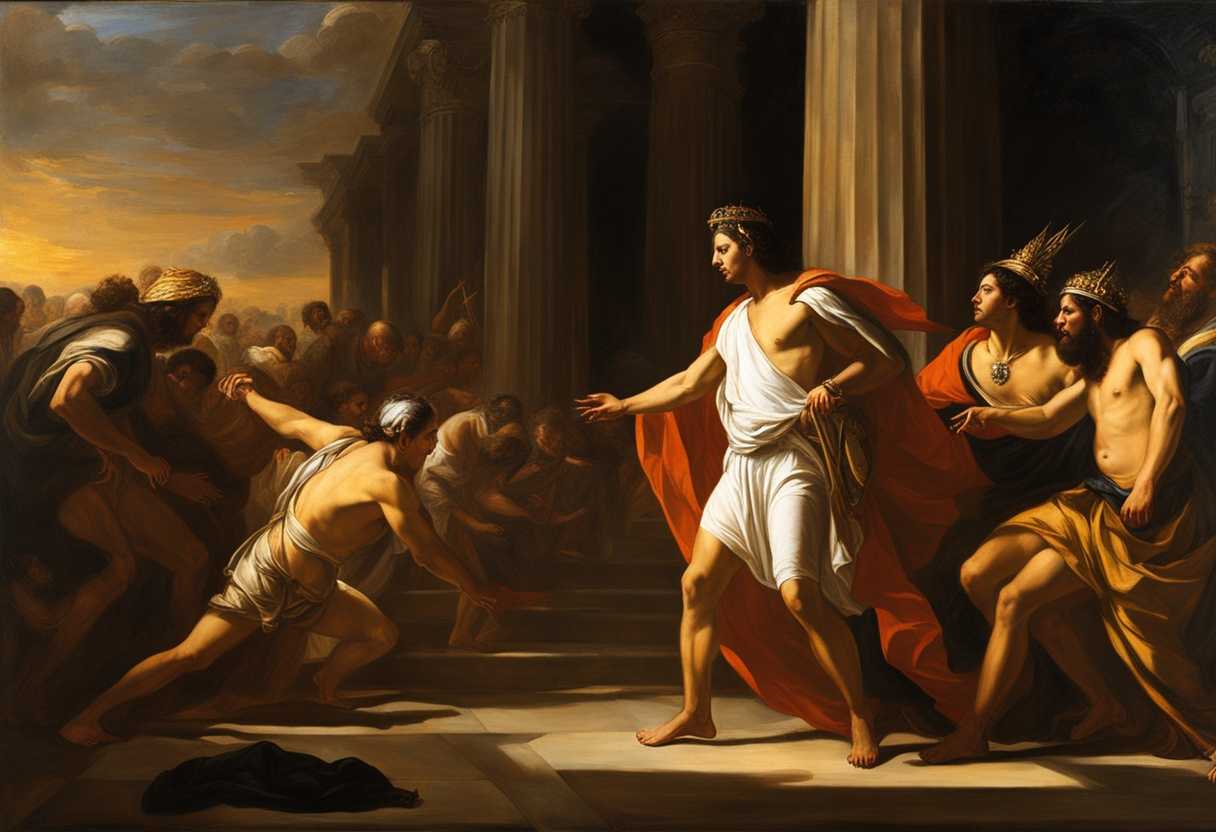
Setting the Scene for Ezekiel 29:1-6
The scene in Ezekiel 29:1-6 takes place in the city of Thebes, which was a prominent city in ancient Egypt. The prophet Ezekiel is delivering a message from the Lord to Pharaoh, the ruler of Egypt. The surroundings are likely opulent and grand, reflecting the power and wealth of the Egyptian empire at that time.
Pharaoh and his courtiers are gathered in a lavish palace, adorned with intricate hieroglyphics and statues of Egyptian gods. The atmosphere is tense as Ezekiel delivers a prophecy of judgment against Egypt for its pride and arrogance. Pharaoh, surrounded by his advisors and officials, listens intently as Ezekiel warns of the impending destruction that will come upon Egypt.
The prophet Ezekiel, a humble servant of God, stands before the mighty Pharaoh, delivering a message of warning and repentance. The room is filled with the scent of incense burning in honor of the Egyptian gods, contrasting with the solemnity of Ezekiel’s words. The tension in the air is palpable as Pharaoh and his courtiers grapple with the weight of the prophecy and the impending consequences of their actions.
What is Ezekiel 29:1-6 about?
God’s judgment on Egypt in this verse serves as a cautionary tale against pride and arrogance. It illustrates the consequences of placing worldly power and achievements above humility and compassion. The warning of destruction and exile serves as a reminder that no nation or individual is immune to the repercussions of hubris and vanity. The verse emphasizes the importance of humility, empathy, and righteousness in the eyes of God by highlighting the downfall of Egypt due to its pride. This verse prompts us to consider our own actions and attitudes as we reflect on it. Do we too fall prey to the trappings of pride and arrogance? Are we prioritizing our own desires over the well-being of others? The message here challenges us to cultivate humility and compassion in our interactions with others, recognizing that true strength lies in benevolence and virtue. Let us strive to embody the values of humility, empathy, and righteousness in our daily lives, heeding this biblical warning.
Understanding what Ezekiel 29:1-6 really means
Ezekiel 29:1-6 delivers a potent prophecy against Egypt, a message that reverberates through the corridors of time to challenge our understanding of power and authority. In the intricate tapestry of biblical prophecy, this passage stands as a testament to God’s sovereignty over all nations, not just Israel. The specific dating mentioned in the passage, “In the tenth year, in the tenth month on the twelfth day,” serves as a poignant reminder of the historical context and the meticulous precision of God’s message. It underscores the divine orchestration of events and the unwavering accuracy of God’s word.
The command to “Set your face against Pharaoh king of Egypt” signifies a direct confrontation and a divine judgment against the ruler of Egypt. God’s declaration, “I am against you, Pharaoh king of Egypt,” resonates with a thunderous warning against pride and self-reliance. Pharaoh’s audacious claim, “The Nile is mine; I made it for myself,” epitomizes the epitome of arrogance and self-deification, a stark reminder of the perils of exalting oneself above God.
Drawing parallels with other biblical passages such as Exodus 7-12, Isaiah 19:1-4, and Jeremiah 46:25-26, Ezekiel’s prophecy against Egypt weaves a tapestry of divine judgment and sovereignty. It echoes the timeless truth that God’s authority transcends borders and rulers, showcasing His supremacy over all earthly powers. In a world fraught with political turmoil and uncertainty, this prophecy stands as a beacon of hope, reassuring believers of God’s unwavering control over the affairs of nations and leaders.
The relevance of Ezekiel 29:1-6 in contemporary society cannot be overstated. It serves as a poignant reminder of the dangers of pride and self-reliance, urging individuals to acknowledge that all power and authority ultimately stem from God. This passage beckons us to embrace humility, repentance, and a profound trust in God’s ultimate sovereignty. It challenges us to reflect on our own attitudes towards power and control, prompting a reevaluation of our reliance on self rather than on the Almighty.
Consider a successful CEO who attributes their company’s success solely to their efforts, disregarding the contributions of others and external factors. When faced with a crisis beyond their control, the CEO’s illusion of power shatters, leading to a humbling realization of their limitations. This anecdote mirrors Pharaoh’s downfall, illustrating the transformative power of humility and the recognition of God’s supremacy over human endeavors.
In conclusion, Ezekiel 29:1-6 stands as a timeless testament to God’s sovereignty and the perils of pride. It beckons us to heed the call to humility, repentance, and a steadfast trust in God’s ultimate authority over all realms of life. As we navigate the complexities of our world, may this prophecy serve as a guiding light, illuminating the path towards a deeper understanding of God’s unassailable sovereignty and the imperative of humility in our walk with Him.
How do we handle pride and arrogance?
Pride and arrogance are often seen as negative traits in many religious teachings, including the Bible. The verses from Ezekiel warn against the pride of Egypt and its ruler, symbolized as a great monster in the midst of its streams. The text emphasizes that because of their arrogance, God will put hooks in their jaws and make the fish of their streams stick to their scales, showcasing a punishment for their haughty behavior.
The verses serve as a reminder that pride and arrogance can lead to downfall and punishment. It is a warning against becoming too self-assured or boastful, as it can result in negative consequences. Individuals who heed this message are encouraged to remain humble and avoid the pitfalls of excessive pride.
It is essential to reflect on our own actions and attitudes to ensure that we are not succumbing to feelings of superiority or behaving arrogantly. Instead, we should strive to cultivate humility and gratitude, acknowledging that all good things come from a higher power. This way, we can avoid the potential consequences of pride and arrogance highlighted in the verse from Ezekiel.
Application
Let’s take a moment to reflect on Ezekiel 29:1-6 and ponder the pitfalls of pride and arrogance in our lives. It’s time to check our hearts and request forgiveness for moments of self-importance. Let’s offer our pride to God and commit to serving with humility and obedience. Will you pause with me and seek God’s grace to walk the path of humble service?

Reverend Michael Johnson is an experienced Church Minister with a profound expertise in spirituality and guidance. With a serene presence and a compassionate heart, he has faithfully served his congregation for over 20 years, leading them on a spiritual journey towards inner peace and enlightenment. Reverend Johnson’s extensive knowledge of religious philosophies and profound understanding of human nature have made him a trusted confidant and mentor to many, as he seamlessly weaves his profound wisdom into life teachings. Reverend Johnson’s calming demeanor and empathetic nature continue to uplift and heal souls, nurturing a sense of unity and tranquility within his community.