
1 After these things God tested Abraham and said to him, “Abraham!” And he said, “Here I am.”
2 He said, “Take your son, your only son Isaac, whom you love, and go to the land of Moriah, and offer him there as a burnt offering on one of the mountains of which I shall tell you.”
3 So Abraham rose early in the morning, saddled his donkey, and took two of his young men with him, and his son Isaac. And he cut the wood for the burnt offering and arose and went to the place of which God had told him.
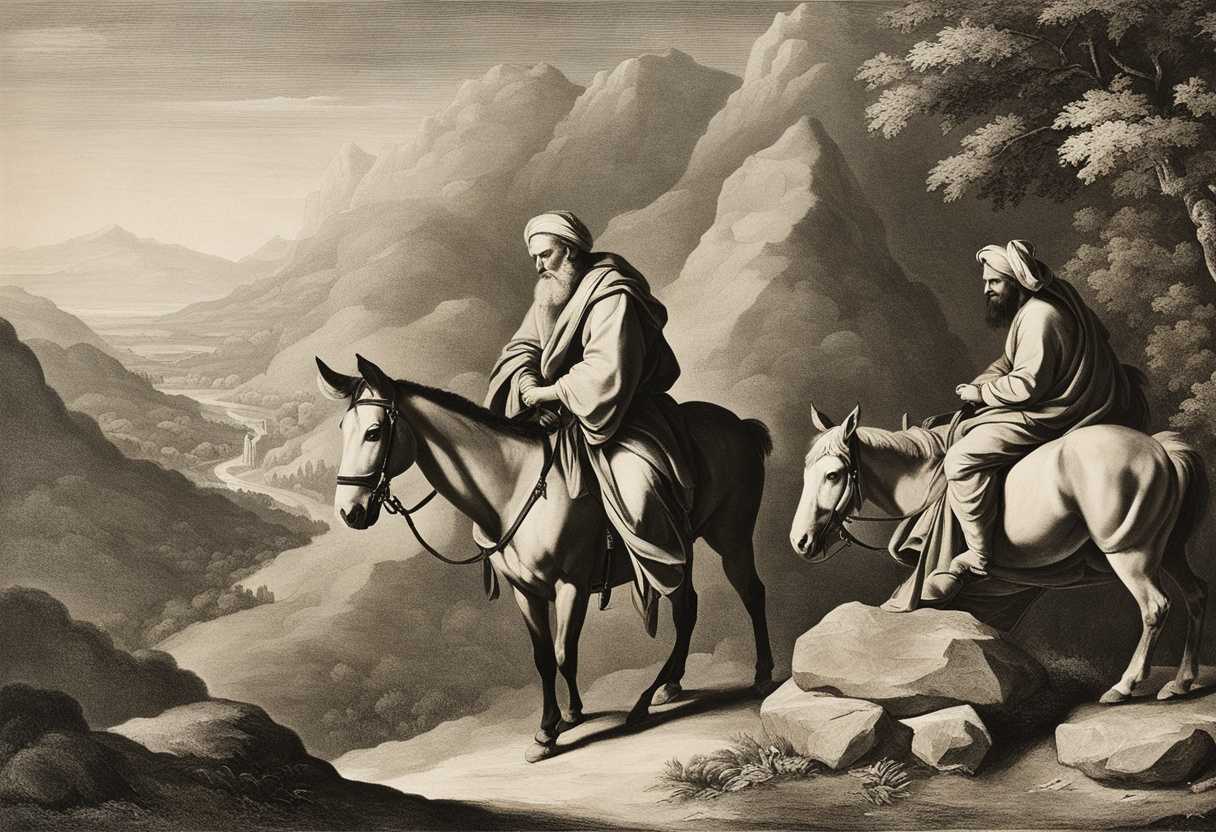
Setting the Scene for Genesis 22:1-3
In Genesis chapter 22, we find Abraham and his son Isaac in a profound and challenging situation. The scene is set on a mountain in the land of Moriah, where God has instructed Abraham to take his beloved son Isaac and offer him as a sacrifice. The surroundings are rugged and solemn, with the mountain looming in the background and the sound of the wind echoing through the valleys.
Abraham, a man of great faith, has obeyed God’s command without question, trusting in His ultimate plan. Isaac, unaware of the true purpose of their journey, walks alongside his father, carrying the wood for the sacrifice. The weight of the impending sacrifice hangs heavy in the air, yet both father and son continue on in obedience and faith.
As they reach the designated spot on the mountain, Abraham prepares the altar and binds Isaac, ready to carry out the unthinkable act. It is a moment of intense emotion and testing of faith, as Abraham wrestles with the command of God and the love for his son. The scene is a powerful testament to Abraham’s unwavering faith and obedience, as well as a foreshadowing of the ultimate sacrifice that God Himself will provide in the form of His Son, Jesus Christ.
What is Genesis 22:1-3 about?
Let’s delve into the profound meaning behind this powerful verse. Abraham faces the ultimate test of faith in this passage. God calls upon him to sacrifice his beloved son, Isaac, as an offering. This request challenges Abraham to his core, as it goes against the moral fabric of society and the natural inclination of a parent to protect their child.
Through this test, Abraham demonstrates unwavering obedience and trust in God’s plan, even when faced with the unimaginable. His willingness to follow God’s command showcases a level of faith that is truly awe-inspiring. This story serves as a timeless example of the importance of faith and obedience in the face of adversity. It prompts us to ponder the depths of our own faith and trust in a higher power, and to reflect on what sacrifices we are willing to make in the name of our beliefs. We are challenged to examine our own faith journeys as we contemplate this verse. How strong is our trust in God’s plan, even when faced with difficult and unfamiliar paths? Are we willing to make sacrifices, both big and small, in the name of our beliefs? Abraham’s story serves as a reminder that true faith requires us to surrender control and fully trust in the divine path laid out before us. Let us strive to embody the unwavering faith and obedience that Abraham displayed in the face of life’s most challenging tests.
Understanding what Genesis 22:1-3 really means
Structure for Commentary
- Introduction and Context
- Detailed Analysis of Key Phrases
- Connection to Other Biblical Passages
- Relevance to Modern Life
- Reflection and Anecdote
- Conclusion and Call to Action
Commentary on Genesis 22:1-3
Introduction and Context
Genesis 22:1-3 presents one of the most striking episodes in the life of Abraham, a pivotal figure in the Bible. This passage details God’s command to Abraham to sacrifice his son, Isaac, and Abraham’s immediate, unquestioning obedience. Let’s identify the subject: “We.” Now, rewrite the sentence in active voice: “We will delve into the meaning behind this dramatic story and explore its relevance to our lives today.”
Detailed Analysis of Key Phrases
First, consider the phrase “God tested Abraham.” This sets the stage for understanding the purpose behind God’s command. A test in biblical terms is not simply a trial but an opportunity for growth and reaffirmation of faith. God often tests his followers not to lead them to failure but to refine their character.
Next, the command “Take your son, your only son, whom you love—Isaac.” The specificity and emotional weight of these words highlight the depth of the sacrifice God was asking of Abraham. This wasn’t just about obedience; it was about trusting God with what was most precious to him.
Abraham’s response is equally critical: “Early the next morning Abraham got up and loaded his donkey.” His prompt action shows a remarkable level of faith. There is no record of hesitation or questioning, only immediate obedience.
Connection to Other Biblical Passages
The themes here echo throughout the Bible. Abraham’s faith is highlighted as being made complete by what he did in James 2:21-22. Hebrews 11:17-19 also recounts this story, emphasizing Abraham’s belief that God could even raise the dead, which speaks to his unwavering trust in God’s promises.
Relevance to Modern Life
So, how does this ancient text speak to us today? At its core, this passage is about trust and obedience, virtues that are timeless. Putting complete trust in God—and acting on that trust—is profoundly challenging yet essential in our fast-paced, often self-centered world.
Reflection and Anecdote
Imagine you’re faced with a difficult decision—a job opportunity that requires moving away from family, or a relationship at a crossroads. Just as Abraham was tested, we too face moments that challenge our faith and values. I recall a personal story from one of our congregants who felt called to leave a lucrative career in order to pursue non-profit work. It was a tough decision, fraught with uncertainty, but ultimately led to a more fulfilling and impactful life.
Conclusion and Call to Action
Genesis 22:1-3 invites us to reflect on our faith and obedience to God. Are we willing to trust God with our most cherished aspects of life? How do we respond when our faith is tested? Let us strive to embody Abraham’s unwavering trust and readiness to follow God’s direction, no matter how daunting it may seem. Think about areas in your life where you might be hesitant to fully trust God in your prayers and reflections this week. Ask for the courage to respond with the same immediacy and faith as Abraham. Let’s walk together in trust and obedience, growing stronger in our faith with each step.
What does true obedience to God look like?
True obedience to God can be seen in the story of Abraham when he was willing to sacrifice his son, Isaac, as commanded by God. This act of obedience demonstrates complete trust and surrender to God’s will, even when it was difficult and went against human understanding. Abraham’s willingness to obey God without hesitation or reservation reveals a deep faith and commitment to following God’s word with no question. This kind of obedience involves putting God above all else, even when it requires sacrifice or goes against our own desires.
True obedience to God goes beyond just following rules or performing rituals; it involves a genuine desire to please God and align one’s will with His. It requires a heart that is willing to submit to God’s authority and direction, trusting in His wisdom and goodness. Obedience to God involves a choice to surrender our own will and preferences in favor of seeking and following His will, even when it may not make sense or be comfortable. It is a conscious decision to live a life that reflects God’s values and priorities, even in the face of challenges or opposition.
Application
Think about Abraham’s choice in Genesis 22:1-3. He was ready to give up his son, his most treasured gift. In today’s world, what are you holding onto that might be holding you back? Are you willing to trust and take a leap of faith, even if it demands sacrifice? How can you put your faith into action today? What will you let go of to grow closer to your purpose?

Reverend Michael Johnson is an experienced Church Minister with a profound expertise in spirituality and guidance. With a serene presence and a compassionate heart, he has faithfully served his congregation for over 20 years, leading them on a spiritual journey towards inner peace and enlightenment. Reverend Johnson’s extensive knowledge of religious philosophies and profound understanding of human nature have made him a trusted confidant and mentor to many, as he seamlessly weaves his profound wisdom into life teachings. Reverend Johnson’s calming demeanor and empathetic nature continue to uplift and heal souls, nurturing a sense of unity and tranquility within his community.