
19 So Abraham returned to his young men, and they arose and went together to Beersheba. And Abraham lived at Beersheba.
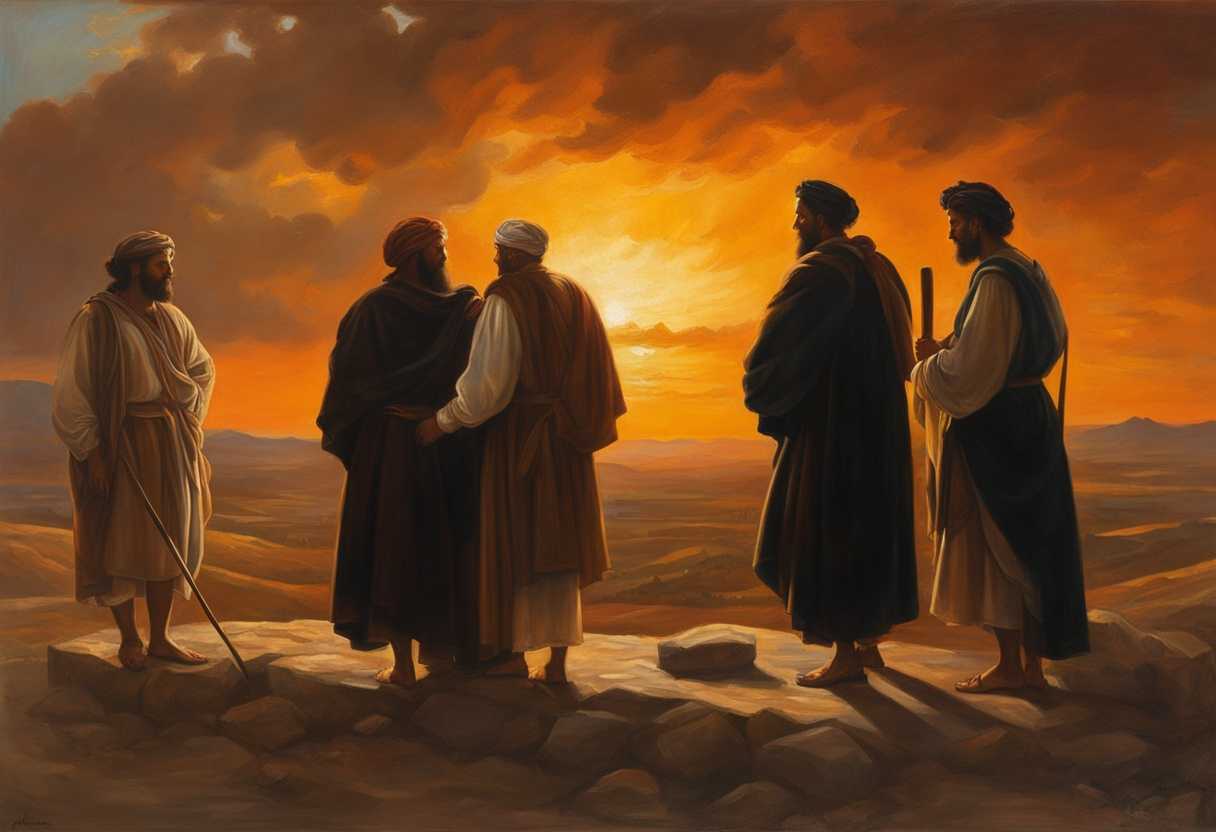
Setting the Scene for Genesis 22:19
In Genesis chapter 22, we find Abraham and his son Isaac at the center of a poignant and dramatic scene. The story unfolds with God testing Abraham’s faith by asking him to sacrifice his beloved son, Isaac, as a burnt offering. Abraham, obedient and faithful, sets out on this journey with Isaac, the two of them walking together towards the designated place of sacrifice.
As they reach the appointed spot, the tension in the air is palpable. The surroundings are solemn and austere, with the altar standing ready and the wood arranged for the sacrifice. Abraham, with a heavy heart but unwavering trust in God, prepares to carry out the unthinkable act. Isaac, unaware of the true purpose of their journey, innocently asks his father about the missing lamb for the offering. Abraham, with tears in his eyes, responds with faith, knowing that God will provide.
In this moment of intense emotion and divine intervention, just as Abraham raises his knife to sacrifice Isaac, an angel of the Lord intervenes, staying his hand. The scene is one of profound relief and gratitude as God provides a ram caught in a thicket as a substitute for Isaac. This pivotal moment showcases Abraham’s unwavering faith and God’s faithfulness in providing for those who trust in Him.
What is Genesis 22:19 about?
Ah, what a powerful verse this is! Here, we see Abraham acknowledging God’s faithfulness and provision in his life. Abraham declares his trust in God’s ability to meet his needs by naming the place “The Lord Will Provide.” It is a testament to his faith and his belief that God will always come through for him.
Think about it, my friend. Have you ever been in a situation where you felt like you had no way out, no solution in sight? Abraham’s act of naming the place serves as a reminder that even in our darkest moments, God is there, ready to provide for us. It challenges us to have the same unwavering faith in God’s provision, knowing that He is always working behind the scenes to take care of us.
So, as you reflect on this verse, I encourage you to consider the areas in your life where you may be struggling or in need. Can you trust in God’s provision, just like Abraham did? The same God who provided for Abraham is watching over you today, ready to meet your every need.
Understanding what Genesis 22:19 really means
Genesis 22:19 concludes a profound narrative that challenges our understanding of faith and obedience. Abraham has just undergone an incredible test, and the verse subtly marks his transition back to everyday life after a spiritually transformative experience. Let’s unpack the significance of this moment and its broader implications for believers.
Firstly, this verse serves as a demarcation between a moment of divine interaction and ordinary human existence. Abraham returns to Beersheba, where he continues to live. This geographical transition is not just physical but deeply symbolic. Beersheba, often a place representing normalcy and routine in scripture, contrasts sharply with the mount where Abraham was asked to sacrifice Isaac. Here, we see a return to the familiar and safe, following an episode of intense spiritual trial. This oscillation between the realms of the divine and the mundane exemplifies the life of faith, where extraordinary moments of divine revelation are often followed by returns to normal life. The phrase “lived at Beersheba” speaks volumes about the aftermath of faith-testing experiences. It suggests a period of reflection and possibly even recuperation. For modern believers, this teaches us about resilience and the process of integrating profound spiritual experiences into our daily lives. How do we continue after being so deeply tested? Abraham’s return to Beersheba symbolizes a re-engagement with the world, carrying new insights and deepened faith.
The concept of dwelling or living somewhere, as Abraham did in Beersheba, also invites us to consider our own foundations. Where do we ‘live’ spiritually, and how do our trials affect this? Just as Abraham likely pondered his near-sacrifice of Isaac and what it meant for his understanding of God’s will, we too are called to find meaning in our challenges, using them to deepen our roots in faith.
From a broader scriptural perspective, this verse connects with other passages where characters return from spiritually significant journeys, like Moses descending from Mount Sinai or Jesus returning from the desert. Each narrative includes a return, a continuation of life wherein the individual must integrate the divine encounter into their daily living. This reflects a pattern of spiritual growth: encounter, test, and integration. A parishioner once shared with me their struggle with illness and how during that trying time, they felt close to God but were uncertain about the future. Upon recovery, similar to Abraham, they had to find a way to ‘dwell’ again in their routine life, now with a renewed understanding of their faith and resilience. This verse, though brief, offers a profound reminder: no matter the trials we face, there is always a way back to ‘Beersheba,’ a place where we can live out our faith enriched by our experiences. How are you integrating your spiritual encounters into your everyday life?
What does obedience in faith look like for me?
Obedience in faith for me means being willing to trust and obey God wholeheartedly, even in the face of difficult and challenging circumstances. Just as Abraham demonstrated his faith by obeying God’s command to sacrifice his son Isaac, I am called to trust in God’s plan and follow His guidance, even when it may not make sense to me or go against my own desires.
Obedience in faith requires a complete surrender of my will and desires to God, and a willingness to follow His leading without hesitation. It means holding fast to my belief in God’s goodness and faithfulness, even when I cannot see the outcome or understand the reasons behind His commands. Like Abraham, I am called to step out in faith, trusting that God will provide and fulfill His promises in His perfect timing. Obedience in faith ultimately involves continually growing and trusting in God’s sovereignty and wisdom. It involves stepping out in faith, even when the path may seem uncertain or challenging, knowing that God is faithful and will always lead me according to His perfect plan.
Application
Imagine you’re at the helm of a bustling family dinner or steering through a hectic workday. In the chaos, there’s an opportunity to anchor yourself just like Abraham did, not on Mount Moriah, but in your daily tasks and decisions. Abraham’s unwavering trust as he climbed the mountain is a call for us to climb our own metaphorical mountains with the same courage and faith. Each challenge, whether at work or home, is a chance to exercise faith and demonstrate obedience to a higher wisdom. So, how will you echo Abraham’s steps in your personal and professional life? Will you rise to the occasion, trusting that every step, even the uncertain ones, is part of a greater plan? What mountain will you conquer today?

Reverend Michael Johnson is an experienced Church Minister with a profound expertise in spirituality and guidance. With a serene presence and a compassionate heart, he has faithfully served his congregation for over 20 years, leading them on a spiritual journey towards inner peace and enlightenment. Reverend Johnson’s extensive knowledge of religious philosophies and profound understanding of human nature have made him a trusted confidant and mentor to many, as he seamlessly weaves his profound wisdom into life teachings. Reverend Johnson’s calming demeanor and empathetic nature continue to uplift and heal souls, nurturing a sense of unity and tranquility within his community.