
15 Then Laban said to Jacob, “Because you are my kinsman, should you therefore serve me for nothing? Tell me, what shall your wages be?”
16 Now Laban had two daughters. The name of the older was Leah, and the name of the younger was Rachel.
17 Leah’s eyes were weak, but Rachel was beautiful in form and appearance.
18 Jacob loved Rachel. And he said, “I will serve you seven years for your younger daughter Rachel.”
19 Laban said, “It is better that I give her to you than that I should give her to any other man; stay with me.”
20 So Jacob served seven years for Rachel, and they seemed to him but a few days because of the love he had for her.
21 Then Jacob said to Laban, “Give me my wife that I may go in to her, for my time is completed.”
22 So Laban gathered together all the people of the place and made a feast.
23 But in the evening he took his daughter Leah and brought her to Jacob, and he went in to her.
24 Laban gave his female servant Bilhah to his daughter Rachel to be her servant.
25 And in the morning, behold, it was Leah! And Jacob said to Laban, “What is this you have done to me? Did I not serve with you for Rachel? Why then have you deceived me?”
26 And Laban said, “It is not so done in our country, to give the younger before the firstborn.
27 Complete the week of this one, and we will give you the other also in return for the service which you shall serve with me for another seven years.”
28 Jacob did so, and completed her week. Then Laban gave him his daughter Rachel to be his wife.
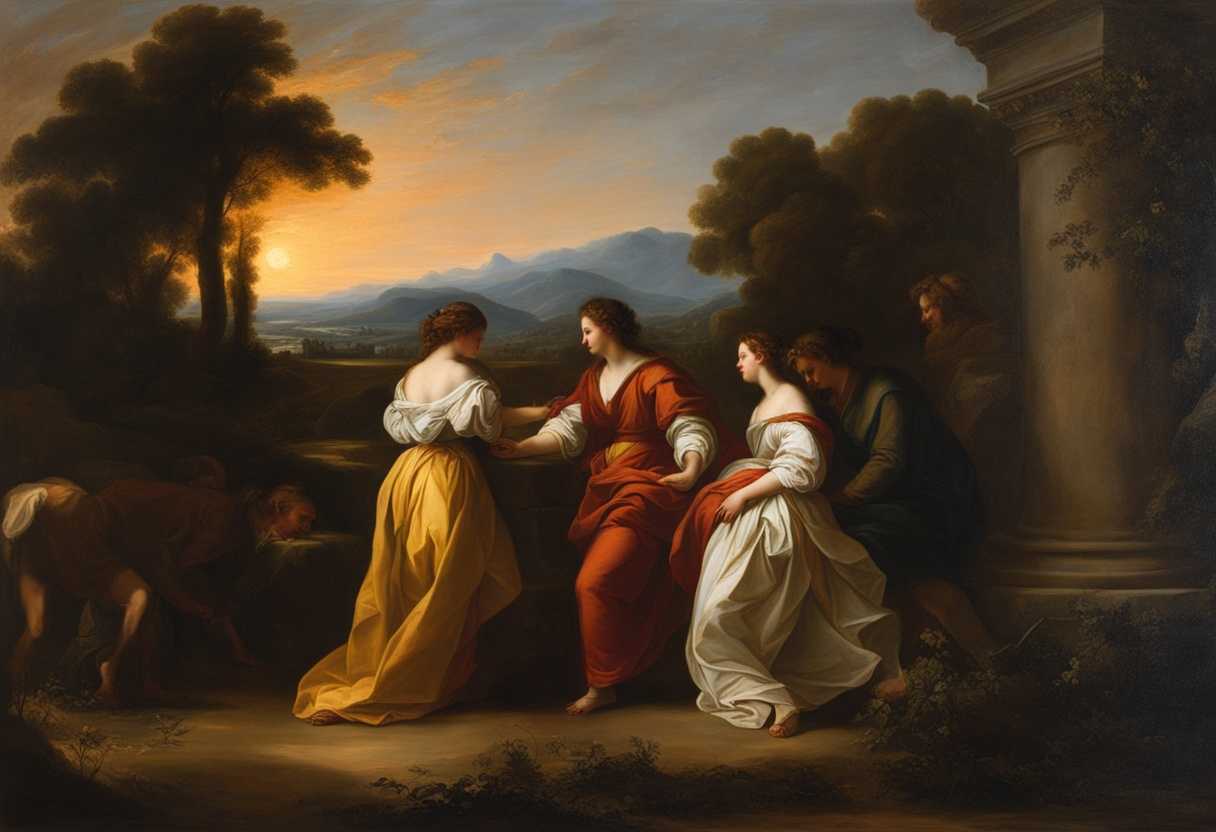
Setting the Scene for Genesis 29:15-28
In Genesis 29:15-28, we find Jacob arriving in the land of Haran. He had left his home to escape the wrath of his brother Esau, who wanted to kill him for taking his blessing from their father, Isaac. Jacob reaches a well in Haran where shepherds are gathering their flocks. Among them is Rachel, the daughter of Laban, Jacob’s uncle. Rachel is a shepherdess, and she has come to water her father’s sheep.
As Jacob approaches the well, he sees Rachel and is immediately captivated by her beauty. Overwhelmed with emotion, he rolls the stone away from the well and waters Rachel’s flock. Rachel runs home to tell her father Laban about the stranger who helped her. Laban, excited to meet his nephew Jacob, invites him to stay with them. Jacob agrees to work for Laban for seven years in exchange for Rachel’s hand in marriage, as he is deeply in love with her.
The scene is set near a well in the land of Haran, with the sun beginning to set, casting a warm glow over the surroundings. The sound of sheep bleating and the gentle flow of water from the well create a peaceful atmosphere. Jacob, Rachel, Laban, and the shepherds are all present, their figures silhouetted against the evening sky as they engage in conversation and make plans for the future.
What is Genesis 29:15-28 about?
Jacob’s complicated relationship with Laban culminates in this verse. Jacob fulfills Laban’s stipulations by marrying both Leah and Rachel, yet simultaneously faces the repercussions of his own deception. Reflecting on this passage prompts us to ponder the consequences of our actions, particularly when they involve deceit or manipulation.
Have you ever found yourself in a situation where you had to navigate the aftermath of your choices? Just like Jacob, we may sometimes experience challenges and conflicts as a result of our past actions. This verse serves as a poignant reminder of the importance of integrity and honesty in our interactions with others. It encourages us to consider the long-term effects of our decisions and the impact they may have on our relationships and circumstances. We delve into the complexities of Jacob’s story, inviting us to reflect on our own lives and the ways in which we handle moral dilemmas. How can we learn from Jacob’s journey and strive to act with transparency and authenticity in our own interactions? We will use this verse as a catalyst for self-examination and growth, seeking to cultivate a spirit of honesty and accountability in all aspects of our lives.
Understanding what Genesis 29:15-28 really means
We immerse ourselves in a narrative rich with themes of love, deception, and family dynamics as we explore Genesis 29:15-28. Historically and spiritually, this passage offers much to dissect and apply to our modern lives. It centers around Jacob, Laban, Leah, and Rachel, turning the spotlight on ethical questions and personal relationships.
First, let us consider the character of Jacob, who arrives at Laban’s household and falls in love with Rachel. His willingness to work seven years to win Rachel’s hand in marriage speaks volumes about his commitment and the value he places on love. “Seven years seemed to him but a few days, for the love he had for her” – this phrase alone could stir a whole sermon about patience and genuine affection. However, the twist comes when Laban deceives Jacob, giving him Leah instead of Rachel. Jacob, the deceiver in his own story with Esau, here finds himself deceived, highlighting a recurring biblical theme: the measure you give will be the measure you get back (Luke 6:38).
Laban’s actions open a discussion on honesty and integrity. Despite cultural and historical differences in marriage customs, the core ethical implications remain relevant. Deception, regardless of its justification, often leads to pain. This brings us to Leah and Rachel, figures sometimes overshadowed yet pivotal. Their plight—being used as pawns in their father’s schemes—reflects issues of autonomy and consent that are incredibly pertinent today.
For us, this story resonates on two levels: personal and communal. Personally, we are urged to reflect on our honesty and how we treat relationships. Are we transparent and fair in our dealings, or do we too deceive for personal gain? Communally, it challenges the functioning of our families and larger networks; it questions the dynamics we cultivate and the legacies we build.
I recall a story in my own ministry, where two brothers were estranged over an inheritance dispute. Each tried to outmaneuver the other, much like Jacob and Laban. It was only through mediating and reflecting on scriptures like this that reconciliation was considered. They saw their story mirrored in Jacob and Laban’s and realized the futility of their deception. As readers and followers of biblical teachings, let us take Genesis 29:15-28 as both a caution and a guide. It asks us to look inwardly at our motives and outwardly at our actions, always striving for righteousness matched with compassion. May we be as earnest as Jacob in his love in our relationships, yet more wise and just in our actions. True fulfillment and peace come from honest dealings and patient love. What areas in your life might require such reflection and change today?
How can we navigate complex relationships with integrity?
Navigating complex relationships with integrity involves being truthful and transparent, as seen in the story of Jacob, Rachel, and Leah in Genesis 29:15-28. Jacob was honest with Laban, Rachel, and Leah about his intentions and expectations in the relationships. He worked diligently for Laban, fulfilling his end of the agreement, despite the unforeseen circumstances he encountered. Jacob remained committed to his responsibilities and did not deceive or manipulate to achieve his desires.
Integrity in relationships also requires honoring commitments and respecting the feelings and rights of others as demonstrated by Jacob marrying both Rachel and Leah according to the customs of the time. He did not favor one over the other or neglect his responsibilities towards either wife, even when faced with challenges and difficulties. Jacob maintained integrity in his complex familial relationships by upholding his commitments and treating both women with fairness and respect.
Additionally, navigating complex relationships with integrity involves handling conflicts and differences with patience, understanding, and empathy. Despite the rivalry and jealousy between Rachel and Leah, Jacob remained a stabilizing force in their relationship, striving to create harmony and understanding between them. Jacob exemplified integrity in his approach to managing the complexities within his family dynamic by communicating openly, listening attentively, and showing compassion towards each individual’s feelings and experiences.
Application
Imagine you’re at the helm of your life’s ship, navigating through the choppy waters of daily decisions. Each choice you make sets the course like turning the wheel toward distant horizons. In the story of Jacob, we see how choices ripple through time, affecting not just Jacob but his future generations. Every decision is like a stroke of the hammer in the construction of your family’s legacy. Are your choices building a strong foundation or a fragile shack? Are you steering toward the stars of blessing and purpose? What legacy do you want to leave for the world watching your journey?

Reverend Michael Johnson is an experienced Church Minister with a profound expertise in spirituality and guidance. With a serene presence and a compassionate heart, he has faithfully served his congregation for over 20 years, leading them on a spiritual journey towards inner peace and enlightenment. Reverend Johnson’s extensive knowledge of religious philosophies and profound understanding of human nature have made him a trusted confidant and mentor to many, as he seamlessly weaves his profound wisdom into life teachings. Reverend Johnson’s calming demeanor and empathetic nature continue to uplift and heal souls, nurturing a sense of unity and tranquility within his community.