
17 So Jacob arose and set his sons and his wives on camels.
18 and he drove away all his livestock, all his property that he had gained, the livestock in his possession that he had acquired in Paddan-aram, to go to the land of Canaan to his father Isaac.
19 Now Laban had gone to shear his sheep, and Rachel stole her father’s household gods.
20 And Jacob tricked Laban the Aramean, by not telling him that he intended to flee.
21 So he fled with all that he had, and arose and crossed the Euphrates, and set his face toward the hill country of Gilead.
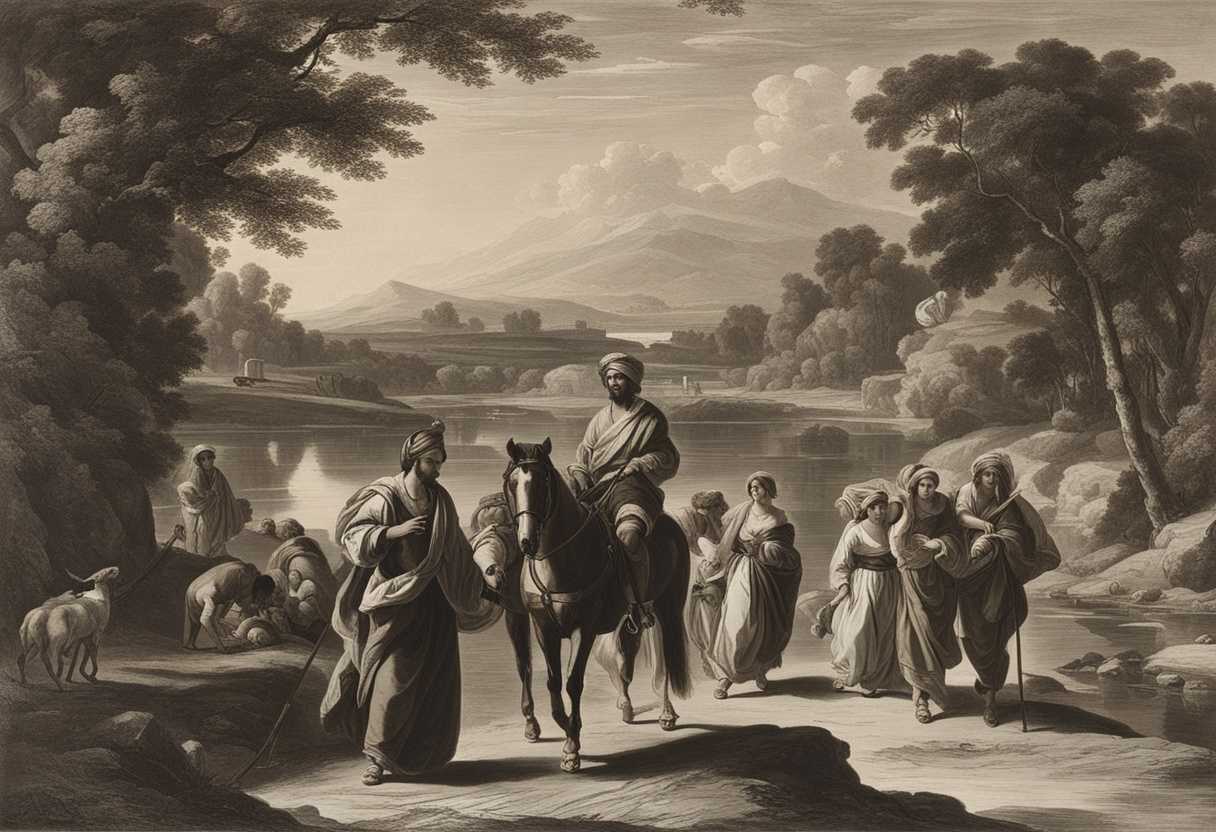
Setting the Scene for Genesis 31:17-21
In Genesis chapter 31, we find Jacob preparing to leave his father-in-law Laban’s household in Haran. Jacob had worked for Laban for twenty years, marrying his daughters Leah and Rachel during that time. However, tensions had arisen between Jacob and Laban, and Jacob decided it was time to return to his homeland.
As Jacob made preparations to depart with his wives, children, and livestock, Laban was away shearing his sheep. Rachel, aware of her father’s displeasure towards Jacob, secretly took Laban’s household gods. Jacob, unaware of Rachel’s actions, set out with his family and possessions towards the land of Canaan. Laban soon discovered the theft and pursued Jacob, catching up with him in the hill country of Gilead.
The scene is tense as Laban confronts Jacob about the stolen idols. Surrounded by the rugged terrain of Gilead, the two men engage in a heated exchange, with Laban accusing Jacob of deceit and betrayal. The confrontation sets the stage for a pivotal moment in Jacob’s journey, as he defends his actions and asserts his independence from Laban’s control.
What is Genesis 31:17-21 about?
Jacob makes a daring escape from his father-in-law Laban’s household in this verse, taking with him his family and all his possessions. However, what adds a twist to the story is the fact that Rachel, Jacob’s wife, secretly steals Laban’s household gods before they leave. This action sets the stage for further tension and drama in the story, as Laban pursues Jacob with the accusation of stealing his gods. We can ponder on the complexities of human relationships and the lengths people may go to in times of conflict or uncertainty as we reflect on this verse. We may also consider the themes of deceit, betrayal, and the consequences of our actions. How does Rachel’s decision to steal Laban’s household gods affect the characters involved? How does this event contribute to the overall narrative of Jacob’s journey and his relationship with Laban? These questions invite us to dive deeper into the story and explore the motivations and implications of the characters’ choices.
Understanding what Genesis 31:17-21 really means
We uncover a narrative rich in themes of liberation, trust, and divine guidance in the verses Genesis 31:17-21. These themes resonate deeply, providing valuable insights into our personal and communal faith journeys.
Context and Overview:
Jacob, having served Laban for over two decades, decides it’s time to leave, taking his family and possessions with him. This decision is not made lightly; it’s fueled by a keen understanding that God is directing his path towards his homeland, despite the potential dangers from both Laban and Esau, who may still hold a grudge. This moment encapsulates a significant act of faith and obedience. Bold steps in faith mean taking action despite an uncertain future. Jacob’s journey embodies the courage to follow divine guidance, even when the path is fraught with potential conflict. Similarly, a modern believer might find themselves discerning God’s call, possibly facing opposition from familiar quarters. It’s about trust. Just as Jacob trusted God’s promises and guidance despite the risks, we are called to trust in God’s overarching plans for our lives.
Relevance to Today:
This passage is incredibly pertinent today as it mirrors our own experiences with decision-making and seeking God’s direction amidst today’s complexities. Who hasn’t felt the trepidation of a major life change or a call to a new vocation? Jacob’s journey from a position of comfort under Laban’s employ to stepping into the unknown demonstrates a profound reliance on God’s faithfulness, a lesson for all believers wrestling with uncertainty.
Analyzing Key Phrases:
The critical phrase, “Jacob got up and put his children and his wives on camels,” reveals more than a mere travel log. It signifies an act of decisive leadership and protective care over his family, driven by unwavering faith in God’s promise. It teaches us about the need for proactive faith—faith that does not just wait passively but steps up to enact God’s will.
Application and Conclusion:
This narrative calls each of us to reflect: Are there areas in our own lives where God is asking us to move forward in faith? Just like Jacob, you might be on the precipice of a major decision. It might be as personal as a career change or as significant as a leap into a new ministry or mission. Remember Jacob’s story in closing as a clear demonstration of how intricate, and sometimes challenging, obedience to God can be. Yet, it is through these acts of faith that we walk closer with God, deepen our trust, and fulfill our divine purpose. Each step, especially the daunting ones, is an opportunity to witness God’s faithfulness and provision unfold in our lives.
How can we discern God’s guidance in difficult decisions?
We can discern God’s guidance by reflecting on His promises and seeking His wisdom through prayer and study of His Word when facing difficult decisions. Just as Jacob sought God’s direction in his journey, we too can turn to God for guidance in times of uncertainty. We can receive clarity and direction from God by aligning our decisions with the principles and teachings of the Bible.
Additionally, seeking counsel from mature and faithful believers can help us in discerning God’s guidance. Surrounding ourselves with a community of believers who can provide wise counsel and hold us accountable can help us make decisions that align with God’s will. Through the encouragement and insights of fellow Christians, we can navigate challenging decisions with confidence that we are walking in God’s guidance. Trusting in God’s faithfulness and sovereignty can ultimately give us peace in making difficult decisions. We can move forward with confidence by putting our faith in God’s provision and guidance, knowing that He is always present to guide and direct our paths. When we acknowledge God’s control over our lives and submit our decisions to Him in prayer, we can rest in the assurance that He will lead us in the way that brings honor and glory to Him.
Application
Imagine you’re at a crossroads in your daily grind, much like Jacob escaping Laban’s clutches, feeling that push to chart a bold new path. It’s about programming your internal GPS to follow the coordinates God lays out, even when fog clouds the road ahead. Trust in that voice guiding you, as you do when your family’s safety is in your hands. Dare to believe that the master plan is tailored just for you, navigating through tough spots with divine precision. Will you step up, listen closely, and pivot towards that calling with the courage of Jacob?

Reverend Michael Johnson is an experienced Church Minister with a profound expertise in spirituality and guidance. With a serene presence and a compassionate heart, he has faithfully served his congregation for over 20 years, leading them on a spiritual journey towards inner peace and enlightenment. Reverend Johnson’s extensive knowledge of religious philosophies and profound understanding of human nature have made him a trusted confidant and mentor to many, as he seamlessly weaves his profound wisdom into life teachings. Reverend Johnson’s calming demeanor and empathetic nature continue to uplift and heal souls, nurturing a sense of unity and tranquility within his community.