
Genesis 32:3-21 is about Jacob preparing himself to meet his brother Esau after years of separation, demonstrating humility, fear, and reliance on God through prayer and sending gifts as a means to seek reconciliation and forgiveness.
3 And Jacob sent messengers before him to Esau his brother in the land of Seir, the country of Edom.
4 He commanded them, “Thus you shall say to my lord Esau: Thus says your servant Jacob, ‘I have sojourned with Laban and stayed until now.
5 I have oxen, donkeys, flocks, male servants, and female servants. I have sent to tell my lord, in order that I may find favor in your sight.’”
6 And the messengers returned to Jacob, saying, “We came to your brother Esau, and he is coming to meet you, and there are four hundred men with him.”
7 Then Jacob was greatly afraid and distressed.
8 for he thought, “I may appease him with the present that goes ahead of me, and afterward I shall see his face. Perhaps he will accept me.”
9 And Jacob said, “O God of my father Abraham and God of my father Isaac, O Lord who said to me, ‘Return to your country and to your kindred, that I may do you good,’
10 I am not worthy of the least of all the deeds of steadfast love and all the faithfulness that you have shown to your servant, for with only my staff I crossed this Jordan, and now I have become two camps.
11 Please deliver me from the hand of my brother, from the hand of Esau, for I fear him, that he may come and attack me, the mothers with the children.
12 But you said, ‘I will surely do you good, and make your offspring as the sand of the sea, which cannot be numbered for multitude.’
13 So he stayed there that night, and from what he had with him he took a present for his brother Esau,
14 two hundred female goats and twenty male goats, twenty ewes and twenty rams,
15 thirty milking camels and their calves, forty cows and ten bulls, twenty female donkeys and ten male donkeys.
16 He delivered them into the hand of his servants, every drove by itself, and said to his servants, “Pass on ahead of me and put a space between drove and drove.”
17 He commanded the first, “When Esau my brother meets you and asks you, ‘To whom do you belong? Where are you going? And whose are these ahead of you?’
18 then you shall say, ‘They belong to your servant Jacob. They are a present sent to my lord Esau. And moreover, he is behind us.’”
19 And you shall say, ‘Moreover, your servant Jacob is behind us.’” For he thought, “I may appease him with the present that goes ahead of me, and afterward I shall see his face. Perhaps he will accept me.”
20 and you shall say, ‘Moreover, your servant Jacob is behind us.’” For he thought, “I may appease him with the present that goes ahead of me, and afterward I shall see his face. Perhaps he will accept me.”
21 So the present passed on before him, and he himself stayed that night in the camp.
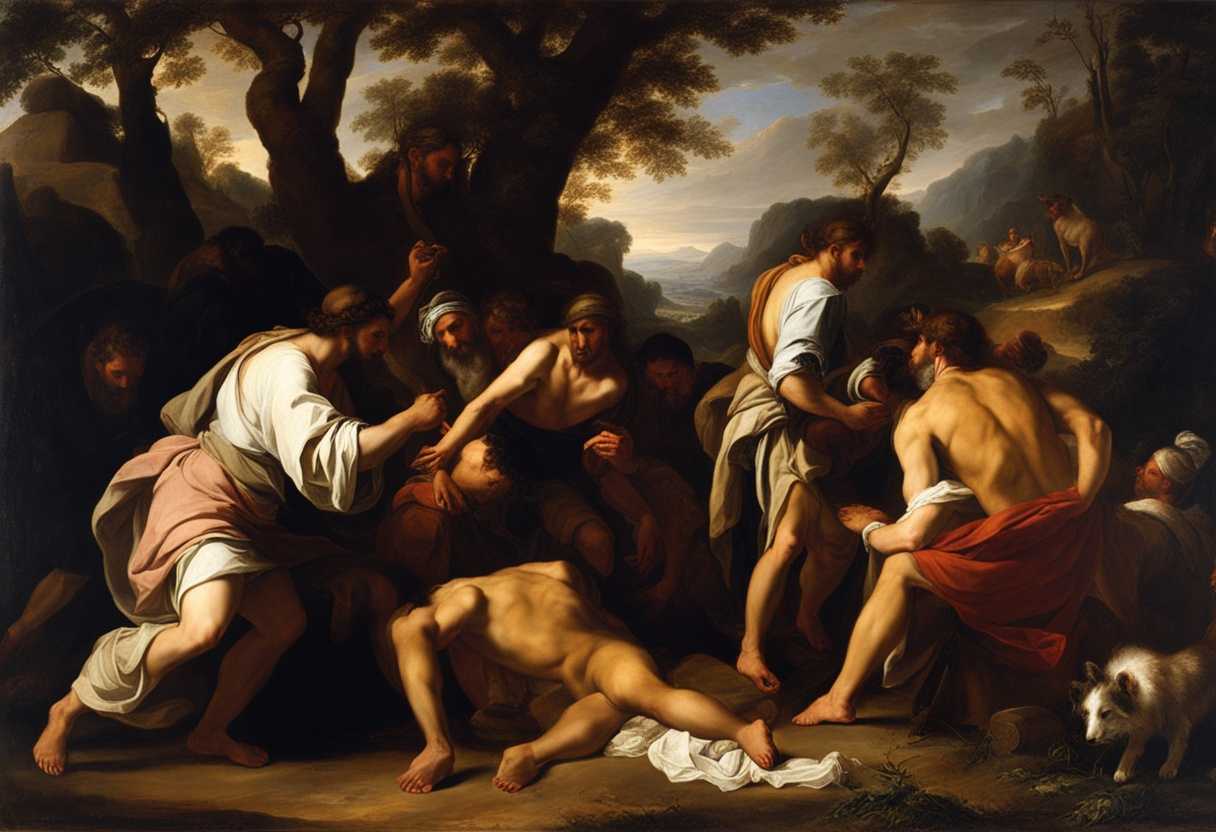
Setting the Scene for Genesis 32:3-21
In Genesis 32:3-21, we find Jacob on his way back to Canaan after spending many years in Haran. He is returning with his family, servants, and livestock. As he nears his homeland, Jacob receives word that his brother Esau, whom he had deceived and angered in the past, is coming to meet him with 400 men. Fearful of Esau’s intentions, Jacob divides his group into two camps, hoping that if one is attacked, the other may escape.
The scene is tense as Jacob prepares for the encounter with Esau. He sends messengers ahead with gifts for his brother, hoping to appease him. That night, Jacob is left alone by the Jabbok River, where he wrestles with a mysterious man until daybreak. This encounter leaves Jacob with a limp but also a blessing, as he is renamed Israel, signifying his struggle and victory with God. The surroundings are described as a lonely and intense moment of wrestling, both physically and spiritually, as Jacob grapples with his past and his future.
What is Genesis 32:3-21 about?
Jacob takes a proactive approach to mend his relationship with his estranged brother, Esau in this verse. Jacob is showing humility, remorse, and a desire for reconciliation by sending generous gifts ahead of their meeting. It signifies Jacob’s willingness to make amends and seek forgiveness for past wrongs between them.
This act of sending gifts can also be seen as a gesture of respect and a demonstration of Jacob’s understanding of the importance of maintaining family bonds. It shows that Jacob is willing to take the first step towards rebuilding trust and repairing their fractured relationship. The gifts act as a symbol of peace offering and a way to soothe any lingering animosity between the two brothers. This verse prompts us to consider the power of humility, forgiveness, and reconciliation in our own relationships as we reflect on it. It challenges us to think about how we can take proactive steps to mend broken relationships and seek forgiveness from those we may have wronged. Just like Jacob, we are reminded of the value of making amends, showing remorse, and extending gestures of peace to foster healing and harmony in our relationships.
Understanding what Genesis 32:3-21 really means
In Genesis 32:3-21, we find Jacob at a pivotal moment in his life, preparing to face his brother Esau after years of separation. The tension is palpable as Jacob sends messengers ahead with gifts, hoping to appease Esau’s potential anger. In his fear and uncertainty, Jacob turns to God in prayer, acknowledging his unworthiness and pleading for deliverance from Esau’s hand. This act of humility and dependence on God’s protection sets the stage for a powerful display of faith and trust in divine providence.
“I am unworthy of all the kindness and faithfulness you have shown your servant,” Jacob’s words echo with humility and gratitude towards God. Despite his past mistakes and deceitful actions, Jacob recognizes the grace and mercy that God has bestowed upon him. This acknowledgment serves as a poignant reminder of the importance of humility in our relationship with God and others.
“Save me, I pray, from the hand of my brother Esau,” Jacob’s heartfelt plea reveals his vulnerability and desperate need for God’s intervention. In times of fear and uncertainty, like Jacob facing Esau, we are reminded to turn to God in prayer, seeking His protection and guidance. Jacob’s example teaches us the power of sincere supplication and trust in God’s ability to deliver us from our troubles.
“I will surely make you prosper and will make your descendants like the sand of the sea,” Jacob recalls God’s promise, reinforcing his faith and hope in the midst of adversity. Despite the looming threat from Esau, Jacob clings to the assurance of God’s covenant and the abundant blessings promised to him and his descendants. This unwavering faith in God’s promises inspires us to trust in His provision and sovereignty, even in the face of daunting challenges.
In our modern lives, we can relate to Jacob’s experience of fear and anxiety when confronted with difficult situations. Whether it be strained relationships, looming conflicts, or uncertain futures, we can learn from Jacob’s example of turning to God in prayer and holding onto His promises. Just as Jacob sought reconciliation with Esau, we are called to make amends and seek peace with those we have wronged or who have wronged us.
Jacob’s story serves as a timeless reminder of the importance of humility, gratitude, and faith in our walk with God. His journey of reconciliation with Esau highlights the transformative power of seeking peace and restoration in broken relationships. As we navigate our own conflicts and challenges, may we emulate Jacob’s trust in God’s protection and guidance, knowing that He is with us every step of the way.
How can we bring reconciliation with those who have wronged us?
Reconciliation can be achieved by taking the initiative to make amends with those who have wronged us. We can open the pathway for healing and forgiveness by having the courage to confront the situation head-on and address the past grievances. We too should be willing to take action towards reconciliation, just as Jacob prepared gifts and took steps to reconcile with his brother Esau after their past conflicts.
However, reconciliation also requires humility and a willingness to acknowledge our own faults and shortcomings in the situation. Jacob humbled himself before Esau, recognizing his own past mistakes and seeking forgiveness. We can create an environment where reconciliation is more likely to occur by demonstrating a spirit of humility and a genuine desire to make things right. Reconciliation often involves a process of communication and understanding. We can work towards mutual understanding and find a way to move forward together by engaging in open and honest dialogue with the person who has wronged us. Through genuine efforts to listen, empathize, and seek understanding, we can build bridges towards reconciliation and healing in our relationships.
Application
When facing uncertain and fearful moments, it’s crucial to seek divine guidance as Jacob did in Genesis 32:3-21. Just as Jacob sought the Lord’s protection, let’s seek God’s strength in our own modern battles. Don’t depend solely on your skills; instead, put your faith in the Higher Power. Are you ready to lean on God’s wisdom and guidance in your toughest times?

Reverend Michael Johnson is an experienced Church Minister with a profound expertise in spirituality and guidance. With a serene presence and a compassionate heart, he has faithfully served his congregation for over 20 years, leading them on a spiritual journey towards inner peace and enlightenment. Reverend Johnson’s extensive knowledge of religious philosophies and profound understanding of human nature have made him a trusted confidant and mentor to many, as he seamlessly weaves his profound wisdom into life teachings. Reverend Johnson’s calming demeanor and empathetic nature continue to uplift and heal souls, nurturing a sense of unity and tranquility within his community.