
4 So they gave to Jacob all the foreign gods that they had, and the rings that were in their ears. Jacob hid them under the terebinth tree that was near Shechem.
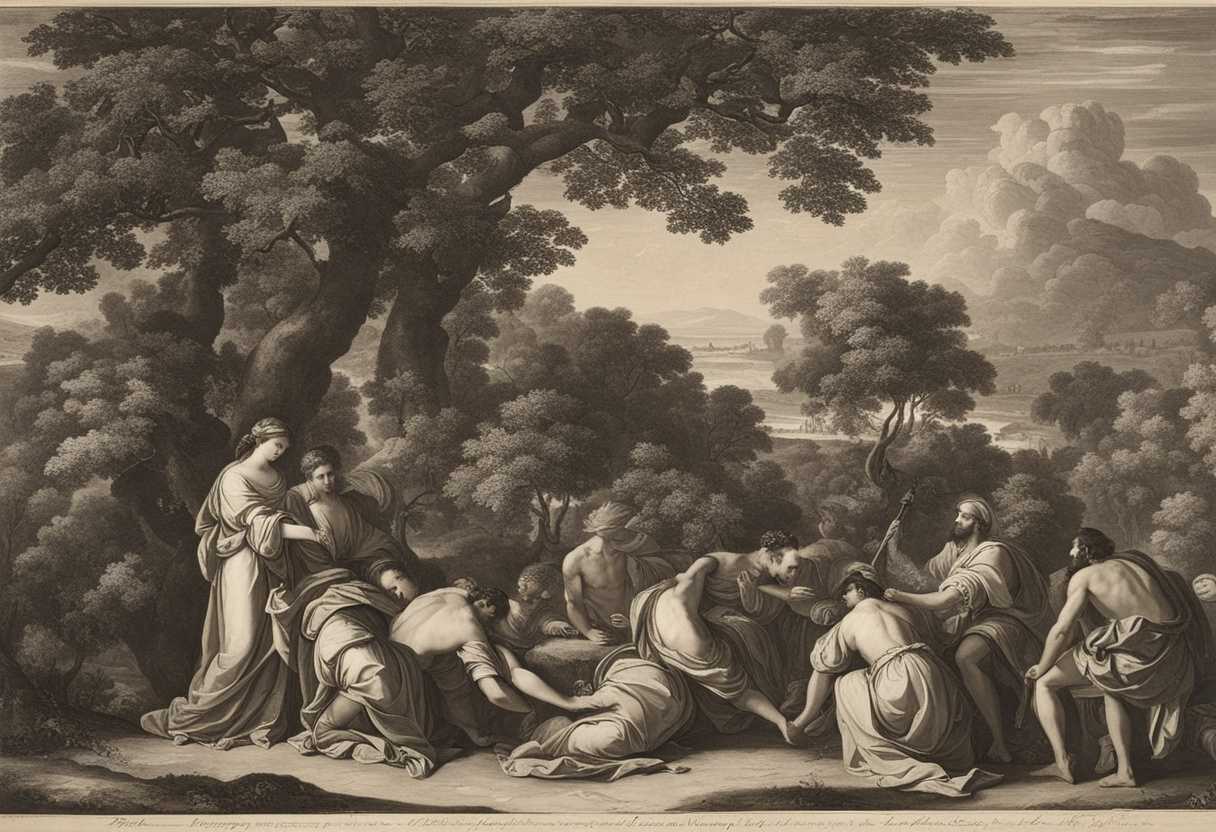
Setting the Scene for Genesis 35:4
In Genesis 35, we find Jacob and his household on a journey to Bethel. After Jacob’s daughter Dinah was violated in Shechem, God instructs Jacob to go to Bethel and build an altar there. Jacob commands his household to get rid of all their foreign gods, purify themselves, and change their garments before they set out on this sacred journey. The scene is set in the early morning as the sun rises, casting a warm glow over the camp as Jacob’s family prepares for this significant spiritual encounter.
The camp is bustling with activity as Jacob’s sons, including Reuben, Simeon, Levi, Judah, and the rest, gather their belongings and prepare to depart for Bethel. Rachel, Jacob’s beloved wife, is seen instructing the servants to pack provisions for the journey, while Leah, the mother of most of Jacob’s children, is busy organizing the younger ones. The air is filled with a sense of anticipation and reverence as the family readies themselves to meet with God at Bethel.
Surrounded by the rugged beauty of the wilderness, Jacob’s camp is a stark contrast to the bustling city of Shechem they had just left behind. The sound of bleating sheep and lowing cattle fills the air as the animals are herded together for the journey. The tents are being dismantled, and the altar of foreign gods is being taken down as Jacob’s household prepares to leave behind their past and embrace a new beginning at Bethel, the house of God.
What is Genesis 35:4 about?
Isn’t it beautiful how Jacob’s act of burying the foreign gods and building an altar to honor God showcases the power of repentance and devotion? Jacob acknowledges his past mistakes in this verse and desires to turn towards God wholeheartedly. Jacob shows us the importance of true repentance and unwavering devotion by getting rid of the idols that were hindering his relationship with God and by erecting an altar in His honor.
This verse serves as a powerful reminder for all of us to examine our own lives and see if there are any “foreign gods” that we need to bury in order to strengthen our connection with God. It prompts us to reflect on our actions, just like Jacob did, and take the necessary steps to realign ourselves with God’s will. Jacob’s example can be followed by purging our hearts of anything that distracts us from God and by building altars of devotion in our own lives, where we can honor and worship Him wholeheartedly.
Understanding what Genesis 35:4 really means
Let’s structure our commentary on the meaning of Genesis 35:4 as follows: Context, Key Phrases, Cross-Referencing Scripture, Relevance Today, and Personal Reflection through an Anecdote.
Context
Genesis 35:4 is situated within the larger narrative of Jacob’s return to Bethel. God commands Jacob to go back to Bethel to erect an altar. Before doing so, Jacob instructs his household to purify themselves by removing foreign gods, changing their garments, and purifying themselves. This moment is significant in Jacob’s transformation and recommitment to God. Key phrases such as “foreign gods,” “earrings,” and “oak tree” hold profound significance in this verse. “Foreign gods” represent the idols and false deities that had infiltrated Jacob’s household, symbolizing distractions and impurities in their faith. The “earrings” are often understood as talismans or symbols of those false gods. Burying these items “under the oak tree” conveys a tangible act of renunciation and a rejection of past errors, signifying a fresh start in their relationship with God.
Cross-Referencing Scripture
This theme of purification and renunciation of false idols is echoed throughout the Bible. For instance, in Joshua 24:23, Joshua instructs the Israelites to “put away the foreign gods which are among you, and incline your heart to the Lord God of Israel.” Similarly, 1 Samuel 7:3 speaks of Samuel telling the Israelites to “return to the Lord with all your hearts, then put away the foreign gods and the Ashtoreths from among you, and prepare your hearts for the Lord.” These passages reinforce the idea that true worship involves both internal and external purification, aligning one’s actions with their faith.
Relevance Today
This verse holds timeless relevance. Today, the “foreign gods” may not be physical idols but can be anything that takes precedence over our relationship with God—such as materialism, career ambitions, or even technology. The call to cast away these distractions challenges us to identify and remove whatever hinders our spiritual walk. It prompts reflective questions: What are the modern idols in my life? Am I willing to let them go to draw nearer to God?
Personal Reflection and Anecdote
Allow me to share an anecdote that illustrates this verse’s relevance. A member of our congregation, let’s call her Lisa, was deeply involved in a lifestyle that prioritized material success over spiritual growth. She spent countless hours working, often neglecting her prayer life and church involvement. Inspired by Jacob’s act of purification, Lisa made a conscious decision to put aside her excessive focus on work. She removed distractions by setting limits on her working hours and dedicating time to her faith and family. This deliberate act of ‘burial’ under the oak tree led to a newfound peace and a deeper connection with God. Genesis 35:4 calls us to examine and radically remove the idols that divert us from our faith journey. This act of purification is not just historical but a perennial call to reclaim our devotion to God, aligning both our hearts and our actions. Reflect on your life—what needs to be buried under the oak tree today?
How can we surrender and purify ourselves before God?
Jacob instructs his household in the verse to surrender all the foreign gods in their midst, purify themselves, and change their garments before proceeding to Bethel. We can learn the importance of surrendering any idols or distractions in our lives that may hinder our relationship with God by following this directive. This act of surrendering signifies a willingness to let go of anything that comes between us and God, allowing us to wholeheartedly focus on Him.
Purifying ourselves involves cleansing our hearts, minds, and actions from anything that is impure or corrupt. This process may include confession, repentance, seeking forgiveness, and striving for a renewed sense of spiritual cleanliness before God. We demonstrate our desire for a deeper connection with God and our commitment to living in accordance with His will by purifying ourselves.
Changing our garments symbolizes a fresh start and a new beginning in our spiritual journey. Just as physical clothes can be changed to reflect a different state or purpose, changing our spiritual garments represents a transformation in our inward being. We prepare ourselves to enter His presence with reverence, humility, and a sincere desire to draw closer to Him by surrendering, purifying, and changing our garments before God.
Application
Imagine your life as a finely tuned machine, where every part works together to keep you thriving in work, family, and faith. Now picture those idols—distractions and false priorities—as rust clogging your gears. Genesis 35:4 calls you to clean out that rust, to strip away anything hindering your relationship with God. It’s time to reset and renew your commitment. Are you ready to clear out the rust and let your life run smoothly?

Reverend Michael Johnson is an experienced Church Minister with a profound expertise in spirituality and guidance. With a serene presence and a compassionate heart, he has faithfully served his congregation for over 20 years, leading them on a spiritual journey towards inner peace and enlightenment. Reverend Johnson’s extensive knowledge of religious philosophies and profound understanding of human nature have made him a trusted confidant and mentor to many, as he seamlessly weaves his profound wisdom into life teachings. Reverend Johnson’s calming demeanor and empathetic nature continue to uplift and heal souls, nurturing a sense of unity and tranquility within his community.