
Genesis 37-45 is about the story of Joseph, highlighting themes of sibling rivalry, jealousy, forgiveness, and God’s providence in working all things together for good.
2 These are the generations of Jacob. Joseph, being seventeen years old, was pasturing the flock with his brothers. He was a boy with the sons of Bilhah and Zilpah, his father’s wives. And Joseph brought a bad report of them to their father.
2 These are the generations of Jacob. Joseph, being seventeen years old, was pasturing the flock with his brothers. He was a boy with the sons of Bilhah and Zilpah, his father’s wives. And Joseph brought a bad report of them to their father.
3 Now Israel loved Joseph more than any other of his sons, because he was the son of his old age. And he made him a robe of many colors.
4 But when his brothers saw that their father loved him more than all his brothers, they hated him and could not speak peacefully to him.
5 Now Joseph had a dream, and when he told it to his brothers they hated him even more.
6 He said to them, “Hear this dream that I have dreamed:
7 And behold, we were binding sheaves in the field, and behold, my sheaf arose and stood upright.
8 His brothers said to him, “Are you indeed to reign over us? Or are you indeed to rule over us?” So they hated him even more for his dreams and for his words.
9 Then he dreamed another dream and told it to his brothers and said, “Behold, I have dreamed another dream. Behold, the sun, the moon, and eleven stars were bowing down to me.”
10 But when he told it to his father and to his brothers, his father rebuked him and said to him, “What is this dream that you have dreamed? Shall I and your mother and your brothers indeed come to bow ourselves to the ground before you?”
11 His brothers were jealous of him, but his father kept the saying in mind.
12 Now his brothers went to pasture their father’s flock near Shechem.
13 And Israel said to Joseph, “Are not your brothers pasturing the flock at Shechem? Come, I will send you to them.” And he said to him, “Here I am.”
14 So he said to him, “Go now, see if it is well with your brothers and with the flock, and bring me word.” So he sent him from the Valley of Hebron, and he came to Shechem.
15 And a man found him wandering in the fields. And the man asked him, “What are you seeking?”
16 And he said, “I am seeking my brothers. Please tell me where they are pasturing the flock.”
17 And the man said, “They have gone away, for I heard them say, ‘Let us go to Dothan.’” So Joseph went after his brothers and found them at Dothan.
18 They saw him from afar, and before he came near to them, they conspired against him to kill him.
19 They said to one another, “Here comes this dreamer.
20 Come now, let us kill him and throw him into one of the pits. Then we will say that a fierce animal has devoured him, and we will see what will become of his dreams.”
21 But when Reuben heard it, he rescued him out of their hands, saying, “Let us not take his life.”
22 And Reuben said to them, “Shed no blood; throw him into this pit here in the wilderness, but do not lay a hand on him”—that he might rescue him out of their hand to restore him to his father.
23 So when Joseph came to his brothers, they stripped him of his robe, the robe of many colors that he wore.
24 Then they took him and threw him into a pit. The pit was empty; there was no water in it.
25 Then they sat down to eat. And looking up they saw a caravan of Ishmaelites coming from Gilead, with their camels bearing gum, balm, and myrrh, on their way to carry it down to Egypt.
26 Then Judah said to his brothers, “What profit is it if we kill our brother and conceal his blood?
27 Come, let us sell him to the Ishmaelites, and let not our hand be upon him, for he is our brother, our own flesh. And his brothers listened to him.
28 Then Midianite traders passed by. And they drew Joseph up and lifted him out of the pit, and sold him to the Ishmaelites for twenty shekels of silver. They took Joseph to Egypt.
29 When Reuben returned to the pit and saw that Joseph was not in the pit, he tore his clothes
30 Then he returned to his brothers and said, “The boy is gone, and I, where shall I go?”
31 Then they took Joseph’s robe and slaughtered a goat and dipped the robe in the blood.
32 And they sent the robe of many colors and brought it to their father and said, “This we have found; please identify whether it is your son’s robe or not.”
33 And he identified it and said, “It is my son’s robe. A fierce animal has devoured him. Joseph is without doubt torn to pieces.”
34 Then Jacob tore his garments and put sackcloth on his loins and mourned for his son many days.
35 All his sons and all his daughters rose up to comfort him, but he refused to be comforted and said, “No, I shall go down to Sheol to my son, mourning.” Thus his father wept for him.
36 Meanwhile the Midianites had sold him in Egypt to Potiphar, an officer of Pharaoh, the captain of the guard.
1 It happened at that time that Judah went down from his brothers and turned aside to a certain Adullamite, whose name was Hirah.
2 And Judah saw there a daughter of a certain Canaanite whose name was Shua. He took her and went in to her.
3 She conceived and bore a son, and he called his name Er.
4 She conceived again and bore a son, and she called his name Onan.
5 And she conceived again and bore a son, and she called his name Shelah. He was in Chezib when she bore him.
6 And Judah took a wife for Er his firstborn, and her name was Tamar.
7 But Er, Judah’s firstborn, was wicked in the sight of the Lord, and the Lord put him to death.
8 Then Judah said to Onan, “Go in to your brother’s wife and perform the duty of a brother-in-law to her, and raise up offspring for your brother.”
9 But Onan knew that the offspring would not be his. So whenever he went in to his brother’s wife he would waste the semen on the ground, so as not to give offspring to his brother.
10 And what he did was wicked in the sight of the Lord, and he put him to death also.
11 Then Judah said to Tamar his daughter-in-law, “Remain a widow in your father’s house, till Shelah my son grows up”—for he feared that he would die, like his brothers. So Tamar went and remained in her father’s house.
12 In the course of time the wife of Judah, Shua’s daughter, died. When Judah was comforted, he went up to Timnah to his sheepshearers, he and his friend Hirah the Adullamite.
13 And when Tamar was told, “Your father-in-law is going up to Timnah to shear his sheep,”
14 she took off her widow’s garments and covered herself with a veil, wrapping herself up, and sat at the entrance to Enaim, which is on the road to Timnah. For she saw that Shelah was grown up, and she had not been given to him in marriage.
15 When Judah saw her, he thought she was a prostitute, for she had covered her face.
16 And he turned to her at the roadside and said, “Come, let me come in to you,” for he did not know that she was his daughter-in-law. She said, “What will you give me, that you may come in to me?”
17 He answered, “I will send you a young goat from the flock.” And she said, “If you give me a pledge, until you send it—”
18 He said, “What pledge shall I give you?” She replied, “Your signet and your cord and your staff that is in your hand.” So he gave them to her and went in to her, and she conceived by him.
19 And she arose and went away, and taking off her veil she put on the garments of her widowhood.
20 When Judah sent the young goat by his friend the Adullamite to take back the pledge from the woman’s hand, he did not find her.
21 And he asked the men of the place, “Where is the cult prostitute who was at Enaim at the roadside?” And they said, “No cult prostitute has been here.”
22 So he returned to Judah and said, “I have not found her. Also, the men of the place said, ‘There has been no cult prostitute here.’”
23 So Judah replied, “Let her keep the things as her own, or we shall be laughed at. You see, I sent this young goat, and you did not find her.”
24 About three months later Judah was told, “Tamar your daughter-in-law has been immoral. Moreover, she is pregnant by immorality.” And Judah said, “Bring her out, and let her be burned.”
25 As she was being brought out, she sent word to her father-in-law, “By the man to whom these belong, I am pregnant.” And she said, “Please identify whose these are, the signet and the cord and the staff.”
26 Then Judah identified them and said, “She is more righteous than I, since I did not give her to my son Shelah.” And he did not know her again.
27 When the time of her labor came, there were twins in her womb.
28 And as he drew back his hand, behold, his brother came out. And she said, “What a breach you have made for yourself!” Therefore his name was called Perez.
29 But as he drew back his hand, behold, his brother came out. And she said, “What a breach you have made for yourself!” Therefore his name was called Perez.
30 When he drew back his hand, behold, his brother came out. And she said, “What a breach you have made for yourself!” Therefore his name was called Perez.
1 Now Joseph had been brought down to Egypt, and Potiphar, an officer of Pharaoh, the captain of the guard, an Egyptian, had bought him from the Ishmaelites who had brought him down there.
2 The Lord was with Joseph, and he became a successful man, and he was in the house of his Egyptian master.
3 When his master saw that the Lord was with him and that the Lord caused all that he did to succeed in his hands.
4 So Joseph found favor in his sight and attended him, and he made him overseer of his house and put him in charge of all that he had.
5 And from the time that he made him overseer in his house and over all that he had, the Lord blessed the Egyptian’s house for Joseph’s sake; the blessing of the Lord was on all that he had, in house and field.
6 So he left all that he had in Joseph’s charge, and because of him he had no concern about anything but the food he ate. And Joseph was handsome in form and appearance.
7 And after a time his master’s wife cast her eyes on Joseph and said, “Lie with me.”
8 But he refused and said to his master’s wife, “Behold, because of me my master has no concern about anything in the house, and he has put everything that he has in my charge.
9 There is no one greater in this house than I am, nor has he kept back anything from me except you, because you are his wife. How then can I do this great wickedness and sin against God?”
10 And as she spoke to Joseph day after day, he would not listen to her, to lie beside her or to be with her.
11 But one day, when he went into the house to do his work and none of the men of the house was there in the house,
12 she caught him by his garment, saying, “Lie with me.” But he left his garment in her hand and fled and got out of the house.
13 And as soon as she saw that he had left his garment in her hand and had fled out of the house,
14 she called to the men of her household and said to them, “See, he has brought among us a Hebrew to laugh at us. He came in to me to lie with me, and I cried out with a loud voice.
15 And as soon as she saw that he had left his garment in her hand and had fled out of the house,
16 And she laid up his garment by her until his master came home,
17 And she told him the same story, saying, “The Hebrew servant, whom you have brought among us, came in to me to laugh at me.
18 But as soon as I lifted up my voice and cried, he left his garment beside me and fled outside.
19 As soon as his master heard the words that his wife spoke to him, “This is the way your servant treated me,” his anger was kindled.
20 And Joseph’s master took him and put him into the prison, the place where the king’s prisoners were confined, and he was there in prison.
21 But the Lord was with Joseph and showed him steadfast love and gave him favor in the sight of the keeper of the prison.
22 And the keeper of the prison put Joseph in charge of all the prisoners who were in the prison. Whatever was done there, he was the one who did it.
23 The keeper of the prison paid no attention to anything that was in Joseph’s charge, because the Lord was with him. And whatever he did, the Lord made it succeed.
1 Some time after this, the cupbearer of the king of Egypt and his baker committed an offense against their lord the king of Egypt.
2 And Pharaoh was angry with his two officers, the chief cupbearer and the chief baker.
3 And he put them in custody in the house of the captain of the guard, in the prison where Joseph was confined.
4 And the captain of the guard appointed Joseph to be with them, and he attended them.
5 And one night they both dreamed—the cupbearer and the baker of the king of Egypt, who were confined in the prison—each his own dream, and each dream with its own interpretation.
6 When Joseph came to them in the morning, he saw that they were troubled.
7 So he asked Pharaoh’s officers who were with him in custody in his master’s house, “Why are your faces downcast today?”
8 They said to him, “We have had dreams, and there is no one to interpret them.” And Joseph said to them, “Do not interpretations belong to God? Please tell them to me.”
9 So the chief cupbearer told his dream to Joseph and said to him, “In my dream there was a vine before me,
10 and in the vine were three branches. It was as though it budded, its blossoms shot forth, and its clusters brought forth ripe grapes.
11 Pharaoh’s cup was in my hand, and I took the grapes and pressed them into Pharaoh’s cup and placed the cup in Pharaoh’s hand.”
12 Then Joseph said to him, “This is its interpretation: the three branches are three days.
13 In three days Pharaoh will lift up your head and restore you to your office, and you shall place Pharaoh’s cup in his hand as formerly, when you were his cupbearer.
14 Only remember me, when it is well with you, and please do me the kindness to mention me to Pharaoh, and so get me out of this house.
15 For I was indeed stolen out of the land of the Hebrews, and here also I have done nothing that they should put me into the pit.”
16 When the chief baker saw that the interpretation was favorable, he said to Joseph, “I also had a dream: there were three cake baskets on my head,
17 In the uppermost basket there were all sorts of baked food for Pharaoh, but the birds were eating it out of the basket on my head.”
18 And Joseph answered and said, “This is its interpretation: the three baskets are three days.
19 Yet within three days Pharaoh will lift up your head—from you!—and hang you on a tree. And the birds will eat the flesh from you.”
20 On the third day, which was Pharaoh’s birthday, he made a feast for all his servants and lifted up the head of the chief cupbearer and the head of the chief baker among his servants.
21 He restored the chief cupbearer to his position, and he placed the cup in Pharaoh’s hand.
22 But he hanged the chief baker, as Joseph had interpreted to them.
23 Yet the chief cupbearer did not remember Joseph, but forgot him.
1 After two whole years, Pharaoh dreamed that he was standing by the Nile.
2 And behold, there came up out of the Nile seven cows, attractive and plump, and they fed in the reed grass.
3 And behold, seven other cows, ugly and thin, came up out of the Nile after them, and stood by the other cows on the bank of the Nile.
4 So the ugly and thin cows ate up the seven attractive and plump cows. Then Pharaoh awoke.
5 And he fell asleep and dreamed a second time. And behold, seven ears of grain, plump and good, were growing on one stalk.
6 And behold, seven ears, withered, thin, and blighted by the east wind, sprouted after them.
7 And the seven plump ears and the seven full ears were blighted by the east wind.
8 So in the morning his spirit was troubled, and he sent and called for all the magicians of Egypt and all its wise men. Pharaoh told them his dreams, but there was none who could interpret them to Pharaoh.
9 Then the chief cupbearer said to Pharaoh, “I remember my offenses today.
10 Pharaoh was angry with his servants and put me in custody in the captain of the guard’s house, me and the chief baker.
11 So we sent a message to Joseph, saying, “Please give us food. For why should we die before your eyes? For our money is gone.”
12 And there was with us a young man, a Hebrew, servant to the captain of the guard. And we told him, and he interpreted our dreams to us, giving an interpretation to each man according to his dream.
13 And there was no one who could interpret them to Pharaoh.
14 Then Pharaoh sent and called Joseph, and they quickly brought him out of the pit. And when he had shaved himself and changed his clothes, he came in before Pharaoh.
15 And Pharaoh said to Joseph, “I have had a dream, and there is no one who can interpret it. I have heard it said of you that when you hear a dream you can interpret it.”
16 Joseph answered Pharaoh, “It is not in me; God will give Pharaoh a favorable answer.”
17 So Pharaoh said to Joseph, “Behold, in my dream I was standing on the banks of the Nile.
18 Behold, in my dream I was standing on the banks of the Nile.
19 Seven other cows came up after them, poor and very ugly and thin, such as I had never seen in all the land of Egypt.
20 And the lean and ugly cows ate up the first seven plump cows,
21 And when they had eaten them up, the appearance of the cows that came up first was still ugly, as at the beginning.
22 And I saw in my dream, and behold, seven ears, full and good, were growing on one stalk.
23 And behold, seven ears, withered, thin, and blighted by the east wind, sprouted after them,
24 And the thin ears swallowed up the seven plump, full ears. Then Pharaoh awoke, and behold, it was a dream.
25 Then Joseph said to Pharaoh, “The dreams of Pharaoh are one; God has revealed to Pharaoh what he is about to do.
26 The seven good cows are seven years, and the seven good ears are seven years; the dreams are one.
27 The seven lean and ugly cows that came up after them are seven years, and the seven empty ears blighted by the east wind are also seven years of famine.
28 It is as I told Pharaoh; God has shown to Pharaoh what he is about to do.
29 Seven years of great abundance are coming throughout the land of Egypt,
30 but after them there will arise seven years of famine, and all the plenty will be forgotten in the land of Egypt. The famine will consume the land,
31 and the plenty will be forgotten in the land of Egypt.
32 And the doubling of Pharaoh’s dream means that the thing is fixed by God, and God will shortly bring it about.
33 Now therefore let Pharaoh select a discerning and wise man, and set him over the land of Egypt.
34 Let Pharaoh proceed to appoint overseers over the land and take one-fifth of the produce of the land of Egypt during the seven plentiful years.
35 They should gather all the food of these good years that are coming and store up grain under the authority of Pharaoh for food in the cities, and let them keep it.
36 And that food shall be a reserve for the land against the seven years of famine that are to occur in the land of Egypt, so that the land may not perish through the famine.”
37 This proposal pleased Pharaoh and all his servants.
38 And Pharaoh said to his servants, “Can we find a man like this, in whom is the Spirit of God?”
39 Then Pharaoh said to Joseph, “Since God has shown you all this, there is none so discerning and wise as you are.
40 You shall be over my house, and all my people shall order themselves as you command. Only as regards the throne will I be greater than you.”
41 So Pharaoh said to Joseph, “See, I have set you over all the land of Egypt.”
42 Then Pharaoh took his signet ring from his hand and put it on Joseph’s hand, and clothed him in garments of fine linen and put a gold chain about his neck.
43 And he made him ride in his second chariot. And they called out before him, “Bow the knee!” Thus he set him over all the land of Egypt.
44 Moreover, Pharaoh said to Joseph, “I am Pharaoh, and without your consent no one shall lift up hand or foot in all the land of Egypt.”
45 And Pharaoh called Joseph’s name Zaphenath-paneah. And he gave him in marriage Asenath, the daughter of Potiphera priest of On. So Joseph went out over the land of Egypt.
46 Joseph was thirty years old when he entered the service of Pharaoh king of Egypt. And Joseph went out from the presence of Pharaoh and went through all the land of Egypt.
47 During the seven plentiful years the earth produced abundantly.
48 And he gathered up all the food of the seven years that the land of Egypt produced, and stored up the food in the cities. He put in every city the food from the fields around it.
49 Joseph stored up grain in great abundance, like the sand of the sea, until he ceased to measure it, for it could not be measured.
50 Before the year of famine came, two sons were born to Joseph.
51 Joseph called the name of the firstborn Manasseh. “For,” he said, “God has made me forget all my hardship and all my father’s house.”
52 The name of the second he called Ephraim, “For God has made me fruitful in the land of my affliction.”
53 The seven years of plenty that occurred in the land of Egypt came to an end.
54 Then the seven years of famine began to come, as Joseph had said. There was famine in all lands, but in all the land of Egypt there was bread.
55 When all the land of Egypt was famished, the people cried to Pharaoh for bread. Pharaoh said to all the Egyptians, “Go to Joseph. What he says to you, do.”
56 So when the famine had spread over all the land, Joseph opened all the storehouses and sold to the Egyptians, for the famine was severe in the land of Egypt.
57 Moreover, all the earth came to Egypt to Joseph to buy grain, because the famine was severe over all the earth.
1 When Jacob learned that there was grain for sale in Egypt, he said to his sons, “Why do you look at one another?”
2 And he said, “Behold, I have heard that there is grain for sale in Egypt. Go down and buy grain for us there, that we may live and not die.”
3 So ten of Joseph’s brothers went down to buy grain in Egypt.
4 But Jacob did not send Benjamin, Joseph’s brother, with his brothers, for he feared that harm might happen to him.
5 Thus the sons of Israel came to buy among the others who came, for the famine was in the land of Canaan.
6 Now Joseph was governor over the land. He was the one who sold to all the people of the land. And Joseph’s brothers came and bowed themselves before him with their faces to the ground.
7 Joseph saw his brothers and recognized them, but he treated them like strangers and spoke roughly to them. “Where do you come from?” he said. “They said, “From the land of Canaan, to buy food.”
8 And Joseph recognized his brothers, but they did not recognize him.
9 And Joseph remembered the dreams that he had dreamed of them. And he said to them, “You are spies; you have come to see the nakedness of the land.”
10 They said to him, “No, my lord, your servants have come to buy food.
11 Then their father Israel said to them, “If it must be so, then do this: take some of the choice fruits of the land in your bags, and carry a present down to the man, a little balm and a little honey, gum, myrrh, pistachio nuts, and almonds.”
12 He said to them, “No, but you have come to see the nakedness of the land.”
13 They said, “We, your servants, are twelve brothers, the sons of one man in the land of Canaan, and behold, the youngest is this day with our father, and one is no more.”
14 And Joseph said to them, “It is as I said to you; you are spies.
15 And this is how you shall be tested: as Pharaoh lives, you shall not go from this place unless your youngest brother comes here.
16 Send one of you, and let him bring your brother, while you remain confined, that your words may be tested, whether there is truth in you. Or else, by the life of Pharaoh, surely you are spies.”
17 And he put them all together in custody for three days.
18 On the third day Joseph said to them, “Do this and you will live, for I fear God:
19 If you are honest men, let one of your brothers remain confined where you are in custody, and let the rest go and carry grain for the famine of your households,
20 but bring your youngest brother to me. Then I shall know that you are not spies but honest men. Then I will deliver your brother to you, and you shall trade in the land.’”
21 Then they said to one another, “In truth we are guilty concerning our brother, in that we saw the distress of his soul, when he begged us and we did not listen. That is why this distress has come upon us.”
22 And Reuben answered them, “Did I not tell you not to sin against the boy? But you did not listen. So now there comes a reckoning for his blood.”
23 They did not know that Joseph understood them, for there was an interpreter between them.
24 He turned away from them and wept. And he returned to them and spoke to them. And he took Simeon from them and bound him before their eyes.
25 Then Joseph gave orders to fill their bags with grain, and to replace every man’s money in his sack, and to give them provisions for the journey. This was done for them.
26 Then they loaded their donkeys with their grain and departed.
27 And as one of them opened his sack to give his donkey fodder at the lodging place, he saw his money in the mouth of his sack.
28 He said to his brothers, “My money has been put back; here it is in the mouth of my sack!” At this their hearts failed them, and they turned trembling to one another, saying, “What is this that God has done to us?”
29 When they came to Jacob their father in the land of Canaan, they told him all that had happened to them, saying,
30 The man, the lord of the land, spoke roughly to us and took us to be spies of the land.
31 And we said to him, ‘We are honest men; we have never been spies.
32 We are twelve brothers, sons of our father. One is no more, and the youngest is this day with our father in the land of Canaan.’
33 The man, the lord of the land, said to us, ‘By this I shall know that you are honest men: leave one of your brothers with me, and take grain for the famine of your households, and go your way.
34 Bring your youngest brother to me. Then I shall know that you are not spies but honest men. Then I will deliver your brother to you, and you shall trade in the land.’”
35 As they emptied their sacks, behold, every man’s bundle of money was in his sack. And when they and their father saw their bundles of money, they were afraid.
36 Their father Jacob said to them, “You have bereaved me of my children: Joseph is no more, and Simeon is no more, and now you would take Benjamin. All this has come against me.”
37 Then Reuben said to his father, “Kill my two sons if I do not bring him back to you. Put him in my hands, and I will bring him back to you.”
38 But he said, “My son shall not go down with you, for his brother is dead, and he is the only one left. If harm should happen to him on the journey that you are to make, you would bring down my gray hairs with sorrow to Sheol.”
1 Now the famine was severe in the land.
2 And when they had eaten the grain that they had brought from Egypt, their father said to them, “Go again, buy us a little food.”
3 But Judah said to him, “The man solemnly warned us, saying, ‘You shall not see my face unless your brother is with you.’
4 If you will send our brother with us, we will go down and buy you food.
5 But if you will not send him, we will not go down, for the man said to us, ‘You shall not see my face, unless your brother is with you.’
6 And Israel said, “Why did you treat me so badly as to tell the man that you had another brother?”
7 They replied, “The man questioned us carefully about ourselves and our kindred, saying, ‘Is your father still alive? Do you have another brother?’ What we told him was in answer to these questions.
8 And Judah said to Israel his father, “Send the boy with me, and we will arise and go, that we may live and not die, both we and you and also our little ones.
9 I will be a pledge of his safety. From my hand you shall require him. If I do not bring him back to you and set him before you, then let me bear the blame forever.
10 For if we had not delayed, surely by now we could have returned twice.”
11 Then their father Israel said to them, “If it must be so, then do this: take some of the choice fruits of the land in your bags, and carry a present down to the man, a little balm and a little honey, gum, myrrh, pistachio nuts, and almonds.”
12 Take double the money with you. Carry back with you the money that was returned in the mouth of your sacks. Perhaps it was an oversight.
13 Take also your brother, and arise, go again to the man.
14 May God Almighty grant you mercy before the man, and may he send back your other brother and Benjamin. And as for me, if I am bereaved of my children, I am bereaved.”
15 So the men took this present, and they took double the money with them, and Benjamin. They arose and went down to Egypt and stood before Joseph.
16 When Joseph saw Benjamin with them, he said to the steward of his house, “Bring the men into the house, and slaughter an animal and make ready, for the men are to dine with me at noon.”
17 And the man did as Joseph told him and brought the men to Joseph’s house.
18 And the men were afraid because they were brought to Joseph’s house, and they said, “It is because of the money, which was replaced in our sacks the first time, that we are brought in, so that he may assault us and fall upon us to make us servants and seize our donkeys.”
19 So they went up to the steward of Joseph’s house and spoke with him at the door of the house,
20 and said, “Oh, my lord, we came down the first time to buy food.
21 And when we came to the lodging place we opened our sacks, and there was each man’s money in the mouth of his sack, our money in full weight. So we have brought it back with us.
22 We have brought other money down with us to buy food. We do not know who put our money in our sacks.”
23 He said, “Peace to you, do not be afraid. Your God and the God of your father has put treasure in your sacks for you. I received your money.” Then he brought Simeon out to them.
24 And the man brought the men into Joseph’s house and gave them water, and they washed their feet, and he gave their donkeys fodder.
25 And they prepared the present for Joseph’s coming at noon, for they heard that they should eat bread there.
26 When Joseph came home, they brought into the house to him the present that they had with them and bowed down to him to the ground.
27 And he inquired about their welfare and said, “Is your father well, the old man of whom you spoke? Is he still alive?”
28 They said, “Your servant our father is well; he is still alive.” And they bowed their heads and prostrated themselves.
29 And he lifted up his eyes and saw his brother Benjamin, his mother’s son, and said, “Is this your youngest brother, of whom you spoke to me? God be gracious to you, my son!”
30 Then Joseph hurried out, for his compassion grew warm for his brother, and he sought a place to weep. And he entered his chamber and wept there.
31 Then he washed his face and came out. And controlling himself he said, “Serve the food.”
32 They served him by himself, and them by themselves, and the Egyptians who ate with him by themselves, because the Egyptians could not eat with the Hebrews, for that is an abomination to the Egyptians.
33 And they sat before him, the firstborn according to his birthright and the youngest according to his youth. And the men looked at one another in amazement.
34 Portions were taken to them from Joseph’s table, but Benjamin’s portion was five times as much as any of theirs. And they drank and were merry with him.
1 Then he commanded the steward of his house, “Fill the men’s sacks with food, as much as they can carry, and put each man’s money in the mouth of his sack,
2 And put my cup, the silver cup, in the mouth of the sack of the youngest, with his money for the grain.” And he did as Joseph told him.
3 As soon as the morning was light, the men were sent away with their donkeys.
4 They had gone only a short distance from the city. Now Joseph said to his steward, “Up, follow after the men, and when you overtake them, say to them, ‘Why have you repaid evil for good?
5 Is it not from this that my lord drinks, and by this that he practices divination? You have done evil in doing this.’”
6 When he overtook them, he spoke to them these words.
7 They said to him, “Why does my lord speak such words as these? Far be it from your servants to do such a thing.
8 Behold, the money that we found in the mouths of our sacks, we brought back to you from the land of Canaan. How then could we steal silver or gold from your lord’s house?
9 Whichever of your servants is found with it shall die, and we also will be my lord’s servants.”
10 The one in whose hand the cup was found shall be my servant, but as for you, go up in peace to your father.”
11 Then each man quickly lowered his sack to the ground, and each man opened his sack.
12 Then he searched and began with the eldest and finished with the youngest. And the cup was found in Benjamin’s sack.
13 Then they tore their clothes, and every man loaded his donkey, and they returned to the city.
14 When Judah and his brothers came to Joseph’s house, he was still there. They fell before him to the ground.
15 And Joseph said to them, “What deed is this that you have done? Do you not know that a man like me can indeed practice divination?”
16 And Judah said, “What shall we say to my lord? What shall we speak? Or how can we clear ourselves? God has found out the guilt of your servants; behold, we are my lord’s servants, both we and he also in whose hand the cup has been found.”
17 But he said, “Far be it from me that I should do so! Only the man in whose hand the cup was found shall be my servant. But as for you, go up in peace to your father.”
18 Then Judah went up to him and said, “Oh, my lord, please let your servant speak a word in my lord’s ears, and let not your anger burn against your servant, for you are like Pharaoh himself.
19 If you should take this one also from me, and harm happens to him, you will bring down my gray hairs in evil to Sheol.’
20 And we said to my lord, ‘We have a father, an old man, and a young brother, the child of his old age. His brother is dead, and he alone is left of his mother’s children, and his father loves him.’
21 Then you said to your servants, ‘Bring him down to me, that I may set my eyes on him.’
22 We said to my lord, ‘The boy cannot leave his father, for if he should leave his father, his father would die.’
23 You said to your servants, ‘Unless your youngest brother comes down with you, you shall not see my face again.’
24 When we went back to your servant my father, we told him the words of my lord.
25 Then our father said, ‘Go back, buy us a little food.’
26 But we said, ‘We cannot go down. If our youngest brother goes with us, then we will go down. For we cannot see the man’s face unless our youngest brother is with us.’
27 And your servant my father said to us, ‘You know that my wife bore me two sons.
28 The one went away, and behold, he was not there, and I said to my father, ‘Where is my son?’
29 If you take this one also from me, and harm happens to him, you will bring down my gray hairs in evil to Sheol.’
30 “Now therefore, as soon as I come to your servant my father, and the boy is not with us, then, as his life is bound up in the boy’s life,”
31 It will come about when he sees that the boy is not with us, that he will die. So your servants will bring down the gray hair of your servant our father with sorrow to Sheol.
32 For your servant became a pledge of safety for the boy to my father, saying, ‘If I do not bring him back to you, then I shall bear the blame before my father all my life.’
33 Now therefore, please let your servant remain instead of the boy as a servant to my lord, and let the boy go back with his brothers.
34 For how can I go back to my father if the boy is not with me? I fear to see the evil that would find my father.”
1 Then Joseph could not control himself before all those who stood by him. He cried, “Make everyone go out from me.” So no one stayed with him when Joseph made himself known to his brothers.
2 And he wept aloud, so that the Egyptians heard it, and the household of Pharaoh heard it.
3 And Joseph said to his brothers, “I am Joseph! Is my father still alive?” But his brothers could not answer him, for they were dismayed at his presence.
4 So Joseph said to his brothers, “Come near to me, please.” And they came near. And he said, “I am your brother, Joseph, whom you sold into Egypt.
5 And now do not be distressed or angry with yourselves because you sold me here, for God sent me before you to preserve life.
6 For the famine has been in the land these two years, and there are yet five years in which there will be neither plowing nor harvest.
7 And God sent me before you to preserve for you a remnant on earth, and to keep alive for you many survivors.
8 So it was not you who sent me here, but God. He has made me a father to Pharaoh, and lord of all his house and ruler over all the land of Egypt.
9 Hurry and go up to my father and say to him, ‘Thus says your son Joseph, God has made me lord of all Egypt. Come down to me; do not tarry.
10 You shall dwell in the land of Goshen, and you shall be near me, you and your children and your children’s children, and your flocks, your herds, and all that you have.
11 There I will provide for you, for there are yet five years of famine to come, so that you and your household, and all that you have, do not come to poverty.’”
12 And his brothers went to feed their father’s flock in Shechem.
13 And you must tell my father of all my honor in Egypt, and of all that you have seen. Go quickly and bring my father down here.”
14 Then he fell upon his brother Benjamin’s neck and wept, and Benjamin wept upon his neck.
15 And he kissed all his brothers and wept upon them. After that his brothers talked with him.
16 When the report was heard in Pharaoh’s house, “Joseph’s brothers have come,” it pleased Pharaoh and his servants.
17 And Pharaoh said to Joseph, “Say to your brothers, ‘Do this: load your beasts and go back to the land of Canaan,
18 take your father and your households, and come to me, and I will give you the best of the land of Egypt, and you shall eat the fat of the land.’
19 You are also commanded, ‘Do this: take wagons from the land of Egypt for your little ones and for your wives, and bring your father, and come.
20 Also do not concern yourselves with your goods, for the best of all the land of Egypt is yours.’”
21 The sons of Israel did so: and Joseph gave them wagons, according to the command of Pharaoh, and gave them provisions for the journey.
22 To each and all of them he gave a change of clothes, but to Benjamin he gave three hundred shekels of silver and five changes of clothes.
23 To his father he sent as follows: ten donkeys loaded with the good things of Egypt, and ten female donkeys loaded with grain, bread, and provision for his father on the journey.
24 So he sent his brothers away, and as they departed, he said to them, “Do not quarrel on the way.”
25 So they went up out of Egypt and came to the land of Canaan to their father Jacob.
26 And they told him, “Joseph is still alive, and he is ruler over all the land of Egypt.” And his heart became numb, for he did not believe them.
27 But when they told him all the words of Joseph, which he had said to them, and when he saw the wagons that Joseph had sent to carry him, the spirit of their father Jacob revived.
28 And Israel said, “It is enough; Joseph my son is still alive. I will go and see him before I die.”
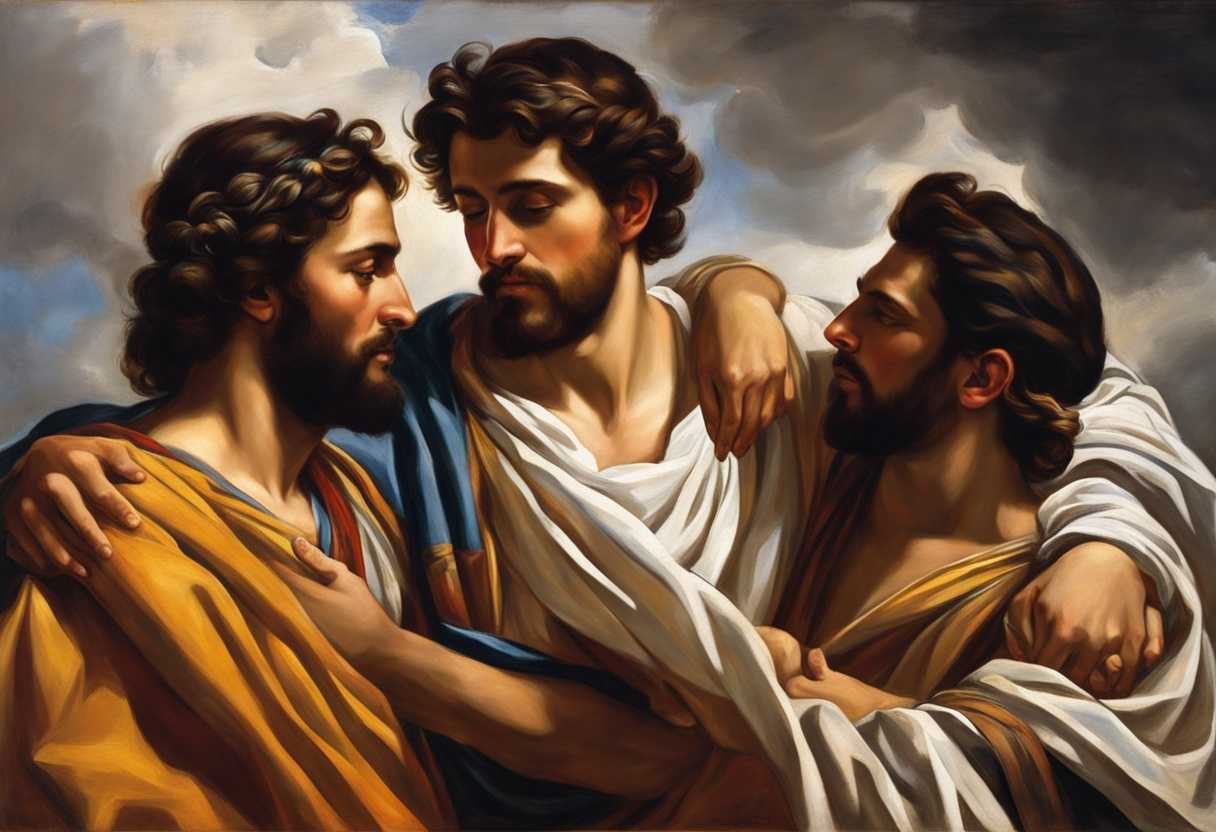
Setting the Scene for Genesis 37-45
In the scene from Genesis 37-45, we find Joseph, the beloved son of Jacob, surrounded by his eleven jealous brothers in the fields of Dothan. Joseph, known for his colorful coat given to him by his father, had shared his dreams of greatness with his brothers, further fueling their resentment towards him. One day, Jacob sends Joseph to check on his brothers who are tending to their flocks, unaware of their growing animosity towards him.
As Joseph approaches, his brothers see an opportunity to rid themselves of him once and for all. They conspire to throw him into a pit and eventually sell him to a passing caravan of Ishmaelites. Joseph, bewildered and betrayed, is taken to Egypt as a slave. The scene is tense and filled with emotion as Joseph pleads with his brothers, but they remain unmoved by his cries for mercy.
The surroundings are vast and open, with the sun beating down on the dry, dusty fields of Dothan. The brothers’ sheep graze nearby, oblivious to the unfolding drama. The tension between the brothers is palpable, as years of jealousy and bitterness come to a head in this pivotal moment. This scene sets the stage for Joseph’s incredible journey from slavery to becoming a powerful ruler in Egypt, ultimately leading to a heartwarming reunion with his brothers.
What is Genesis 37-45 about?
Joseph’s incredible journey in this verse shows how he was betrayed by his brothers, sold into slavery, falsely accused, and eventually became a powerful and forgiving leader in Egypt. It highlights the theme of forgiveness and God’s faithfulness throughout Joseph’s life. Despite the many hardships he faced, Joseph stayed faithful to God, and ultimately, his faith led him to a position of power where he could help not only his family but also the entire nation of Egypt during a severe famine. This verse reminds us of the power of forgiveness, perseverance, and trust in God’s plan even in the face of adversity. We are challenged to examine our own lives as we reflect on Joseph’s story. Do we have the strength and faith to forgive those who have wronged us? Are we willing to trust in God’s sovereignty and plan for our lives, even when things seem to be falling apart? Joseph’s journey serves as a powerful example of how God can turn the darkest moments in our lives into opportunities for growth, redemption, and ultimately, forgiveness. Let us strive to be inspired by Joseph’s example and live a life of faith, forgiveness, and perseverance, knowing that God is always faithful and in control.
Understanding what Genesis 37-45 really means
In Genesis 37-45, we delve into the captivating narrative of Joseph, a tale filled with betrayal, providence, forgiveness, and redemption. From Joseph’s vivid dreams to his brothers’ treacherous actions, his journey from the pit to the palace in Egypt, and the eventual reconciliation with his family, this passage is a tapestry of emotions and divine intervention.
One key verse that encapsulates the depth of Joseph’s trials is found in Genesis 37:4, where it is poignantly stated, “They hated him and could not speak a kind word to him.” This verse vividly portrays the intense jealousy and animosity that Joseph’s brothers harbored towards him, setting the stage for the unfolding drama of betrayal and resilience.
Amidst the turmoil, a beacon of hope shines through in Genesis 39:2, declaring, “The Lord was with Joseph.” This simple yet profound statement underscores the overarching theme of God’s presence and favor in Joseph’s life, even in the midst of adversity and injustice.
As the narrative unfolds, we are confronted with the powerful declaration in Genesis 50:20, where Joseph proclaims, “You intended to harm me, but God intended it for good.” This pivotal moment encapsulates the transformative nature of God’s providence, turning malevolent intentions into avenues for blessing and growth.
Drawing parallels from related biblical passages such as Romans 8:28, Matthew 5:44, and Psalm 105:16-22, we see echoes of God’s providential care, the call to love our enemies, and the faithfulness of God in the midst of trials. These verses serve as guideposts for understanding the complexities of human relationships and the redemptive power of forgiveness.
In a world rife with betrayal and injustice, Joseph’s story resonates deeply with modern audiences. His journey from the depths of despair to a position of influence and blessing offers a glimmer of hope to those facing similar challenges, reminding us that God can turn our trials into triumphs.
Joseph’s transformation from a prideful youth to a wise and forgiving leader serves as a poignant reminder of the importance of personal growth and reliance on God’s timing. His example of forgiveness in the face of betrayal stands as a beacon of light in a world often clouded by resentment and grudges.
In conclusion, the story of Joseph serves as a timeless testament to God’s faithfulness, the transformative power of forgiveness, and the potential for redemption in every circumstance. It beckons us to trust in God’s plan, seek reconciliation in the face of adversity, and embrace the journey of growth and healing that follows forgiveness.
How can we navigate jealousy and forgiveness in family?
The story of Joseph and his brothers in Genesis 37-45 is a powerful example of navigating jealousy and forgiveness within a family. Joseph’s brothers’ jealousy towards him led them to sell him into slavery, causing great pain and strife within the family. However, Joseph’s ability to forgive his brothers despite their betrayal demonstrates the power of forgiveness in healing familial wounds. Joseph goes through a journey of self-discovery and growth before he can truly extend forgiveness to his brothers in the story. This highlights the fact that forgiveness is a process that takes time, reflection, and often involves personal growth. Joseph not only reconciles with his brothers but also ultimately saves his family from the famine by choosing forgiveness over resentment.
Jealousy is a common emotion within families and can lead to hurtful actions and broken relationships if not addressed. However, the story of Joseph and his brothers reminds us of the importance of forgiveness in overcoming jealousy and healing family dynamics. Through empathy, understanding, and a willingness to let go of past grievances, families can work towards reconciliation and create stronger, more harmonious relationships.
Application
Consider the inspiring tale of Joseph – how he transformed trials into triumphs, following God’s guidance to flourish despite adversity. Just like Joseph, let us trust in the divine plan meant for us, even when obstacles seem insurmountable. God’s unwavering faithfulness will pave the way for us to overcome hurdles and grow beyond our comfort zones. Will you embrace challenges as opportunities for growth, drawing strength from God’s path for you today?

Reverend Michael Johnson is an experienced Church Minister with a profound expertise in spirituality and guidance. With a serene presence and a compassionate heart, he has faithfully served his congregation for over 20 years, leading them on a spiritual journey towards inner peace and enlightenment. Reverend Johnson’s extensive knowledge of religious philosophies and profound understanding of human nature have made him a trusted confidant and mentor to many, as he seamlessly weaves his profound wisdom into life teachings. Reverend Johnson’s calming demeanor and empathetic nature continue to uplift and heal souls, nurturing a sense of unity and tranquility within his community.