
18 They saw him from afar, and before he came near to them, they conspired against him to kill him.
19 They said to one another, “Here comes this dreamer.
20 Come now, let us kill him and throw him into one of the pits. Then we will say that a fierce animal has devoured him, and we will see what will become of his dreams.”
21 But when Reuben heard it, he rescued him out of their hands, saying, “Let us not take his life.”
22 And Reuben said to them, “Shed no blood; throw him into this pit here in the wilderness, but do not lay a hand on him”—that he might rescue him out of their hand to restore him to his father.
23 So when Joseph came to his brothers, they stripped him of his robe, the robe of many colors that he wore.
24 Then they took him and threw him into a pit. The pit was empty; there was no water in it.
25 Then they sat down to eat. And looking up they saw a caravan of Ishmaelites coming from Gilead, with their camels bearing gum, balm, and myrrh, on their way to carry it down to Egypt.
26 Then Judah said to his brothers, “What profit is it if we kill our brother and conceal his blood?
27 Come, let us sell him to the Ishmaelites, and let not our hand be upon him, for he is our brother, our own flesh.” And his brothers listened to him.
28 Then Midianite traders passed by. And they drew Joseph up and lifted him out of the pit, and sold him to the Ishmaelites for twenty shekels of silver. They took Joseph to Egypt.
29 When Reuben returned to the pit and saw that Joseph was not in the pit, he tore his clothes.
30 Then he returned to his brothers and said, “The boy is gone, and I, where shall I go?”
31 Then they took Joseph’s robe and slaughtered a goat and dipped the robe in the blood.
32 And they sent the robe of many colors and brought it to their father and said, “This we have found; please identify whether it is your son’s robe or not.”
33 And he identified it and said, “It is my son’s robe. A fierce animal has devoured him. Joseph is without doubt torn to pieces.”
34 Then Jacob tore his garments and put sackcloth on his loins and mourned for his son many days.
35 All his sons and all his daughters rose up to comfort him, but he refused to be comforted and said, “No, I shall go down to Sheol to my son, mourning.” Thus his father wept for him.
36 Meanwhile the Midianites had sold him in Egypt to Potiphar, an officer of Pharaoh, the captain of the guard.
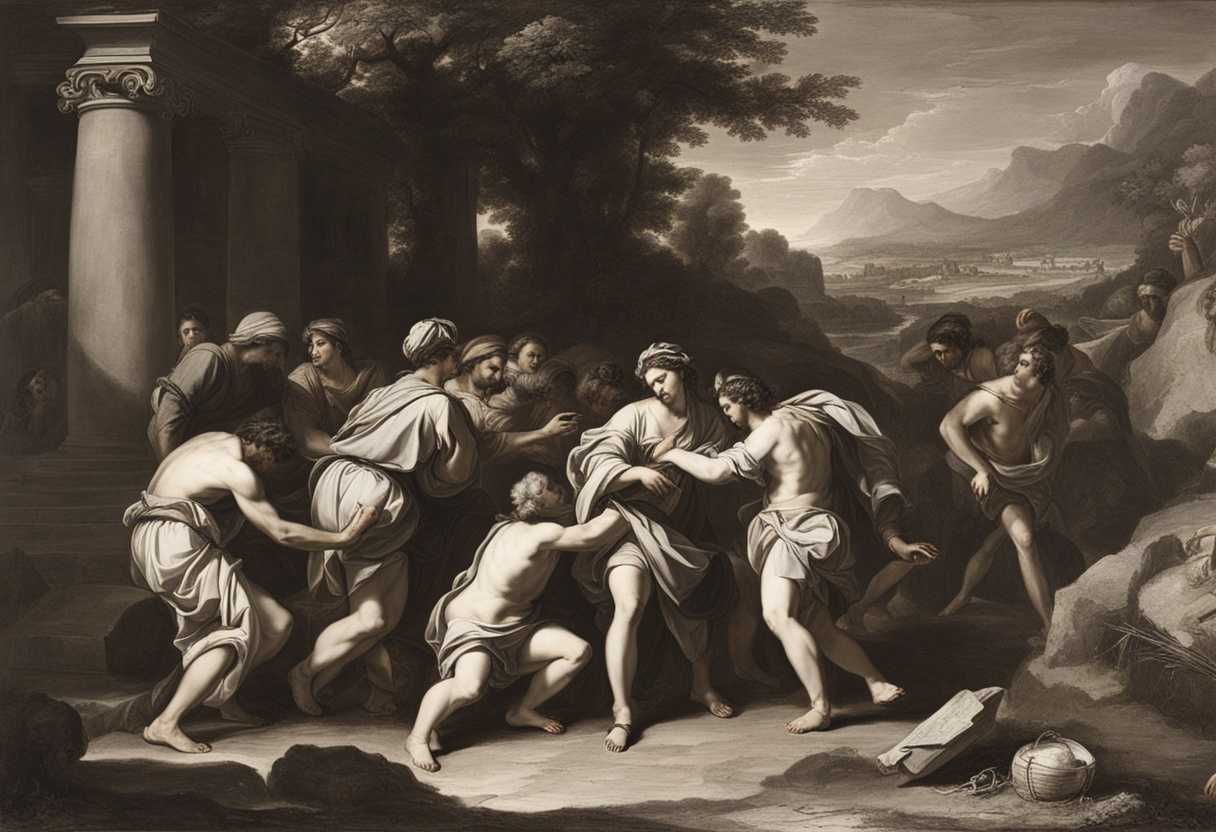
Setting the Scene for Genesis 37:18-36
In Genesis chapter 37, we find Joseph, the beloved son of Jacob, in the midst of a tumultuous family situation. Joseph’s brothers, filled with jealousy and resentment towards him due to their father’s favoritism, conspire to get rid of him. The scene unfolds in the fields of Dothan, a pastoral setting with rolling hills and fields of crops stretching out into the distance.
As the brothers see Joseph approaching from afar, they hatch a plan to seize him and throw him into a pit. Reuben, the eldest brother, initially tries to save Joseph by suggesting they throw him into the pit instead of killing him outright. However, when Reuben is not present, the other brothers decide to sell Joseph to a passing caravan of Ishmaelites, who are on their way to Egypt.
The tension is palpable as Joseph is stripped of his coat of many colors, a symbol of his father’s love, and is taken away from his family, bound for a foreign land. The betrayal and heartache in the air are almost tangible as the brothers deceive their father Jacob, presenting Joseph’s bloodied coat as evidence of his demise. The scene is fraught with emotion, as Joseph’s fate takes a drastic turn, setting the stage for the unfolding of God’s plan in his life.
What is Genesis 37:18-36 about?
Isn’t it incredible how despite facing betrayal from his own brothers, Joseph’s story takes a remarkable turn? From being sold into slavery, he not only survives but also rises to a position of power in Egypt. This verse teaches us about resilience, perseverance, and the ability to overcome even the most difficult circumstances.
Imagine the strength and character Joseph must have possessed to not only endure the hardships of slavery but to also thrive and eventually become a leader in a foreign land. This verse reminds us that our current circumstances do not define our future. Just like Joseph, we too can rise above adversity and emerge stronger and more resilient. It serves as a powerful reminder that no matter what challenges we may face, with faith, determination, and perseverance, we can overcome them and achieve greatness.
Understanding what Genesis 37:18-36 really means
Structure for Commentary:
- Introduction to the Passage
- Context and Background
- Detailed Analysis of Key Phrases
- Related Biblical Passages
- Relevance to Modern Life
- Anecdote to Engage the Reader
- Final Thoughts and Reflection
Introduction to the Passage
Genesis 37:18-36 depicts the pivotal moment where Joseph’s brothers conspire against him out of jealousy and ultimately sell him into slavery. This narrative is rich in themes like betrayal, envy, and divine providence, offering valuable lessons for our lives today.
Context and Background
To fully grasp the significance of this passage, we need to consider the context. Joseph, the favored son of Jacob, has dreams indicating that he will one day rule over his family. These dreams, combined with Jacob’s overt favoritism, kindle resentment among his brothers, setting the stage for their drastic actions. “They saw him from a distance” is the phrase being considered for detailed analysis.” This not only describes Joseph’s brothers noticing him approaching but also symbolizes the emotional distance and disconnect in their relationship. Their jealousy, which blinds them to familial bonds and moral considerations, is highlighted by the statement “Let us kill him.” Lastly, “sold him to the Ishmaelites” marks a turning point in Joseph’s life, leading to his eventual rise in Egypt.
Related Biblical Passages
This story can be juxtaposed with the New Testament account of Jesus’ betrayal. Just as Joseph was sold by his kin, Jesus was betrayed by Judas, one of his closest followers. Both stories emphasize that God’s plan often operates through human actions, even those that seem cruel or unjust. Romans 8:28 reminds us, “And we know that in all things God works for the good of those who love him.”
Relevance to Modern Life
The themes of jealousy and betrayal are timeless. How often do we allow jealousy to cloud our judgments, leading to harmful actions? Feelings of envy can be destructive in workplaces, families, and friendships. Recognizing these emotions and addressing them can lead to healthier relationships and personal growth.
Anecdote to Engage the Reader
Let me share a story about a man named Peter. Just like Joseph, Peter experienced betrayal by close friends at his place of work. Initially, he was devastated. However, he chose to respond with forgiveness and faith in God’s bigger plan. Over time, Peter found a better job that suited his skills and passions. Like Joseph, he rose above his circumstances, and his faith grew stronger.
Final Thoughts and Reflection
Reflect on your own life. Is there someone you’ve distanced yourself from because of jealousy or misunderstanding? Can you seek reconciliation? Joseph’s story encourages us to trust in God’s plan, even when we face betrayal or hardship. God can use what man intends for harm for good. Let’s strive to cultivate forgiveness, trust, and faith as we navigate our own lives. Genesis 37:18-36 isn’t just an ancient story; it’s a reminder of the human condition and God’s unwavering presence in our lives. Take these lessons to heart, and consider how they might transform your daily interactions.
How can we respond to jealousy and betrayal?
When we are faced with jealousy and betrayal, it is important to remember that these are negative emotions and actions rooted in personal insecurities or desires. Jealousy stems from a feeling of inferiority or the fear of losing someone or something we value. Betrayal, on the other hand, often arises from self-interest or a lack of integrity. Jealousy led to betrayal in the story of Joseph and his brothers in Genesis, but ultimately, it was part of a bigger plan that brought about reconciliation and redemption. Staying true to our values and beliefs is crucial in moments of jealousy and betrayal. Instead of seeking revenge or holding grudges, we should strive to show forgiveness and understanding. We can transcend the negative impact of jealousy and betrayal by maintaining our integrity and extending grace to those who wrong us. Like Joseph who forgave his brothers and eventually reconciled with them, we can choose to rise above the hurt and work towards healing and restoration.
Application
Think of your life as a team project at work or a family gathering. Joseph faced jealousy and betrayal from his own brothers. Are you supporting your ‘team’ or secretly wishing for someone’s downfall? Let’s turn away from envy and aim for unity and grace. Will you stand against jealousy and choose love and forgiveness today?

Reverend Michael Johnson is an experienced Church Minister with a profound expertise in spirituality and guidance. With a serene presence and a compassionate heart, he has faithfully served his congregation for over 20 years, leading them on a spiritual journey towards inner peace and enlightenment. Reverend Johnson’s extensive knowledge of religious philosophies and profound understanding of human nature have made him a trusted confidant and mentor to many, as he seamlessly weaves his profound wisdom into life teachings. Reverend Johnson’s calming demeanor and empathetic nature continue to uplift and heal souls, nurturing a sense of unity and tranquility within his community.