
9 But Onan knew that the offspring would not be his. So whenever he went in to his brother’s wife he would waste the semen on the ground, so as not to give offspring to his brother.
10 And what he did was wicked in the sight of the Lord, and he put him to death also.
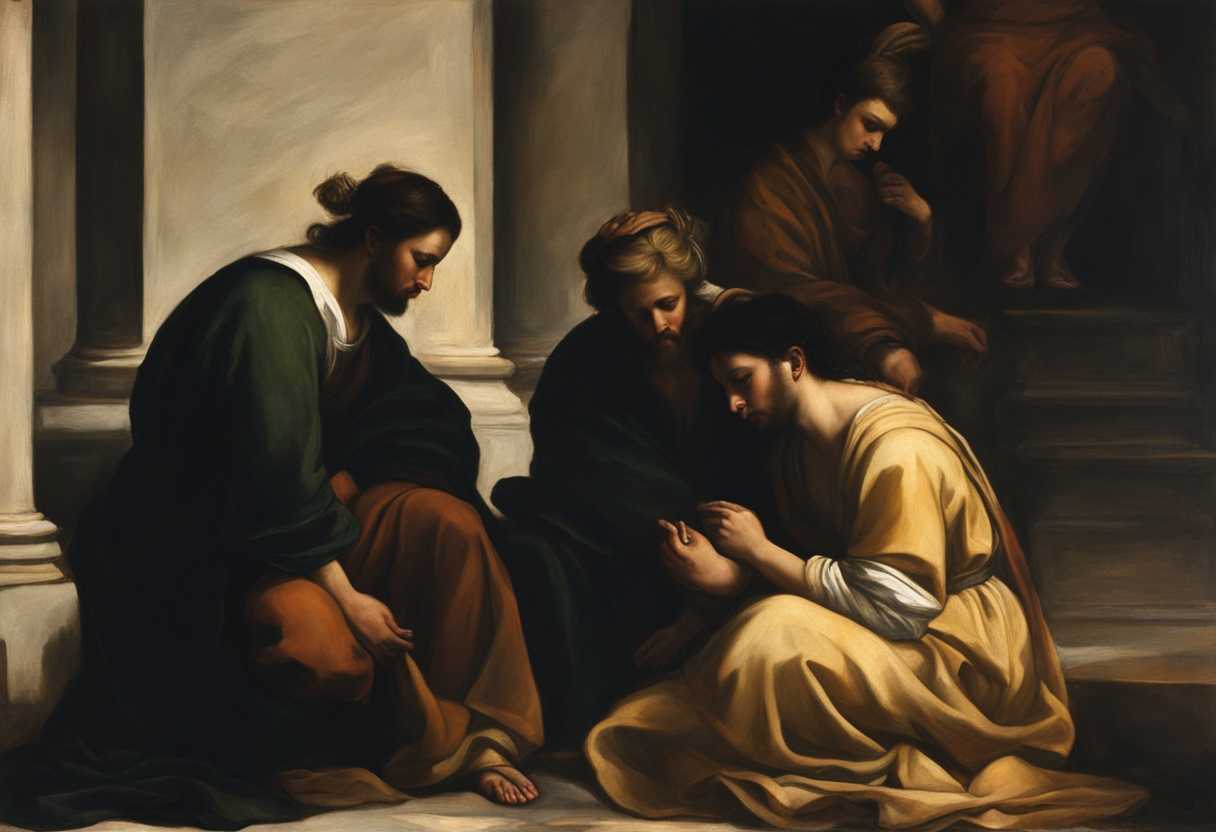
Setting the Scene for Genesis 38:9-10
In Genesis chapter 38, we find the story of Judah and Tamar. Judah had three sons: Er, Onan, and Shelah. Judah arranged for his firstborn son, Er, to marry Tamar. However, Er was wicked in the sight of the Lord, so the Lord took his life. Following the custom of levirate marriage, Judah then instructed his second son, Onan, to fulfill his duty by marrying Tamar and providing offspring for his deceased brother. However, Onan also acted wickedly in the eyes of the Lord and spilled his seed on the ground, so the Lord took his life as well.
The scene in Genesis 38:9-10 takes place after the deaths of Er and Onan. Judah was hesitant to give his last son, Shelah, to Tamar in marriage, fearing that Shelah might also die. Tamar, realizing that she was being denied the opportunity to have children and secure her future, took matters into her own hands. She disguised herself as a prostitute and waited for Judah by the roadside. When Judah saw her, he mistook her for a prostitute and slept with her, not realizing that she was actually Tamar, his daughter-in-law.
The scene is set on a dusty roadside, with the sun setting in the distance, casting a warm glow over the landscape. Judah, burdened by the loss of his sons and the responsibility of providing for Tamar, unknowingly engages in a scandalous encounter with her. The tension and drama of this moment in Genesis 38 highlight the complexities of family relationships and the lengths to which individuals would go to secure their future and fulfill their obligations.
What is Genesis 38:9-10 about?
A complex familial and societal situation is seen in this verse. Judah’s son, Onan, was expected to fulfill a duty known as the levirate marriage custom. This custom dictated that if a man died childless, his brother should marry the widow to produce children who would then be considered the deceased man’s heirs. Onan not only disregarded the tradition but also failed to honor his brother’s memory and lineage by disobeying this obligation.
Think about the weight of responsibilities and expectations that Onan pushed aside with his refusal. What does this act of disobedience reveal about his character and values? Consider how his actions will impact the widow, the family, and the community at large. Reflect on the broader themes of duty, legacy, and the consequences of individual choices within a larger social framework.
Understanding what Genesis 38:9-10 really means
Onan was instructed to fulfill his duty as a brother by entering into a levirate marriage with Tamar, his brother’s widow, in Genesis 38:9-10, where we encounter his compelling and somewhat controversial actions. His refusal to produce offspring that would be considered his deceased brother’s heirs leads to his demise, executed by divine intervention. This passage is often discussed in theological circles for its implications regarding obedience, duty, and the consequences of sin. Levirate marriage, a common social practice in ancient times, aimed at preserving a family’s lineage and property, is the concept we will delve into first. Deuteronomy 25:5-10 provides a further explanation of this duty, underscoring its importance in Jewish culture and law. Onan’s actions, therefore, were not just a personal refusal but a violation of social and divine laws. When scripture mentions that Onan “spilled his seed on the ground,” it symbolically represents his blatant disregard for the continuance of his brother’s name and welfare of his family. What can we learn from this? It highlights the gravity of familial responsibilities and the consequences of shirking them. Levirate marriages are no longer practiced in most cultures today, but the underlying principle can still resonate. It brings us to reflect on how we handle our obligations, not only to our family but to broader commitments. Are we, like Onan, sometimes guilty of acting with selfish motives at the expense of larger responsibilities?
Let’s consider a modern parallel: imagine someone who, entrusted with managing family business assets after the death of a parent, chooses instead to exploit these for personal gain, disregarding the benefit and sustainability of the family unit. Just like Onan’s act had broader implications than mere personal choice, so do our decisions ripple out to affect others in our intertwined lives. We invite you to reflect on your own actions by meditating on this narrative. Are we considerate of the effects they have on our family’s welfare and our community’s well-being? This story encourages us to examine our motivations and to act with integrity and respect towards the duties we are bound by, whether they be social, familial, or spiritual.
Lastly, Onen’s story is a solemn reminder that there are divine consequences to our actions. It encourages a healthy fear of divine judgment, which in turn guides us to live righteously. Consider how the responsibilities bestowed upon you align with your actions in your daily walk. Are you, like Onan, dismissing them, or are you fulfilling them with the honor they deserve? This reflection not only ensures we are aligned with ethical standards but also fortifies our relationships and our community.
What does it mean to uphold personal integrity?
Upholding personal integrity means being committed to doing what is right and honoring one’s responsibilities, even when it may not be easy or convenient. Onan, the character in Genesis 38:9-10, did not fulfill his duty to provide offspring for his brother’s widow. Personal integrity involves maintaining honesty, trustworthiness, and moral uprightness in all situations, even when faced with challenges or temptations to act contrary to one’s values. Individuals demonstrate their commitment to living according to ethical principles and values by upholding personal integrity. It also involves taking responsibility for one’s actions and doing what is right in the sight of both oneself and others. The story of Genesis 38:9-10 highlights the importance of remaining steadfast in one’s moral convictions and behaving with honor and righteousness in all aspects of life, as it shows the consequences of failing to uphold personal integrity.
Application
Imagine your daily commitments as the foundation stones of a skyscraper — every promise you keep adds another level to the towering structure of your integrity. At work, your word becomes the blueprint others rely on, forming a framework of trust and dependability. At home, each fulfilled commitment weaves stronger bonds within your family, creating a safety net of love and support. Your actions are the beams that support and impact your relationships, shaping them with every choice you make. Will you be the architect of a life built on integrity, ensuring that your skyscraper stands tall even in strong winds? What blueprint will you choose to follow today?

Reverend Michael Johnson is an experienced Church Minister with a profound expertise in spirituality and guidance. With a serene presence and a compassionate heart, he has faithfully served his congregation for over 20 years, leading them on a spiritual journey towards inner peace and enlightenment. Reverend Johnson’s extensive knowledge of religious philosophies and profound understanding of human nature have made him a trusted confidant and mentor to many, as he seamlessly weaves his profound wisdom into life teachings. Reverend Johnson’s calming demeanor and empathetic nature continue to uplift and heal souls, nurturing a sense of unity and tranquility within his community.