
1 When Jacob learned that there was grain for sale in Egypt, he said to his sons, “Why do you look at one another?”
2 And he said, “Behold, I have heard that there is grain for sale in Egypt. Go down and buy grain for us there, that we may live and not die.”
3 So ten of Joseph’s brothers went down to buy grain in Egypt.
4 But Jacob did not send Benjamin, Joseph’s brother, with his brothers, for he feared that harm might happen to him.
5 Thus the sons of Israel came to buy among the others who came, for the famine was in the land of Canaan.
6 Now Joseph was governor over the land. He was the one who sold to all the people of the land. And Joseph’s brothers came and bowed themselves before him with their faces to the ground.
7 And Joseph saw his brothers and recognized them, but he treated them like strangers and spoke roughly to them. “Where do you come from?” he said. They said, “From the land of Canaan, to buy food.”
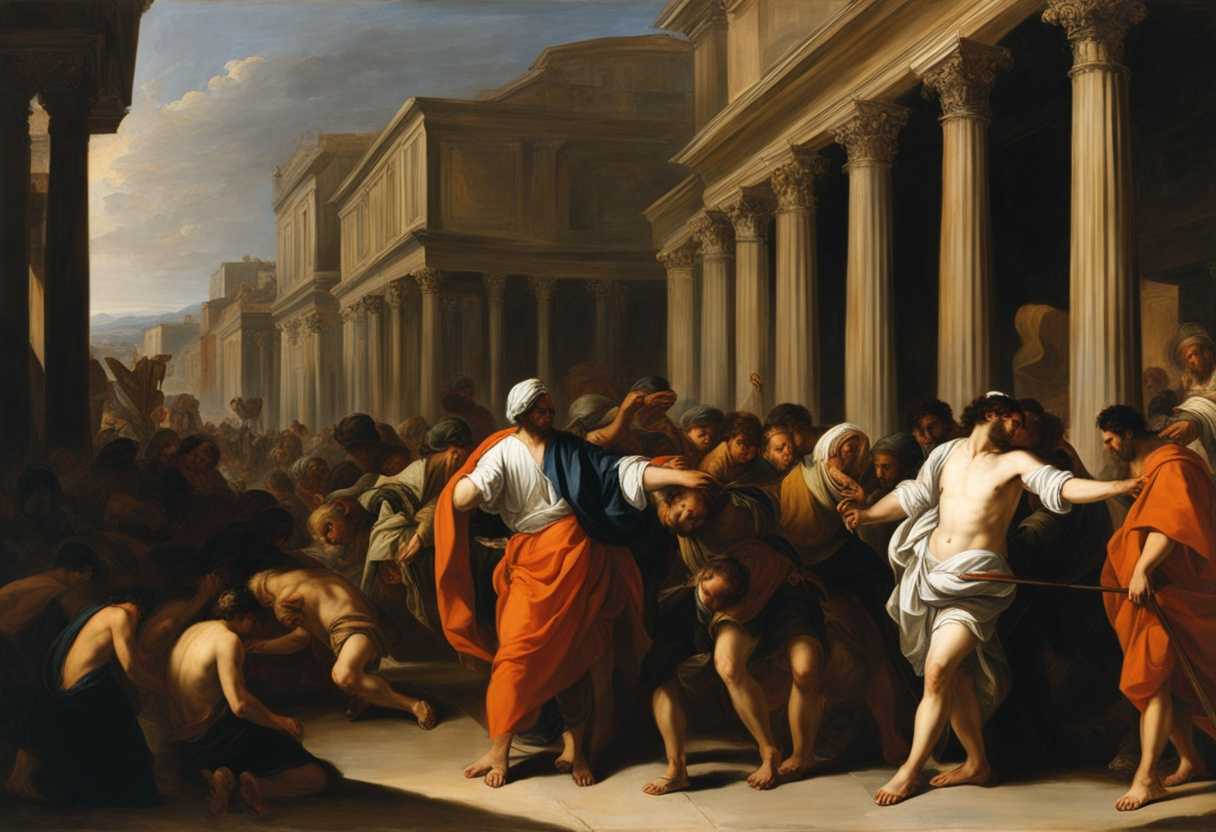
Setting the Scene for Genesis 42:1-7
In Genesis chapter 42, we find Joseph, the son of Jacob, who had been sold into slavery by his brothers and eventually rose to become a powerful ruler in Egypt. A severe famine had struck the land, and Joseph, now second in command only to Pharaoh, was overseeing the distribution of grain.
Jacob, who was also known as Israel, sent his sons to Egypt to buy grain as they were facing the effects of the famine. The scene is set in Egypt, specifically in the city where Joseph was in charge of the grain supply. As Jacob’s sons arrived, they stood before Joseph, not recognizing him due to the passage of time and the fact that he now dressed and spoke as an Egyptian.
Joseph, however, recognized his brothers and remembered the dreams he had as a young man, where his brothers had bowed down to him. This moment marked the beginning of a series of events where Joseph tested his brothers to see if they had truly changed from the envious and deceitful men they once were. The tension and emotions in the air were palpable as Joseph interacted with his brothers, setting the stage for a powerful story of forgiveness, redemption, and reconciliation.
What is Genesis 42:1-7 about?
This verse embodies a powerful theme of forgiveness and reconciliation. Despite Joseph’s brothers betraying and causing him great harm in the past, Joseph chooses to show them grace and compassion when they are in need during the famine. It speaks to the idea that forgiveness is a choice that we can make, even in the face of betrayal and hurt. Joseph’s actions show us that it is possible to let go of past grievances and extend kindness to others, even those who have wronged us.
Reflecting on this verse, we are encouraged to ponder our own capacity for forgiveness. How often do we hold onto grudges and let past hurts weigh us down? What would it look like for us to follow Joseph’s example and choose forgiveness, even when it seems difficult or undeserved? We can learn from Joseph’s story and strive to cultivate a spirit of reconciliation and mercy in our own lives by contemplating these questions.
Understanding what Genesis 42:1-7 really means
A deeply meaningful narrative in Genesis 42:1-7 extends beyond the simple act of Joseph’s brothers coming to Egypt to buy grain. This passage is ripe with layers of emotional complexity, spiritual lessons, and ethical inquiries. Let’s explore this rich tapestry woven by moral questioning and divine providence.
Firstly, the passage foregrounds the theme of desperation and recognition. Joseph’s brothers, driven by famine, come to Egypt, unwittingly fulfilling the dreams Joseph had many years before. This reversal of roles, where the once-powerful brothers stand needy before Joseph, whom they sold into slavery, accentuates the biblical principle that God’s plans are ultimately mysterious and surpass human understanding. The Lord declares in Jeremiah 29:11, “For I know the plans I have for you, plans for welfare and not for evil, to give you a future and a hope.””
The phrase where Joseph’s brothers did not recognize him, but he recognized them, opens a complex interplay of forgiveness and justice. What do these recognitions signify in our lives? Are there moments when we fail to see the workings of God in our challenges? This brings to light the lesson that often, in our darkest times, we are blind to the transformative work being performed within us and through us. Here, Joseph’s discretion in revealing his identity explores the theme of divine timing — a key element that encourages patience in the pursuit of understanding God’s will. Joseph’s emotional restraint and strategic silence invite us to reflect on how we handle power and advantage over those who have wronged us in this scenario. It echoes with Christ’s teachings in Matthew 5:44, “But I say to you, Love your enemies and pray for those who persecute you.” Thus, the text challenges us: How do we respond to those who have hurt us when we are given a position to influence their fate?
An anecdote that illustrates the relevance of these themes today could be of a person who, after many years, encounters a former bully in a situation where the tables have turned. The individual, now in a place of authority, chooses to assist instead of retaliating, recognizing the profound impact of grace and forgiveness. Genesis 42:1-7 is not merely a story of a family reunion. It is a divine narrative that questions our perceptions of justice, challenges our capacity for forgiveness, and enhances our understanding of God’s omnipresent guidance in our lives. Let us ponder these verses and incorporate the lessons into our daily interactions and spiritual journey, keeping in mind that recognition, forgiveness, and strategic silence can lead to profound healing and restoration in our relationships.
What roles do forgiveness and reconciliation play in family relationships?
Forgiveness and reconciliation play crucial roles in family relationships. Joseph eventually forgives his brothers for their betrayal and reconciles with them in the context of the verse. This act of forgiveness led to reconciliation and the restoration of their family bonds. Forgiveness in family relationships can help heal wounds and rebuild trust. It allows for the possibility of reconciliation and restoration of broken relationships. Without forgiveness, resentments can fester and damage the family unit, causing rifts that may be difficult to mend. Reconciliation, on the other hand, can bring about a sense of unity and peace within the family. Forgiveness and reconciliation are important components of maintaining healthy family dynamics overall. They promote understanding, empathy, and the willingness to move past conflicts in order to strengthen relationships and foster a sense of unity among family members.
Application
Consider your life as a complex network of roads and bridges. Each connection represents a relationship — with family, friends, or colleagues. Just as a bridge can weaken over time, so can our ties with others if marred by unresolved conflicts or misunderstandings. Like Joseph, who chose to rebuild bridges with his brothers despite deep betrayal, you too have the power to initiate repair and strengthen these vital connections. Are you ready to pave the path to forgiveness, to extend the olive branch even when it feels undeserved? Will you take the brave step towards mending a crucial bridge today?

Reverend Michael Johnson is an experienced Church Minister with a profound expertise in spirituality and guidance. With a serene presence and a compassionate heart, he has faithfully served his congregation for over 20 years, leading them on a spiritual journey towards inner peace and enlightenment. Reverend Johnson’s extensive knowledge of religious philosophies and profound understanding of human nature have made him a trusted confidant and mentor to many, as he seamlessly weaves his profound wisdom into life teachings. Reverend Johnson’s calming demeanor and empathetic nature continue to uplift and heal souls, nurturing a sense of unity and tranquility within his community.