
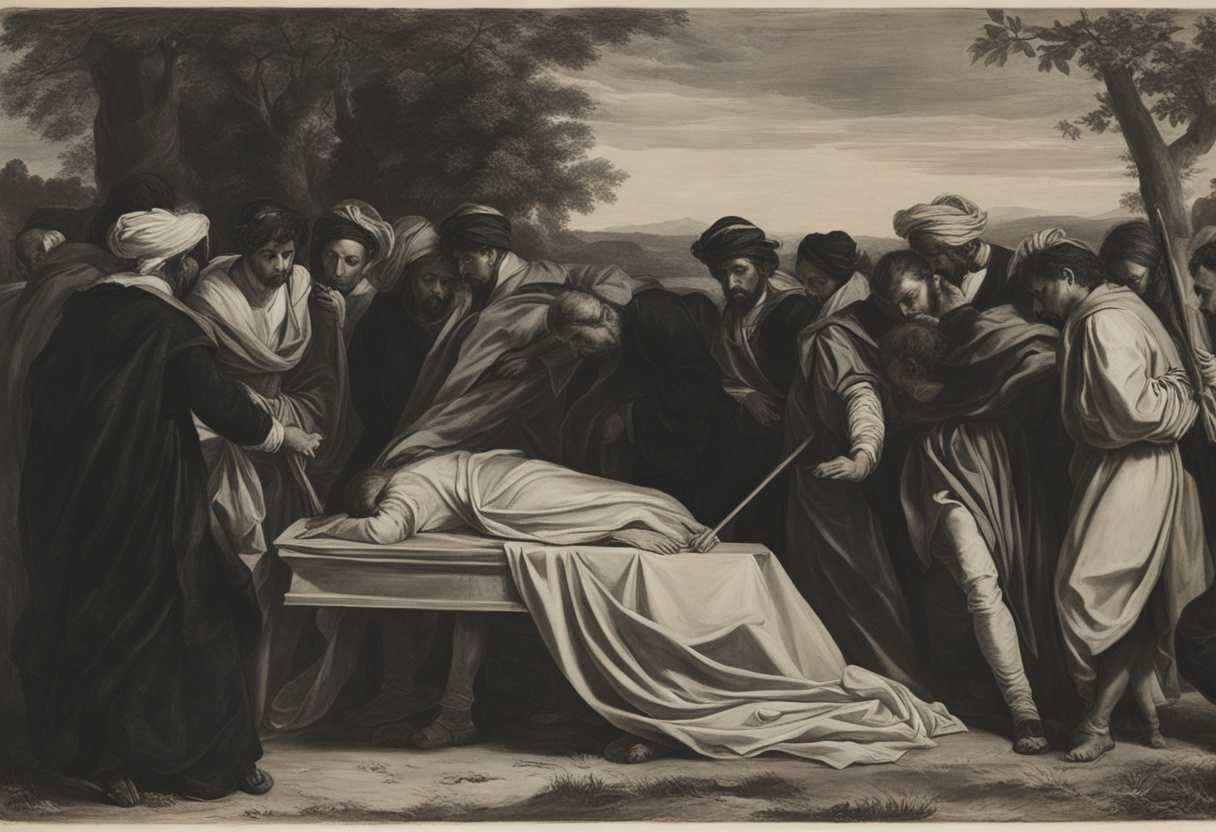
1 Then Joseph fell on his father’s face and wept over him and kissed him.
2 And Joseph commanded his servants the physicians to embalm his father. So the physicians embalmed Israel.
3 And forty days were required for it, for that is how many are required for embalming. And the Egyptians wept for him seventy days.
4 When the days of weeping for him were past, Joseph spoke to the household of Pharaoh, saying, “If now I have found favor in your eyes, please speak in the ears of Pharaoh, saying,
5 My father made me swear, saying, ‘I am about to die: in my tomb that I hewed out for myself in the land of Canaan, there shall you bury me.’ Now therefore, let me please go up and bury my father. Then I will return.
6 And Pharaoh said, “Go up and bury your father, as he made you swear.”
7 So Joseph went up to bury his father.
8 and all the household of Joseph, his brothers, and his father’s household. Only their children, their flocks, and their herds were left in the land of Goshen.
9 And there went up with him both chariots and horsemen. It was a very great company.
10 They came to the threshing floor of Atad, which is beyond the Jordan, and there they lamented with a very great and grievous lamentation, and he made a mourning for his father seven days.
11 And when the inhabitants of the land, the Canaanites, saw the mourning on the threshing floor of Atad, they said, “This is a grievous mourning for the Egyptians.” Therefore the place was named Abel-mizraim; it is beyond the Jordan.
12 Thus his sons did for him as he had commanded them,
13 for his sons carried him to the land of Canaan and buried him in the cave of the field at Machpelah, to the east of Mamre, which Abraham bought with the field from Ephron the Hittite to possess as a burying place.
14 After he had buried his father, Joseph returned to Egypt with his brothers and all who had gone up with him to bury his father.
15 When Joseph’s brothers saw that their father was dead, they said, “It may be that Joseph will hate us and pay us back for all the evil that we did to him.”
16 So they sent a message to Joseph, saying, “Your father gave this command before he died,
17 ‘Say to Joseph, “Please forgive the transgression of your brothers and their sin, because they did evil to you.”’ And now, please forgive the transgression of the servants of the God of your father.” And Joseph wept when they spoke to him.
18 His brothers also came and fell down before him and said, “Behold, we are your servants.”
19 But Joseph said to them, “Do not fear, for am I in the place of God?
20 As for you, you meant evil against me, but God meant it for good, to bring it about that many people should be kept alive, as they are today.
21 So do not fear; I will provide for you and your little ones.” Thus he comforted them and spoke kindly to them.
22 So Joseph remained in Egypt, he and his father’s house. Joseph lived 110 years.
23 And Joseph saw Ephraim’s children of the third generation. The children also of Machir the son of Manasseh were counted as Joseph’s own.
24 And Joseph said to his brothers, “I am about to die, but God will visit you and bring you up out of this land to the land that he swore to Abraham, to Isaac, and to Jacob.”
25 Then Joseph made the sons of Israel swear, saying, “God will surely visit you, and you shall carry up my bones from here.”
26 So Joseph died, being 110 years old. They embalmed him, and he was put in a coffin in Egypt.
The True Meaning of Genesis 50
The Book of Genesis, the first book of the Bible, is believed to have been written by Moses, the great prophet and leader of the Israelites. We witness the conclusion of the story of Joseph, the son of Jacob, whose life was marked by both triumph and tragedy in this final chapter.
This chapter recounts the events following the death of Jacob, Joseph’s beloved father. The brothers of Joseph, who had once betrayed him, are now seeking his forgiveness as the Israelites mourn the loss of their patriarch. The chapter also foreshadows the future exodus of the Israelites from Egypt, as Joseph prophesies that God will one day bring his people back to the land promised to their ancestors.
Throughout this passage, we are reminded of the overarching theme of God’s providence and the importance of forgiveness, as Joseph’s brothers are ultimately reconciled with him. This chapter serves as a bridge between the patriarchal narratives of Genesis and the impending Israelite exodus, setting the stage for the next pivotal events in the biblical story.
Genesis 50:1-6
Jacob, also known as Israel, is mourned and buried by his sons, including Joseph, in Genesis 50:1-6. This passage is a poignant moment in the story of the patriarchs, marking the end of an era for the family of Israel.
Firstly, in verse 1, we observe Joseph throwing himself upon the face of his father and weeping over him. This demonstrates the deep love and respect Joseph had for his father. Despite all the trials and betrayals Joseph faced, his love for his father remained steadfast. This moment reflects the importance of family bonds and the grief that comes with losing a loved one. It humanizes Joseph, showing his vulnerability and deep emotions, which is a stark contrast to his position of power and authority in Egypt. The physicians embalmed Jacob in verse 2 as the mourning continues, which was a customary practice in ancient Egypt. The process of embalming served not only as a means to preserve the body but also as a way to show honor to the deceased. This act of embalming symbolizes the respect and reverence shown to Jacob in his death. It is a reminder of how death is a natural part of life and how we should honor and remember those who have passed before us.
Moving on to verse 4, we see that Joseph asks Pharaoh for permission to go and bury his father in the land of Canaan, as Jacob had requested before his death. This request highlights Joseph’s obedience and loyalty to his father’s wishes. Despite all his success and influence in Egypt, Joseph remains connected to his roots and is committed to fulfilling his father’s dying wish. The importance of honoring our parents and fulfilling their last wishes is emphasized here, showcasing Joseph’s respect for his father and the value of family traditions. A grand funeral procession for Jacob is witnessed in verses 5-6, with both the elders of Egypt and Joseph’s household accompanying him. This funeral procession signifies the stature and respect Jacob held, not only within his family but also among the Egyptians. The inclusion of both Egyptians and Hebrews in the procession shows the unity and respect that Joseph commanded in Egypt. It demonstrates how Joseph was able to bridge the gap between his Egyptian identity and his Hebrew roots, exemplifying reconciliation and unity amidst diversity. This passage in Genesis 50 illustrates the themes of family bonds, honoring the deceased, obedience to parents, and unity among diverse groups. It reminds us of the importance of preserving traditions, respecting the wishes of our loved ones, and valuing our roots and heritage. Just as Joseph remained faithful to his father in life and death, we are called to cherish and uphold the values and legacies passed down to us. The story of Jacob’s burial serves as a poignant reminder of the cycle of life and the eternal bond of family that transcends time and challenges.
Genesis 50:7-14
A significant event unfolds in Genesis 50:7-14 after the passing of Jacob, also known as Israel. The verse describes the burial procession of Jacob with great detail. This procession included not only the family members of Jacob but also the elders of Egypt, officials of Pharaoh’s household, and chariots and horsemen. This impressive display of mourning and respect for Jacob’s death shows the high regard in which he was held, not only by his immediate family but also by the people of Egypt.
The fact that the Egyptians joined in this mourning procession is significant as it highlights the deep impact Jacob had on the land of Egypt during his time there. Jacob, through his son Joseph, had played a crucial role in saving Egypt and the surrounding regions from a severe famine by interpreting Pharaoh’s dreams and implementing a plan to store food during the years of plenty. This act of kindness and wisdom endeared Jacob and his family to the Egyptians, leading to their participation in his burial rites. This event serves as a reminder of the importance of honoring and respecting those who have impacted our lives positively.
Furthermore, the reverence shown for Jacob in his death reflects the honor and significance of the patriarchs in the biblical narrative. Jacob was one of the great patriarchs of Israel, chosen by God to carry on the covenant that began with Abraham. The Bible often emphasizes the importance of honoring one’s parents and ancestors, and we see this principle exemplified in the elaborate burial procession for Jacob. The Ten Commandments in Exodus 20:12 instruct people to “Honor your father and your mother, so that you may live long in the land the Lord your God is giving you.”” This respect for one’s parents and forefathers is a timeless message that transcends cultures and generations.
Additionally, the unity displayed in the mourning of Jacob’s death is a powerful testament to the importance of family and community. Despite the tumultuous history of Jacob’s family, marked by jealousy, betrayal, and reconciliation, they come together to mourn his passing. This unity serves as a reminder of the strength that can be found in family bonds and the ability to overcome past grievances for the greater good. God’s people living together in unity is good and pleasant, as stated in Psalm 133:1.” This unity in mourning not only honors Jacob but also sets an example for future generations to prioritize familial relationships and reconciliation. The burial procession of Jacob described in Genesis 50:7-14 serves as a poignant reminder of the importance of honoring those who have influenced our lives, the legacy of the patriarchs in the biblical narrative, the significance of family unity, and the timeless messages found in the scriptures about respect, unity, and honoring one’s parents and ancestors. It also highlights the transformative power of forgiveness and reconciliation within families.
Genesis 50:15-21
We read about a significant and heartfelt moment in the story of Joseph, one of the central figures in the book of Genesis, in Genesis 50:15-21. This passage deals with the aftermath of their father Jacob’s death when Joseph’s brothers, who had previously sold him into slavery out of jealousy, fear that Joseph might seek revenge now that their father is no longer alive. This scene is a culmination of years of turmoil, forgiveness, and reconciliation within Joseph’s family.
When Joseph’s brothers approached him, they did so with trepidation and fear. They fell down before him, acknowledging their guilt and seeking forgiveness. This moment is powerful because it reveals the deep emotional wounds that existed within the family due to their past actions. Despite the passage of time, the brothers still carried the weight of their betrayal towards Joseph.
Joseph’s response to his brothers’ plea is profound and showcases his growth and maturity throughout the hardships he faced. He wept at their words, showing both his emotional vulnerability and his capacity for empathy and forgiveness. Joseph’s reply is a testament to his faith in God’s sovereignty and his belief that even the evil acts of his brothers were ultimately used by God for a greater purpose. He reassured his brothers that he harbored no ill will towards them, understanding that what they meant for harm, God meant for good.
This passage teaches us timeless lessons about forgiveness, reconciliation, and the transformative power of grace. Joseph’s ability to forgive his brothers despite the pain they caused him reflects the biblical principle of forgiveness that is echoed throughout the Bible. Jesus teaches the importance of forgiveness in Matthew 6:14-15, stating, “For if you forgive other people when they sin against you, your heavenly Father will also forgive you.” But if you do not forgive others their sins, your Father will not forgive your sins.” Joseph’s forgiveness of his brothers sets a powerful example for us all to emulate in our own lives. Joseph’s recognition of God’s overarching plan in the midst of suffering and betrayal reminds us of God’s faithfulness and sovereignty. This theme is woven throughout the Bible, from the story of Joseph to the crucifixion of Jesus Christ. Romans 8:28 reassures us of this truth: “And we know that in all things God works for the good of those who love him, who have been called according to his purpose.” Just as God used Joseph’s suffering for good, he can also work through our own trials and tribulations for a greater purpose. Genesis 50:15-21 captures a powerful moment of forgiveness and reconciliation within Joseph’s family. It underscores the importance of letting go of past hurts, extending grace to others, and trusting in God’s plan even in the face of adversity. Joseph’s story serves as a beacon of hope and a testament to the transformative power of forgiveness.
Genesis 50:22-26
Joseph, a central figure in the narrative of the Israelites, concludes the book of Genesis and his life is seen in Genesis 50:22-26. Let’s break down these verses section by section.
Verse 22 begins with Joseph living in Egypt, along with his father’s household. At this point, we see that Joseph lived a long and fulfilling life, having witnessed both trials and triumphs. Joseph had gone from being betrayed by his brothers, sold into slavery, wrongly imprisoned, to becoming the second most powerful man in Egypt. His story serves as a powerful testament to God’s providence and faithfulness in times of adversity. The fact that Joseph was able to reconcile with his brothers, forgive them, and provide for his family during the famine shows the importance of forgiveness, reconciliation, and trusting in God’s plan. It is a reminder that no matter how bleak our circumstances may seem, God can turn things around for our good (Romans 8:28). Joseph saw three generations of his family, descendants of Ephraim and Manasseh, in verse 23. Seeing his children’s children was a fulfillment of God’s promise to make his offspring as numerous as the stars in the sky (Genesis 15:5). It highlights the importance of God’s covenant with Abraham, Isaac, and Jacob, which was now being carried on through Joseph’s descendants. The promise of God’s faithfulness to future generations is a recurring theme throughout the Bible, emphasizing the interconnectedness of God’s plan across multiple generations.
Verse 24 then shifts the focus to Joseph’s impending death. Before his passing, he makes his brothers swear an oath that they will carry his bones up from Egypt to be buried in the Promised Land when God fulfills His promise to bring the Israelites out of Egypt. This request by Joseph is significant because it shows his unwavering faith in God’s promise to deliver the Israelites to the land of Canaan. Joseph’s desire to be buried in the Promised Land signifies his identification with the future hope of the Israelite nation. This act also foreshadows the Exodus and the eventual return of the Israelites to Canaan under the leadership of Moses.
Finally, in verses 25-26, we see Joseph’s death at the age of 110, followed by his embalming and preparation for burial. The text emphasizes that Joseph lived to see the third generation of Ephraim’s children. The mention of his embalming reflects the Egyptian customs of preserving the body for the afterlife. However, Joseph’s faith was not in the preservation of his physical body but in the promise of the resurrection and the inheritance of the land that God had sworn to give to Abraham and his descendants. This act symbolizes Joseph’s trust in God’s ultimate deliverance and his confidence in the fulfillment of God’s covenant promises. Genesis 50:22-26 encapsulates the themes of faith, forgiveness, providence, and the fulfillment of God’s promises. Joseph’s life serves as a powerful example of remaining steadfast in faith during times of adversity and trusting in God’s sovereign plan. His story continues to inspire believers to forgive those who have wronged them, to trust in God’s provision, and to have confidence in the fulfillment of God’s promises across generations.
After Genesis 50
The brothers were relieved that Joseph had forgiven them. They knew they had done wrong, but Joseph’s compassion and wisdom had saved them all. Joseph gave the family one final instruction as they prepared to return home. “When I die, do not bury me here,” he said. “Carry my bones back to the land God promised our ancestors.” With that, Joseph blessed his family and closed his eyes for the last time. The Israelites now faced an uncertain future in a foreign land. But they knew God’s promise would guide them, even in the darkest of times.

Reverend Michael Johnson is an experienced Church Minister with a profound expertise in spirituality and guidance. With a serene presence and a compassionate heart, he has faithfully served his congregation for over 20 years, leading them on a spiritual journey towards inner peace and enlightenment. Reverend Johnson’s extensive knowledge of religious philosophies and profound understanding of human nature have made him a trusted confidant and mentor to many, as he seamlessly weaves his profound wisdom into life teachings. Reverend Johnson’s calming demeanor and empathetic nature continue to uplift and heal souls, nurturing a sense of unity and tranquility within his community.