
Genesis 6-8 is about God’s judgment on a corrupt humanity through the flood, highlighting themes of sin, divine mercy, and covenant as Noah and his family are saved and given a new beginning to repopulate the earth.
5 The Lord saw that the wickedness of man was great in the earth, and that every intention of the thoughts of his heart was only evil continually.
2 the sons of God saw that the daughters of man were attractive. And they took as their wives any they chose.
3 Then the Lord said, “My Spirit shall not abide in man forever, for he is flesh: his days shall be 120 years.”
4 There were giants in the earth in those days, and also after that, when the sons of God came in unto the daughters of men, and they bare children to them, the same became mighty men which were of old, men of renown.
5 The Lord saw that the wickedness of man was great in the earth, and that every intention of the thoughts of his heart was only evil continually.
6 And the Lord regretted that he had made man on the earth, and it grieved him to his heart.
7 So the Lord said, “I will blot out man whom I have created from the face of the land, man and animals and creeping things and birds of the heavens, for I am sorry that I have made them.”
8 But Noah found favor in the eyes of the Lord.
9 These are the generations of Noah. Noah was a righteous man, blameless in his generation. Noah walked with God.
10 These are the generations of Noah. Noah was a righteous man, blameless in his generation. Noah walked with God.
11 Now the earth was corrupt in God’s sight, and the earth was filled with violence.
12 And God saw the earth, and behold, it was corrupt, for all flesh had corrupted their way on the earth.
13 And God said to Noah, “I have determined to make an end of all flesh, for the earth is filled with violence through them. Behold, I will destroy them with the earth.
14 Make yourself an ark of gopher wood.
15 This is how you are to make it: the length of the ark three hundred cubits, its breadth fifty cubits, and its height thirty cubits.
16 Make a roof for the ark, and finish it to a cubit above, and set the door of the ark in its side. Make it with lower, second, and third decks.
17 For behold, I will bring a flood of waters upon the earth to destroy all flesh in which is the breath of life under heaven. Everything that is on the earth shall die.
18 But I will establish my covenant with you, and you shall come into the ark, you, your sons, your wife, and your sons’ wives with you.
19 And of every living thing of all flesh, you shall bring two of every sort into the ark to keep them alive with you. They shall be male and female.
20 Of the birds according to their kinds, and of the animals according to their kinds, of every creeping thing of the ground, according to its kind, two of every sort shall come in to you to keep them alive.
21 And you shall take for yourself of all food that is eaten, and you shall gather it to yourself, and it shall be food for you and for them.
22 Noah did this; he did all that God commanded him.
1 Then the Lord said to Noah, “Go into the ark, you and all your household, for I have seen that you are righteous before me in this generation.
2 Take with you seven pairs of all clean animals, the male and his mate, and a pair of the animals that are not clean, the male and his mate,
3 and seven pairs of the birds of the heavens also, male and female, to keep their offspring alive on the face of all the earth.
4 For in seven days I will send rain on the earth forty days and forty nights, and every living thing that I have made I will blot out from the face of the ground.
5 And Noah did all that the Lord had commanded him.
6 Noah was six hundred years old when the flood of waters came upon the earth.
7 And Noah and his sons and his wife and his sons’ wives with him went into the ark to escape the waters of the flood.
8 Of clean animals, and of animals that are not clean, and of birds, and of everything that creeps on the ground,
9 two and two, male and female, went into the ark with Noah, as God had commanded Noah.
10 And after seven days the waters of the flood came upon the earth.
11 In the six hundredth year of Noah’s life, in the second month, on the seventeenth day of the month, on that day all the fountains of the great deep burst forth, and the windows of the heavens were opened.
12 And rain fell upon the earth forty days and forty nights.
13 On the very same day Noah and his sons, Shem and Ham and Japheth, and Noah’s wife and the three wives of his sons with them entered the ark,
14 they and every beast, according to its kind, and all the livestock according to their kinds, and every creeping thing that creeps on the earth, according to its kind, and every bird, according to its kind, every winged creature.
15 They went into the ark with Noah, two and two of all flesh in which there was the breath of life.
16 And those that entered, male and female of all flesh, went in as God had commanded him. And the Lord shut him in.
17 The flood continued forty days on the earth. The waters increased and bore up the ark, and it rose high above the earth.
18 The waters prevailed and increased greatly on the earth, and the ark floated on the face of the waters.
19 And the waters prevailed so mightily on the earth that all the high mountains under the whole heaven were covered.
20 The waters prevailed above the mountains, covering them fifteen cubits deep.
21 And all flesh died that moved on the earth, birds, livestock, beasts, all swarming creatures that swarm on the earth, and all mankind.
22 Everything on the dry land in whose nostrils was the breath of life died.
23 He blotted out every living thing that was on the face of the ground, man and animals and creeping things and birds of the heavens. They were blotted out from the earth. Only Noah was left, and those who were with him in the ark.
24 And the waters prevailed on the earth 150 days.
1 But God remembered Noah and all the beasts and all the livestock that were with him in the ark. And God made a wind blow over the earth, and the waters subsided.
2 The fountains of the deep and the windows of the heavens were closed, the rain from the heavens was restrained,
3 The waters receded from the earth continually. At the end of 150 days the waters had abated.
4 And in the seventh month, on the seventeenth day of the month, the ark came to rest on the mountains of Ararat.
5 The waters continued to recede until the tenth month; in the tenth month, on the first day of the month, the tops of the mountains were seen.
6 At the end of forty days Noah opened the window of the ark that he had made.
7 and sent out a raven. It went to and fro until the waters were dried up from the earth.
8 Then he sent forth a dove from him, to see if the waters had subsided from the face of the ground.
9 But the dove found no place to set her foot, and she returned to him to the ark, for the waters were still on the face of the whole earth. So he put out his hand and took her and brought her into the ark with him.
10 He waited another seven days, and again he sent forth the dove out of the ark.
11 And the dove came back to him in the evening, and behold, in her mouth was a freshly plucked olive leaf. So Noah knew that the waters had subsided from the earth.
12 And he waited yet another seven days and sent forth the dove, and she did not return to him anymore.
13 In the six hundred and first year, in the first month, the first day of the month, the waters were dried from off the earth. And Noah removed the covering of the ark and looked, and behold, the face of the ground was dry.
14 In the second month, on the twenty-seventh day of the month, the earth had dried out.
15 Then God said to Noah,
16 “Go out from the ark, you and your wife, and your sons and your sons’ wives with you.”
17 Bring out with you every living thing that is with you of all flesh—birds and animals and every creeping thing that creeps on the earth—so that they may swarm on the earth, and be fruitful and multiply on the earth.”
18 So Noah went out, and his sons and his wife and his sons’ wives with him.
19 Every beast, every creeping thing, and every bird, everything that moves on the earth, went out by families from the ark.
20 Then Noah built an altar to the Lord and took some of every clean animal and some of every clean bird and offered burnt offerings on the altar.
21 And when the Lord smelled the pleasing aroma, the Lord said in his heart, “I will never again curse the ground because of man, for the intention of man’s heart is evil from his youth. I will never again strike down every living creature as I have done.
22 While the earth remains, seedtime and harvest, cold and heat, summer and winter, day and night, shall not cease.
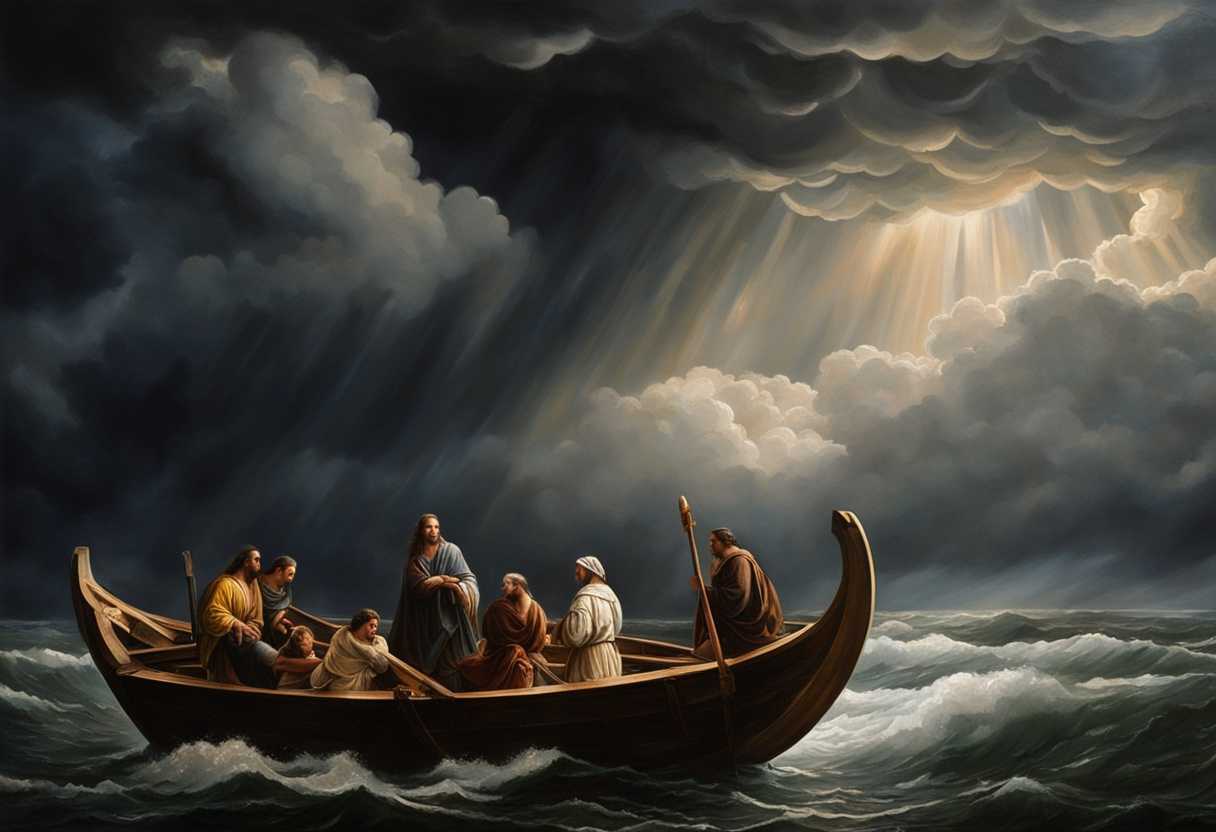
Setting the Scene for Genesis 6-8
In the ancient world, a time marked by rampant wickedness and corruption, the earth was filled with violence and immorality. The air was thick with despair as humanity had turned away from the ways of the Creator. Among the throngs of people, there was one man who stood out—Noah. He was a righteous man, blameless in his generation, and he walked faithfully with God. As the sun dipped below the horizon, casting a golden hue over the land, Noah received a divine revelation that would change the course of history. God spoke to him, revealing His plan to cleanse the earth of its wickedness through a great flood, and instructed Noah to build an ark, a massive vessel that would save him, his family, and pairs of every living creature.
As Noah gathered his three sons—Shem, Ham, and Japheth—he shared the weight of the task ahead. The family worked tirelessly, day after day, under the scorching sun and the watchful eyes of a skeptical world. The sound of hammering echoed through the valleys as they constructed the ark, a monumental structure of gopher wood, measuring hundreds of feet long. The air was filled with the scent of freshly cut timber and the cries of birds overhead, while the distant mountains stood as silent witnesses to the unfolding drama. Neighbors and passersby mocked Noah, ridiculing his warnings of impending doom, yet he remained steadfast, driven by faith and obedience to God’s command.
As the ark neared completion, the skies began to darken, and the first drops of rain fell, a prelude to the deluge that would soon engulf the earth. Noah, his wife, and their sons, along with their daughters-in-law, gathered their provisions and the animals that would board the ark. The atmosphere was charged with a mix of anxiety and anticipation, as the family prepared to enter the sanctuary that would protect them from the chaos outside. The world around them transformed into a scene of impending judgment, with the once-familiar landscape now shrouded in ominous clouds. The door of the ark loomed large, a symbol of salvation amidst the storm, as Noah and his family took their first steps into a new beginning, leaving behind a world that had chosen to reject the Creator’s ways.
What is Genesis 6-8 about?
What an incredible story we’re diving into with Genesis 6-8! At its core, this passage showcases the profound themes of obedience, judgment, mercy, and hope. We begin with Noah, who stood as a beacon of righteousness in a world filled with corruption and violence. Can you imagine being in Noah’s sandals, tasked not only with building an immense ark but also with being the last bastion of faithfulness in a society that had seemingly turned its back on God? His obedience to God’s command, despite the ridicule and disbelief he must have faced, sets an extraordinary precedent for faith in the unseen. The Great Flood, a monumental event that signifies both judgment and renewal, is encountered as we progress through the narrative. The flood was not merely a means of punishment for the wicked but also served as a cleansing act, paving the way for new beginnings. We often face moments of chaos in our own lives that strip away the old and make way for transformation. After the floodwaters receded, God established a covenant with Noah—one that included the beautiful symbol of the rainbow. This wasn’t just a promise that the earth would never again be destroyed by water; it was also a reassurance of God’s enduring commitment to humanity and creation. Isn’t it comforting to think about the ways in which God interacts with us, offering signs of His presence and promises even amidst our storms? The account of Noah teaches us vital lessons about the relationship between divine command, human response, and the grace that follows. The obedience of one can alter the course of history! Have you ever found yourself in a situation where standing firm in your beliefs felt daunting? The story encourages us to navigate our faith journeys with courage. It reminds us that, indeed, there is always hope after the storm, represented by that radiant spectrum of colors in the sky. What covenants do you see in your own life as you reflect on this passage? And how can we, like Noah, choose to embody obedience in our daily actions?
Understanding what Genesis 6-8 really means
Genesis chapters 6 to 8 recount the story of Noah, the Ark, and the Great Flood. This narrative serves as a pivotal moment in biblical history, illustrating themes of judgment, grace, and covenant. It invites us to explore the depths of human nature and the divine response to it. As we delve into this passage, we are confronted with profound questions about righteousness, the consequences of sin, and the hope that emerges from despair.
The themes of judgment and righteousness are starkly evident. The world was filled with wickedness, prompting God to cleanse it through the flood. This act reflects God’s holiness and justice, reminding us that there are consequences for moral decay. Yet, amidst this judgment, we see a glimmer of grace. Noah found favor in God’s eyes, highlighting the concept of grace where salvation is offered even in the face of impending doom. This duality of judgment and grace invites us to reflect on our own lives. Are we living in a way that aligns with God’s righteousness, or are we contributing to the moral decay around us?
After the flood, God establishes a covenant with Noah, symbolized by the rainbow. This promise signifies hope and restoration, assuring humanity that the earth will not be destroyed by flood again. It is a powerful reminder of God’s commitment to His creation. The covenant also invites us to consider our own commitments. How do we respond to God’s grace? Are we willing to enter into a relationship with Him that reflects our understanding of His mercy and love?
Related biblical passages further illuminate the significance of Noah’s story. Hebrews 11:7 commends Noah for his faith and obedience in building the Ark, emphasizing that faith must be accompanied by action. In 2 Peter 2:5, Noah is referred to as a “herald of righteousness,” underscoring his role in warning others about the impending judgment. These verses challenge us to consider our own faith. Are we living out our beliefs in a way that impacts those around us?
The relevance of Noah’s story extends into our contemporary world, where moral decay can often be observed. The narrative serves as a reminder that God remains sovereign and that His grace is available to those who seek it. Consider a community facing a crisis, such as a natural disaster. In the aftermath, acts of kindness and solidarity emerge, reminiscent of Noah’s family working together to survive. This reflects the human capacity for resilience and hope, even in dire circumstances. How can we cultivate such resilience in our own lives and communities?
Meaningful phrases within the text further enrich our understanding. “Noah found favor in the eyes of the Lord” emphasizes the personal relationship between Noah and God, suggesting that righteousness involves both actions and intentions. Conversely, “The earth was corrupt in God’s sight” serves as a sobering reminder of the seriousness of sin and its consequences. Finally, “I will establish my covenant with you” signifies God’s unwavering commitment to humanity, reassuring us that despite our failures, He desires a relationship with us.
In conclusion, the story of Noah is not merely an ancient tale; it is a profound narrative that speaks to the human condition. It challenges us to reflect on our own lives, our relationship with God, and the choices we make. As we navigate our modern world, may we strive to be like Noah—faithful, obedient, and hopeful in the face of adversity. Let us embrace the lessons of judgment, grace, and covenant, allowing them to shape our lives and our communities.
How can we find hope in times of turmoil?
Recognizing the possibility of renewal and transformation often requires finding hope in times of turmoil. The narrative highlights how even in the face of overwhelming chaos and despair, there is a path towards restoration. The assurance that something new can emerge from difficult circumstances allows individuals to feel that there is meaning behind their struggles. Embracing the idea that change is possible can instill a sense of optimism and motivate proactive actions toward positive outcomes.
Furthermore, the importance of faith and perseverance is a central theme in navigating through challenging times. Individuals can endure hardships by holding onto belief and maintaining a commitment to purpose, understanding that their journey has a larger significance. This encourages resilience, as it fosters a mindset that sees beyond immediate suffering and focuses on the potential for redemption and peace.
Lastly, the idea that a faithful presence exists amidst adversity serves as a profound source of comfort. Recognizing that there is support and guidance available can provide strength during uncertain times. People often find hope through community, shared experiences, and the assurance that they are not alone. Individuals can cultivate an environment where hope flourishes, even amid life’s storms, by connecting with others and nurturing these relationships.
Application
Just like in business where you make tough choices to build a brighter future, your faith can guide you through life’s storms. Think of Noah, who stood firm in his beliefs when everyone else was skeptical. Are you ready to trust in something bigger, even when chaos surrounds you? Every day, you face decisions that can either bring you closer to your goals or pull you off course. Take a moment to reflect—how can you let your faith steer you through this turbulent world? Are you prepared to paddle forward despite the waves?

Reverend Michael Johnson is an experienced Church Minister with a profound expertise in spirituality and guidance. With a serene presence and a compassionate heart, he has faithfully served his congregation for over 20 years, leading them on a spiritual journey towards inner peace and enlightenment. Reverend Johnson’s extensive knowledge of religious philosophies and profound understanding of human nature have made him a trusted confidant and mentor to many, as he seamlessly weaves his profound wisdom into life teachings. Reverend Johnson’s calming demeanor and empathetic nature continue to uplift and heal souls, nurturing a sense of unity and tranquility within his community.