
18 The sons of Noah who went forth from the ark were Shem, Ham, and Japheth. Ham was the father of Canaan.
19 These three were the sons of Noah, and from these the people of the whole earth were dispersed.
20 Noah began to be a man of the soil, and he planted a vineyard.
21 He drank of the wine and became drunk and lay uncovered in his tent.
22 And Ham, the father of Canaan, saw the nakedness of his father and told his two brothers outside.
23 Then Shem and Japheth took a garment, laid it on both their shoulders, and walked backward and covered the nakedness of their father. Their faces were turned backward, and they did not see their father’s nakedness.
24 When Noah awoke from his wine and knew what his youngest son had done to him,
25 he said, “Cursed be Canaan;
a servant of servants shall he be to his brothers.”
26 He also said, “Blessed be the Lord, the God of Shem; and let Canaan be his servant.”
27 May God enlarge Japheth, and let him dwell in the tents of Shem, and let Canaan be his servant.”
28 And Noah lived after the flood three hundred and fifty years.
29 All the days of Noah were nine hundred and fifty years, and he died.
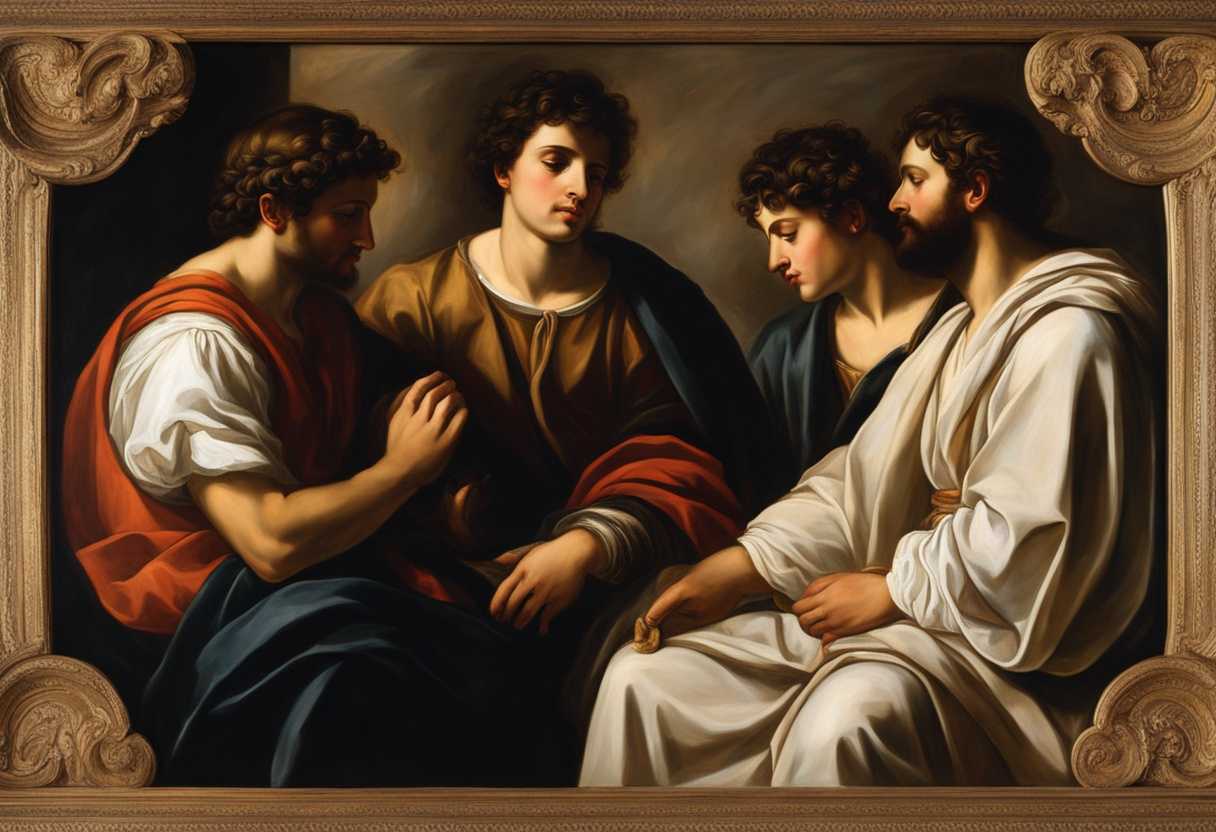
Setting the Scene for Genesis 9:18-29
In Genesis chapter 9, we find Noah, a righteous man who had found favor in the eyes of the Lord, along with his three sons: Shem, Ham, and Japheth. The scene takes place after the great flood that had wiped out all living creatures on earth, except for those saved on the ark. The family had just disembarked from the ark onto dry land, a new beginning for humanity.
Noah, now an old man, had planted a vineyard and made wine. One day, he drank too much of the wine and became drunk, lying naked in his tent. Ham, one of his sons, saw his father’s nakedness and told his brothers outside. Shem and Japheth, in an act of respect and honor, took a garment and walked backward into the tent to cover their father without looking at him.
The scene is one of vulnerability, respect, and family dynamics. It showcases the humanity of these biblical figures and the complexities of their relationships. Noah’s actions and his sons’ responses set the stage for the unfolding of events that would shape the future of their descendants.
What is Genesis 9:18-29 about?
The story of Noah being found drunk by his sons in this verse illustrates the importance of honoring and respecting one’s parents. Despite Noah’s mistake of becoming intoxicated, the actions of Ham, Shem, and Japheth towards their father hold significant lessons for us. Ham’s disrespect and lack of reverence towards his father serve as a stark contrast to the actions of Shem and Japheth, who cover their father’s nakedness out of respect and honor. This story highlights the values of filial piety and the importance of treating one’s parents with dignity and love, even in challenging situations.
Through this passage, we can reflect on our own relationships with our parents and consider how we show them honor and respect. It prompts us to think about how we react when our parents make mistakes or face difficulties – do we respond with compassion and care, or do we act disrespectfully? The actions of Noah’s sons show us the impact of our behaviors towards our parents and remind us of the virtue of honoring and caring for them unconditionally. This verse ultimately challenges us to consider how we can embody the values of love, respect, and honor towards our parents, just as Shem and Japheth did for Noah.
Understanding what Genesis 9:18-29 really means
We explore the complexities of human nature, consequences, and the importance of family dynamics in Genesis 9:18-29. This passage follows the upheaval of the great flood and highlights the fragile human condition post-crisis.
Firstly, it’s crucial to understand the context immediately after the flood, a time when Noah and his sons step into the role of repopulating and stewarding a cleansed earth. Intriguingly, here we see Noah, previously characterized by his righteous and blameless nature (Genesis 6:9), in a vulnerable and compromised position, drunk and exposed in his tent. This scene starkly contrasts with the former depictions of Noah, hinting at the perennial struggle between human frailty and moral uprightness.
Noah’s inebriation and subsequent exposure are pivotal, as they set the scene for the actions of his sons, which lead to lasting consequences and blessings. While Ham, the father of Canaan, reacts to his father’s state by telling his two brothers outside (potentially derisively), Shem and Japheth demonstrate respect and dignity by covering their father without looking at his nakedness. This act underlines a thematic emphasis on respecting one’s parents and preserving familial honor.
The reactions of Noah’s sons not only define their moral standings but ripple forward to bring about a curse and a blessing (Genesis 9:25-27). This is a vivid reminder of the significant impact of our choices and actions on future generations, a topic just as relevant today as ever. Our reactions to family members during vulnerable times often set a course for harmony or discord in our own lives.
Indeed, every reader might recall an “exposure” moment within their own family—a time when someone’s imperfection was laid bare. Reflecting on how we responded or how we were treated can be enlightening and might even redirect how we handle such moments moving forward. Genesis 9:18-29 serves as a rich narrative pool from which to draw lessons about human imperfections, respect for family, and the enduring consequences of our actions. The account encourages us to examine personal and familial respect closely: how do we treat our family members when they are most vulnerable? How do we expect to be treated? Let this passage be a reminder of the weight of our conduct and the power of dignity and respect in the maintenance of familial bonds and moral fortitude.
How can we navigate family conflicts with grace?
Family conflicts can be challenging to navigate, and it is important to approach them with grace and understanding. Noah’s family experiences a moment of discord in the passage from Genesis. Each person involved in times of conflict is a unique individual with their own thoughts, feelings, and perspectives. Approaching the situation with empathy and a willingness to listen can help to foster understanding and resolution.
It is also important to remember that forgiveness plays a significant role in healing family conflicts. Just as Noah’s family faced challenges but eventually found a way to move forward, extending forgiveness and showing compassion can help mend strained relationships. It is possible to navigate family conflicts with grace and ultimately strengthen relationships within the family unit by acknowledging mistakes, seeking reconciliation, and working towards understanding each other’s viewpoints.
Application
Imagine steering a ship where every small turn you make sets the course for the generations that follow in your wake. Just like in the intricate dance of family life illustrated in Genesis 9:18-29, every action and decision casts ripples that extend far beyond our immediate sight. This passage not only uncovers the complexities within familial bonds but also highlights the weight of our choices. Today, stand at the helm of your family’s future with wisdom. Choose to forge a legacy marked by righteousness and obedience, a beacon for the generations to come. Will you adjust your sails and chart a course that honors this powerful lesson?

Reverend Michael Johnson is an experienced Church Minister with a profound expertise in spirituality and guidance. With a serene presence and a compassionate heart, he has faithfully served his congregation for over 20 years, leading them on a spiritual journey towards inner peace and enlightenment. Reverend Johnson’s extensive knowledge of religious philosophies and profound understanding of human nature have made him a trusted confidant and mentor to many, as he seamlessly weaves his profound wisdom into life teachings. Reverend Johnson’s calming demeanor and empathetic nature continue to uplift and heal souls, nurturing a sense of unity and tranquility within his community.