
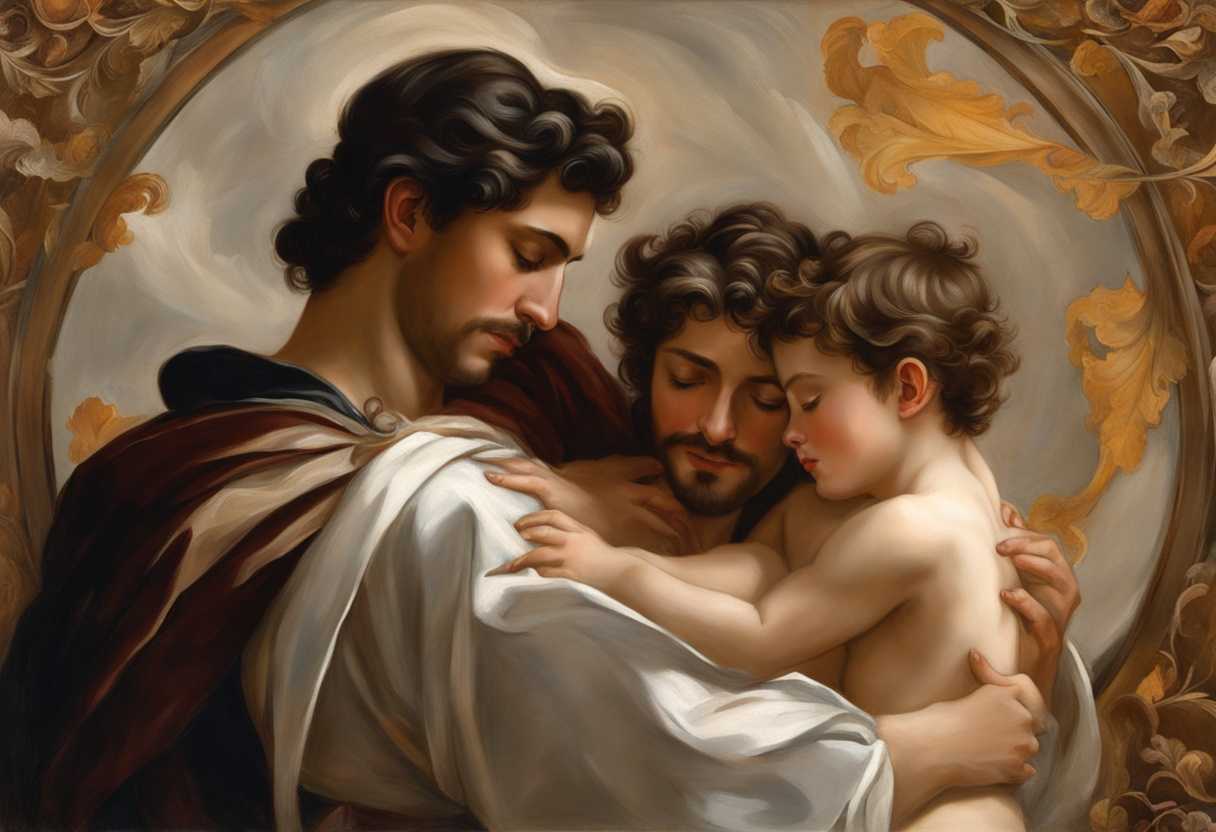
23 Then Shem and Japheth took a garment, laid it on both their shoulders, and walked backward and covered the nakedness of their father. Their faces were turned backward, and they did not see their father’s nakedness.
Setting the Scene for Genesis 9:23
In Genesis chapter 9, we find the story of Noah and his three sons: Shem, Ham, and Japheth. After the great flood, Noah and his family, along with pairs of every kind of animal, emerged from the ark onto dry land. The scene described in Genesis 9:23 takes place shortly after this event, when Noah plants a vineyard and makes wine for the first time.
In this particular scene, Noah becomes drunk from the wine he has made and is lying uncovered in his tent. Ham, one of his sons, sees his father’s nakedness and tells his brothers outside. Shem and Japheth, in a display of respect and honor for their father, take a garment and walk backward into the tent to cover Noah without looking at him. This act of covering their father’s nakedness without seeing it earns them Noah’s blessing.
The setting for this scene is likely a simple tent or shelter that Noah had constructed after leaving the ark. The atmosphere is one of post-flood tranquility, with the earth beginning to renew itself after the catastrophic event. The relationship dynamics between the family members are highlighted in this moment, showcasing the respect and honor that Shem and Japheth demonstrate towards their father, Noah.
What is Genesis 9:23 about?
Ham, one of Noah’s sons, dishonors his father by seeing him naked in this verse from the book of Genesis. The act of seeing someone naked may seem insignificant to some, but in this context, it symbolizes a lack of respect and honor towards one’s father. We are taught as children to honor and respect our parents, and we should consider seeing them in a vulnerable state like nakedness as a private and respectful moment, not one to be shared or exploited.
This verse serves as a poignant reminder of the importance of showing respect and honor towards our parents and elders. It prompts us to reflect on our own actions and behaviors towards our family members, especially our parents. How do we treat them in times of vulnerability or weakness? Do we offer them the same level of respect and dignity that we expect for ourselves? Let this verse be a guide for us to always show love, respect, and honor towards our parents, recognizing the significance of our relationships with them.
Understanding what Genesis 9:23 really means
Themes of respect, family relationships, and the sanctity of human dignity are richly woven into the narrative found in Genesis 9:23. This passage serves as a vital learning point for us today, one that underscores the importance of treating one another with decency and honor.
To start, the passage effectively illustrates the principle of respect towards our family members. The act of Shem and Japheth, where they take a garment and, walking backward, cover their father’s nakedness without looking upon him, speaks volumes about maintaining an individual’s dignity. Their decision to walk backward signifies a deliberate choice to avoid humiliating their father. This gesture can be juxtaposed with Ephesians 4:32, which commands us to “be kind and compassionate to one another, forgiving each other, just as in Christ God forgave you.” Both scriptures underline the importance of respecting others’ vulnerabilities, emphasizing that deliberate kindness and shielding their honor, much like covering one’s nakedness, is a form of love and respect.
Further exploring the narrative, the contrast between the brothers’ actions introduces a lesson on the consequences of our choices. When faced with the same situation, Ham chooses to expose his father’s condition, while his brothers choose a dignified response. This divergence in action aligns with Galatians 6:7: “Do not be deceived: God cannot be mocked. A man reaps what he sows.” Each decision we make, especially regarding how we treat others, plants seeds that will grow and manifest in our lives, either as blessings or lessons.
The relevance of this passage to contemporary life cannot be overstated. Someone highlights or exposes someone’s shortfall in a modern commonplace scenario in workplaces or homes. Isn’t it more virtuous and constructive to ‘cover’ this shortfall and address it privately, rather than humiliating the person publicly? This action not only preserves relationships but also fosters a nurturing environment where people feel safe and valued.
An anecdote to further this reflection might involve a situation in a community or church setting. Imagine a member who mistakenly sends an inappropriate joke via a group email intended for private viewing. Leaders and members of the community have two choices: highlight the mistake in a public manner, causing embarrassment, or address the person directly and privately, thus covering his ‘nakedness’ and preserving his dignity, much like Shem and Japheth did.
Therefore, the phrases in this passage are not merely historical records; they serve as timeless reminders of the values we should cherish and exemplify. Let us strive to be like Shem and Japheth, using our actions to protect and uplift, turning our backs to others’ faults not out of ignorance but out of respect and love. How might this interpretation change the way you interact in your own family or community?
How can we reconcile broken relationships within our family?
One way we can reconcile broken relationships within our family is by prioritizing forgiveness and understanding. It is important to acknowledge past hurts and mistakes while also showing compassion and empathy towards one another. Just as Noah’s sons covered their father’s nakedness instead of exposing it, we should aim to protect and support our family members, even in times of vulnerability and weakness.
Additionally, communication plays a crucial role in repairing broken relationships. Engaging in open and honest conversations can help address misunderstandings or conflicts that may have led to the estrangement. We can work towards finding common ground and building a stronger connection within the family by actively listening to each other’s perspectives and feelings. We can begin the journey of reconciliation and healing within our family by following the example of Noah’s sons in showing respect and care towards one another.
Application
In this fast-paced world where we juggle responsibilities, from work deadlines to family dinners, it’s easy to overlook the quiet cries for help from those closest to us. Like gently covering someone’s flaws with a warm blanket on a chilly evening, Genesis 9:23 invites us to shield our loved ones in their vulnerable moments. We must rise, everyday, with determination, embracing the hero within us to safeguard the dignity and honor of our family, elevating them with grace and respect when they’re most exposed. Will you be the cornerstone that upholds the sanctuary of your family’s trust and love?

Reverend Michael Johnson is an experienced Church Minister with a profound expertise in spirituality and guidance. With a serene presence and a compassionate heart, he has faithfully served his congregation for over 20 years, leading them on a spiritual journey towards inner peace and enlightenment. Reverend Johnson’s extensive knowledge of religious philosophies and profound understanding of human nature have made him a trusted confidant and mentor to many, as he seamlessly weaves his profound wisdom into life teachings. Reverend Johnson’s calming demeanor and empathetic nature continue to uplift and heal souls, nurturing a sense of unity and tranquility within his community.