
Hebrews 11:1-8 is about the importance of faith in God’s promises, showcasing examples from the lives of biblical figures such as Abel, Enoch, Noah, and Abraham who demonstrated unwavering faith and obedience in the face of uncertainty and challenges.
1 Now faith is the assurance of things hoped for, the conviction of things not seen.
2 For by it the people of old received their commendation.
3 By faith we understand that the universe was created by the word of God, so that what is seen was not made out of things that are visible.
4 By faith Abel offered to God a more acceptable sacrifice than Cain, through which he was commended as righteous, God commending him by accepting his gifts. And through his faith, though he died, he still speaks.
By faith Enoch was taken up so that he should not see death, and he was not found, because God had taken him. Now before he was taken he was commended as having pleased God.
6 And without faith it is impossible to please him, for whoever would draw near to God must believe that he exists and that he rewards those who seek him.
7 By faith Noah, being warned by God concerning events as yet unseen, in reverent fear constructed an ark for the saving of his household. By this he condemned the world and became an heir of the righteousness that comes by faith.
8 By faith Abraham obeyed when he was called to go out to a place that he was to receive as an inheritance. And he went out, not knowing where he was going.
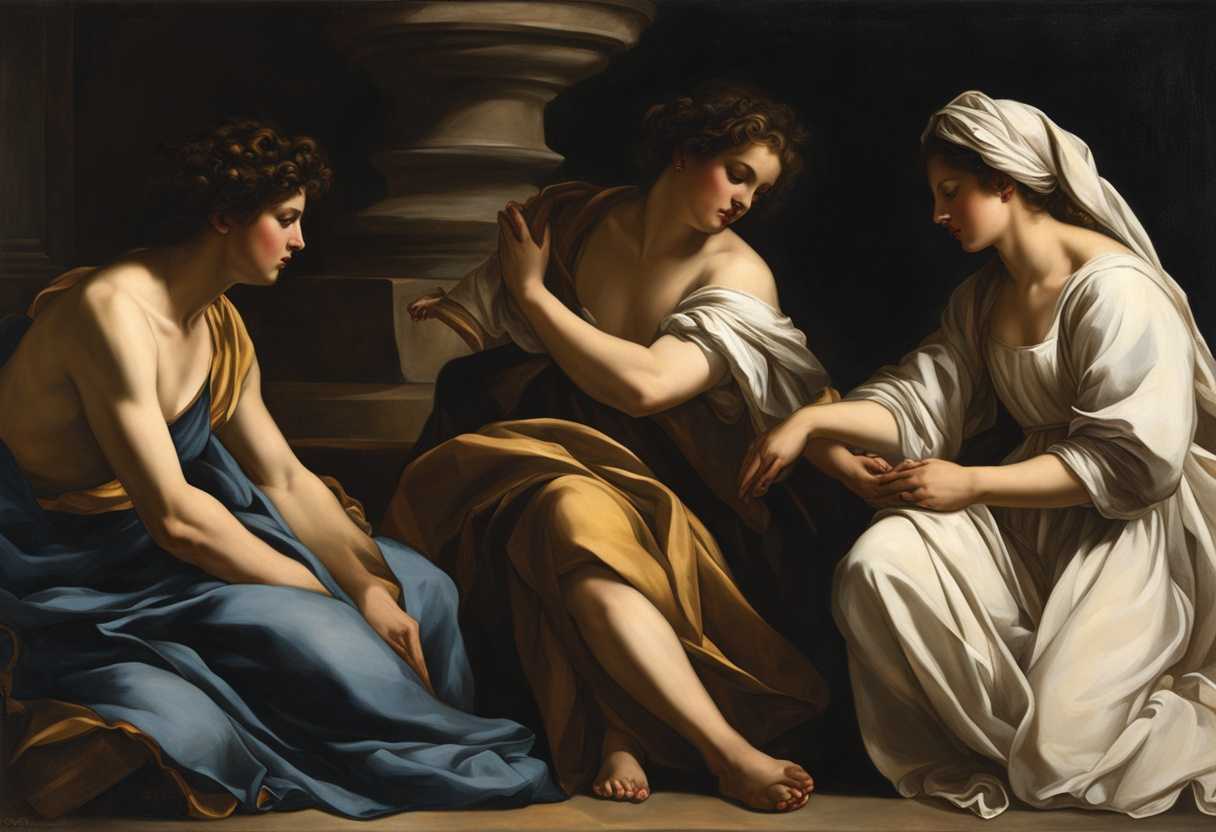
Setting the Scene for Hebrews 11:1-8
In Hebrews chapter 11, the author sets the scene by describing a gathering of believers who have come together for a study on faith. The room is dimly lit by oil lamps, casting a warm glow on the faces of those present. The air is filled with anticipation and reverence as the group settles in to listen to the teachings.
Among those gathered are prominent figures from the Old Testament, such as Abraham, Sarah, and Noah. Each of them has a story of faith and obedience that will be shared and discussed during the study. Abraham, known as the father of faith, sits at the head of the group, his weathered face reflecting years of walking with God. Sarah, his wife, sits beside him, her eyes filled with a mixture of joy and sorrow from the trials they have faced together. Noah, the faithful builder of the ark, is also present, his presence a reminder of God’s faithfulness in the midst of adversity.
As the study begins, the room is filled with a sense of awe and wonder at the faith of these individuals. The author of Hebrews paints a vivid picture of their lives, highlighting the challenges they faced and the unwavering trust they had in God’s promises. Through their stories, the group is inspired to deepen their own faith and trust in the unseen.
What is Hebrews 11:1-8 about?
This verse speaks to the essence of faith – it’s believing in something even when we can’t see it with our eyes. We have faith that a seed planted in the soil will grow into a beautiful flower, even though we can’t witness the process happening underground. It’s about having trust and confidence in something greater than ourselves, even in the face of uncertainty.
Reflect on your own life – have there been moments when you held onto hope and belief in something intangible? Perhaps you hoped for a better future, or trusted in a loved one’s promise despite not having concrete evidence at that moment. This verse encourages us to have unwavering faith, knowing that there is power in the unseen and the unknown. It challenges us to trust in the possibility of miracles and the fulfillment of our deepest desires, even when they may seem out of reach. So, let this verse inspire you to hold onto your hopes and dreams with unwavering faith, knowing that the unseen can manifest into reality in ways beyond your imagination.
Understanding what Hebrews 11:1-8 really means
Hebrews 11:1-8 is a foundational passage that defines faith and provides examples of faith in action. Often referred to as the “Faith Hall of Fame,” this passage highlights the faith of key figures in biblical history.
“Now faith is the substance of things hoped for, the evidence of things not seen.” Faith gives a tangible reality to our hopes, serving as the foundation upon which our aspirations are built. It acts as proof of unseen realities, a conviction that what is unseen is still true. This concept is echoed in 2 Corinthians 5:7 and Romans 8:24-25, emphasizing the importance of walking by faith and patiently waiting for unseen hopes.
“For by it the elders obtained a good report.” The faith of the ancestors was recognized and commended by God, as seen in the example of Abraham in James 2:23, where his belief was credited to him as righteousness.
“Through faith we understand that the worlds were framed by the word of God.” Creation itself is an act of faith, believing that God spoke the universe into existence, as stated in Genesis 1:1 and John 1:3, underscoring the power of God’s word in creation.
“By faith Abel offered unto God a more excellent sacrifice than Cain.” Abel’s faith led him to offer a better sacrifice, accepted by God, as seen in Genesis 4:4, highlighting the importance of faith in worship and obedience.
“By faith Enoch was translated that he should not see death.” Enoch’s faith was so strong that he did not experience death but was taken directly by God, showcasing the intimate relationship between faith and pleasing God, as depicted in Genesis 5:24.
“But without faith it is impossible to please him.” Faith is essential to a relationship with God, as emphasized in Matthew 17:20, illustrating the significance of faith in experiencing the miraculous and pleasing God.
“By faith Noah, being warned of God of things not seen as yet, moved with fear, prepared an ark.” Noah’s faith led him to act on God’s warning, even though the flood was not yet visible, demonstrating obedience and trust in God’s promises, as shown in Genesis 6:22.
“By faith Abraham, when he was called to go out into a place which he should after receive for an inheritance, obeyed.” Abraham’s obedience and willingness to go where God led him, even without knowing the destination, exemplify faith in action, showcasing the trust and reliance on God’s guidance.
How can we demonstrate faith like the heroes mentioned?
We can demonstrate faith like the heroes mentioned in Hebrews 11 by trusting in what we hope for, even when we cannot see it. We can step out in faith and trust in God’s promises, even when the path ahead is uncertain, just as Abraham left his comfortable life to follow God’s call to an unknown land. We can demonstrate our faith by believing in the unseen and having confidence that God is faithful to fulfill His promises.
Like Noah, who obediently built an ark despite never having seen rain before, we can demonstrate our faith by taking action in obedience to God’s word, even when it may seem illogical to the world around us. We can trust in God’s plans and directions for our lives, knowing that His ways are higher than our ways. We can demonstrate our trust in His sovereign will and provision for us by following His guidance and stepping out in faith.
Application
Embrace the power of faith as shown by the saints of old in Hebrews 11:1-8. Trust in God’s promises, especially in times of doubt or difficulty. Just like our predecessors Abraham and Sarah, take that leap of faith in your journey with confidence. Will you answer the call to trust God completely, even when the road ahead seems uncertain?

Reverend Michael Johnson is an experienced Church Minister with a profound expertise in spirituality and guidance. With a serene presence and a compassionate heart, he has faithfully served his congregation for over 20 years, leading them on a spiritual journey towards inner peace and enlightenment. Reverend Johnson’s extensive knowledge of religious philosophies and profound understanding of human nature have made him a trusted confidant and mentor to many, as he seamlessly weaves his profound wisdom into life teachings. Reverend Johnson’s calming demeanor and empathetic nature continue to uplift and heal souls, nurturing a sense of unity and tranquility within his community.