
Hebrews 7:11-17 is about the superiority of the priesthood of Melchizedek over the Levitical priesthood, highlighting that Jesus Christ, as a priest in the order of Melchizedek, fulfills and surpasses the old covenant system through His eternal and perfect priestly role.
11 Now if perfection had been attainable through the Levitical priesthood (for under it the people received the law), what further need would there have been for another priest to arise after the order of Melchizedek, rather than one named after the order of Aaron?
12 For when there is a change in the priesthood, there is necessarily a change in the law as well.
13 For the one of whom these things are spoken belonged to another tribe, from which no one has ever served at the altar.
14 For it is evident that our Lord was descended from Judah, and in connection with that tribe Moses said nothing about priests.
15 This becomes even more evident when another priest arises in the likeness of Melchizedek,
16 who has become a priest, not on the basis of a legal requirement concerning bodily descent, but by the power of an indestructible life.
17 For it is witnessed of him, “You are a priest forever, after the order of Melchizedek.”
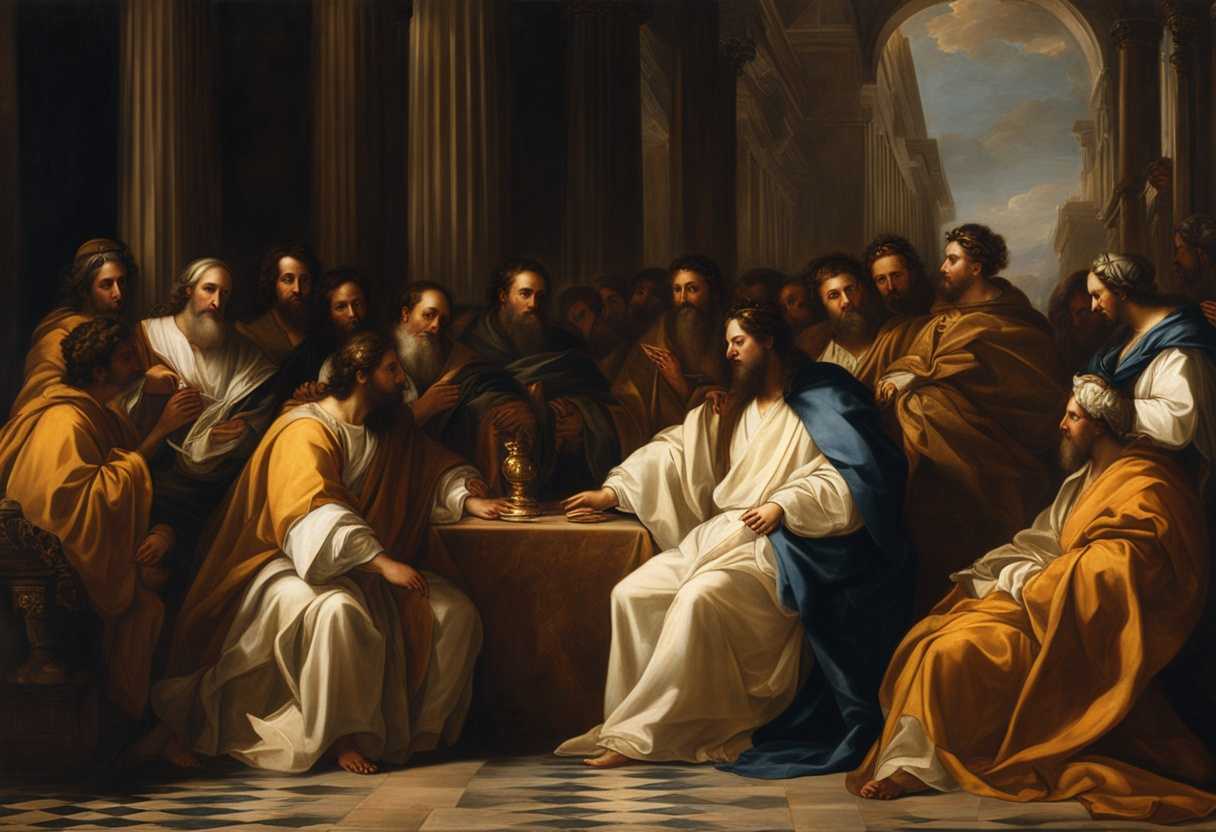
Setting the Scene for Hebrews 7:11-17
In the heart of ancient Jerusalem, a bustling city alive with the sounds of merchants hawking their wares and the aroma of spices wafting through the air, a significant gathering is taking place. The Temple stands majestically at the center, its golden facade glimmering in the sunlight, drawing the faithful and curious alike. Among the throngs of people, a small group of men, dressed in the traditional robes of the Levites, are engaged in a deep discussion about the priesthood and its significance in the lives of the people. They are gathered to contemplate the implications of the Levitical priesthood, which has been the cornerstone of their religious practices for generations.
Among them is a learned scribe named Eleazar, who has dedicated his life to studying the Scriptures. He is joined by his friend, a priest named Zechariah, who has recently returned from performing his duties in the Temple. Their conversation is animated, as they reflect on the limitations of the Levitical priesthood, which, despite its importance, is unable to bring about true perfection or complete reconciliation with God. They ponder the prophecy of a new order of priesthood, one that transcends the old, and they find themselves drawn to the figure of Melchizedek, the mysterious king of Salem who blessed Abraham and is said to have no recorded lineage. This figure, they believe, holds the key to understanding a greater priesthood that is eternal and unchanging.
As the sun begins to set, casting a warm golden hue over the Temple, the men gather closer, their voices hushed with reverence. They discuss how Melchizedek, who is both a king and a priest, foreshadows a new covenant that will be established through a descendant of David, one who will fulfill the role of a high priest forever. The air is thick with anticipation as they realize that this new priesthood, unlike the Levitical one, does not require a lineage or a system of sacrifices to mediate between God and humanity. Instead, it is rooted in the power of an indestructible life, a promise that brings hope and renewal to their weary hearts. The scene is set for a profound revelation that will change the course of their faith and the understanding of their relationship with God.
What is Hebrews 7:11-17 about?
This passage explores the profound implications of Jesus’ priesthood in contrast to the Levitical priesthood, which is central to the Jewish religious tradition. The Levitical priests, descended from Aaron, served a vital role in the covenant relationship between God and His people. They performed sacrifices and rituals, bringing the people’s concerns before God. However, these functions were bound by time; the priests were mortal, and their sacrifices had to be repeated, emphasizing the temporary nature of their work. Have you ever considered the weight of that repetition? It’s like a task that never truly reaches completion—a cycle without resolution.
Now, when we think about Jesus and His eternal priesthood, we begin to see a radical transformation in our understanding of divine intercession. Jesus, portrayed as the perfect high priest, does not merely fulfill the role but transcends it. His sacrifice was once and for all, echoing through eternity and offering a definitive solution for sin. Isn’t it fascinating to think that through Jesus, we have access to God’s grace without the need for an earthly mediator? This concept invites us to reflect on the security and permanence of our relationship with God. If the Levitical priests represented an ongoing need for atonement, how does recognizing Jesus’ eternal nature provide us with assurance and hope? This is the core of the message that urges us to shift our focus from temporary rituals to a sustained relationship with the eternal. We challenge ourselves to ask: How does understanding the permanence of Jesus’ priesthood affect our daily lives? As we navigate our struggles, do we rely on temporary fixes, or do we lean into the sufficiency of Christ’s eternal sacrifice? It’s a journey of recognizing that we are not merely participants in an age-old ritual, but recipients of a lasting promise. Therefore, as we reflect on this passage, we can embrace a deeper understanding of Jesus’ role as our high priest, leading us to a more profound appreciation of our faith and the assurance it brings. What might change in your life if you fully embraced this truth?
Understanding what Hebrews 7:11-17 really means
In Hebrews 7:11-17, the author delves into the profound transition from the Levitical priesthood to the priesthood of Jesus, drawing a compelling contrast that speaks to both the Jewish audience of the time and to us today. The Levitical priesthood, while established and revered, is portrayed as insufficient for achieving true perfection. This raises an important question: What does it mean for us to recognize the limitations of human systems, even those that are deeply rooted in tradition? The author’s argument sets the stage for understanding the necessity of a new priesthood, one that is not bound by the constraints of lineage or the law.
Central to this passage is the figure of Melchizedek, a mysterious priest-king who predates the Levitical system. By presenting Melchizedek as a type of Christ, the author emphasizes the eternal nature of Jesus’ priesthood. This invites us to reflect on the significance of Jesus as our high priest. Unlike the Levitical priests, who were mortal and flawed, Jesus embodies a perfect and everlasting priesthood. How does this understanding of Jesus as a high priest impact our view of God’s accessibility? It assures us that we can approach God without fear, knowing that Jesus intercedes on our behalf.
The passage also resonates with other biblical texts, such as Psalm 110:4, which prophesies the priesthood of Jesus in the order of Melchizedek. This connection reinforces the idea that Jesus’ role is not a mere afterthought but a fulfillment of God’s divine plan. In Hebrews 4:14-16, we see Jesus empathizing with our weaknesses, further solidifying His role as our compassionate high priest. Romans 8:34 echoes this sentiment, affirming that Christ intercedes for us at the right hand of God. These verses collectively paint a picture of a Savior who is intimately involved in our lives, offering us hope and assurance.
In our contemporary context, many individuals grapple with feelings of disconnection and unworthiness. The assurance that Jesus serves as our high priest can be a source of profound comfort. Imagine someone burdened by guilt from past mistakes, feeling unworthy to approach God. The realization that Jesus has already made the ultimate sacrifice and continually intercedes for us can transform their perspective. It encourages them to seek a relationship with God, reminding us all that we are not defined by our past but by the grace extended to us through Christ.
The phrases within this passage carry significant weight. The term “a better hope” encapsulates the transformative power of Jesus’ priesthood. It signifies a shift from the old covenant, which relied on the law and sacrifices, to a new covenant rooted in grace and redemption. Similarly, the phrase “perfected forever” emphasizes the completeness of Christ’s work. His sacrifice was not a temporary measure; it assures believers of their eternal standing before God. Lastly, the reference to Melchizedek as “without father or mother” symbolizes the divine and everlasting nature of Christ’s priesthood, contrasting sharply with the mortality of earthly priests.
In conclusion, Hebrews 7:11-17 offers a message of hope, assurance, and the promise of a relationship with God through Jesus Christ. As we reflect on this passage, we are reminded of the depth of God’s love and the lengths He has gone to secure our redemption. This understanding should inspire us to live in gratitude and to share this good news with others who may feel lost or unworthy. How can we embody this message in our daily lives, extending the grace we have received to those around us? Let us ponder this as we seek to live out our faith in a world that desperately needs the hope found in Christ.
How does Jesus fulfill my spiritual needs today?
Jesus fulfills your spiritual needs today by serving as the ultimate high priest, offering a direct and personal connection to God. Unlike the Levitical priests, who mediated through rituals and sacrifices, Jesus offers a perfect and eternal relationship with the Father. This means that you can approach God with confidence, knowing that your sins are forgiven and that you are accepted as a beloved child. His intercession represents a bridge between humanity and God, providing assurance that your spiritual journey is supported by His grace and love. Jesus’ sacrificial role assures you that His atoning work meets your spiritual needs. He has demonstrated the highest form of love and commitment to your well-being by willingly giving Himself. This profound act of selflessness not only addresses the issue of guilt and separation from God but also invites you into a life of purpose and hope. The assurance of forgiveness and the promise of eternal life can fill your heart with peace, helping you navigate life’s challenges with the knowledge that you are accountable to a loving Savior.
Lastly, through His resurrection, Jesus promises transformation and renewal in your spiritual life. He empowers you with the Holy Spirit, enabling you to grow, flourish, and respond to God’s calling on your life. This dynamic relationship nurtures your spiritual growth, equips you to face difficulties, and encourages you to embrace your identity in Christ. By relying on Jesus, you receive spiritual sustenance and a guiding presence that shapes and enriches your journey of faith.
Application
Think of Christ as your ultimate guide in the hustle of life, like a wise mentor steering you through the challenges of work and family. His priesthood is your lifeline, offering a fresh perspective that goes beyond old rules and rituals. This is your moment to strengthen that bond with Him, letting His strength infuse your everyday choices. Remember, the law alone can’t save you; it’s the grace of Jesus that transforms your journey. Are you ready to let His presence lead you and change everything?

Reverend Michael Johnson is an experienced Church Minister with a profound expertise in spirituality and guidance. With a serene presence and a compassionate heart, he has faithfully served his congregation for over 20 years, leading them on a spiritual journey towards inner peace and enlightenment. Reverend Johnson’s extensive knowledge of religious philosophies and profound understanding of human nature have made him a trusted confidant and mentor to many, as he seamlessly weaves his profound wisdom into life teachings. Reverend Johnson’s calming demeanor and empathetic nature continue to uplift and heal souls, nurturing a sense of unity and tranquility within his community.