
Hosea 1-3 is about the covenant relationship between God and Israel, illustrated through the prophet Hosea’s tumultuous marriage to Gomer, symbolizing Israel’s unfaithfulness and God’s enduring love and desire for reconciliation despite their infidelity.
1 The word of the Lord that came to Hosea, the son of Beeri, in the days of Uzziah, Jotham, Ahaz, and Hezekiah, kings of Judah, and in the days of Jeroboam the son of Joash, king of Israel.
2 When the Lord first spoke through Hosea, the Lord said to Hosea, “Go, take to yourself a wife of whoredom and have children of whoredom, for the land commits great whoredom by forsaking the Lord.”
3 So he went and took Gomer, the daughter of Diblaim, and she conceived and bore him a son.
4 And the Lord said to him, “Call his name Jezreel, for in just a little while I will punish the house of Jehu for the blood of Jezreel, and I will put an end to the kingdom of the house of Israel.
5 And on that day I will break the bow of Israel in the Valley of Jezreel.
6 She conceived again and bore a daughter. And the Lord said to him, “Call her name No Mercy, for I will no more have mercy on the house of Israel, to forgive them at all.
7 But I will have mercy on the house of Judah, and I will save them by the Lord their God. I will not save them by bow or by sword or by war or by horses or by horsemen.
8 When she had weaned No Mercy, she conceived and bore a son.
9 And the Lord said, “Call his name Not My People, for you are not my people, and I am not your God.”
10 Yet the number of the children of Israel shall be like the sand of the sea, which cannot be measured or numbered. And in the place where it was said to them, “You are not my people,” it shall be said to them, “Children of the living God.”
11 And the children of Judah and the children of Israel shall be gathered together, and they shall appoint for themselves one head. And they shall go up from the land, for great shall be the day of Jezreel.
1 Say to your brothers, “You are my people,” and to your sisters, “You have received mercy.”
2 “Plead with your mother, plead—
for she is not my wife,
and I am not her husband—
that she put away her whoring from her face,
and her adultery from between her breasts;
3 lest I strip her naked
and make her as in the day she was born
and make her like a wilderness,
and make her like a parched land,
and kill her with thirst.
4 And I will not have mercy on her children, for they are children of whoredom.
5 For their mother has played the whore;
she who conceived them has acted shamefully.
For she said, ‘I will go after my lovers,
who give me my bread and my water,
my wool and my flax, my oil and my drink.’
6 Therefore I will hedge up her way with thorns, and I will build a wall against her, so that she cannot find her paths.
7 She shall pursue her lovers but not overtake them, and she shall seek them but shall not find them. Then she shall say, ‘I will go and return to my first husband, for it was better for me then than now.’
8 And she did not know that it was I who gave her the grain, the wine, and the oil, and who lavished on her silver and gold, which they used for Baal.
9 “Therefore I will take back my grain in its time, and my wine in its season, and I will take away my wool and my flax, which were to cover her nakedness.”
10 And now I will uncover her lewdness in the sight of her lovers, and no one shall rescue her out of my hand.
11 And I will put an end to all her mirth, her feasts, her new moons, her Sabbaths, and all her appointed feasts.
12 And I will lay waste her vines and her fig trees, of which she said, ‘These are my wages, which my lovers have given me.’ I will make them a forest, and the beasts of the field shall devour them.
13 And I will punish her for the feast days of the Baals when she burned offerings to them and adorned herself with her ring and jewelry, and went after her lovers and forgot me, declares the Lord.
14 “Therefore, behold, I will allure her, and bring her into the wilderness, and speak tenderly to her.”
15 And there I will give her her vineyards and make the Valley of Achor a door of hope. And there she shall answer as in the days of her youth, as at the time when she came out of the land of Egypt.
16 “And in that day, declares the Lord, you will call me ‘My Husband,’ and no longer will you call me ‘My Baal.’”
17 For I will remove the names of the Baals from her mouth, and they shall be remembered by name no more.
18 And I will make for them a covenant on that day with the beasts of the field, the birds of the heavens, and the creeping things of the ground. And I will abolish the bow, the sword, and war from the land, and I will make you lie down in safety.
19 And I will betroth you to me forever. I will betroth you to me in righteousness and in justice, in steadfast love and in mercy.
20 I will betroth you to me in faithfulness. And you shall know the Lord.
21 “And in that day I will answer, declares the Lord,
I will answer the heavens,
and they shall answer the earth,”
22 and the earth shall answer the grain, the wine, and the oil, and they shall answer Jezreel,
23 And I will have mercy on No Mercy, and I will say to Not My People, ‘You are my people’; and he shall say, ‘You are my God.’”
1 And the Lord said to me, “Go again, love a woman who is loved by another man and is an adulteress, even as the Lord loves the children of Israel, though they turn to other gods and love cakes of raisins.”
2 So I bought her for fifteen shekels of silver and a homer and a lethech of barley.
3 And I said to her, “You must dwell as mine for many days. You shall not play the whore, or belong to another man; so will I also be to you.”
4 For the people of Israel shall dwell many days without king or prince, without sacrifice or pillar, without ephod or household gods.
5 Afterward the children of Israel shall return and seek the Lord their God, and David their king, and they shall come in fear to the Lord and to his goodness in the latter days.
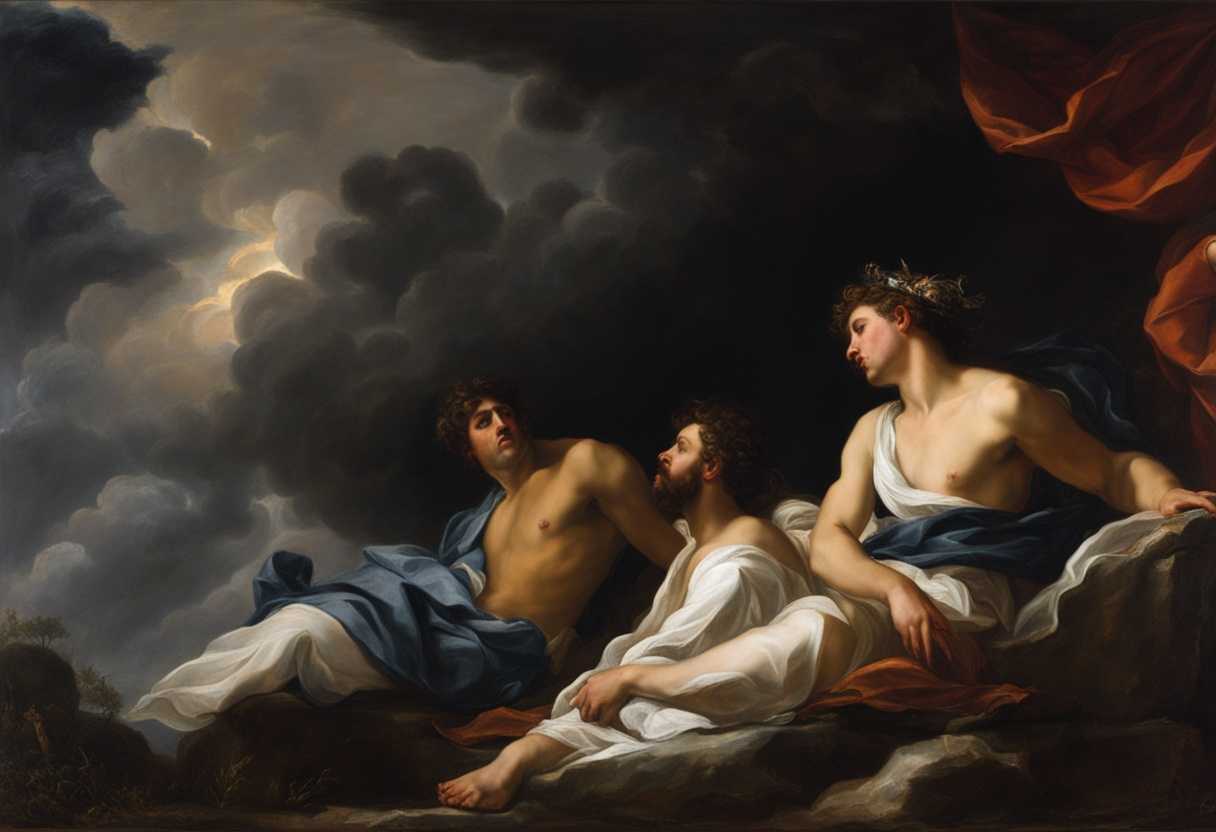
Setting the Scene for Hosea 1-3
In the ancient land of Israel, during a tumultuous period marked by political instability and moral decay, the prophet Hosea finds himself in a deeply personal and poignant scenario. The sun hangs low in the sky, casting a warm golden hue over the rugged hills of Ephraim, where the air is thick with the scent of wildflowers and the distant sound of sheep bleating. Hosea, a man of God, is called to deliver a message of both judgment and hope to a wayward nation. His heart is heavy, not only with the burden of prophecy but also with the pain of his own domestic life. He has been commanded to marry Gomer, a woman whose unfaithfulness symbolizes Israel’s infidelity to God. This union, fraught with emotional turmoil, serves as a living metaphor for the relationship between the Lord and His people.
As Hosea stands in the doorway of his modest home, he watches Gomer, who is both his wife and a reflection of the nation’s waywardness. She is beautiful yet restless, her spirit yearning for freedom and excitement beyond the confines of their life together. Hosea’s heart aches as he recalls the moments of joy they shared, now overshadowed by her repeated betrayals. The couple’s home, filled with the laughter of their children, is a stark contrast to the reality of Gomer’s choices. Hosea’s prophetic calling compels him to love her unconditionally, even as she strays, embodying the relentless love of God for His people. The surrounding landscape, dotted with olive trees and the distant sound of a flowing stream, serves as a backdrop to this complex relationship, where love and pain intertwine.
In the midst of this personal struggle, the larger narrative of Israel unfolds. The nation, much like Gomer, has turned away from God, chasing after idols and engaging in practices that lead them further from their Creator. Hosea’s prophetic voice echoes through the valleys and towns, calling the people to repentance and reminding them of the steadfast love of God. The tension between divine judgment and mercy is palpable, as Hosea’s life becomes a living testament to the depth of God’s love, even in the face of betrayal. As he navigates the challenges of his marriage and the weight of his prophetic mission, Hosea embodies the heart of God, longing for His people to return to Him, to heal the rift caused by their unfaithfulness, and to embrace the hope of restoration that lies ahead.
What is Hosea 1-3 about?
Hosea’s marriage in the book of Hosea provides a profound illustration of the dynamics of love, betrayal, and redemption. Hosea is instructed by God to marry Gomer, a woman who is unfaithful to him. This relationship becomes a powerful symbol of God’s relationship with Israel, a nation that repeatedly turns away from Him. Isn’t it striking how the personal and the divine intertwine in such a visceral way? Through this narrative, we see the heartbreak that accompanies infidelity—not just in a marital sense, but also as a metaphor for the way the Israelites have worshipped false idols and neglected their covenant with God. Reflect on the complexities of love and faithfulness as we delve deeper into this passage. Hosea’s enduring love for Gomer, despite her betrayals, mirrors God’s unfailing love for His people, despite their disobedience. This raises questions for us: What does it mean to be truly faithful? Can love endure even in the face of betrayal and disappointment? What does redemption look like in the context of brokenness? Hosea’s story challenges us to consider the nature of forgiveness and reconciliation—can we find a path back to a relationship that has been marred by hurt and unfaithfulness? The narrative ultimately culminates in the promise of redemption. God does not abandon Israel even when they stray; instead, there is a call to return and embrace a renewed relationship. This is where hope is found. How can we, in our own lives, embody this call to redemption and restoration? The themes present in Hosea’s marriage resonate far beyond ancient Israel, offering timeless lessons on loyalty, compassion, and the relentless pursuit of love. Are we willing to confront our own failures and seek a path toward healing and renewal in our relationships, upholding the value of devotion even amidst adversity?
Understanding what Hosea 1-3 really means
The Book of Hosea is a profound prophetic text in the Old Testament that uses the metaphor of marriage to illustrate the complex relationship between God and Israel. Hosea’s life, particularly his tumultuous marriage to Gomer, serves as a living parable of Israel’s unfaithfulness to God. This narrative invites us to explore the depths of divine love and the pain of betrayal, prompting us to reflect on our own relationships with God and others.
One of the key themes in Hosea is unfaithfulness and redemption. Hosea’s personal experiences mirror Israel’s spiritual infidelity, as both the prophet and the nation grapple with the consequences of turning away from their commitments. Yet, amid this unfaithfulness, God’s love and mercy shine brightly. Despite Israel’s repeated betrayals, God remains steadfast, longing for reconciliation. This duality of infidelity and grace is a powerful reminder of the complexities of love and the possibility of redemption.
Several biblical passages resonate with the themes found in Hosea. For instance, Jeremiah 3:14 captures God’s yearning for His people to return, emphasizing His role as a loving husband. Similarly, Romans 5:8 illustrates God’s love for humanity, showing that Christ died for us while we were still sinners. This parallel reinforces the message of redemption that permeates Hosea. Furthermore, 1 John 1:9 offers the promise of forgiveness, highlighting God’s desire to restore our relationship with Him, no matter how far we may have strayed.
In our modern lives, the themes of unfaithfulness and redemption are particularly relevant. Many individuals experience feelings of abandonment or betrayal, whether in personal relationships or in their spiritual journeys. Consider the story of a couple who faced infidelity but chose to seek counseling and rebuild their relationship. Their journey illustrates the power of forgiveness and commitment, mirroring God’s unwavering love for His people. Such narratives remind us that healing and restoration are possible, even in the most challenging circumstances.
Hosea contains meaningful phrases that encapsulate its core messages. For example, when God declares, “I will show love to those I called ‘Not my loved ones,’” it highlights His grace and willingness to extend love to those who feel unworthy. This phrase reassures us that our identity is not defined by our failures but by God’s enduring love. Similarly, the declaration “You are my people” signifies belonging and covenant, reminding us that despite our shortcomings, we are still invited into a relationship with God. Lastly, “I will heal their waywardness” speaks to God’s restorative power, assuring us that no matter how far we stray, He is always ready to heal and restore us.
In conclusion, Hosea’s message is timeless, urging us to consider the importance of faithfulness in our relationships and the boundless love of God. As we reflect on our own lives, we must ask ourselves: Are there areas where we have been unfaithful, either in our relationships with others or in our relationship with God? Let us embrace God’s love and seek reconciliation, knowing that He is always ready to welcome us back with open arms. This call to action invites us to engage deeply with the themes of Hosea, fostering a renewed commitment to faithfulness and love in our lives.
How do I show unconditional love in difficult relationships?
Showing unconditional love in difficult relationships involves embracing compassion and forgiveness, regardless of the circumstances or behavior of the other person. It’s essential to approach each interaction with empathy, understanding their pain and struggles. This means being willing to listen without judgment and giving grace, even when it feels undeserved. You create a safe space that encourages healing and growth by fostering a genuine connection rooted in kindness, allowing the relationship to flourish despite its challenges.
Another key aspect is commitment to the relationship itself, which requires maintenance and nurturing. This involves being present and dedicating time and effort, regardless of the difficulties faced. Demonstrating consistency in your love and support can create a solid foundation that reassures the other person of your steadfastness. When challenges arise, rather than withdrawing or retaliating, offering reassurance and maintaining open lines of communication can help bridge divides and rebuild trust.
Finally, it’s important to practice resilience and the willingness to move forward together. This means recognizing that setbacks may occur, but through patience and love, the bond can strengthen over time. You model a love that perseveres by holding onto the vision of a hopeful future and actively working through issues. Thus, even in the face of adversity, your actions can reflect a commitment to love that is unwavering and transformative, paving the way for reconciliation and deeper connections.
Application
Imagine your job where you pour your heart into every project, yet sometimes lose sight of why you started. Just like in the story of Hosea, God is always reaching out, no matter how far we drift. It’s time to reconnect with that passionate spark in your life. Consider the love you give your family—it’s a reminder of the love waiting for you from above. Are you ready to embrace that love and transform your life?

Reverend Michael Johnson is an experienced Church Minister with a profound expertise in spirituality and guidance. With a serene presence and a compassionate heart, he has faithfully served his congregation for over 20 years, leading them on a spiritual journey towards inner peace and enlightenment. Reverend Johnson’s extensive knowledge of religious philosophies and profound understanding of human nature have made him a trusted confidant and mentor to many, as he seamlessly weaves his profound wisdom into life teachings. Reverend Johnson’s calming demeanor and empathetic nature continue to uplift and heal souls, nurturing a sense of unity and tranquility within his community.