
Isaiah 24-27 is about the impending judgment of God upon the earth, the destruction of the wicked, and the promise of restoration and redemption for the faithful, ultimately portraying a vision of hope and divine sovereignty over creation.
1 Behold, the Lord will empty the earth and make it desolate,
and he will twist its surface and scatter its inhabitants.
2 And it shall be, as with the people, so with the priest; as with the slave, so with his master; as with the maid, so with her mistress; as with the buyer, so with the seller; as with the lender, so with the borrower; as with the creditor, so with the debtor.
3 The earth shall be utterly empty and utterly plundered; for the Lord has spoken this word.
4 The earth mourns and withers;
the world languishes and withers;
the highest people of the earth languish.
5 The earth lies defiled under its inhabitants; for they have transgressed the laws, violated the statutes, broken the everlasting covenant.
6 Therefore a curse devours the earth,
and its inhabitants suffer for their guilt;
therefore the inhabitants of the earth are scorched,
and few men are left.
7 The wine mourns, the vine languishes, all the merry-hearted sigh.
8 The mirth of the tambourines is stilled, the noise of the jubilant has ceased, the mirth of the lyre is stilled.
9 No more do they drink wine with singing; strong drink is bitter to those who drink it.
10 The wasted city is broken down;
every house is shut up so that none can enter.
11 There is an outcry in the streets for lack of wine; all joy has grown dark; the gladness of the earth is banished.
12 In the city is left desolation,
and the gate is battered into ruins.
13 For thus it shall be in the midst of the earth among the nations, as when an olive tree is beaten, as at the gleaning when the grape harvest is done.
14 They lift up their voices, they sing for joy; over the majesty of the Lord they shout from the west.
15 Therefore in the east give glory to the Lord; in the coastlands of the sea, give glory to the name of the Lord, the God of Israel.
16 From the ends of the earth we hear songs of praise, of glory to the Righteous One.
17 Terror and the pit and the snare are upon you, O inhabitant of the earth!
18 He who flees at the sound of the terror shall fall into the pit, and he who climbs out of the pit shall be caught in the snare. For the windows of heaven are opened, and the foundations of the earth tremble.
19 The earth is utterly broken, the earth is split apart, the earth is violently shaken.
20 The earth staggers like a drunken man;
it sways like a hut;
its transgression lies heavy upon it,
and it falls, and will not rise again.
21 On that day the Lord will punish the host of heaven, in heaven, and the kings of the earth, on the earth.
22 They will be gathered together as prisoners in a pit; they will be shut up in a prison, and after many days they will be punished.
23 Then the moon will be confounded and the sun ashamed,
for the Lord of hosts reigns on Mount Zion and in Jerusalem,
and his glory will be before his elders.
1 O Lord, you are my God;
I will exalt you; I will praise your name,
for you have done wonderful things,
plans formed of old, faithful and sure.
2 For you have made the city a heap, the fortified city a ruin; the foreigners’ palace is a city no more; it will never be rebuilt.
3 Therefore strong peoples will glorify you;
cities of ruthless nations will fear you.
4 For you have been a stronghold to the poor, a stronghold to the needy in his distress, a shelter from the storm and a shade from the heat; for the breath of the ruthless is like a storm against a wall,
5 And he will swallow up on this mountain
the covering that is cast over all peoples,
the veil that is spread over all nations.
6 On this mountain the Lord of hosts will make for all peoples a feast of rich food, a feast of well-aged wine, of rich food full of marrow, of aged wine well refined.
7 And he will swallow up on this mountain
the covering that is cast over all peoples,
the veil that is spread over all nations.
8 He will swallow up death forever; and the Lord God will wipe away tears from all faces, and the reproach of his people he will take away from all the earth, for the Lord has spoken.
9 It will be said on that day, “Behold, this is our God; we have waited for him, that he might save us. This is the Lord; we have waited for him; let us be glad and rejoice in his salvation.”
10 For the hand of the Lord will rest on this mountain, and Moab shall be trampled down in his place, as straw is trampled down in a dunghill.
11 And he will spread out his hands in the midst of it as a swimmer spreads his hands out to swim, but the Lord will lay low his pompous pride together with the skill of his hands.
12 And the high fortifications of his walls he will bring down, lay low, and cast to the ground, to the dust.
1 In that day this song will be sung in the land of Judah: “We have a strong city; he sets up salvation as walls and bulwarks.
2 Open the gates, that the righteous nation that keeps faith may enter in.
3 You keep him in perfect peace whose mind is stayed on you, because he trusts in you.
4 Trust in the Lord forever, for the Lord God is an everlasting rock.
5 For he has humbled the inhabitants of the height, the lofty city. He lays it low, lays it low to the ground, casts it to the dust.
6 The foot tramples it,
the feet of the poor, the steps of the needy.”
7 The way of the righteous is level;
you make smooth the path of the righteous.
8 In the path of your judgments, O Lord, we wait for you; your name and remembrance are the desire of our soul.
9 My soul yearns for you in the night;
my spirit within me earnestly seeks you.
10 If favor is shown to the wicked,
he does not learn righteousness;
in the land of uprightness he deals corruptly
and does not see the majesty of the Lord.
11 O Lord, your hand is lifted up, but they do not see it. Let them see your zeal for your people, and be ashamed. Let the fire for your adversaries consume them.
12 O Lord, you will ordain peace for us,
for you have indeed done for us all our works.
13 O Lord our God, other lords besides you have ruled over us, but your name alone we bring to remembrance.
14 They are dead, they will not live; they are shades, they will not arise; to that end you have visited them with destruction and wiped out all remembrance of them.
15 But you have increased the nation, O Lord, you have increased the nation; you are glorified; you have enlarged all the borders of the land.
16 O Lord, in distress they sought you;
they poured out a whispered prayer
when your discipline was upon them.
17 Like a pregnant woman who writhes and cries out in her pangs when she is near to giving birth, so were we because of you, O Lord;
18 We were pregnant, we writhed, but we have given birth to wind. We have accomplished no deliverance in the earth, and the inhabitants of the world have not fallen.
19 Your dead shall live; their bodies shall rise. You who dwell in the dust, awake and sing for joy! For your dew is a dew of light, and the earth will give birth to the dead.
20 Come, my people, enter your chambers,
and shut your doors behind you;
hide yourselves for a little while
until the fury has passed by.
21 For behold, the Lord is coming out from his place to punish the inhabitants of the earth for their iniquity, and the earth will disclose the blood shed on it, and will no more cover its slain.
1 In that day the Lord with his hard and great and strong sword will punish Leviathan the fleeing serpent, Leviathan the twisting serpent, and he will slay the dragon that is in the sea.
2 In that day,
“A pleasant vineyard, sing of it!
3 I, the Lord, am its keeper;
every moment I water it.
Lest anyone punish it,
I keep it night and day.
4 I have no wrath.
Would that I had thorns and briers to battle!
I would march against them,
I would burn them up together.
5 Or let them lay hold of my protection,
let them make peace with me,
let them make peace with me.”
6 In days to come Jacob shall take root,
Israel shall blossom and put forth shoots
and fill the whole world with fruit.
7 Has he struck them as he struck those who struck them?
Or have they been slain as their slayers were slain?
8 Measure by measure, by exile you contended with them; he removed them with his fierce breath in the day of the east wind.
9 Therefore by this the guilt of Jacob will be atoned for, and this will be the full fruit of the removal of his sin: when he makes all the stones of the altars like chalkstones crushed to pieces, no Asherim or incense altars will remain standing.
10 For the fortified city is solitary, a habitation deserted and forsaken, like the wilderness; there the calf grazes; there it lies down and strips its branches.
11 When its boughs are dry, they are broken; women come and make a fire of them. For this is a people without discernment; therefore he who made them will not have compassion on them; he who formed them will show them no favor.
12 In that day from the river Euphrates to the Brook of Egypt the Lord will thresh out the grain, and you will be gleaned one by one, O people of Israel.
13 And in that day a great trumpet will be blown, and those who were lost in the land of Assyria and those who were driven out to the land of Egypt will come and worship the Lord on the holy mountain at Jerusalem.
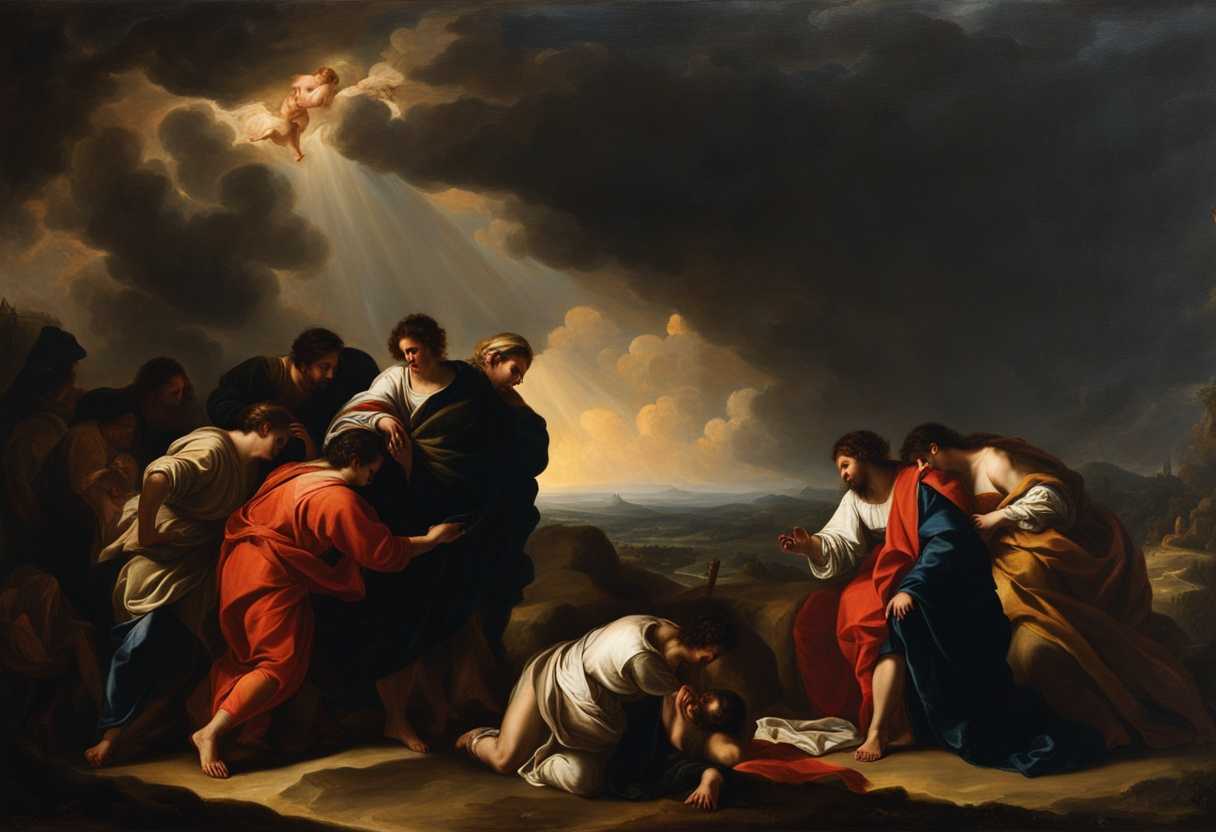
Setting the Scene for Isaiah 24-27
In the heart of ancient Jerusalem, a group of weary travelers gathers on a sun-drenched hillside, their faces etched with the lines of hardship and hope. The air is thick with the scent of wildflowers and the distant sound of a bubbling brook, a stark contrast to the weight of the message they have come to hear. Among them stands Isaiah, the prophet, a man of profound vision and deep conviction. His robes, tattered yet dignified, flutter gently in the warm breeze as he prepares to deliver a message that speaks of both judgment and restoration. The people, a mix of the faithful and the doubtful, have come from various corners of the land, drawn by the promise of divine revelation amidst the chaos of their lives.
As the sun begins to dip below the horizon, casting a golden hue over the landscape, Isaiah raises his voice, echoing the themes of desolation and hope found in the prophecies of the last days. He speaks of the earth being laid waste, of cities crumbling, and of the heavens shaking—a vivid portrayal of the turmoil that has befallen the people due to their disobedience. Yet, within this dire proclamation, he weaves a thread of hope, reminding them of the promise of a new creation, where joy will replace sorrow, and the faithful will be gathered to worship once more. The crowd listens intently, some with tears in their eyes, as they reflect on their own lives and the state of their nation, feeling the weight of their collective sin but also the flicker of hope that Isaiah offers.
Surrounding them are the remnants of a once-thriving city, now a shadow of its former glory. Crumbling walls and abandoned homes serve as a backdrop to Isaiah’s words, a physical manifestation of the spiritual decay that has taken root. Yet, in the distance, the majestic mountains stand tall, a reminder of God’s enduring presence and the promise of restoration. As the sun sets, casting long shadows over the land, the people are left with a sense of urgency and anticipation, pondering the duality of their fate—judgment and redemption intertwined, as they cling to the hope that one day, the earth will be filled with the knowledge of the Lord, and they will be gathered in joy to sing praises once more.
What is Isaiah 24-27 about?
Isaiah 24-27 presents a profound tableau of themes that revolve around God’s judgment, the restoration of His chosen people, and the ultimate establishment of His kingdom. Here in these chapters, we see a stark contrast between the devastation brought on by human sin and rebellion, and the hope that unfolds through divine intervention. Have you ever considered the weight that judgment carries? It’s not merely about punishment; it often serves to bring about refinement and awakening. The imagery Isaiah uses paints a vivid picture of a world in chaos, the earth mourning due to the consequences of humanity’s choices. Yet, reflecting on this, we are reminded that judgment isn’t the end of the story. Could it be that God allows such moments to draw us nearer to Him, to recognize our need for restoration? The narrative shifts focus from judgment to a promise of hope and renewal for Israel as we move deeper into these chapters. Isn’t it striking how the very God who judges is also the one who offers redemption? Through the metaphor of God as a refuge and a fortress, we see that restoration goes hand-in-hand with the acknowledgment of past failings. Isn’t it comforting to think that no matter how deep our plight, God’s grace is deeper still? The imagery of the new kingdom, marked by peace and communion, lays the groundwork for an understanding that God’s ultimate plan transcends our earthly troubles. This restoration is not confined merely to Israel but expands to embody a universal hope for all who align themselves with God’s will. How do you see the implications of this restoration in your own life journey, and how can it inspire us to seek a deeper relationship with the divine? Isaiah 24-27 ultimately culminates in the triumphant vision of God’s kingdom, a perfect realm where justice prevails. This isn’t just a promise for Israel but extends to all of us who seek holiness and wholeness. It prompts us to ask ourselves: are we living in a way that reflects this hope? Are we contributing to the longing for God’s kingdom on earth? We are invited to participate in the unfolding of a narrative that leads to victory over despair and darkness as we embrace the principles of justice, love, and mercy that are at the heart of these chapters. This means engaging actively in our communities, embodying the values that the coming kingdom represents. What small steps could you take today to be part of this great restoration?
Understanding what Isaiah 24-27 really means
Isaiah chapters 24-27 present a vivid portrayal of God’s judgment and ultimate restoration. Often referred to as the “Isaiah Apocalypse,” these chapters depict the end of the world and the establishment of God’s kingdom. They invite us to explore the profound themes of desolation and hope, urging us to reflect on our own lives in light of divine sovereignty.
To fully grasp the significance of these passages, we must consider the historical context in which Isaiah prophesied. Living during a time of great turmoil for Israel, Isaiah addressed both immediate concerns and future hope. His words resonate with the tension between judgment and redemption, reminding us that even in our darkest moments, God’s plans for restoration remain intact.
Key themes emerge throughout these chapters. First, we encounter the theme of judgment and desolation. The earth is described as being laid waste, symbolizing the consequences of sin and rebellion against God. This stark imagery serves as a reminder of the fragility of our world and the urgent need for repentance. Yet, amidst this desolation, we also find a promise of hope and restoration. God’s reign will be established, highlighting His mercy and faithfulness to His people.
These themes echo throughout Scripture, particularly in passages like Revelation 21:1-4, which speaks of a new heaven and a new earth. Similarly, Matthew 24:30-31 discusses the coming of the Son of Man, linking the judgment of the world with the hope of redemption. Together, these texts reinforce the idea that God’s ultimate plan encompasses both justice and grace.
In our contemporary world, filled with chaos, injustice, and suffering, the messages in Isaiah 24-27 resonate deeply. They remind us that God is sovereign and will ultimately bring about justice. As we grapple with issues such as climate change, social injustice, and personal struggles, we can find solace in the assurance that God is at work, even when circumstances seem dire.
Consider the example of a community that has faced a natural disaster. Initially, the destruction feels overwhelming, and hope appears lost. Yet, as the community comes together to rebuild, they discover strength in unity and faith. This mirrors the message of Isaiah: even in desolation, there is potential for renewal and restoration.
Meaningful phrases within these chapters further illuminate their significance. For instance, “The earth is utterly broken” signifies the depth of human sin and its consequences. It serves as a stark reminder of our need for repentance. Conversely, “He will swallow up death forever” points to the ultimate victory over death and sin, a promise fulfilled in Christ. This declaration offers hope to those who mourn, assuring them that death is not the end. Finally, “The Lord will reign” emphasizes God’s sovereignty, reassuring us that He is in control and will establish His kingdom.
In conclusion, Isaiah 24-27 serves as a profound reminder of the duality of God’s nature—His justice and mercy. As we reflect on these chapters, we are called to acknowledge our need for repentance while holding onto the hope of restoration that God promises. In our daily lives, we can find comfort in knowing that despite the trials we face, God is working towards a greater purpose. How can we actively participate in this restoration in our own communities? What steps can we take to embody the hope that Isaiah so passionately conveys?
How can I find hope amidst life’s turmoil?
Finding hope amidst life’s turmoil often involves embracing a belief in renewal and divine restoration. When faced with challenges, it’s important to remember that circumstances, no matter how overwhelming, are not permanent. There exists a promise of transformation and the assurance that brighter days will come. Recognizing the transient nature of struggles can provide a sense of comfort and anticipation for what lies ahead.
Additionally, cultivating a perspective centered on gratitude can help highlight the positives in life, even when everything seems bleak. Reflecting on the small joys, whether they come from supportive relationships, personal achievements, or moments of beauty, can significantly shift one’s outlook. This mindfulness helps to anchor us, reminding us that there is always something worth holding onto, even in dark times.
Lastly, engaging in community can serve as a powerful source of hope. Sharing experiences and seeking support from others who have navigated similar trials fosters a sense of belonging and collective resilience. We can find strength, encouragement, and shared wisdom in these connections, reinforcing the notion that we are never truly alone in our struggles. Through faith, gratitude, and community, the path to hope becomes clearer, guiding us through our darkest moments.
Application
Take a moment to look at how you’re prioritizing your life, much like you manage work projects or family time. Are there distractions pulling you away from your true purpose? Let go of those things that weigh you down and lean into what really matters. Embrace the challenges as opportunities to shine your light and share your story of hope. Will you step up and become a beacon of grace in a world that desperately needs it?

Reverend Michael Johnson is an experienced Church Minister with a profound expertise in spirituality and guidance. With a serene presence and a compassionate heart, he has faithfully served his congregation for over 20 years, leading them on a spiritual journey towards inner peace and enlightenment. Reverend Johnson’s extensive knowledge of religious philosophies and profound understanding of human nature have made him a trusted confidant and mentor to many, as he seamlessly weaves his profound wisdom into life teachings. Reverend Johnson’s calming demeanor and empathetic nature continue to uplift and heal souls, nurturing a sense of unity and tranquility within his community.