
Isaiah 36:1-22 is about King Sennacherib of Assyria threatening and mocking Judah, demonstrating the importance of trusting in God’s protection and sovereignty in times of adversity.
1 In the fourteenth year of King Hezekiah, Sennacherib king of Assyria came up against all the fortified cities of Judah and took them.
2 And the king of Assyria sent the Rabshakeh from Lachish to King Hezekiah at Jerusalem, with a great army. And he stood by the conduit of the upper pool on the highway to the Washer’s Field.
3 Then the Rabshakeh said to them, “Say to Hezekiah, ‘Thus says the great king, the king of Assyria: On what do you rest this trust of yours?
4 And the Rabshakeh said to them, “Say to Hezekiah, ‘Thus says the great king, the king of Assyria: On what do you rest this trust of yours?
5 “I say, ‘Your counsel and strength for the war are only empty words.’ Now on whom do you rely, that you have rebelled against me?”
6 Behold, you are trusting in Egypt, that broken reed of a staff, which will pierce the hand of any man who leans on it. Such is Pharaoh king of Egypt to all who trust in him.
7 But if you say to me, “We trust in the Lord our God,” is it not he whose high places and altars Hezekiah has removed, saying to Judah and to Jerusalem, “You shall worship before this altar”?
8 Come now, make a wager with my master the king of Assyria: I will give you two thousand horses, if you are able on your part to set riders on them.
9 How then can you repulse a single captain among the least of my master’s servants, when you trust in Egypt for chariots and for horsemen?
10 Have I now come up without the Lord against this land to destroy it? The Lord said to me, “Go up against this land and destroy it.”
11 Then Eliakim, Shebna, and Joah said to the Rabshakeh, “Please speak to your servants in Aramaic, for we understand it. Do not speak to us in the language of Judah within the hearing of the people who are on the wall.”
12 But the Rabshakeh said, “Has my master sent me to speak these words to your master and to you, and not to the men sitting on the wall, who are doomed with you to eat their own dung and drink their own urine?”
13 Then the Rabshakeh stood and called out in a loud voice in the language of Judah: “Hear the words of the great king, the king of Assyria!
14 Thus says the king: ‘Do not let Hezekiah deceive you, for he will not be able to deliver you.
15 Do not let Hezekiah make you trust in the Lord by saying, “The Lord will surely deliver us. This city will not be given into the hand of the king of Assyria.”
16 Do not listen to Hezekiah. For thus says the king of Assyria: Make your peace with me and come out to me. Then each one of you will eat of his own vine, and each one of his own fig tree, and each one of you will drink the water of his own cistern,
17 until I come and take you away to a land like your own land, a land of grain and wine, a land of bread and vineyards.
18 Beware lest Hezekiah mislead you by saying, “The Lord will deliver us.” Has any of the gods of the nations delivered his land out of the hand of the king of Assyria?
19 Where are the gods of Hamath and Arpad? Where are the gods of Sepharvaim? Have they delivered Samaria out of my hand?
20 Who among all the gods of these lands have delivered their lands out of my hand, that the Lord should deliver Jerusalem out of my hand?’”
21 But they were silent and answered him not a word, for the king’s command was, “Do not answer him.”
22 Then Eliakim the son of Hilkiah, who was over the household, and Shebna the secretary, and Joah the son of Asaph, the recorder, came to Hezekiah with their clothes torn and told him the words of the Rabshakeh.
Setting the Scene for Isaiah 36:1-22
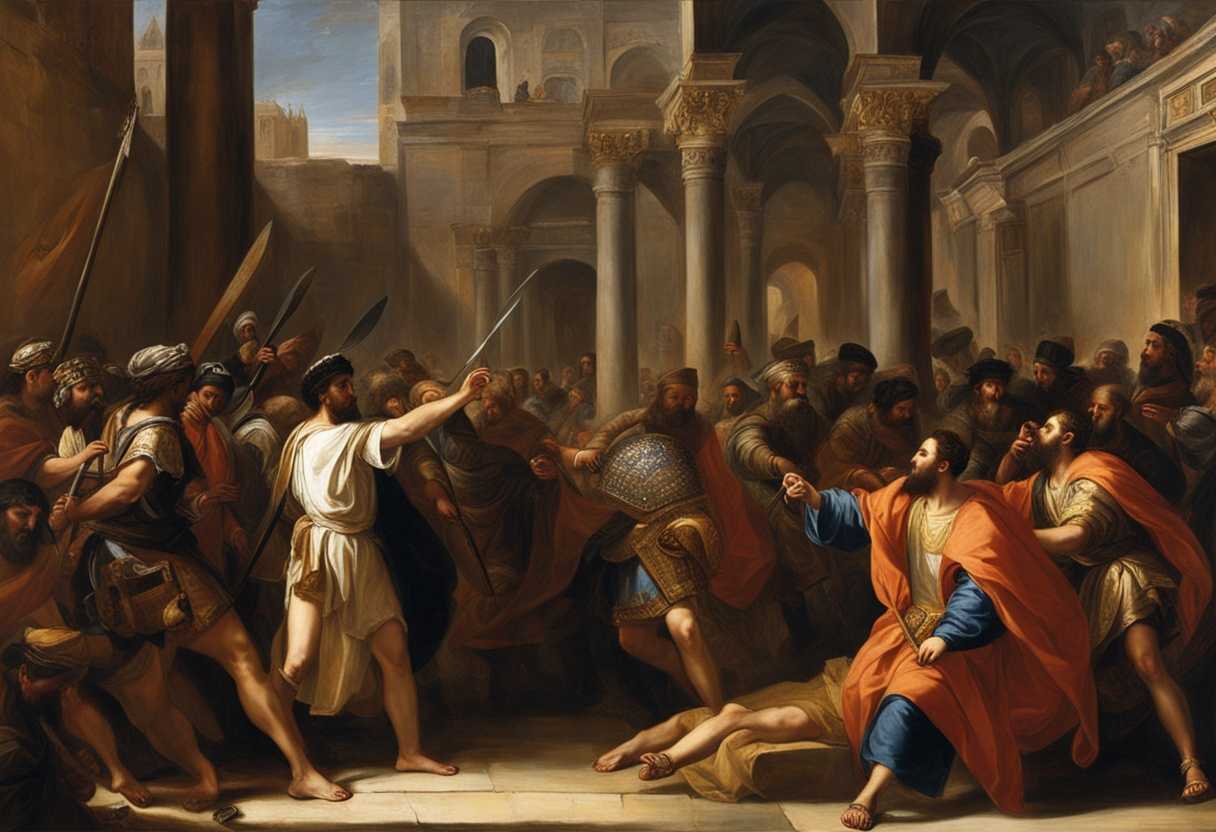
In Isaiah chapter 36, we find ourselves in the royal court of King Hezekiah of Judah in Jerusalem. The scene is tense as messengers from the Assyrian king, Sennacherib, have arrived at the city gates. The Assyrians, led by Rabshakeh, are there to deliver a message of intimidation and threats to King Hezekiah and the people of Judah. The Assyrians have already conquered many nations, and now they are laying siege to Jerusalem, the last stronghold standing in their way.
King Hezekiah is gathered with his officials and advisors, including the prophet Isaiah, to hear the message from the Assyrians. The atmosphere is charged with fear and uncertainty as the Assyrian messenger boasts of his king’s power and mocks the faith of the people of Judah. The people of Jerusalem are looking to their king and the prophet Isaiah for guidance and reassurance in this dire situation.
The city of Jerusalem is bustling with activity as preparations for a possible siege are underway. The walls of the city stand tall, a symbol of hope and protection for the people within. King Hezekiah, known for his faithfulness to God, is faced with a difficult decision as he seeks wisdom and guidance from the prophet Isaiah in this critical moment. The stage is set for a dramatic confrontation between the forces of Assyria and the faith of the people of Judah.
What is Isaiah 36:1-22 about?
God’s protection and faithfulness towards His people are powerfully demonstrated in these verses. The Assyrian king’s threats symbolize the challenges and threats we often face in our own lives. Like the people of Judah, we may at times feel overwhelmed and helpless in the face of adversity. However, just as Hezekiah turned to God in prayer for deliverance, we too can find strength and hope in seeking God’s help in times of trouble.
This story serves as a reminder of the importance of faith and trust in God’s providence. It shows us that no matter how dire the circumstances may seem, God is always in control and is ready to come to our aid. It prompts us to reflect on our own responses to challenges – do we turn to God in prayer and trust in His power to save us, or do we rely solely on our own strength? Let this passage inspire us to deepen our faith and reliance on God, knowing that He is always there to deliver us from our troubles.
Understanding what Isaiah 36:1-22 really means
In Isaiah 36:1-22, we are transported back to a tumultuous time in Judah’s history, where the Assyrian forces, led by King Sennacherib, lay siege to Jerusalem during King Hezekiah’s reign. The Assyrian field commander, known as the Rabshakeh, is sent to demand the city’s surrender, employing cunning tactics to instill doubt and fear among the people.
The key themes and phrases in this passage shed light on the spiritual warfare at play. The Rabshakeh’s insidious words, “Do not let Hezekiah deceive you,” aim to undermine trust in both the earthly leadership and divine providence. Conversely, Hezekiah’s resolute declaration, “The LORD will deliver us,” stands as a beacon of faith amidst the enemy’s mockery, emphasizing the unwavering trust in God’s intervention.
The relevance of this narrative extends beyond its historical context, resonating with modern-day challenges. Just as Judah faced the Assyrian threat, individuals today confront their own “Assyrians” in the form of personal struggles, societal pressures, and spiritual battles. The call to trust in God echoes through the ages, urging believers to anchor their faith in Him rather than yielding to fear and uncertainty.
Moreover, the importance of unity and supportive leadership emerges as a timeless lesson. The enemy’s tactic to isolate the people from Hezekiah mirrors contemporary efforts to divide communities and undermine faith. Standing united in faith and rallying behind godly leadership remains as crucial today as it was in ancient times.
To illustrate the enduring relevance of this passage, consider the analogy of a small business owner facing financial turmoil akin to Jerusalem besieged by the Assyrians. Just as Hezekiah turned to God in prayer and sought His guidance, the business owner chooses faith over despair. Through perseverance and wise counsel, the business navigates the crisis, showcasing the transformative power of faith and divine intervention.
In dissecting the phrases within Isaiah 36:1-22, we uncover profound truths about spiritual warfare and unwavering faith. “Do not let Hezekiah deceive you” exposes the enemy’s ploy to sow doubt, emphasizing the destructive nature of fear. Conversely, “The LORD will deliver us” serves as a potent reminder of God’s supremacy over earthly threats, urging believers to cling to faith in adversity. Lastly, “Do not listen to Hezekiah” underscores the vital connection to godly leadership and community support in times of trial, reinforcing the significance of unity in faith.
By delving into these themes and phrases, readers can glean valuable insights from Isaiah 36:1-22, drawing strength and inspiration to navigate their own challenges with unwavering faith and trust in God’s deliverance.
How should we respond when faced with adversity?
When facing adversity, it is important to remember that God is with us and in control of all situations. We should not be afraid or discouraged, but instead put our trust in Him. We should seek God’s wisdom and strength through prayer and meditation on His word, just as the Israelites in the book of Isaiah sought guidance from the prophet Isaiah in the face of adversity.
Adversity can test our faith and patience, but it is also an opportunity for growth and reliance on God. We should turn to God for guidance, protection, and deliverance in our times of trouble, just as King Hezekiah turned to God for help when the Assyrians threatened his kingdom. We can overcome any challenge that comes our way by placing our trust in Him and leaning on His strength.
Application
Just as in the world of emails and meetings, staying steadfast in your beliefs is crucial in life’s challenges. Like a strong network connection, rely on God’s sovereignty to guide you through life’s trials. Harness the power of King Hezekiah’s story to fuel your trust in God’s plan. Will you choose to stand strong in faith and seek divine wisdom when faced with adversity?

Reverend Michael Johnson is an experienced Church Minister with a profound expertise in spirituality and guidance. With a serene presence and a compassionate heart, he has faithfully served his congregation for over 20 years, leading them on a spiritual journey towards inner peace and enlightenment. Reverend Johnson’s extensive knowledge of religious philosophies and profound understanding of human nature have made him a trusted confidant and mentor to many, as he seamlessly weaves his profound wisdom into life teachings. Reverend Johnson’s calming demeanor and empathetic nature continue to uplift and heal souls, nurturing a sense of unity and tranquility within his community.