
John 11:1-27 is about Jesus demonstrating his power over death by raising Lazarus from the dead, illustrating his divine authority as the Son of God who gives eternal life to those who believe in him.
1 Now a certain man was ill, Lazarus of Bethany, the village of Mary and her sister Martha.
2 It was Mary who anointed the Lord with ointment and wiped his feet with her hair, whose brother Lazarus was ill.
3 So the sisters sent to him, saying, “Lord, he whom you love is ill.”
4 But when Jesus heard it he said, “This illness does not lead to death. It is for the glory of God, so that the Son of God may be glorified through it.”
5 Now Jesus loved Martha and her sister and Lazarus.
6 So, when he heard that Lazarus was ill, he stayed two days longer in the place where he was.
7 Then after this he said to the disciples, “Let us go to Judea again.”
8 The disciples said to him, “Rabbi, the Jews were just now seeking to stone you, and are you going there again?”
9 Jesus answered, “Are there not twelve hours in the day? If anyone walks in the day, he does not stumble, because he sees the light of this world.
10 But if anyone walks in the night, he stumbles, because the light is not in him.”
11 After saying these things, he said to them, “Our friend Lazarus has fallen asleep, but I go to awaken him.”
12 The disciples said to him, “Lord, if he has fallen asleep, he will recover.”
13 Now Jesus had spoken of his death, but they thought that he meant taking rest in sleep.
14 Then Jesus told them plainly, “Lazarus has died,
15 and for your sake I am glad that I was not there, so that you may believe. But let us go to him.
16 So Thomas, called the Twin, said to his fellow disciples, “Let us also go, that we may die with him.”
17 Now when Jesus came, he found that Lazarus had already been in the tomb four days.
18 Bethany was near Jerusalem, about two miles off,
19 and many of the Jews had come to Martha and Mary to console them concerning their brother.
20 So when Martha heard that Jesus was coming, she went and met him, but Mary remained seated in the house.
21 Martha said to Jesus, “Lord, if you had been here, my brother would not have died.
22 But even now I know that whatever you ask from God, God will give you.”
23 Jesus said to her, “Your brother will rise again.”
24 Martha said to him, “I know that he will rise again in the resurrection on the last day.”
25 Jesus said to her, “I am the resurrection and the life. Whoever believes in me, though he die, yet shall he live,
26 and everyone who lives and believes in me shall never die. Do you believe this?”
27 She said to him, “Yes, Lord; I believe that you are the Christ, the Son of God, who is coming into the world.”
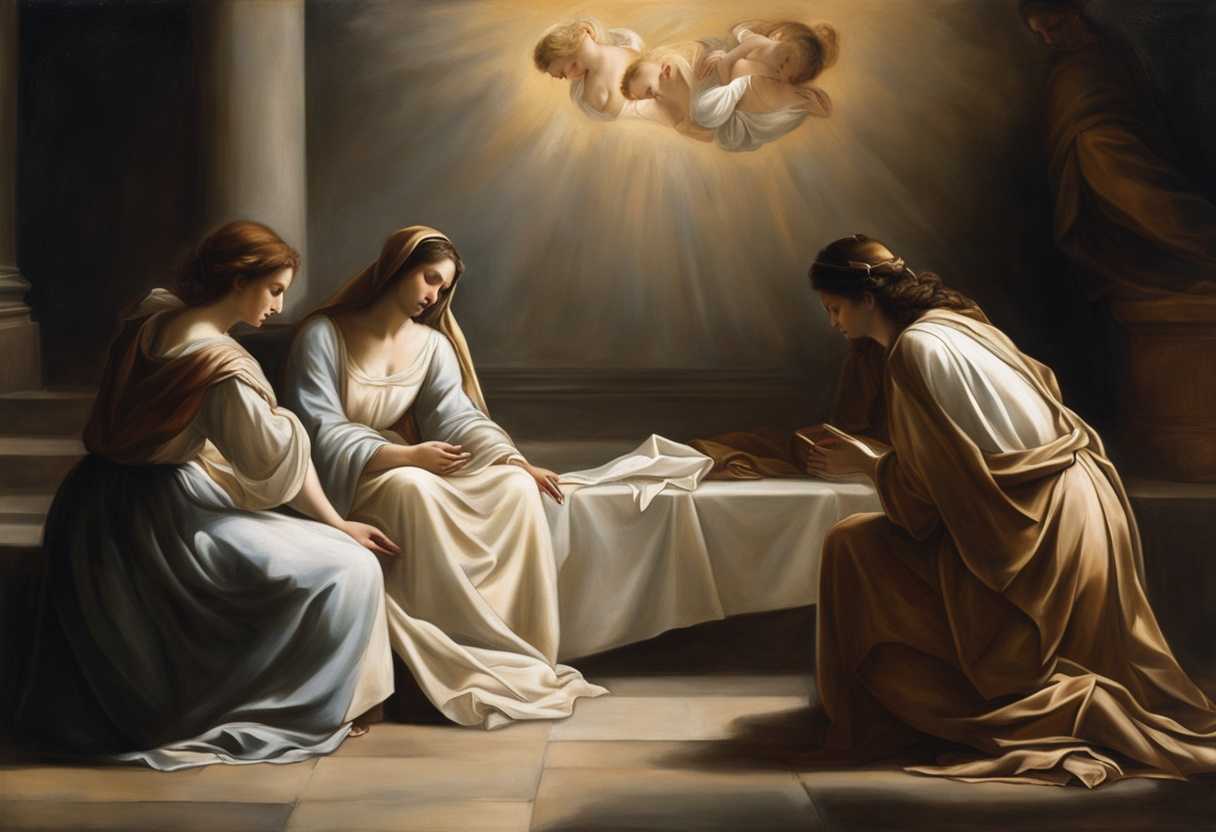
Setting the Scene for John 11:1-27
The scene in John chapter 11 opens with Jesus receiving a message from Mary and Martha, the sisters of Lazarus, informing him that their brother is very ill. Jesus is in the town of Bethany, a small village located about two miles east of Jerusalem. Mary and Martha are deeply concerned for their brother’s well-being and have sent for Jesus, knowing of his miraculous healing powers.
Upon receiving the message, Jesus informs his disciples that Lazarus’s illness will not lead to death but will serve a greater purpose to glorify God. Despite this assurance, Jesus remains where he is for two more days before deciding to go to Bethany. When Jesus finally arrives, he finds that Lazarus has already been in the tomb for four days. The scene is filled with grief and mourning, as many Jews from Jerusalem have come to console Mary and Martha.
As Jesus approaches the tomb, he is met by Martha, who expresses her faith in Jesus and her belief that God will grant him whatever he asks. Jesus then asks for the stone covering the tomb to be removed, despite Martha’s concern about the stench that would come from the decaying body. Jesus then calls out to Lazarus, commanding him to come out of the tomb. In a moment of divine power, Lazarus emerges from the tomb, still wrapped in burial cloths. This miraculous event serves as a powerful demonstration of Jesus’s authority over death and solidifies the faith of those who witness it.
What is John 11:1-27 about?
Isn’t it amazing how powerful and miraculous Jesus’ actions are in this verse? Jesus not only showcases his authority over death itself but also provides a glimpse of the resurrection to come by raising Lazarus from the dead. This event serves as a powerful foreshadowing of Jesus’ own resurrection, which would ultimately conquer death once and for all.
Just imagine the astonishment and awe the onlookers felt when they witnessed Lazarus emerging from the tomb at Jesus’ command. It’s a beautiful reminder of Jesus’ divine nature and his ability to bring life out of death. This verse not only showcases Jesus’ unmatched power but also serves as a profound reassurance of the hope and promise of eternal life through him. It’s a powerful testimony to the incredible miracles that only Jesus, the Son of God, can perform.
Understanding what John 11:1-27 really means
In John 11:1-27, we delve into the poignant narrative of the death and resurrection of Lazarus, a story that encapsulates profound themes of faith, resurrection, and the incomparable power of Jesus. The passage opens with Jesus being informed of Lazarus’s illness, the beloved brother of Mary and Martha, highlighting the intimate relationships within this close-knit group. The setting in Bethany, near Jerusalem, adds a layer of significance, underscoring the proximity to the religious center and the unfolding events that will soon transpire.
“This illness does not lead to death; rather it is for God’s glory” (v. 4) resonates with a divine purpose behind Lazarus’s suffering, showcasing how Jesus intends to reveal God’s power and magnificence through this trial. This notion prompts reflection on the idea that even in our own struggles and hardships, there may be a higher, unseen purpose at play. Jesus’s profound declaration, “I am the resurrection and the life” (v. 25), asserts His authority over life and death, offering believers the unwavering promise of eternal life in Him.
“Do you believe this?” (v. 26) poses a pivotal question that transcends the narrative, urging individuals to introspect on their personal faith in Jesus’s transformative power and enduring promises. Connecting this to other biblical passages like John 3:16, Romans 8:28, and 1 Corinthians 15:20-22, we witness a tapestry of interconnected truths emphasizing God’s redemptive plan, the assurance of eternal life, and the transformative power of resurrection through Christ.
The relevance of Lazarus’s story echoes through time, offering solace and hope to those grappling with grief and loss, while underscoring the indispensable role of faith in Jesus’s ability to bring forth life and renewal. Through anecdotes of modern-day “resurrections”—be it physical healing, restored relationships, or newfound purpose—we witness firsthand the miraculous outcomes that stem from unwavering faith and trust in God’s providence.
In conclusion, John 11:1-27 encapsulates profound lessons on the matchless power of Jesus, the paramount importance of unwavering faith, and the eternal promise of life in Him. As we navigate our own journeys, may we heed the call to reflect on our faith and trust in Jesus’s ability to breathe life and hope into every circumstance, knowing that He is the ultimate source of resurrection and transformation.
How can we have faith in resurrection and life?
We can have faith in resurrection and life by understanding that Jesus is the source of both. He showed his power over death when he raised Lazarus from the dead, demonstrating that he has the authority to give life to the dead. This miracle serves as a powerful reminder of the promise of resurrection for all believers. We can trust that Jesus, just as he brought Lazarus back to life, has the power to resurrect us and give us eternal life.
Through this account, we see that Jesus is not only able to give physical life but also spiritual life. We can have faith that he will raise us to eternal life by believing in him. This event foreshadows Jesus’ own resurrection, which is the ultimate proof of his power over death and the fulfillment of his promise to grant us eternal life through him. Therefore, we can have faith in resurrection and life by putting our trust in Jesus as the one who has the power to conquer death and give us new life.
Application
Imagine you’re stuck in a dead-end job, feeling like there’s no way out, or perhaps struggling to keep your family together through tough times. Just as Jesus brought Lazarus back from the dead, He can revive the parts of your life that feel hopeless. Trust Him to turn your impossible into possible. Will you dare to believe that He can perform miracles in your life?

Reverend Michael Johnson is an experienced Church Minister with a profound expertise in spirituality and guidance. With a serene presence and a compassionate heart, he has faithfully served his congregation for over 20 years, leading them on a spiritual journey towards inner peace and enlightenment. Reverend Johnson’s extensive knowledge of religious philosophies and profound understanding of human nature have made him a trusted confidant and mentor to many, as he seamlessly weaves his profound wisdom into life teachings. Reverend Johnson’s calming demeanor and empathetic nature continue to uplift and heal souls, nurturing a sense of unity and tranquility within his community.