
John 11:1-29 is about Jesus demonstrating his power over death through the miracle of raising Lazarus from the dead, symbolizing his ability to bring spiritual rebirth and eternal life to all who believe in him.
1 Now a certain man was ill, Lazarus of Bethany, the village of Mary and her sister Martha.
2 It was Mary who anointed the Lord with ointment and wiped his feet with her hair, whose brother Lazarus was ill.
3 So the sisters sent to him, saying, “Lord, he whom you love is ill.”
4 But when Jesus heard it he said, “This illness does not lead to death. It is for the glory of God, so that the Son of God may be glorified through it.”
5 Now Jesus loved Martha and her sister and Lazarus.
6 So, when he heard that Lazarus was ill, he stayed two days longer in the place where he was.
7 Then after this he said to the disciples, “Let us go to Judea again.”
8 The disciples said to him, “Rabbi, the Jews were just now seeking to stone you, and are you going there again?”
9 Jesus answered, “Are there not twelve hours in the day? If anyone walks in the day, he does not stumble, because he sees the light of this world.
10 But if anyone walks in the night, he stumbles, because the light is not in him.”
11 After saying these things, he said to them, “Our friend Lazarus has fallen asleep, but I go to awaken him.”
12 The disciples said to him, “Lord, if he has fallen asleep, he will recover.”
13 Now Jesus had spoken of his death, but they thought that he meant taking rest in sleep.
14 Then Jesus told them plainly, “Lazarus has died,
15 and for your sake I am glad that I was not there, so that you may believe. But let us go to him.
16 So Thomas, called the Twin, said to his fellow disciples, “Let us also go, that we may die with him.”
17 Now when Jesus came, he found that Lazarus had already been in the tomb four days.
18 Bethany was near Jerusalem, about two miles off,
19 and many of the Jews had come to Martha and Mary to console them concerning their brother.
20 So when Martha heard that Jesus was coming, she went and met him, but Mary remained seated in the house.
21 Martha said to Jesus, “Lord, if you had been here, my brother would not have died.
22 But even now I know that whatever you ask from God, God will give you.”
23 Jesus said to her, “Your brother will rise again.”
24 Martha said to him, “I know that he will rise again in the resurrection on the last day.”
25 Jesus said to her, “I am the resurrection and the life. Whoever believes in me, though he die, yet shall he live,
26 and everyone who lives and believes in me shall never die. Do you believe this?”
27 She said to him, “Yes, Lord; I believe that you are the Christ, the Son of God, who is coming into the world.”
28 When she had said this, she went and called her sister Mary, saying in private, “The Teacher is here and is calling for you.”
29 When she heard this, she rose quickly and went to him.
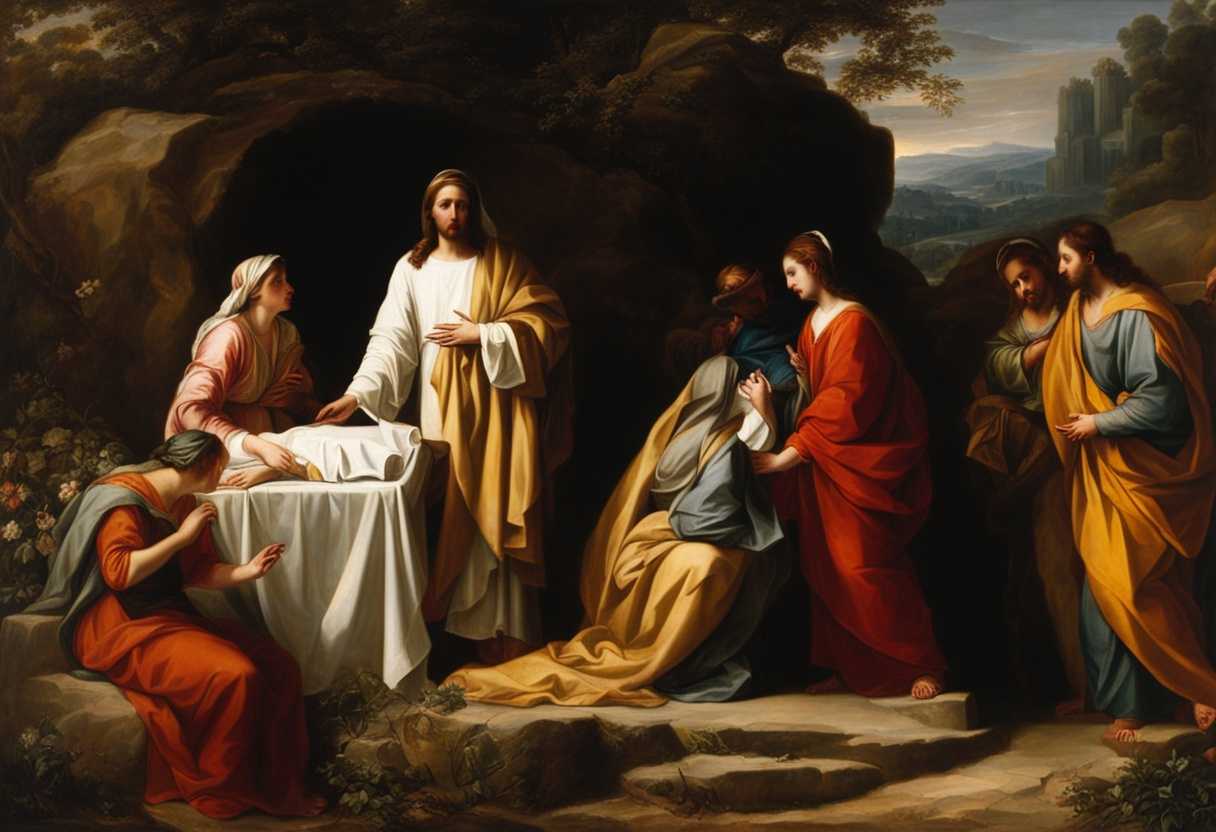
Setting the Scene for John 11:1-29
The scene in John chapter 11 opens with Jesus receiving a message from Mary and Martha, the sisters of Lazarus, informing him that their brother is very ill. Jesus is in a different town across the Jordan River when he receives this news. Mary and Martha are deeply concerned for their brother’s well-being and have sent for Jesus, knowing of his miraculous healing powers.
Upon hearing the news, Jesus informs his disciples that Lazarus’s illness will not lead to death but will serve a greater purpose to glorify God. Despite this, Jesus remains where he is for two more days before deciding to go to Bethany, where Mary, Martha, and Lazarus reside. The scene is filled with tension and anticipation as Jesus and his disciples make their way to Bethany, knowing that a significant event is about to unfold.
As Jesus arrives in Bethany, he finds that Lazarus has already been in the tomb for four days. The scene is heavy with grief as Mary and Martha mourn the loss of their brother. Jesus is deeply moved by their sorrow and the scene is charged with emotion as he asks to be taken to the tomb. It is in this poignant moment that Jesus performs one of his most famous miracles, raising Lazarus from the dead, showcasing his power over death and solidifying the faith of those present.
What is John 11:1-29 about?
This verse encapsulates a profound moment in the Bible where Jesus showcases his divinity and power over death by reviving Lazarus from the dead. It serves as a powerful foreshadowing of Jesus’ imminent resurrection, revealing to his disciples and followers the extent of his divine capabilities. Jesus not only displays his authority in this miraculous event but also offers a glimpse of the eternal life that believers can attain through their faith in him.
Have you ever considered the significance of this miracle in the grand narrative of Jesus’ life? How does it highlight the core message of Christianity, emphasizing the belief in life after death and the promise of resurrection? Jesus invites us to contemplate the deeper meaning of existence and the eternal hope that he brings through his sacrificial love by raising Lazarus from the dead. This verse serves as a powerful reminder of the transformative power of faith and the assurance of life beyond the limitations of this earthly realm.
Understanding what John 11:1-29 really means
The story of Lazarus in John 11:1-29 is a poignant account of faith, hope, and the power of Jesus over life and death. In Bethany, a man named Lazarus falls ill, and despite his sisters, Mary and Martha, sending for Jesus, he succumbs to death. However, Jesus arrives and performs a miraculous act by raising Lazarus from the dead, showcasing His divine authority and compassion.
In verse 4, Jesus declares, “This illness does not lead to death,” indicating that Lazarus’s sickness serves a higher purpose of glorifying God. This statement challenges our understanding of suffering and highlights the sovereignty of God in all circumstances. Similarly, when Jesus proclaims, “I am the resurrection and the life” in verse 25, He asserts His supremacy over life and death, offering believers the hope of eternal life through Him.
The passage emphasizes the significance of faith in Jesus for eternal life. Jesus’s assurance in verse 25 that “He who believes in me will live, even though he dies” underscores the foundational role of faith in securing a future beyond physical death. This promise resonates with believers today, providing a source of hope and assurance amidst life’s uncertainties and challenges.
Drawing parallels to other biblical passages such as John 5:24-25, Romans 8:11, and 1 Corinthians 15:20-22, we see a consistent theme of resurrection, eternal life, and the transformative power of faith in Christ. These passages reinforce the central message of Jesus’s authority over death and His promise of new life for believers.
In our contemporary context, the story of Lazarus offers profound lessons. It reminds us that in moments of despair and hopelessness, Jesus remains the source of ultimate hope and restoration. Just as Mary and Martha clung to faith in the face of death, we are encouraged to trust in Jesus’s power to bring life out of seemingly dead situations.
Furthermore, the narrative of Jesus’s delayed arrival to Lazarus’s tomb teaches us about the importance of trusting in God’s timing. Even when circumstances appear bleak and prayers seem unanswered, we are called to have faith that God’s plan unfolds according to His perfect timing and purpose.
In conclusion, the story of Lazarus serves as a compelling testimony to Jesus’s authority, the promise of eternal life through faith, and the enduring hope found in trusting God’s timing. It challenges us to reflect on our own faith in the midst of trials and to find solace in the unwavering power of Christ over life and death.
How can we deepen our faith in times of doubt?
We can deepen our faith in times of doubt by reflecting on the truth of God’s word and the promises He has made to us. We can hold onto the promises found in Scripture that remind us of God’s faithfulness and love for us, just as Jesus assured Martha of the resurrection and the power of God. When we immerse ourselves in the truth of God’s word, we are reminded of His sovereign power and unfailing love, which can help strengthen our faith in times of doubt.
Additionally, seeking out the support and encouragement of other believers can help us deepen our faith during times of doubt. Like Mary and Martha found comfort in the community of believers who mourned with them, we too can find strength in the fellowship of other Christians who can pray for us, offer words of encouragement, and point us back to the truth of God’s word. Surrounding ourselves with a community of believers who can walk alongside us in our faith journey can provide the support and reassurance we need to overcome our doubts and deepen our faith in God.
Application
Just like balancing work and family can seem impossible, so can trusting in something greater when times get tough. The story of Lazarus shows us that believing in miracles isn’t just for the past—it’s for now, in our modern lives. When was the last time you let yourself trust completely, even when life throws curveballs? Strengthen your faith, embrace the impossible, and watch as miracles unfold. Are you ready to trust in God’s timing and see the amazing things He has planned for you?

Reverend Michael Johnson is an experienced Church Minister with a profound expertise in spirituality and guidance. With a serene presence and a compassionate heart, he has faithfully served his congregation for over 20 years, leading them on a spiritual journey towards inner peace and enlightenment. Reverend Johnson’s extensive knowledge of religious philosophies and profound understanding of human nature have made him a trusted confidant and mentor to many, as he seamlessly weaves his profound wisdom into life teachings. Reverend Johnson’s calming demeanor and empathetic nature continue to uplift and heal souls, nurturing a sense of unity and tranquility within his community.