
1 Now a certain man was ill, Lazarus of Bethany, the village of Mary and her sister Martha.
2 It was Mary who anointed the Lord with ointment and wiped his feet with her hair, whose brother Lazarus was ill.
3 So the sisters sent to him, saying, “Lord, he whom you love is ill.”
4 But when Jesus heard it he said, “This illness does not lead to death. It is for the glory of God, so that the Son of God may be glorified through it.”
5 Now Jesus loved Martha and her sister and Lazarus.
6 So, when he heard that Lazarus was ill, he stayed two days longer in the place where he was.
7 Then after this he said to the disciples, “Let us go to Judea again.”
8 The disciples said to him, “Rabbi, the Jews were just now seeking to stone you, and are you going there again?”
9 Jesus answered, “Are there not twelve hours in the day? If anyone walks in the day, he does not stumble, because he sees the light of this world.
10 But if anyone walks in the night, he stumbles, because the light is not in him.”
11 After saying these things, he said to them, “Our friend Lazarus has fallen asleep, but I go to awaken him.”
12 The disciples said to him, “Lord, if he has fallen asleep, he will recover.”
13 Now Jesus had spoken of his death, but they thought that he meant taking rest in sleep.
14 Then Jesus told them plainly, “Lazarus has died,
15 and for your sake I am glad that I was not there, so that you may believe. But let us go to him.
16 So Thomas, called the Twin, said to his fellow disciples, “Let us also go, that we may die with him.”
17 Now when Jesus came, he found that Lazarus had already been in the tomb four days.
18 Bethany was near Jerusalem, about two miles off,
19 and many of the Jews had come to Martha and Mary to console them concerning their brother.
20 So when Martha heard that Jesus was coming, she went and met him, but Mary remained seated in the house.
21 Martha said to Jesus, “Lord, if you had been here, my brother would not have died.
22 But even now I know that whatever you ask from God, God will give you.”
23 Jesus said to her, “Your brother will rise again.”
24 Martha said to him, “I know that he will rise again in the resurrection on the last day.”
25 Jesus said to her, “I am the resurrection and the life. Whoever believes in me, though he die, yet shall he live,
26 and everyone who lives and believes in me shall never die. Do you believe this?”
27 She said to him, “Yes, Lord; I believe that you are the Christ, the Son of God, who is coming into the world.”
28 When she had said this, she went and called her sister Mary, saying in private, “The Teacher is here and is calling for you.”
29 When she heard this, she rose quickly and went to him.
30 Now Jesus had not yet come into the village, but was still in the place where Martha had met him.
31 Then the Jews who were with her in the house, consoling her, saw Mary rise quickly and go out. They followed her, supposing that she was going to the tomb to weep there.
32 Now when Mary came to where Jesus was and saw him, she fell at his feet, saying to him, “Lord, if you had been here, my brother would not have died.”
33 When Jesus saw her weeping, and the Jews who had come with her also weeping, he was deeply moved in his spirit and greatly troubled.
34 He said, “Where have you laid him?” They said to him, “Lord, come and see.”
35 Jesus wept.
36 So the Jews said, “See how he loved him!”
37 But some of them said, “Could not he who opened the eyes of the blind man also have kept this man from dying?”
38 Then Jesus, deeply moved again, came to the tomb. It was a cave, and a stone lay against it.
39 Jesus said, “Take away the stone.”
40 Jesus said to her, “Did I not tell you that if you believed you would see the glory of God?”
41 So they took away the stone. And Jesus lifted up his eyes and said, “Father, I thank you that you have heard me.
42 I knew that you always hear me, but I said this on account of the people standing around, that they may believe that you sent me.
43 When he had said these things, he cried out with a loud voice, “Lazarus, come out.”
44 The man who had died came out, his hands and feet bound with linen strips, and his face wrapped with a cloth. Jesus said to them, “Unbind him, and let him go.”
45 Many of the Jews therefore, who had come with Mary and had seen what he did, believed in him,
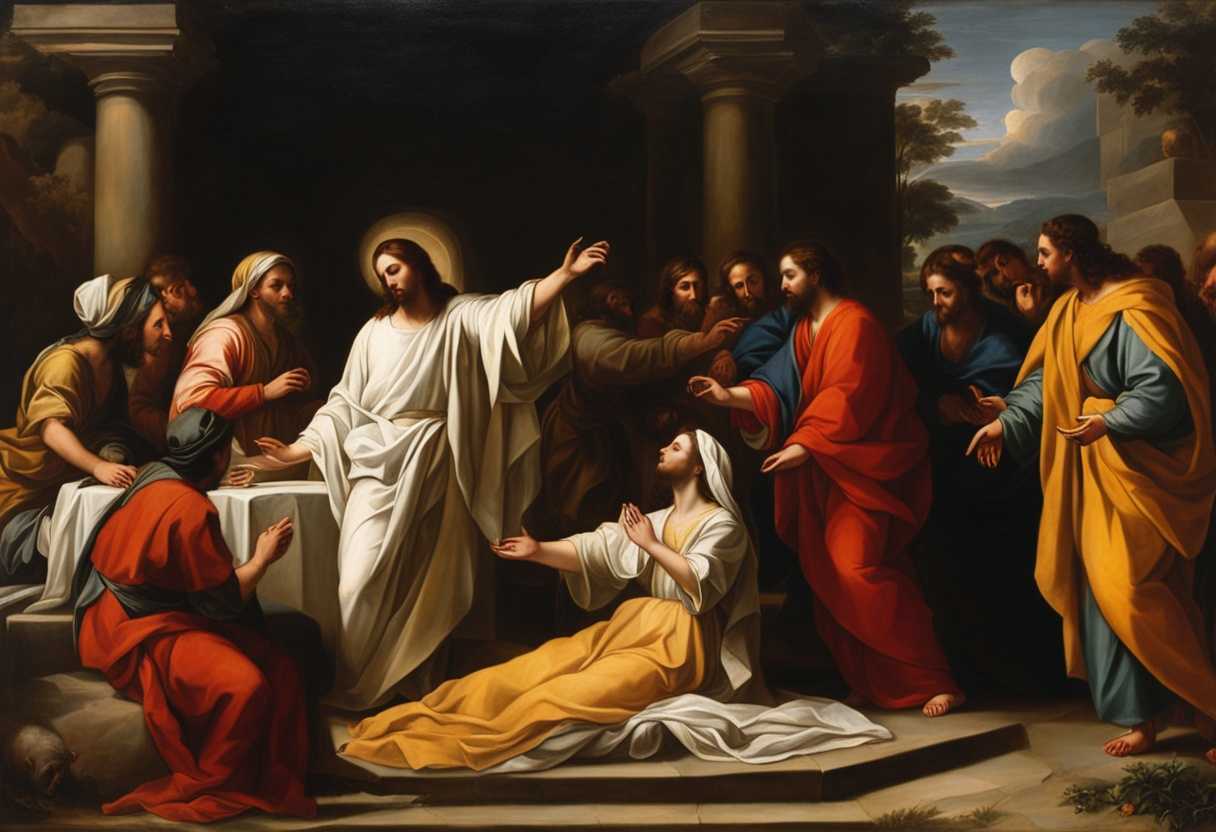
Setting the Scene for John 11:1-45
In John chapter 11, we find Jesus and his disciples in the town of Bethany, where Mary and Martha, the sisters of Lazarus, reside. The scene is set in a somber atmosphere as Lazarus has fallen ill and his sisters send word to Jesus, who is in another town, to come and heal him. Upon receiving the message, Jesus informs his disciples that Lazarus’s illness will not lead to death but will be used for the glory of God.
As Jesus and his disciples arrive in Bethany, they are met by a grieving Martha who expresses her faith in Jesus, believing that if he had been there, her brother would not have died. Jesus then asks to be taken to the tomb where Lazarus has been laid. The surroundings are filled with mourning and sadness as friends and family members have gathered to pay their respects to Lazarus.
As they approach the tomb, Jesus commands the stone to be rolled away, and despite Martha’s initial hesitation due to the stench of death, Jesus calls out to Lazarus to come out. In a miraculous display of power, Lazarus emerges from the tomb, alive and well, to the amazement of all those present. This powerful scene serves as a testament to Jesus’s authority over death and his ability to bring forth life, reinforcing the belief of those who witnessed this incredible event.
What is John 11:1-45 about?
Isn’t it amazing how this verse showcases Jesus’s miraculous power and divinity? Jesus not only displays his authority over death but also hints at his own impending resurrection by bringing Lazarus back to life. It’s a powerful reminder of Jesus’s identity as the Son of God and the savior of humanity.
This verse not only speaks to Jesus’s divine nature but also highlights the theme of life triumphing over death. It offers hope and comfort to those who believe in Jesus, knowing that he has the power to overcome even the greatest of obstacles. He offers us the promise of eternal life and the hope of a future resurrection, just as Jesus brought Lazarus back from the dead.
So, as we reflect on this verse, let’s be encouraged by the incredible power of our Savior and take comfort in the assurance that Jesus’s victory over death is also a promise for us. Let’s hold onto this truth as we face challenges and difficulties, knowing that Jesus has the ultimate authority over life and death.
Understanding what John 11:1-45 really means
Structure for the Commentary:
- Introduction to the Passage
- Context and Background
- Key Phrases and Their Meanings
- Connection to Other Biblical Passages
- Relevance to People Today
- Anecdote for Practical Understanding
- Conclusion and Reflection
Commentary:
Introduction to the Passage
John 11:1-45 narrates the miraculous event where Jesus raises Lazarus from the dead. This passage is a cornerstone in understanding Jesus’ power over life and death, emphasizing His divine authority and compassionate nature.
Context and Background
This event occurs in Bethany, where Lazarus, the brother of Mary and Martha, has died. Jesus is informed of Lazarus’ illness but delays His visit, arriving four days after Lazarus has been entombed. The delay is purposeful, setting the stage for a profound demonstration of Jesus’ divinity.
Key Phrases and Their Meanings
One of the most striking statements Jesus makes is, “I am the resurrection and the life.” This phrase encapsulates the essence of Christian belief—that through Jesus, eternal life is possible. When Jesus weeps, it shows His deep compassion and empathy, reflecting His shared humanity with us. The command, “Lazarus, come out,” signifies the authority of Jesus’ word, bringing life where there was death.
Connection to Other Biblical Passages
This passage echoes the promise found in John 3:16, where eternal life is offered to those who believe. It also aligns with Ezekiel 37:1-14, where the prophet sees a vision of dry bones coming to life, symbolizing God’s power to restore life. Additionally, it prefigures Jesus’ own resurrection, as described in John 20, affirming that He indeed holds the keys to life and death. This passage provides hope in today’s world, where death and suffering are prevalent. It reassures us that Jesus has power over life and death and that He cares deeply about our struggles. What challenges are you facing that feel insurmountable? This story invites you to trust in Jesus’ power and compassion.
Anecdote for Practical Understanding
I once knew a woman who faced a seemingly hopeless situation: her son was diagnosed with a terminal illness. She turned to this passage for comfort. She placed her trust in Him just as Mary and Martha trusted Jesus. While her son did pass away, she found peace in the belief that death is not the end, but a gateway to eternal life with Christ. This story highlights the transformative power of faith in Jesus’ promises.
Conclusion and Reflection
John 11:1-45 is not just a historical account but a living testament to Jesus’ power and love. Reflect on how this passage speaks to your life. Are there areas where you need to invite Jesus’ transformative power? You can embody the hope and compassion Jesus demonstrated, bringing life and light to those around you.
How can our faith in God overcome death?
Our faith in God can overcome death because it acknowledges that God has power over life and death. Jesus demonstrates in this story from John 11 that He has authority even over death itself, showing that death is not the end for those who believe in Him. This event emphasizes the importance of having faith in God’s ability to bring about new life and hope even in the face of death.
When we put our trust in God, we believe that He is the ultimate source of life and resurrection. Our faith enables us to see beyond the limitations of this world and look to God’s promise of eternal life. We can find peace and comfort knowing that death is not the final chapter of our existence by believing in God’s power to overcome death. Our faith in God gives us the strength to face death with hope and confidence that He will ultimately triumph over it.
Application
Think of your work and family life—busy, chaotic, sometimes overwhelming. Remember Jesus raising Lazarus, showing ultimate power and faith. Like He revived Lazarus, He can breathe life into your toughest situations. Trust His timing, His power, even when things seem impossible. Will you take a leap and trust Him to bring life where you see only dead ends?

Reverend Michael Johnson is an experienced Church Minister with a profound expertise in spirituality and guidance. With a serene presence and a compassionate heart, he has faithfully served his congregation for over 20 years, leading them on a spiritual journey towards inner peace and enlightenment. Reverend Johnson’s extensive knowledge of religious philosophies and profound understanding of human nature have made him a trusted confidant and mentor to many, as he seamlessly weaves his profound wisdom into life teachings. Reverend Johnson’s calming demeanor and empathetic nature continue to uplift and heal souls, nurturing a sense of unity and tranquility within his community.