
John 12:1-7 is about Mary anointing Jesus’ feet with expensive perfume, which serves as a foreshadowing of Jesus’ impending death and burial, emphasizing both the intimacy of Mary’s act and the significance of Jesus’ sacrifice.
1 Six days before the Passover, Jesus therefore came to Bethany, where Lazarus was, whom Jesus had raised from the dead.
2 So they gave a dinner for him there. Martha served, and Lazarus was one of those reclining with him at table.
3 Mary therefore took a pound of expensive ointment made from pure nard, and anointed the feet of Jesus and wiped his feet with her hair. The house was filled with the fragrance of the perfume.
4 But Judas Iscariot, one of his disciples (he who was about to betray him), said,
5 “Why was this ointment not sold for three hundred denarii and given to the poor?”
6 He said this, not because he cared about the poor, but because he was a thief, and having charge of the moneybag he used to help himself to what was put into it.
7 Jesus said, “Leave her alone, so that she may keep it for the day of my burial.”
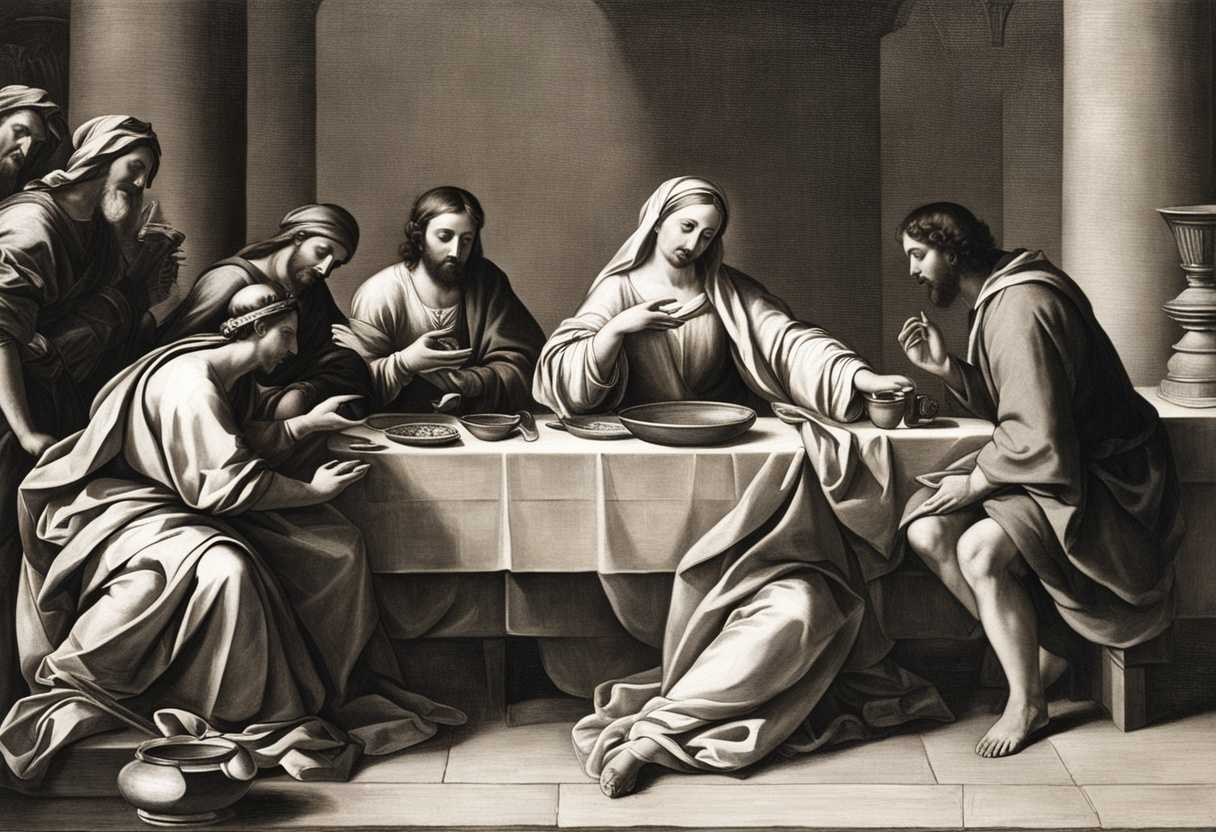
Setting the Scene for John 12:1-7
The scene in John chapter 12 opens with Jesus returning to Bethany, a village just outside Jerusalem. He arrives at the home of his dear friends, Lazarus, Martha, and Mary. The siblings were known to have a close relationship with Jesus, and their home was a place of comfort and hospitality for him.
As Jesus reclines at the table, enjoying the company of his friends, Mary enters the room with an alabaster jar of expensive perfume. She approaches Jesus and pours the fragrant oil on his feet, then wipes them with her hair. The room is filled with the sweet aroma of the perfume, and the act of devotion and humility displayed by Mary touches the hearts of all present.
Judas Iscariot, one of Jesus’ disciples, questions the extravagance of Mary’s gesture, suggesting that the perfume could have been sold to help the poor. However, Jesus defends Mary, commending her for her act of love and explaining that she has anointed him for his burial. This poignant moment foreshadows the events to come and highlights the deep love and understanding shared between Jesus and his devoted followers.
What is John 12:1-7 about?
Mary’s profound act of devotion towards Jesus is witnessed in this verse as she anoints his feet with expensive perfume. This act symbolizes an expression of love, respect, and humility towards Jesus. Mary’s gesture goes beyond mere material value; it is a reflection of her deep reverence and understanding of Jesus’ importance in her life.
Judas’ objection to Mary’s act raises questions about the true motives behind his dissent. Is it driven by a genuine concern for the poor, or does it stem from jealousy or greed? Jesus’ defense of Mary highlights the importance of genuine love and gratitude in actions of worship. It serves as a reminder to prioritize sincerity and purity of heart in our relationship with God. We are encouraged to examine our own attitudes towards acts of worship and service as we reflect on this verse. Are our actions driven by a sincere and selfless love for God, or are they tainted by ulterior motives? Let us learn from Mary’s example of wholehearted devotion and seek to emulate her deep reverence and love for our Savior.
Understanding what John 12:1-7 really means
In John 12:1-7, we find ourselves six days before the Passover, in Bethany, where Jesus is visiting the home of Lazarus, whom He had miraculously raised from the dead. The scene is set at a dinner given in Jesus’ honor, attended by His close friends and disciples. Among the key characters are Jesus, the central figure whose impending sacrifice is foreshadowed; Lazarus, a living testament to Jesus’ power over death; Mary, who demonstrates profound devotion and worship; and Judas Iscariot, whose reaction reveals his true character and foreshadows his betrayal.
Mary’s act of anointing Jesus with costly perfume, described as “a pint of pure nard, an expensive perfume,” holds deep significance. It symbolizes her deep love and reverence for Jesus, while also prefiguring His burial. Her act of humility and service, as she wipes His feet with her hair, is a powerful expression of worship and submission. The fragrance of the perfume filling the house symbolizes how true worship and devotion to Jesus can permeate and transform the environment around us. Jesus’ defense of Mary, saying, “Leave her alone,” underscores the importance of sincere worship and the recognition of His impending sacrifice.
Parallel accounts in Matthew 26:6-13 and Mark 14:3-9 emphasize the significance of Mary’s act and Jesus’ acknowledgment of it as preparation for His burial. In Luke 10:38-42, we see another instance of Mary prioritizing spiritual devotion over worldly concerns by choosing to sit at Jesus’ feet. Paul’s words in Philippians 3:8 echo Mary’s actions, as he speaks of considering everything a loss compared to the surpassing worth of knowing Christ.
Mary’s act challenges us to consider what we are willing to sacrifice for our faith and how we express our devotion to Jesus. It encourages believers to engage in worship that is heartfelt and sincere, not merely ritualistic. This passage reminds us to prioritize our relationship with Jesus above material possessions and societal expectations. Just as Mary’s act of pouring out the expensive perfume was misunderstood by some, true devotion often involves personal sacrifice and may not always be understood by others.
Reflecting on this passage, we are prompted to examine our own acts of worship and devotion. Are we willing to give our best to Jesus, even when it costs us dearly? Are we prepared to defend and support those who show genuine love and reverence for Him? Through Mary’s example, we learn the value of heartfelt worship and the importance of recognizing Jesus’ ultimate sacrifice.
What is our true motivation for service to God?
Our true motivation for service to God should come from a place of love and devotion towards Him. Our deep affection for Him should fuel our service to God, just as Mary poured expensive perfume on Jesus’ feet out of genuine love and adoration. When we truly understand and appreciate the love that God has for us, it should compel us to serve Him wholeheartedly and selflessly.
We should not serve God out of a sense of obligation or to gain recognition from others, but rather out of a sincere desire to honor and glorify Him. Our service to God should be characterized by a sacrificial and humble attitude, just as Mary’s act of service was a costly sacrifice done out of pure love. When our motivation for serving God is rooted in genuine love and reverence for Him, our actions will reflect the depth of our relationship with Him.
Application
Consider Mary’s act of pouring costly perfume on Jesus. She gave her most valuable possession because her devotion was deeper than her wallet. In the hustle of work and family commitments, can you find ways to offer your most valuable time and energy to meaningful service and worship? Are you ready to show your love for God through selfless actions, even when it’s not convenient or easy? What is your perfume, and how will you pour it out today?

Reverend Michael Johnson is an experienced Church Minister with a profound expertise in spirituality and guidance. With a serene presence and a compassionate heart, he has faithfully served his congregation for over 20 years, leading them on a spiritual journey towards inner peace and enlightenment. Reverend Johnson’s extensive knowledge of religious philosophies and profound understanding of human nature have made him a trusted confidant and mentor to many, as he seamlessly weaves his profound wisdom into life teachings. Reverend Johnson’s calming demeanor and empathetic nature continue to uplift and heal souls, nurturing a sense of unity and tranquility within his community.