
John 12:12-36 is about the triumphant entry of Jesus into Jerusalem, showcasing how His kingdom is not of this world and emphasizing the necessity of His impending sacrifice for the salvation of mankind.
12 The next day the large crowd that had come to the feast heard that Jesus was coming to Jerusalem.
12 So they took branches of palm trees and went out to meet him, crying out, “Hosanna! Blessed is he who comes in the name of the Lord, even the King of Israel!”
14 And Jesus found a young donkey and sat on it, just as it is written,
15 “Fear not, daughter of Zion; behold, your king is coming, sitting on a donkey’s colt!”
16 His disciples did not understand these things at first, but when Jesus was glorified, then they remembered that these things had been written about him and had been done to him.
17 So the crowd that had been with him when he called Lazarus out of the tomb and raised him from the dead continued to bear witness.
18 The reason why the crowd went to meet him was that they heard he had done this sign.
19 So the Pharisees said to one another, “You see that you are gaining nothing. Look, the world has gone after him.”
20 Now among those who went up to worship at the feast were some Greeks.
21 So these came to Philip, who was from Bethsaida in Galilee, and asked him, “Sir, we wish to see Jesus.”
22 Philip went and told Andrew; Andrew and Philip went and told Jesus.
23 And Jesus answered them, “The hour has come for the Son of Man to be glorified.
24 Truly, truly, I say to you, unless a grain of wheat falls into the earth and dies, it remains alone; but if it dies, it bears much fruit.
25 Whoever loves his life loses it, and whoever hates his life in this world will keep it for eternal life.
26 If anyone serves me, he must follow me; and where I am, there will my servant be also. If anyone serves me, the Father will honor him.
27 “Now is my soul troubled. And what shall I say? ‘Father, save me from this hour’? But for this purpose I have come to this hour.”
28 Father, glorify your name.” Then a voice came from heaven: “I have glorified it, and I will glorify it again.”
29 The crowd that stood there and heard it said that it had thundered. Others said, “An angel has spoken to him.”
30 Jesus answered, “This voice has come for your sake, not mine.
31 Now is the judgment of this world; now will the ruler of this world be cast out.
32 And I, when I am lifted up from the earth, will draw all people to myself.”
33 He said this to show by what kind of death he was going to die.
34 So the crowd answered him, “We have heard from the Law that the Christ remains forever. How can you say that the Son of Man must be lifted up? Who is this Son of Man?”
35 So Jesus said to them, “The light is among you for a little while longer. Walk while you have the light, lest darkness overtake you. The one who walks in the darkness does not know where he is going.
36 While you have the light, believe in the light, that you may become sons of light.”
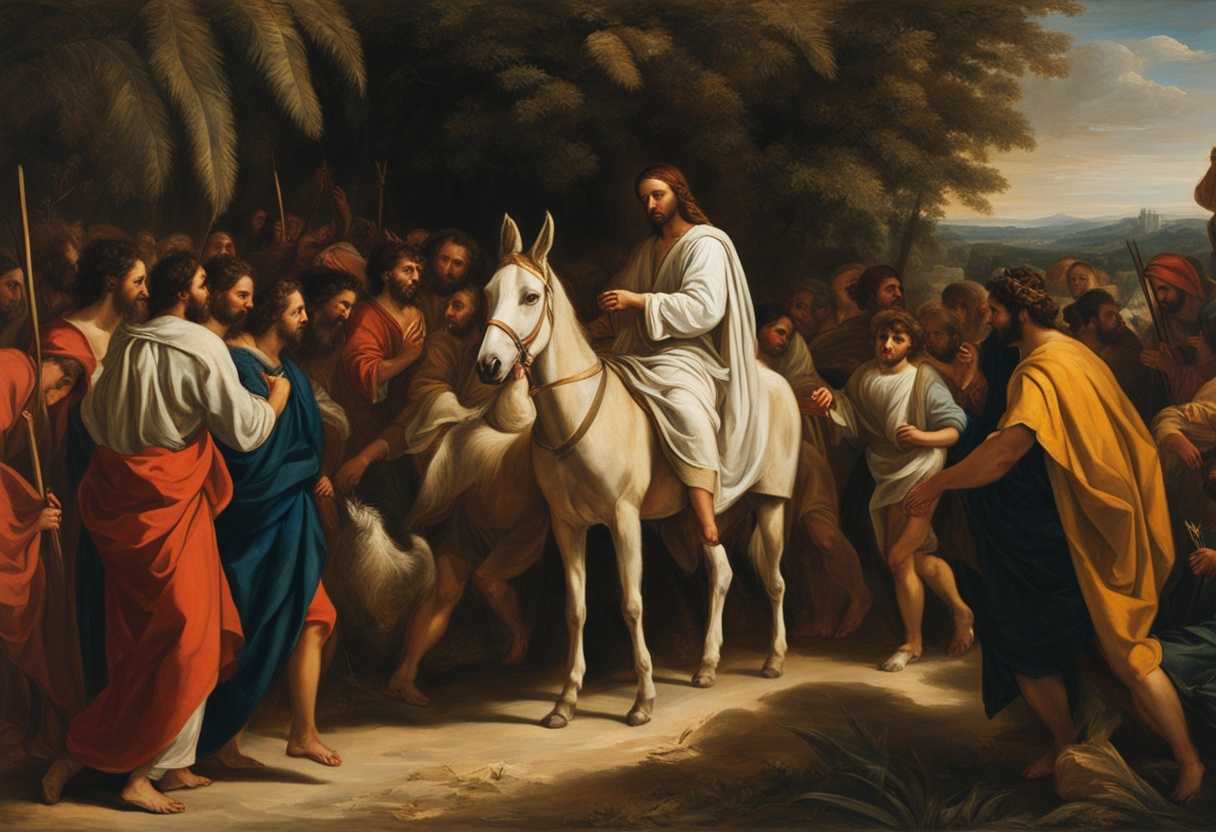
Setting the Scene for John 12:12-36
The scene in John chapter 12 is set in Jerusalem during the time of the Passover festival. Jesus, accompanied by his disciples, enters the city riding on a donkey, fulfilling the prophecy in Zechariah 9:9. The people in the city hear that Jesus is coming and they come out to meet him, waving palm branches and shouting “Hosanna! Blessed is he who comes in the name of the Lord!” The atmosphere is filled with excitement and anticipation as the crowd recognizes Jesus as the long-awaited Messiah.
Among the disciples accompanying Jesus are Peter, James, John, Andrew, and Philip. They have been following Jesus throughout his ministry, witnessing his miracles and teachings. The disciples are filled with a mix of emotions – awe at the reception Jesus is receiving, confusion about what the future holds, and a growing sense of the significance of the events unfolding before them. As they walk alongside Jesus, they are caught up in the energy of the crowd and the sense of expectation that something momentous is about to happen.
The streets of Jerusalem are crowded with pilgrims who have come to celebrate the Passover. The city is buzzing with activity as people prepare for the festival, offering sacrifices at the temple and participating in various rituals. The air is filled with the scent of incense and the sounds of prayers and songs. In the midst of this bustling scene, Jesus and his disciples make their way towards the temple, where Jesus will continue to teach and minister to the people, knowing that his time on earth is drawing to a close.
What is John 12:12-36 about?
Jesus enters Jerusalem amidst a chorus of praise from the people in this verse, marking a significant event in His life. The people’s jubilant welcome symbolizes their recognition of Jesus as a figure of importance, possibly even as the long-awaited Messiah. This moment is both a culmination of Jesus’ ministry and a foreshadowing of the events to come, specifically His upcoming death and ultimate glorification through resurrection. We can ponder the complexities of Jesus’ identity and the reactions He elicited from those around Him as we reflect on this verse. What does it mean for Jesus to be both celebrated and destined for sacrifice at the same time? How does this interplay between honor and sacrifice shape our understanding of Jesus as a central figure in Christianity? These questions encourage us to delve deeper into the theological significance of Jesus’ journey to Jerusalem, inviting us to contemplate the profound mystery of His mission and the ultimate purpose behind His sacrificial death.
Understanding what John 12:12-36 really means
The passage in John 12:12-36 captures a pivotal moment in Jesus’ ministry as He enters Jerusalem amidst cheers of “Hosanna!” and foretells His impending death. The crowd’s exclamation of “Hosanna! Blessed is he who comes in the name of the Lord!” reflects their recognition of Jesus as the Messiah, their longing for salvation evident in the plea to be saved. Jesus acknowledges that His time to be glorified through the cross has come, emphasizing the necessity of His sacrificial death for the redemption of humanity. The metaphor of a grain of wheat dying to bear fruit illustrates the transformative power of Jesus’ sacrifice, bringing forth spiritual life for believers.
In Zechariah 9:9, the prophecy of the righteous and victorious king riding on a donkey finds fulfillment in Jesus’ humble entry into Jerusalem, underscoring His identity as the promised Messiah. Isaiah 53:5 poignantly portrays Jesus’ suffering and death for the forgiveness of sins, highlighting the profound impact of His sacrifice on humanity. Philippians 2:8-9 emphasizes Jesus’ humility and obedience, leading to His exaltation by God, showcasing the ultimate glorification of Christ.
The timeless themes of hope, sacrifice, and discipleship in this passage resonate deeply with believers today. In a world marked by uncertainty and suffering, Jesus’ sacrificial love and triumph over death offer profound hope and assurance. The call to follow Jesus and serve others echoes the transformative power of faith and love in our lives, inspiring us to live out our beliefs with courage and compassion.
Consider a scenario where a community faces a natural disaster, and volunteers selflessly risk their lives to rescue and aid others. Their actions mirror Jesus’ sacrificial love, bringing hope and unity amidst chaos. Just as the volunteers’ efforts bear fruit in saved lives and restored communities, Jesus’ death and resurrection bring spiritual renewal and eternal life to those who believe, illustrating the profound impact of His sacrifice on humanity.
In conclusion, the passage in John 12:12-36 challenges us to reflect on the significance of Jesus’ sacrifice and the call to discipleship. It prompts us to embody Christ’s example of selfless love and service in our daily lives, fostering a deeper understanding of faith and a commitment to following Jesus with unwavering devotion.
What does it mean to follow Jesus wholeheartedly?
Following Jesus wholeheartedly means actively choosing to surrender to His teachings, guidance, and example in every aspect of one’s life. It involves complete dedication to living out His principles, sharing His love with others, and aligning one’s actions with His will. This commitment requires a genuine desire to follow Jesus not just on the surface level, but with deep sincerity and conviction.
When one follows Jesus wholeheartedly, it means making Him the center of one’s life and allowing His teachings to transform one’s thoughts, attitudes, and behaviors. It involves a willingness to prioritize God’s kingdom above personal desires and ambitions, and to seek His guidance in every decision. This kind of wholehearted devotion requires a continual striving to grow closer to Jesus, to deepen one’s faith, and to serve others with humility and compassion. A lifelong journey of faith, marked by a steadfast commitment to walk in His ways and reflect His love to the world, ultimately follows Jesus wholeheartedly.
Application
Think about the sacrifices you make every day for work and family. Now, reflect on the ultimate sacrifice Christ made for you. Jesus showed humility and obedience through every step of His journey. Are you ready to move beyond just hearing His teachings and start living them? Are you prepared to put action behind your faith? What will you do today to follow His example?

Reverend Michael Johnson is an experienced Church Minister with a profound expertise in spirituality and guidance. With a serene presence and a compassionate heart, he has faithfully served his congregation for over 20 years, leading them on a spiritual journey towards inner peace and enlightenment. Reverend Johnson’s extensive knowledge of religious philosophies and profound understanding of human nature have made him a trusted confidant and mentor to many, as he seamlessly weaves his profound wisdom into life teachings. Reverend Johnson’s calming demeanor and empathetic nature continue to uplift and heal souls, nurturing a sense of unity and tranquility within his community.