
John 12:12-50 is about Jesus entering Jerusalem amidst the celebration of the crowd, foretelling his impending death and resurrection as a necessary sacrifice for the salvation of humanity, calling for faith in him as the light of the world and warning against rejecting him, emphasizing the need to follow him and abide in his teachings to inherit eternal life.
12 The next day the large crowd that had come to the feast heard that Jesus was coming to Jerusalem.
12 So they took branches of palm trees and went out to meet him, crying out, “Hosanna! Blessed is he who comes in the name of the Lord, even the King of Israel!”
14 And Jesus found a young donkey and sat on it, just as it is written,
15 “Fear not, daughter of Zion; behold, your king is coming, sitting on a donkey’s colt!”
16 His disciples did not understand these things at first, but when Jesus was glorified, then they remembered that these things had been written about him and had been done to him.
17 So the crowd that had been with him when he called Lazarus out of the tomb and raised him from the dead continued to bear witness.
18 The reason why the crowd went to meet him was that they heard he had done this sign.
19 So the Pharisees said to one another, “You see that you are gaining nothing. Look, the world has gone after him.”
20 Now among those who went up to worship at the feast were some Greeks.
21 So these came to Philip, who was from Bethsaida in Galilee, and asked him, “Sir, we wish to see Jesus.”
22 Philip went and told Andrew; Andrew and Philip went and told Jesus.
23 And Jesus answered them, “The hour has come for the Son of Man to be glorified.
24 Truly, truly, I say to you, unless a grain of wheat falls into the earth and dies, it remains alone; but if it dies, it bears much fruit.
25 Whoever loves his life loses it, and whoever hates his life in this world will keep it for eternal life.
26 If anyone serves me, he must follow me; and where I am, there will my servant be also. If anyone serves me, the Father will honor him.
27 “Now is my soul troubled. And what shall I say? ‘Father, save me from this hour’? But for this purpose I have come to this hour.”
28 Father, glorify your name.” Then a voice came from heaven: “I have glorified it, and I will glorify it again.”
29 The crowd that stood there and heard it said that it had thundered. Others said, “An angel has spoken to him.”
30 Jesus answered, “This voice has come for your sake, not mine.
31 Now is the judgment of this world; now will the ruler of this world be cast out.
32 And I, when I am lifted up from the earth, will draw all people to myself.”
33 He said this to show by what kind of death he was going to die.
34 So the crowd answered him, “We have heard from the Law that the Christ remains forever. How can you say that the Son of Man must be lifted up? Who is this Son of Man?”
35 So Jesus said to them, “The light is among you for a little while longer. Walk while you have the light, lest darkness overtake you. The one who walks in the darkness does not know where he is going.
36 While you have the light, believe in the light, that you may become sons of light.”
Though he had done so many signs before them, they still did not believe in him,
38 so that the word spoken by the prophet Isaiah might be fulfilled: “Lord, who has believed what he heard from us, and to whom has the arm of the Lord been revealed?”
39 Therefore they could not believe. For again Isaiah said,
40 “He has blinded their eyes
and hardened their heart,
lest they see with their eyes,
and understand with their heart, and turn,
and I would heal them.”
41 Isaiah said these things because he saw his glory and spoke of him.
42 Nevertheless, many even of the authorities believed in him, but for fear of the Pharisees they did not confess it, so that they would not be put out of the synagogue;
43 for they loved the glory that comes from man more than the glory that comes from God.
44 And Jesus cried out and said, “Whoever believes in me, believes not in me but in him who sent me.
45 And whoever sees me sees him who sent me.
46 I have come into the world as light, so that whoever believes in me may not remain in darkness.
47 If anyone hears my words and does not keep them, I do not judge him; for I did not come to judge the world but to save the world.
48 The one who rejects me and does not receive my words has a judge; the word that I have spoken will judge him on the last day.
49 For I have not spoken on my own authority, but the Father who sent me has himself given me a commandment—what to say and what to speak.
50 And I know that his commandment is eternal life. What I say, therefore, I say as the Father has told me.”
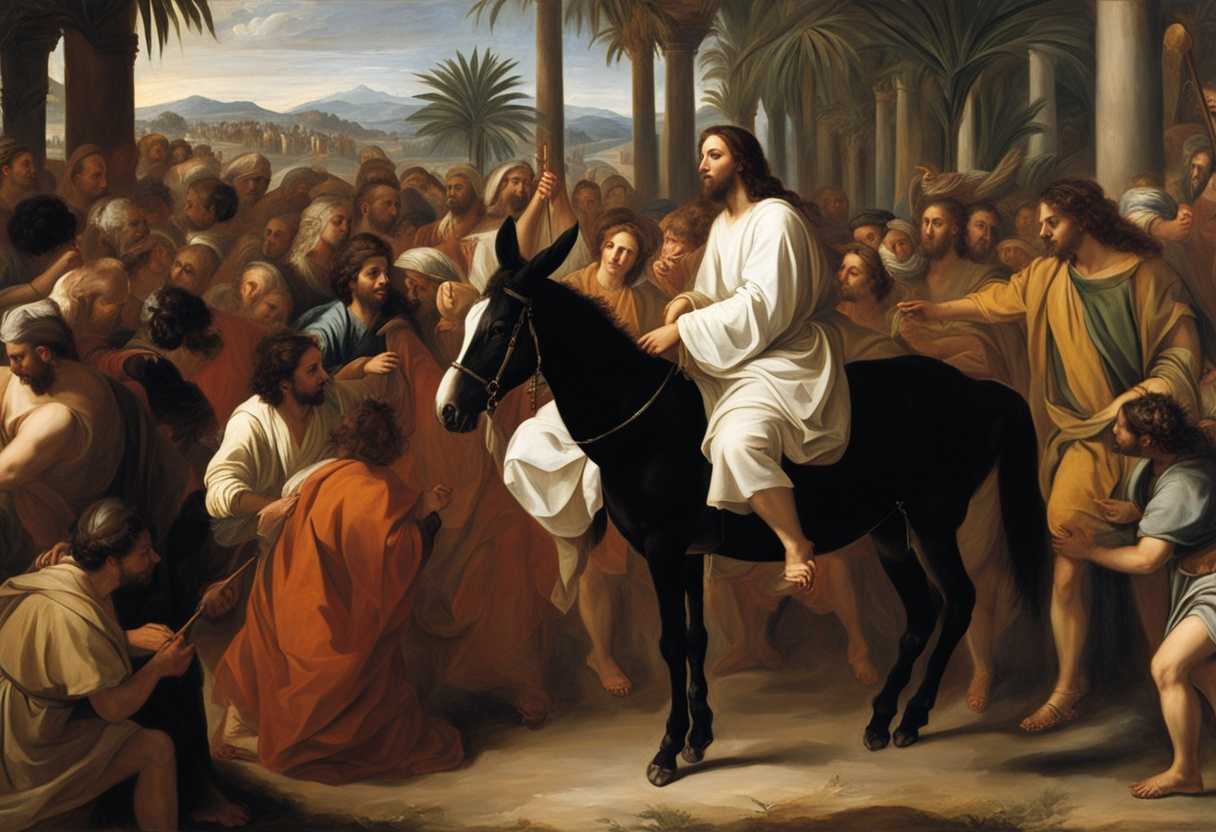
Setting the Scene for John 12:12-50
In John chapter 12, the scene is set in Jerusalem during the time of the Passover festival. Jesus, along with his disciples, has come to Jerusalem for the feast. The city is bustling with people from all over, as Jews gather to celebrate this important religious event. The atmosphere is charged with excitement and anticipation as many have heard of Jesus’ miracles and teachings.
As Jesus enters Jerusalem, riding on a donkey, the crowds welcome him with shouts of “Hosanna! Blessed is he who comes in the name of the Lord!” The people are spreading their cloaks and palm branches on the road, a gesture of honor and respect for Jesus. The Pharisees and religious leaders are watching closely, feeling threatened by Jesus’ growing popularity and influence among the people.
Amidst this backdrop of celebration and tension, Jesus speaks to the crowds, foretelling his upcoming death and the purpose of his mission on earth. He uses the imagery of a seed needing to die in order to bear much fruit, foreshadowing his own sacrificial death on the cross. The scene is filled with symbolism and significance, as Jesus prepares his disciples and the people for the events that will soon unfold.
What is John 12:12-50 about?
Jesus enters Jerusalem, the holy city, in this verse, marking a pivotal moment in his life and a significant event in Christian faith. He is portrayed as the Messiah, the long-awaited savior and king who was prophesied to come. It signifies the fulfillment of Old Testament prophecies and marks a crucial turning point in Jesus’ ministry. Jesus’s foretelling of his death shows his unwavering dedication to his divine mission to save humanity. Despite knowing the suffering and sacrifice that lay ahead, he embraces it with courage and purpose, setting an example of selflessness and obedience to God’s will. Jesus invites his followers to deepen their faith and trust in him as the Son of God and the source of salvation by calling for belief in him. We reflect on this verse, encouraging us to contemplate the significance of Jesus’ actions and teachings. How does his entry into Jerusalem as the Messiah inspire our own faith journey? What does his willingness to endure suffering and death teach us about sacrifice and love? Let us ponder these questions and strive to follow Jesus’ example of unwavering faith and commitment to God’s plan for redemption.
Understanding what John 12:12-50 really means
In the passage of John 12:12-50, we witness a significant moment in Jesus’ ministry as He enters Jerusalem triumphantly, setting the stage for His ultimate sacrifice. The crowd’s exclamation of “Hosanna! Blessed is he who comes in the name of the Lord!” signifies their recognition of Jesus as the promised Messiah, fulfilling Old Testament prophecies. This declaration echoes Psalm 118:25-26, emphasizing Jesus’ role as the King and Savior awaited by the people.
Jesus, aware of His impending death, declares, “The hour has come for the Son of Man to be glorified.” Here, He alludes to His crucifixion and resurrection, which will reveal His divine glory and fulfill God’s plan of redemption. This statement parallels His prayer in John 17:1, underscoring the significance of the events about to unfold. Through the metaphor of a grain of wheat dying to bear fruit, Jesus illustrates that His sacrificial death will bring forth a bountiful harvest of believers, as seen in 1 Corinthians 15:36.
The call to discipleship is central in Jesus’ teachings, as He emphasizes the necessity of following Him and serving others. “Whoever serves me must follow me; and where I am, my servant also will be,” highlights the self-sacrificial nature of true discipleship, echoing Jesus’ words in Matthew 16:24. Furthermore, Jesus identifies Himself as the light of the world, offering salvation and truth to those who believe in Him. This concept of light dispelling darkness is reiterated in John 8:12, emphasizing the transformative power of faith in Jesus.
Today, this passage remains relevant as it challenges believers to have faith in Jesus as the Messiah, find hope in His sacrificial love, and commit to a life of discipleship marked by humility and service. In a world filled with moral ambiguity, Jesus’ teachings provide a clear path and purpose, guiding us through life’s challenges. Just as volunteers bring light and hope in times of crisis, Jesus serves as a beacon of hope and a model of selfless service, illuminating our way in the darkness of uncertainty.
In conclusion, John 12:12-50 serves as a poignant reminder of Jesus’ mission and the call to follow Him wholeheartedly. It urges us to embody courage and compassion, reflecting His light in a world that yearns for hope and salvation. May we heed His call to discipleship, walking in His footsteps, and spreading His light to those around us.
How can we fully surrender to God’s will?
To fully surrender to God’s will means to completely trust in His plan and submit ourselves to His guidance and direction in all aspects of our lives. It requires acknowledging that God’s wisdom far surpasses our own and abandoning any self-reliance or desire to control our circumstances. Surrendering to God means being willing to let go of our own desires, agendas, and expectations in order to align ourselves with His perfect will. We essentially give up our own will in favor of His by surrendering to God’s will. This involves a deep sense of humility and a recognition that God’s ways are higher than our ways. Surrendering to God’s will requires a conscious decision to yield control and allow God to work in and through us for His purposes. It means offering ourselves up as vessels through which His divine plan can be carried out, trusting that His intentions for our lives are always in our best interest, even if we may not fully understand them at the moment.
Application
Think about the way you juggle work and care for your family. Imagine carrying a light through the darkness, guiding others as you go. Jesus gave everything, showing us humility, love, and service. Let’s take that example and live it daily, casting light on the path for others. Will you step up and be that beacon of hope in our world?

Reverend Michael Johnson is an experienced Church Minister with a profound expertise in spirituality and guidance. With a serene presence and a compassionate heart, he has faithfully served his congregation for over 20 years, leading them on a spiritual journey towards inner peace and enlightenment. Reverend Johnson’s extensive knowledge of religious philosophies and profound understanding of human nature have made him a trusted confidant and mentor to many, as he seamlessly weaves his profound wisdom into life teachings. Reverend Johnson’s calming demeanor and empathetic nature continue to uplift and heal souls, nurturing a sense of unity and tranquility within his community.