
John 12:27-50 is about Jesus acknowledging His pending crucifixion, expressing trust in God’s plan, teaching the importance of belief in Him as the Son of God, and warning of the consequences of rejecting Him as the light of the world.
27 “Now is my soul troubled. And what shall I say? ‘Father, save me from this hour’? But for this purpose I have come to this hour.”
28 Father, glorify your name.” Then a voice came from heaven: “I have glorified it, and I will glorify it again.”
29 The crowd that stood there and heard it said that it had thundered. Others said, “An angel has spoken to him.”
30 Jesus answered, “This voice has come for your sake, not mine.
31 Now is the judgment of this world; now will the ruler of this world be cast out.
32 And I, when I am lifted up from the earth, will draw all people to myself.”
33 He said this to show by what kind of death he was going to die.
34 So the crowd answered him, “We have heard from the Law that the Christ remains forever. How can you say that the Son of Man must be lifted up? Who is this Son of Man?”
35 So Jesus said to them, “The light is among you for a little while longer. Walk while you have the light, lest darkness overtake you. The one who walks in the darkness does not know where he is going.
36 While you have the light, believe in the light, that you may become sons of light.”
Though he had done so many signs before them, they still did not believe in him,
38 so that the word spoken by the prophet Isaiah might be fulfilled: “Lord, who has believed what he heard from us, and to whom has the arm of the Lord been revealed?”
39 Therefore they could not believe. For again Isaiah said,
40 “He has blinded their eyes
and hardened their heart,
lest they see with their eyes,
and understand with their heart, and turn,
and I would heal them.”
41 Isaiah said these things because he saw his glory and spoke of him.
42 Nevertheless, many even of the authorities believed in him, but for fear of the Pharisees they did not confess it, so that they would not be put out of the synagogue;
43 for they loved the glory that comes from man more than the glory that comes from God.
44 And Jesus cried out and said, “Whoever believes in me, believes not in me but in him who sent me.
45 And whoever sees me sees him who sent me.
46 I have come into the world as light, so that whoever believes in me may not remain in darkness.
47 If anyone hears my words and does not keep them, I do not judge him; for I did not come to judge the world but to save the world.
48 The one who rejects me and does not receive my words has a judge; the word that I have spoken will judge him on the last day.
49 For I have not spoken on my own authority, but the Father who sent me has himself given me a commandment—what to say and what to speak.
50 And I know that his commandment is eternal life. What I say, therefore, I say as the Father has told me.”
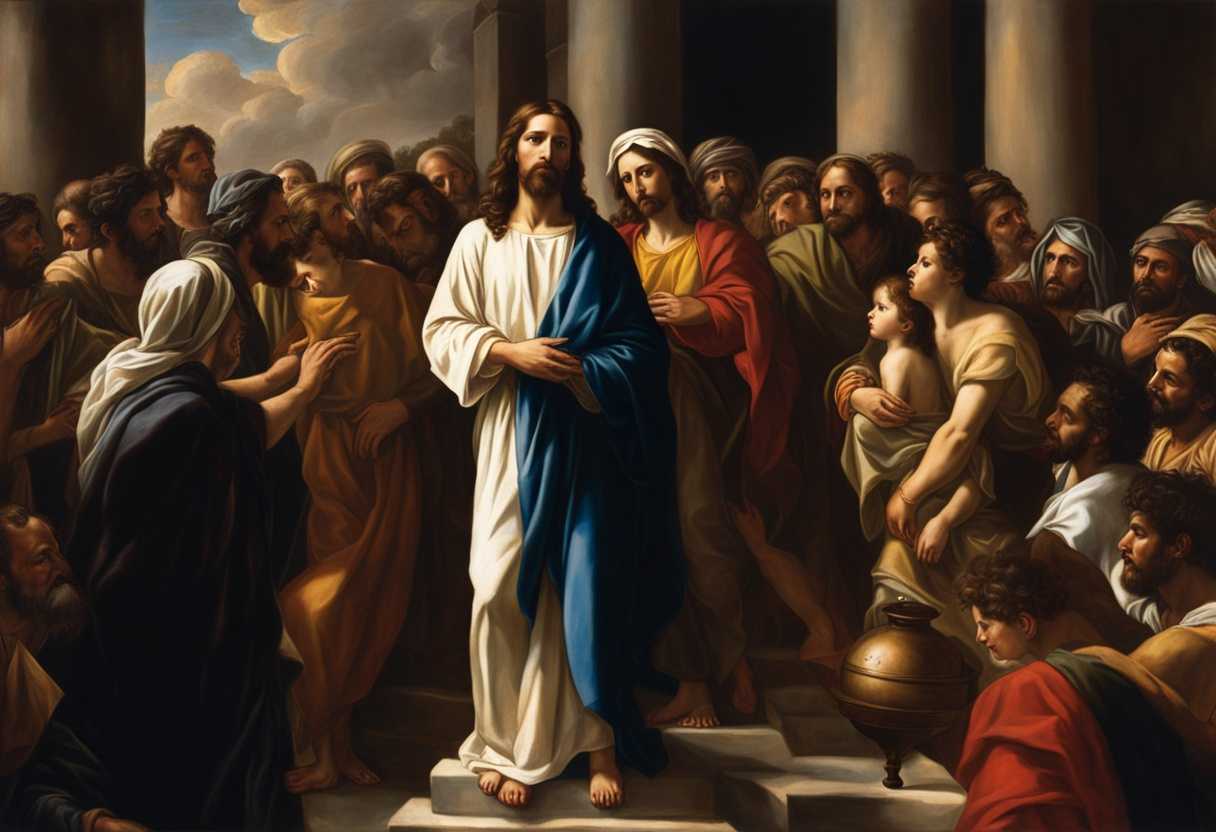
Setting the Scene for John 12:27-50
In John chapter 12, we find Jesus in the final days leading up to his crucifixion. The scene takes place in Bethany, at the home of Mary, Martha, and Lazarus. Jesus is reclining at the table with his disciples, including Judas Iscariot, who would later betray him. The atmosphere is tense as Jesus speaks about his impending death, expressing his inner turmoil and asking God to glorify His name.
The room is filled with the fragrance of expensive perfume as Mary anoints Jesus’ feet, foreshadowing his burial. Judas objects to this act of devotion, revealing his true motives. Jesus responds with a rebuke, highlighting the contrast between Mary’s selfless love and Judas’ betrayal. The disciples are bewildered by Jesus’ words, struggling to understand the significance of what is unfolding before them.
As the conversation continues, Jesus speaks about his role as the light of the world, urging the people to believe in him before he is taken away. The crowd is divided in their response to Jesus, with some believing in him while others remain skeptical. The tension in the room is palpable as Jesus prepares his disciples for the events that are about to unfold, ultimately leading to his crucifixion and resurrection.
What is John 12:27-50 about?
This verse is filled with layers of profound meaning and encourages deep reflection. Jesus foresaw his impending death and used this knowledge to remind his disciples of the importance of believing in him as the son of God. Jesus was preparing his followers for the challenging times ahead by emphasizing the need for faith in him. This act of prediction not only showcases his divinity but also serves as a test of the disciples’ trust and commitment to him.
Furthermore, Jesus’s mention of judgment and eternal life brings to light the eternal consequences of one’s belief in him. Jesus underscores the gravity of the decision to accept or reject him by addressing the ultimate destiny of souls. This verse serves as a poignant reminder of the significance of faith and the eternal rewards that await those who believe in him. It prompts us to contemplate our own beliefs and choices, urging us to consider the implications they have on our eternal destiny. So, how does this verse speak to your own beliefs and understanding of Jesus’s teachings? What do you think it means to truly believe in him and how does this belief shape your everyday life and decisions?
Understanding what John 12:27-50 really means
In John 12:27-50, we find Jesus addressing a crowd in Jerusalem, revealing the turmoil in His soul as He foretells His impending death. This passage is crucial as it sheds light on Jesus’ mission, underlining the necessity of His sacrifice for humanity’s redemption and emphasizing the call to believe in Him for eternal life.
Jesus’ poignant words, “Now my soul is troubled,” resonate with the depth of His human emotions, showcasing the gravity of the sacrifice He was about to make on the cross. Despite His distress, Jesus selflessly prays, “Father, glorify your name,” demonstrating His unwavering commitment to fulfilling God’s will and prioritizing God’s glory above His own comfort.
Furthermore, when Jesus declares, “The light is among you for a little while longer,” He refers to Himself as the light of the world, urging people to embrace faith in Him before it’s too late. The statement, “Whoever believes in me may not remain in darkness,” underscores the transformative power of faith in Jesus, offering hope and salvation to all who trust in Him.
This passage finds resonance in other biblical texts like John 1:4-5, which portrays Jesus as the eternal light shining in the darkness, and Isaiah 53:3-5, a prophecy foretelling the suffering servant, aligning with Jesus’ prediction of His own suffering and death. Additionally, in Matthew 5:14-16, Jesus calls His followers the light of the world, encouraging them to reflect His light in a darkened world.
The relevance of this passage to contemporary audiences is profound. Just as Jesus faced His troubles with faith and a focus on God’s glory, we are likewise called to trust God in our moments of distress. The urgency of believing in Jesus as the light of the world remains as pressing today as it was during His earthly ministry. Life’s uncertainties highlight the importance of embracing faith without delay.
Consider a scenario where an individual grapples with a significant life decision, feeling overwhelmed and uncertain. Reflecting on Jesus’ troubled soul yet unwavering faith, they find solace in surrendering their worries to God, seeking His guidance, and aligning their desires with His glory.
In conclusion, John 12:27-50 serves as a poignant reminder of Jesus’ humanity, His divine purpose in sacrificing Himself for humanity’s salvation, and the imperative to believe in Him for eternal life. It beckons us to trust God in our darkest hours and to radiate His light in a world often shrouded in darkness and despair.
How can we follow Jesus and receive eternal life?
To follow Jesus and receive eternal life, we must understand that Jesus came to earth to fulfill God’s plan for salvation. This involved His sacrificial death on the cross as the atonement for our sins. We can have eternal life through Him by believing in Jesus as the Son of God and Savior. We, as followers of Jesus, are called to deny ourselves, take up our cross, and follow Him, walking in obedience to His teachings and example.
Jesus emphasized the importance of faith in Him for salvation. He declared Himself as the way, the truth, and the life, stating that no one comes to the Father except through Him. We can have the assurance of eternal life by placing our trust in Jesus and committing our lives to Him. We, as we continue to follow Jesus, are called to bear fruit in keeping with our faith, reflecting His love, grace, and truth to the world around us.
Application
Think of your life like a demanding job or being there for your family. Reading John 12:27-50, you see the heavy responsibility Jesus took on. Just like overcoming challenges at work or home, you need to face the darkness in your life. Will you step up, embrace the truth, and follow Jesus’ path? Can you bear fruit and brighten your world like He did, or will you ignore the call?

Reverend Michael Johnson is an experienced Church Minister with a profound expertise in spirituality and guidance. With a serene presence and a compassionate heart, he has faithfully served his congregation for over 20 years, leading them on a spiritual journey towards inner peace and enlightenment. Reverend Johnson’s extensive knowledge of religious philosophies and profound understanding of human nature have made him a trusted confidant and mentor to many, as he seamlessly weaves his profound wisdom into life teachings. Reverend Johnson’s calming demeanor and empathetic nature continue to uplift and heal souls, nurturing a sense of unity and tranquility within his community.