
John 12:3-5 is about Mary demonstrating her deep love and devotion to Jesus by anointing his feet with expensive perfume, prompting Judas to question the extravagance while Jesus defends her act as preparation for his burial.
3 Mary therefore took a pound of expensive ointment made from pure nard, and anointed the feet of Jesus and wiped his feet with her hair. The house was filled with the fragrance of the perfume.
4 But Judas Iscariot, one of his disciples (he who was about to betray him), said,
5 “Why was this ointment not sold for three hundred denarii and given to the poor?”
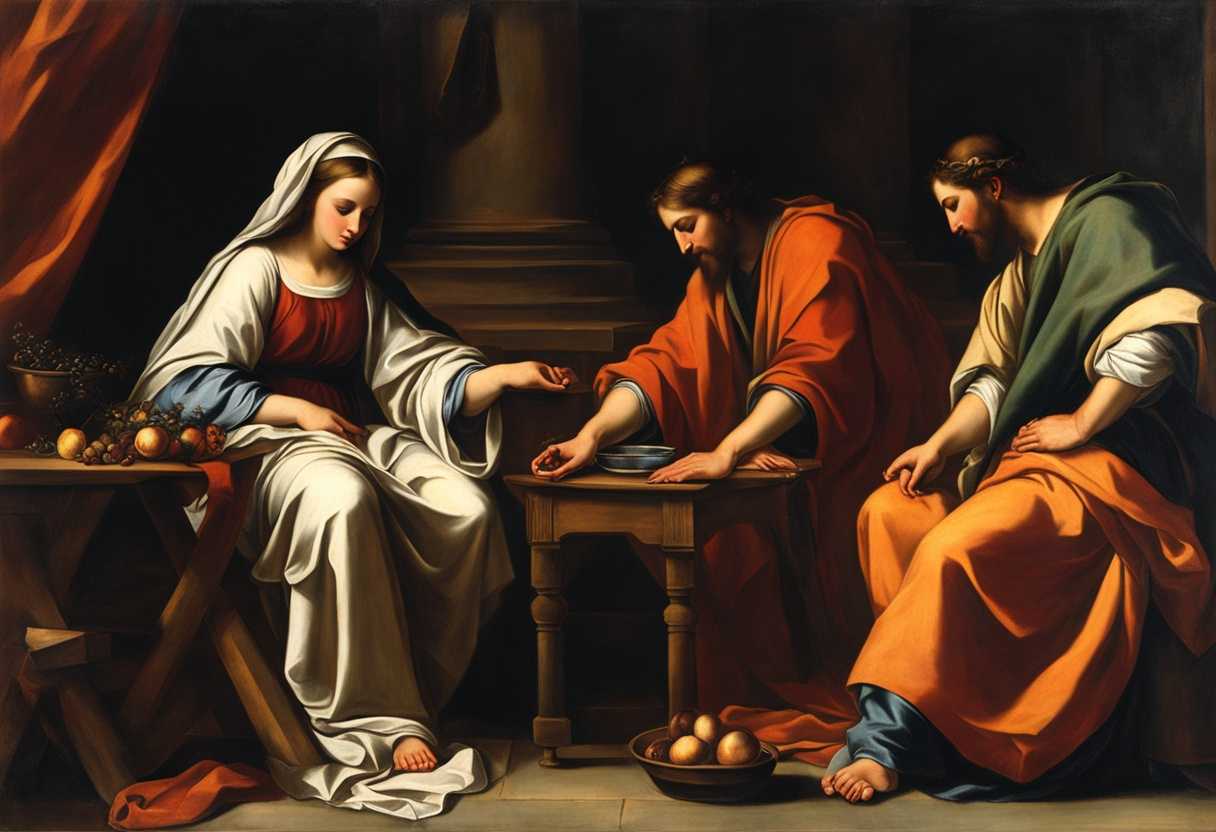
Setting the Scene for John 12:3-5
In John chapter 12, we find Jesus dining in the town of Bethany at the home of Simon the leper. The scene is set in a modest yet welcoming house, with a table adorned with various dishes and the aroma of food filling the air. Jesus is reclining at the table, surrounded by his disciples and other guests, including Lazarus, whom Jesus had raised from the dead.
As they are enjoying the meal and engaging in conversation, Mary, the sister of Lazarus, enters the room with an alabaster jar of expensive perfume. She approaches Jesus, breaks the jar, and pours the fragrant oil on his feet, then wipes them with her hair. The room falls silent as the sweet scent fills the air, and Judas Iscariot, one of the disciples, questions the extravagance of Mary’s gesture, suggesting that the perfume could have been sold to help the poor.
The atmosphere in the room is charged with emotion as Jesus defends Mary’s actions, commending her for her act of love and devotion. The scene captures a moment of intimacy and reverence, as Mary expresses her deep affection for Jesus in a profound and sacrificial way, foreshadowing the impending events of Jesus’ crucifixion and burial.
What is John 12:3-5 about?
This verse from the Bible teaches us about the depth of love and devotion. Mary’s act of anointing Jesus’ feet with costly perfume was a display of her immense love and reverence for Him. She was giving her best, her most precious possession, as an expression of her affection for Jesus. This act was not about the material value of the perfume; it was about the sincerity and intensity of her love for the Lord.
On the other hand, Judas’ reaction to Mary’s act raises important questions about our intentions and priorities. Judas questioned the perceived waste of the expensive perfume, showing a lack of understanding and appreciation for Mary’s gesture. His focus on the material worth of the perfume reveals a shallow perspective compared to Mary’s deep love for Jesus. This verse challenges us to reflect on our own attitudes towards expressing love and devotion to God. Are we willing to give our best, even if it seems extravagant to others? Do we prioritize material wealth over spiritual enrichment and connection with God? Let us strive to emulate Mary’s example of wholehearted devotion and selfless love for the Divine in our lives. Let us prioritize the spiritual over the material and offer our best to God without reservations. May we find inspiration in Mary’s actions to show our love for God through sincere and sacrificial acts, disregarding any judgment or misunderstanding from those who do not share our faith and devotion.
Understanding what John 12:3-5 really means
The passage in John 12:3-5 recounts a poignant moment where Mary, the sister of Martha and Lazarus, demonstrates her deep devotion to Jesus by anointing His feet with expensive perfume and wiping them with her hair. This act of reverence takes place shortly before Jesus’ crucifixion, adding a profound layer of significance to Mary’s actions. The scene unfolds with Judas Iscariot, one of Jesus’ disciples, criticizing Mary for what he perceives as wastefulness, questioning why the costly ointment was not sold to benefit the poor instead.
This event is also captured in related Bible passages such as Matthew 26:6-13 and Mark 14:3-9, emphasizing the importance of Mary’s act of devotion. Additionally, Luke 10:38-42 contrasts Mary’s focus on Jesus and spiritual matters with Martha’s distractions, highlighting the value of prioritizing spiritual devotion. Furthermore, in John 13:1-17, Jesus washes the disciples’ feet, exemplifying humility and service, which resonates with Mary’s act of anointing His feet.
Mary’s act symbolizes devotion and sacrifice, inspiring individuals today to prioritize their faith and demonstrate devotion through acts of kindness and service. Judas’ criticism serves as a reminder that genuine acts of devotion may be misunderstood or judged by others, urging us to focus on our intentions and not be swayed by external opinions. The passage underscores the importance of worship and honoring God, even when such acts may seem extravagant or impractical to onlookers.
Consider a scenario where someone faces criticism for donating a significant portion of their income to charity instead of saving it for themselves. Like Mary, this individual understands the deeper value of their actions and remains steadfast in their commitment to their cause, finding fulfillment in selfless giving. The phrase “anointed the feet of Jesus” signifies deep reverence and humility, acknowledging Jesus’ divine kingship and foreshadowing His burial. Similarly, “wiped his feet with her hair” highlights Mary’s humility and personal sacrifice, as using her hair to wipe Jesus’ feet demonstrates her willingness to lay down her pride and honor Him.
Judas’ question, “Why was this ointment not sold for three hundred denarii and given to the poor?” challenges readers to reflect on the true motives behind their actions and the importance of heartfelt worship over mere practicality. By contemplating this passage, individuals can glean insights into the significance of genuine devotion, the value of worship, and the importance of remaining true to one’s intentions despite external criticism.
How can we show extravagant love for Jesus?
One way we can show extravagant love for Jesus is by giving our best to Him. We can offer our most valuable possessions, talents, and time to Him, just as the woman anointed Jesus with costly perfume. When we prioritize Jesus above all else and are willing to sacrifice for His sake, we demonstrate our extravagant love for Him.
Another way to show extravagant love for Jesus is by serving Him with a heart of humility and gratitude. The woman in the verse demonstrated her love for Jesus by humbly kneeling at His feet and anointing Him. When we serve Jesus with a posture of humility, acknowledging His worthiness and our unworthiness, we show our extravagant love for Him. Additionally, having a heart full of gratitude for all that Jesus has done for us can inspire us to love Him extravagantly in return.
Furthermore, we can show extravagant love for Jesus by expressing our devotion to Him openly and unashamedly. The woman in the verse did not hold back in her expression of love for Jesus, despite the judgment of others. When we boldly and unapologetically proclaim our love for Jesus in both words and actions, regardless of what others may think, we exhibit extravagant love for Him.
Application
Ever felt like your family or job demands so much, yet you still give your all? Reflect on Mary’s act in John 12:3-5—she poured out her best for Jesus. How can you pour your heart, time, and resources into honoring Him today? Maybe it’s giving more attention to your faith amidst your busy schedule. What small but significant step can you take right now?

Reverend Michael Johnson is an experienced Church Minister with a profound expertise in spirituality and guidance. With a serene presence and a compassionate heart, he has faithfully served his congregation for over 20 years, leading them on a spiritual journey towards inner peace and enlightenment. Reverend Johnson’s extensive knowledge of religious philosophies and profound understanding of human nature have made him a trusted confidant and mentor to many, as he seamlessly weaves his profound wisdom into life teachings. Reverend Johnson’s calming demeanor and empathetic nature continue to uplift and heal souls, nurturing a sense of unity and tranquility within his community.